Skip to content
Facing the uncertainty of divorce can be overwhelming, but you have far more control over the outcome than you might realize. In Texas, mediation for divorce isn't just an alternative path—it's a standard, and often required, part of the process. It’s a guided, confidential negotiation where you and your spouse make the big decisions with the help of a neutral third party, letting you design your family’s future in a private office instead of a public courtroom.
Understanding Mediation in a Texas Divorce
When you picture a divorce, you might imagine a tense courtroom battle. The reality for most Texas families, however, is very different. The legal system here strongly encourages couples to work out their disagreements on their own, and mediation is the main tool for getting that done. Think of it less like a trial and more like a structured conversation, with a professional facilitator there to keep the discussion on track.
Instead of a judge making decisions for you, mediation empowers you and your spouse to make them together. The whole process is built on the simple idea that you—the parents and partners—are the real experts on your family's needs.
Why Texas Courts Prioritize Mediation
Courts across Texas, especially in major hubs like Harris, Dallas, and Travis counties, see mediation as a critical step for a few good reasons. Court dockets are packed, and trials are expensive, time-consuming, and emotionally draining for everyone. By requiring most couples to try mediation before they can even get a final trial on the calendar, judges are giving you a dedicated chance to find common ground.
The legal support for this is woven throughout the Texas Family Code, which promotes the “amicable and non-judicial settlement of disputes” over children and property. Mediation hits that goal head-on by giving you a framework to:
- Keep control over the final decisions in your divorce.
- Keep your personal and financial details private, out of public court records.
- Create custom solutions that a judge might not have the power to order.
- Lower the emotional and financial toll that comes with a drawn-out court fight.
The real purpose of mediation is to shift the power from the courthouse back to you. It turns a hostile process into a problem-solving one, where you can build an agreement that actually works for your family's unique situation.
Understanding mediation's role is key for both clients and the lawyers guiding them. For firms that specialize in this sensitive practice, exploring winning modern family law marketing strategies can help them connect with families who need this guidance. At the end of the day, mediation isn't just a procedural hoop to jump through; it's a genuine opportunity to end your marriage with dignity and build a stable foundation for whatever comes next.
How Mediation Fits Into Your Divorce Timeline
Feeling lost in the legal maze of a divorce is completely normal. Understanding the timeline—where you are and what’s coming next—can give you a powerful sense of clarity and control.
Mediation isn't some strange detour from the main process. For most Texas families, it's a planned, essential stop on the road to finalizing the divorce. It's the structured, confidential setting where you and your spouse get to call the shots, rather than leaving your future in a judge's hands.
Whether you're facing a contested divorce (where you disagree on key issues) or a relatively smooth uncontested one, mediation has a critical role to play. It's designed to help you resolve your differences before they spiral into a costly and public courtroom battle.
Mediation in an Uncontested Divorce
If you and your spouse are mostly on the same page, you might be wondering, "Why do we even need a mediator?" Think of mediation in an uncontested divorce as a final workshop. It’s where you hammer out the last few details of your Marital Settlement Agreement (MSA).
This is your chance to confirm the fine print on property division, formalize the parenting plan, and make sure every legal "i" is dotted and "t" is crossed before you present your agreement to a judge. It’s a crucial step to ensure no detail is overlooked, giving your final decree the strength and clarity it needs to stand the test of time.
Mediation in a Contested Divorce
When a divorce is contested, mediation becomes the primary tool for avoiding a trial. What was once a niche alternative is now a mainstream, often court-ordered, step in family law cases across Texas—especially in major hubs like Houston, Dallas-Fort Worth, Austin, and San Antonio.
While Texas law doesn't automatically mandate mediation the second a divorce petition is filed, most family courts now require couples to try it before they'll even consider setting a contested trial date. It's become a standard pre-trial requirement baked into the local court rules.
This infographic really brings the concept to life, showing how mediation creates a more direct path to an agreement compared to the long, winding, and often unpredictable road of a courtroom trial.
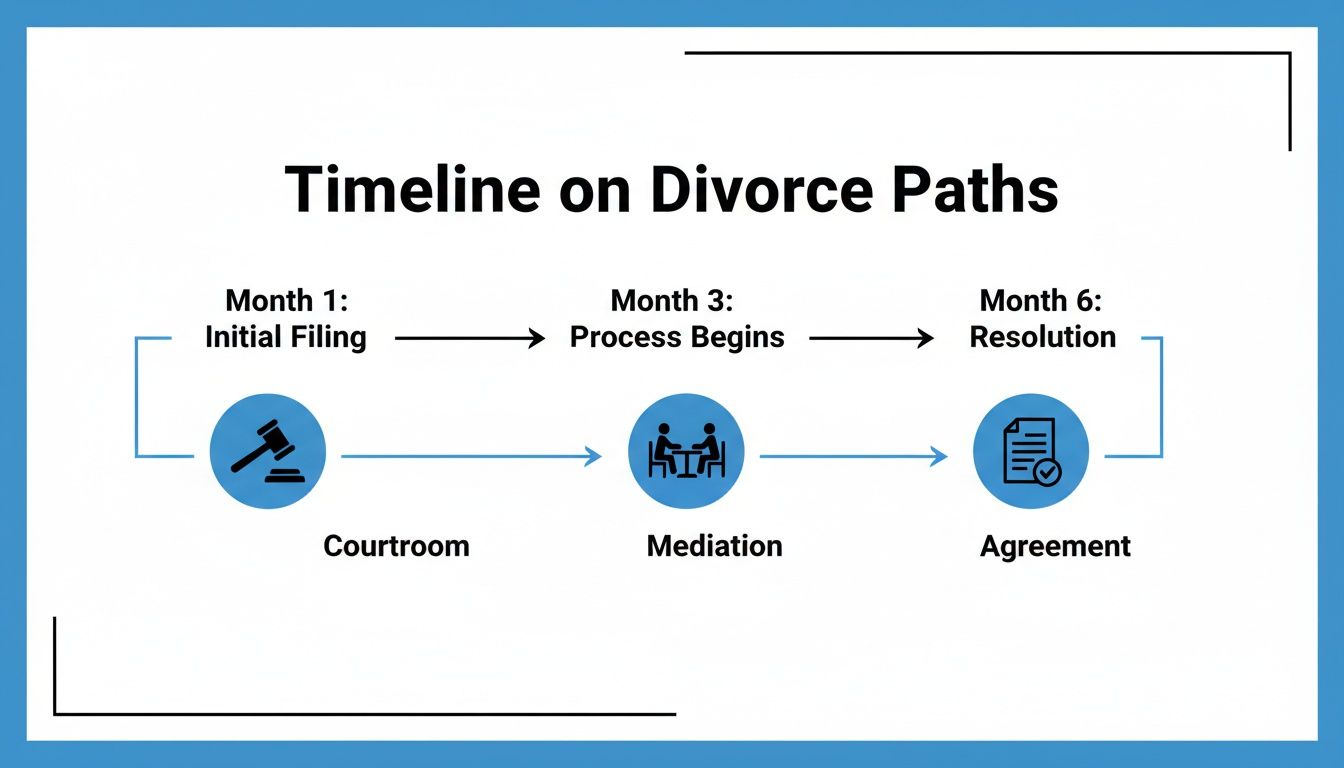
As the visual shows, litigation is always there as a backstop. But mediation is specifically designed to be a more efficient and empowering route to a final, settled agreement.
The role of mediation shifts slightly depending on how much conflict exists between you and your spouse. This table breaks down the key differences.
Mediation's Role in Contested vs Uncontested Divorce
| Stage of Divorce | Role of Mediation in Contested Divorce | Role of Mediation in Uncontested Divorce |
|---|---|---|
| Initial Filing | Typically occurs after initial legal filings and information exchange (discovery). | Often happens early in the process, sometimes even before filing, to create the initial agreement. |
| Primary Goal | To resolve major disputes (custody, property, support) and avoid a costly, lengthy trial. | To review, refine, and formalize an existing agreement, ensuring all legal requirements are met. |
| Level of Conflict | High conflict is expected. The mediator's job is to de-escalate and find common ground on contentious issues. | Low conflict is the norm. The focus is on collaboration and ensuring no small details are missed. |
| Attorney Involvement | Attorneys are almost always present to advise their clients and protect their interests during negotiations. | Attorneys may or may not attend the session itself, but will draft and review the final documents. |
| Outcome | To produce a legally binding Mediated Settlement Agreement (MSA) that becomes the foundation for the Final Decree. | To confirm all terms for the Final Decree of Divorce, making the final court appearance a simple formality. |
Ultimately, whether your path is contested or uncontested, mediation serves the same fundamental purpose: to put the power of decision-making back in your hands and pave a clearer way toward finalizing your divorce.
The Texas Divorce Process: A Step-by-Step View
To give you a bird's-eye view of exactly where mediation fits, here’s a simplified look at the Texas divorce timeline from start to finish.
- Filing the Original Petition for Divorce: One spouse officially starts the case by filing a petition with the court. This kicks off Texas's mandatory 60-day waiting period before any divorce can be finalized.
- Serving the Other Spouse: The filing spouse (the Petitioner) has to formally notify the other spouse (the Respondent) that a case has been opened.
- The Discovery Phase: This is the formal information-gathering stage. Through their attorneys, both sides exchange financial documents, property records, and other important information. This step ensures everyone is negotiating with the same set of facts on the table.
- Temporary Orders Hearing (If Needed): If there are urgent issues—like who stays in the house or what the temporary child custody schedule will be—the court can issue Temporary Orders. These rules stay in place while the divorce is ongoing. Often, these issues can be resolved in an early mediation session instead of a formal hearing.
- Mediation: This is the main event. You and your spouse, along with your attorneys, meet with a neutral mediator to negotiate the final terms of your divorce. This includes everything from child custody and support to how you'll divide your property. The vast majority of Texas divorces settle right here. For a deeper dive, check out our guide on how long divorce mediation can take.
- Finalizing the Agreement: Once you reach a settlement, your attorneys will draft a Final Decree of Divorce based on the terms you agreed upon in your Mediated Settlement Agreement.
- Prove-Up Hearing: This is a very brief, informal court appearance. You present your signed decree to the judge for approval, and once the judge signs it, your divorce is legally final.
Navigating the Day of Mediation Step by Step
Walking into a mediation session can feel like stepping into the unknown. But knowing what the day looks like transforms that anxiety into a structured opportunity to find a resolution. Think of it less like a courtroom showdown and more like a carefully planned business negotiation for your family's future, with a neutral professional guiding the conversation. This roadmap will give you a clear picture of the day, so you can walk in feeling prepared and confident.

Stage 1: The Initial Joint Session
Your mediation will almost always start with everyone in the same room: you, your spouse, both of your attorneys, and the mediator. This is the joint session. Don't worry, this isn't a time for hashing out old arguments. It's an orientation.
The mediator kicks things off by laying out the ground rules. They’ll explain their role as a neutral guide, drive home the point that everything said is confidential, and set the goal for the day—to help you both reach an agreement you can live with. Sometimes you might have a chance to make a brief opening statement, but more often than not, the attorneys will handle this part.
Stage 2: Private Caucus Sessions
After that brief joint session, the process quickly breaks out into separate rooms. You and your attorney will set up in one room, while your spouse and their attorney will be in another. This is where the real work begins, through a series of private meetings called caucuses.
The mediator will then shuttle back and forth between the two rooms, acting as both a messenger and a sounding board. In your caucus, you'll finally have the space to speak freely with your attorney.
This is your time to:
- Talk through the other side's proposals in private.
- Strategize your next offer or counteroffer.
- Ask your attorney any question you have without your spouse hearing it.
- Be completely honest about your concerns, frustrations, and what's most important to you.
These private sessions are designed to lower the emotional temperature of the negotiation, allowing for more logical and strategic decisions.
Stage 3: The Negotiation Process
The heart of mediation is the back-and-forth negotiation, all managed by the mediator. They will carry offers, counteroffers, and messages between the rooms, helping both sides understand where the other is coming from and explore potential compromises.
A good mediator does a lot more than just relay numbers. They can help translate the "why" behind a proposal and reality-test ideas, sometimes gently questioning whether a certain demand would actually hold up in front of a judge. This process continues, often for several hours, as you work through every issue—from who gets the house to the fine details of the parenting plan.
Your attorney’s role during this phase is absolutely critical. They will analyze each proposal, advise you on the long-term legal and financial consequences, and help you craft counteroffers that protect your interests while still moving the needle toward a final agreement.
Stage 4: Finalizing the Mediated Settlement Agreement
If you and your spouse manage to find common ground on all your issues, the final step is to put it all in writing. The mediator, usually with input from both attorneys, will draft a Mediated Settlement Agreement (MSA). This document is the culmination of your entire day's work.
It will detail every single point you've agreed upon, leaving zero room for interpretation. You and your attorney will go over this document with a fine-tooth comb to make sure it perfectly reflects the deals you made. Once both you and your spouse sign the MSA, it becomes an incredibly powerful legal document.
Under Section 153.0071 of the Texas Family Code, a signed MSA is binding and irrevocable. This is huge. It means that once signed, neither of you can just wake up the next day and change your mind. You are legally entitled to a divorce decree based on the exact terms of that agreement. This finality is one of the greatest strengths of mediation for divorce in Texas, providing the certainty you need to close this chapter. The signed MSA is then used to create the Final Decree of Divorce for the judge to sign.
Resolving Key Issues in Your Divorce Mediation
Mediation is where the rubber meets the road. It's the place where broad, painful disagreements get hammered out into specific, practical solutions for your family's future. This is your chance to settle everything, piece by piece, from who stays in the house to which holidays the kids spend with each parent.

Unlike a courtroom, where a judge is bound by rigid legal formulas, mediation gives you the flexibility to create custom agreements that actually fit your life. You're in the driver's seat, able to build a settlement that a court simply couldn't order from the bench.
Crafting a Detailed Parenting Plan
For any parent, nothing matters more than your children’s well-being and stability. In mediation, you don't just agree to "custody"—you build a comprehensive Parenting Plan that acts as a detailed roadmap for your new co-parenting relationship.
This goes way beyond just deciding where the kids will live. You'll work through the nitty-gritty details, including:
- Possession Schedules: Will you stick with a standard Texas schedule, or does your family need something more custom? You can hammer out specific drop-off times, add a right-of-first-refusal clause (for when a parent needs a sitter), and design schedules around unique work or school needs.
- Holiday and Vacation Time: Mediation lets you map out holidays for years to come. Maybe you agree to alternate Thanksgiving and Christmas each year, or perhaps one parent always gets a specific holiday that’s important to their family. It's up to you.
- Decision-Making Rights: How will you handle the big decisions about your children’s education, non-emergency healthcare, and religious upbringing? You'll need to decide if you'll agree jointly on everything or if one parent will have the final say in certain areas.
Calculating Support and Dividing Finances
Let’s be honest—the financial talks are often the most complex and emotionally charged part of any divorce. Mediation creates a confidential, structured space to tackle these issues head-on, with your lawyer right there to protect your interests.
Here, you'll address two major financial pillars:
- Child Support: Starting with the Texas guidelines, you’ll calculate the monthly support amount. But mediation also allows you to plan for other child-related costs, like health insurance, extracurriculars, and even future college expenses—details a standard court order often overlooks.
- Spousal Maintenance: If one spouse qualifies, you'll negotiate the amount and duration of post-divorce spousal support. You might agree to a lump-sum payment or structure monthly payments to help provide a stable transition for the receiving spouse.
Dividing Your Community Property
Under the Texas Family Code, any assets and debts you acquired during your marriage are considered community property. The law says they must be divided in a "just and right" manner, and mediation is where you get to decide what that actually looks like.
You'll create a detailed inventory of everything you own and owe together—from the house and cars to retirement accounts and credit card debt—and negotiate a fair way to split it all.
This process covers straightforward assets like bank accounts, but it’s invaluable for more complex property, such as:
- The Family Home: Will one spouse buy out the other's share? Or will you sell the house and split the proceeds?
- Retirement Accounts: How will you divide 401(k)s, IRAs, and pensions without triggering massive tax penalties?
- Business Interests: If you own a business, mediation is critical for determining its value and figuring out how to handle ownership or a buyout without destroying the company you built.
Especially in high-asset divorces, untangling finances requires a sophisticated approach. It's vital to understand all the moving parts, so exploring the finance and divorce considerations for high net worth individuals can provide crucial context.
How To Prepare For A Successful Mediation
Walking into divorce mediation can feel incredibly nerve-wracking. That’s completely normal. But I’ve found that what separates a successful mediation from a stressful one often comes down to the work you do before you ever sit down at the table. Solid preparation is what turns that anxiety into confidence, empowering you to negotiate from a place of strength instead of just reacting to whatever comes your way.
This isn't about creating more work for you during an already difficult time. It's about giving you control. Let's walk through how you and your attorney can strategically prepare, so you can become an informed advocate for your own future.

First, Gather Every Essential Document
You simply can’t negotiate what you don’t fully understand. The first—and most critical—step is to gather all the financial and personal documents that create a complete, accurate picture of your marital estate and family life. These documents are the hard evidence that supports your position, ensuring the entire negotiation is grounded in facts, not just feelings or guesswork.
Working closely with your attorney, you'll assemble a comprehensive file. Think of it as building the foundation for every proposal you make and every offer you consider. It’s the bedrock of a fair agreement.
Your Texas Divorce Mediation Preparation Checklist
To make sure nothing gets missed, we've put together a checklist of the key documents and information you'll need to have ready. Going through this list with your attorney will ensure you have a complete financial picture, which is the foundation for a fair settlement.
| Category | Specific Documents or Tasks | Why It Is Important |
|---|---|---|
| Income & Employment | Last 2 years of tax returns; recent pay stubs for both spouses. | Establishes current income for calculating child support and determining spousal maintenance needs. |
| Assets (Real Estate) | Deeds to all properties; recent mortgage statements; property tax appraisals. | Provides an accurate value and equity figure for the marital home and any other real estate. |
| Assets (Financial) | Statements for all bank accounts, retirement accounts (401k, IRA), and investment accounts. | Creates a complete inventory of liquid and long-term assets to be divided. |
| Assets (Vehicles) | Titles and loan statements for all cars, boats, or other vehicles. | Confirms ownership and outstanding debt on major assets. |
| Debts | Credit card statements, car loan information, personal loan documents, student loan statements. | A full accounting of marital liabilities is just as crucial as tracking assets. |
| Business Records | If a business is involved: profit/loss statements, balance sheets, and potentially a business valuation. | Crucial for fairly dividing a complex asset like a family-owned business. |
| Personal Property | Create an inventory of significant items (art, jewelry, furniture, collectibles). | Helps assign value to personal belongings and prevents disputes over smaller items later. |
Having these documents organized and ready is more than just busywork; it's about walking into the room with clarity and confidence.
Next, Define Your Goals And Priorities
Mediation is all about give and take. If you walk in without a clear idea of what truly matters most to you, you risk giving up the wrong things or wasting energy fighting for issues that aren't actually your top priority. Before your session, you and your attorney need to sit down and map out your goals.
Think of it as your negotiation playbook. You need to identify your "must-haves," your "nice-to-haves," and your "willing-to-concede" items.
A successful mediation isn’t about winning every single point. It’s about securing an overall agreement that protects your future and meets the needs of your children. Knowing your priorities is the key to achieving that outcome.
This requires some real honesty with yourself. Is keeping the family home your absolute number one goal, even if it means taking a smaller share of a retirement account? Is a specific holiday schedule with your children completely non-negotiable? Having those answers locked in helps your attorney advocate effectively for what is most important to you and keeps the negotiation focused.
Finally, Cultivate A Mindset For Compromise
Preparing your mindset is just as critical as preparing your documents. You have to walk into that room understanding that the goal is to find a middle ground—a solution that both you and your spouse can live with. It’s not a battle to be won. Your spouse is coming in with their own set of goals and fears, and reaching a final agreement will absolutely require flexibility from both of you.
This doesn't mean you should just roll over and agree to anything. It means being open to creative solutions and trying your best to focus on building a stable future rather than relitigating the past. Listen to your mediator, trust the guidance of your attorney, and stay focused on the main objective: crafting a fair, lasting settlement that allows everyone to move forward.
For an even deeper dive into getting ready, our firm has a detailed guide on how to prepare for divorce mediation that can help you feel even more confident. A proactive approach gives you control and clarity—two of the most valuable assets you can have in any mediation for divorce in Texas.
What Happens After Mediation
Getting through a mediation session is a huge milestone on your divorce journey. Whether you managed to settle every single issue or just chipped away at a few, you've made real progress. Knowing what comes next will give you the confidence to see this process through to the very end.
If you and your spouse successfully hammered out a full agreement, the next step is to make it legally official.
From Agreement to Final Decree
When you both sign a Mediated Settlement Agreement (MSA), you're not just shaking hands on a deal—you're creating a legally binding and irrevocable contract. Under the Texas Family Code, that signed document becomes the official blueprint for your Final Decree of Divorce. Your attorney will take the terms you agreed to, from how you'll divide the furniture to the details of your parenting plan, and draft the formal court order that the judge will sign.
Turning your MSA into a signed decree is a careful process. It requires precise legal drafting to ensure every detail is correct and, just as importantly, enforceable down the road. To get a better sense of this crucial final stage, you can check out our detailed guide on the timelines and steps for officializing a Texas divorce post-mediation.
If You Didn't Reach a Full Agreement
It's perfectly okay if you didn't resolve every single issue. Don't see it as a failure. A partial agreement is still a massive win because it shrinks the list of topics you still have to fight about. If you hit a wall on one or two sticking points, you still have options on the table:
- Schedule another mediation session to take another crack at the remaining issues.
- Let your attorneys negotiate directly to see if they can find a middle ground.
- Prepare for a final trial, where a judge will make the final call, but only on the specific matters you couldn't resolve.
Frequently Asked Questions About Divorce Mediation in Texas
It's completely normal to have questions as you think about using mediation for your divorce in Texas. Even though the process puts you in control, it can feel a little confusing at first. Here are some straightforward answers to the questions we hear most often from our clients.
What Happens if We Don’t Reach an Agreement in Mediation?
First off, if you don't settle every single issue, it’s not a failure—it's progress. You’ve successfully narrowed down the list of things you disagree on, which is a huge step forward. From there, you have a few options:
- Schedule another session. Sometimes, all you need is a little time to think things over before bridging those final gaps.
- Let your attorneys negotiate. Your lawyers can pick up where you left off, working to resolve the last few items outside of the formal mediation setting.
- Go to court for the remaining issues. If you’re truly at a standstill on one specific topic, like spousal support or who gets a particular asset, that single issue can be presented to a judge to make the final call.
Your attorney’s job is to help you figure out which path makes the most sense, both financially and emotionally. Remember, a partial agreement is still a major win.
Is the Mediator's Decision Legally Binding?
This is a really common misconception, and it’s an important one to clear up. The mediator makes zero decisions for you. Think of them as a neutral guide for your negotiation, not a private judge.
They might offer a fresh perspective or "reality check" a proposal by asking how a judge might see it, but they are not making any rulings. The only thing that becomes legally binding is the Mediated Settlement Agreement (MSA), and that only happens after you and your spouse have both voluntarily signed it. Until those signatures are on the page, nothing is set in stone.
Can I Go to Mediation Without an Attorney?
While you technically can, we strongly advise against it. Walking into mediation without your own lawyer puts you at a serious disadvantage.
Your attorney is your advocate, your advisor, and your legal shield in that room. They're there to make sure any agreement you consider is fair, legally sound, and doesn't accidentally sign away your rights under the Texas Family Code.
An experienced family law attorney can give you real-time advice on offers, protect you from feeling pressured, and make sure the final MSA is drafted correctly so it holds up in court. Going it alone means you're negotiating against your spouse and their lawyer without that same protection. Your future is far too important to take that risk.
What to Do Next
The agreements you reach in mediation become the foundation of your post-divorce life. These decisions are too important to leave to chance, and you shouldn't have to navigate this complex process on your own. You need a legal advocate in your corner who can protect your rights and help you negotiate the best possible outcome for your family and your future.
- Take Stock of Your Assets: Start making a simple list of your shared property and debts.
- Define Your Parenting Goals: Think about what a realistic, stable, and healthy parenting schedule would look like for your children.
- Consult with an Experienced Attorney: Get clear legal advice on your rights before you walk into the negotiating room.
The settlement you sign will be legally binding and will shape your family's future for years. Don't go into this process alone. The dedicated attorneys at The Law Office of Bryan Fagan, PLLC are here to guide you with strength and expertise. Schedule a free consultation with us today to discuss your case and learn how we can protect what matters most.