Skip to content
You pick up the envelope, see the word “divorce,” and set it on the counter because opening it feels like making everything real.
That reaction is human. It’s also dangerous. If you’re wondering what happens if you ignore divorce papers in Texas, the short answer is this: the case can keep moving without you, and your silence can hand the other side a major advantage before you’ve had a real chance to tell your story.
The Cost of Silence After Receiving Divorce Papers
Many people don’t ignore divorce papers because they’re careless. They ignore them because they’re stunned, angry, embarrassed, or hoping the whole thing will slow down if they wait long enough. A lot of spouses tell themselves they need a few days to breathe.
The problem is that the court doesn’t treat silence as a pause button. It treats silence as nonparticipation.

If the papers are sitting unopened on your kitchen table, the legal risk is already building. Your spouse’s case doesn’t disappear because you’re upset with the filing, disagree with the allegations, or think your marriage can still be saved. Texas courts allow one spouse to move a divorce forward even if the other spouse refuses to engage.
That matters in practical ways. When you don’t respond, you’re not just avoiding conflict. You may be giving up your chance to influence who stays in the house, who pays which debts, how retirement accounts are handled, and what parenting terms get put in front of the judge.
Ignoring the papers doesn’t protect your rights. It leaves them undefended.
For many families, the first panic is about cost. If that’s one of your concerns, it helps to understand the financial side early so fear doesn’t turn into inaction. This Texas divorce cost breakdown can help you get your bearings.
What silence usually costs you
- Your control: Once you stop participating, the other side gets more room to define the case.
- Your version of events: Judges can only consider what is properly put before the court.
- Your timing: Waiting often turns a manageable response into an emergency.
- Your options: It is usually easier to prevent a bad outcome than to undo one later.
How a Default Judgment Works in a Texas Divorce
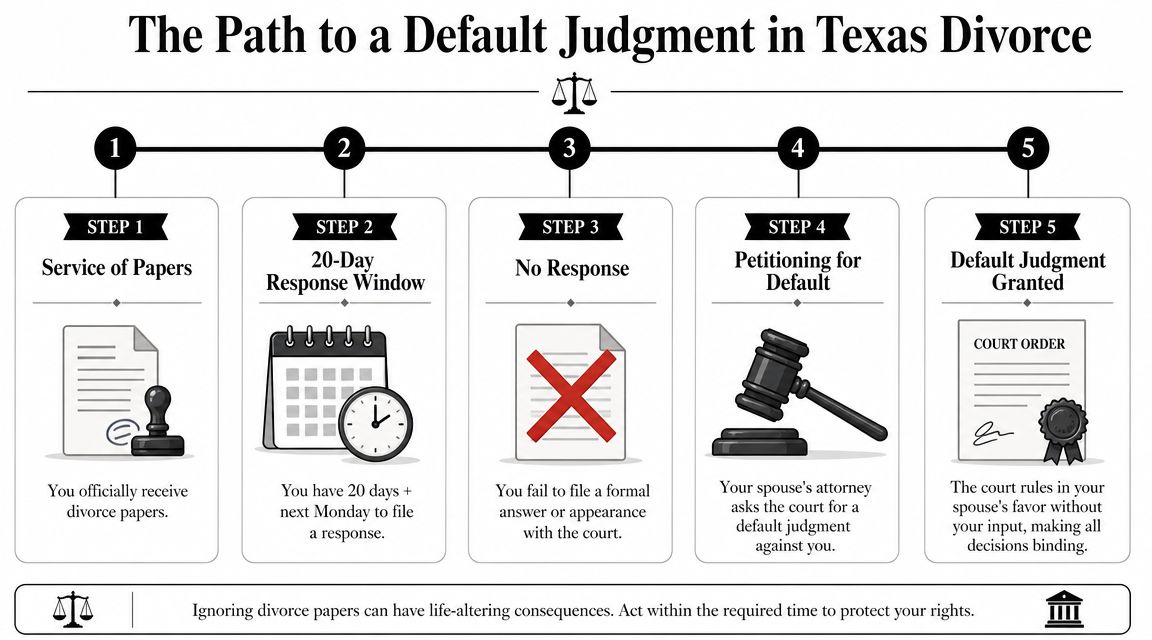
A default judgment is what can happen when one spouse is properly served, does nothing, and the other spouse asks the court to proceed anyway. It is akin to forfeiting a game before it starts. The court still has to follow the rules, but you’re no longer on the field making your case.
Texas sets a strict answer deadline. If you were properly served and don’t file an answer by 10:00 a.m. on the Monday after 20 days from service, the filing spouse may seek a default judgment. Texas also still requires a mandatory 60-day waiting period from the date the petition was filed before the divorce can usually be finalized, according to the Texas State Law Library’s divorce answer guide.
What “served” means
Service usually means you officially received the divorce papers in a legally recognized way. Once service happens, the response clock starts. It does not matter that you don’t like the petition. It does not matter that you disagree with your spouse’s claims. The deadline still applies.
The two clocks that matter
People often confuse the answer deadline with the waiting period. They are not the same.
| Clock | What it controls | Why it matters |
|---|---|---|
| Answer deadline | Your deadline to file a response | Missing it opens the door to default |
| Waiting period | The earliest point a divorce can usually be finalized | It does not protect you from the consequences of staying silent |
The answer deadline is about preserving your right to participate. The waiting period is about when the court can usually sign a final decree.
Practical rule: Filing an answer doesn't mean you agree with the divorce petition. It means you're protecting your right to be heard.
What the filing spouse can do next
Once the deadline passes without an answer, the petitioner can ask the court for a default. If the court grants it, the case can move toward final orders without your participation. That's why understanding default divorce in Texas is so important if you've already delayed.
A default case isn't the court “punishing” you. It's the court allowing the legal process to continue when one side doesn't show up. From the judge's perspective, the system still has to function. From your perspective, that means inaction can quickly become a serious legal disadvantage.
The Real-World Impact on Your Property, Finances, and Children
The biggest misunderstanding in these cases is that default only means “the divorce goes through.” That is far too mild. A default can shape the actual terms that govern your money, your property, and your family life after the marriage ends.
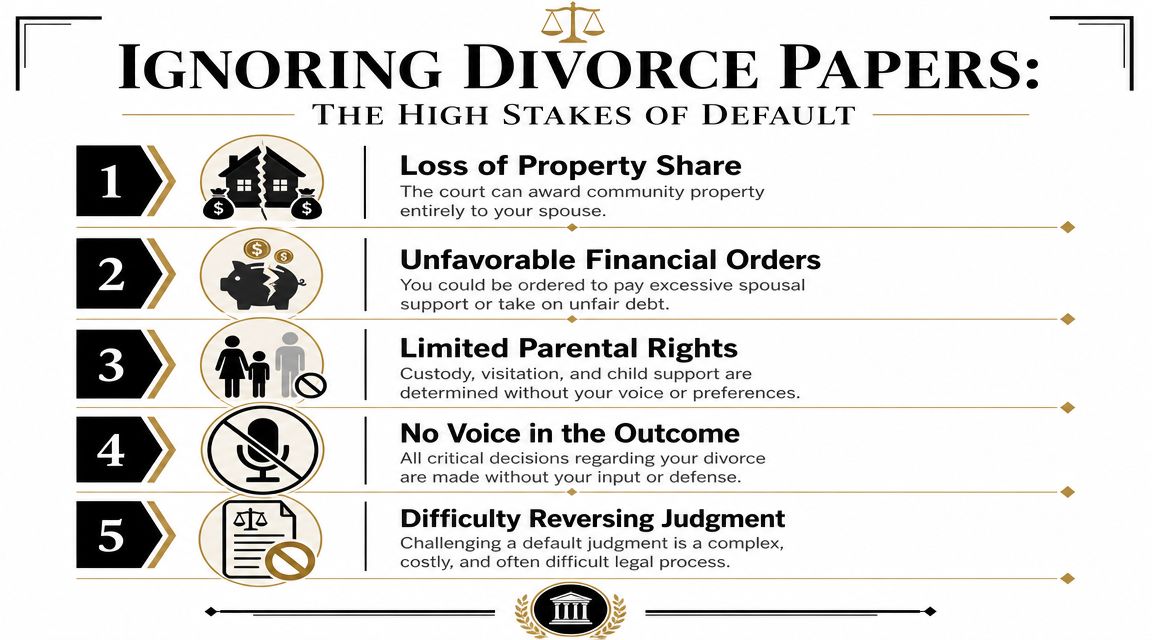
If a Texas divorce respondent is properly served and does not file an answer by the deadline, the case can proceed by default judgment, and the court may finalize the divorce without that spouse's participation. Texas Law Help notes that if a spouse never files an answer after proper service, a default divorce is available, and Texas family law guidance explains that the court can issue final orders on property division and child support based on the petitioner's requested terms, as discussed in Texas Law Help's explanation of an unresponsive spouse.
Property and debt can be decided without your input
Texas divorces often involve more than a checking account and a couch. Your case may include a house, retirement savings, business interests, vehicles, credit card balances, tax issues, and personal property that one spouse values far more than the other realizes.
If you don't answer, you may lose your chance to raise issues such as:
- Community versus separate property: Some assets may need tracing or documentation.
- Debt allocation: A decree can assign responsibility for debts in ways that affect your future finances.
- Business ownership concerns: A closely held business may need careful treatment, especially when records are incomplete.
- Retirement division: These accounts often require attention early, not after orders are already signed.
For business owners and people with substantial assets, silence is especially risky. If you have a professional practice, a family company, stock-based compensation, or real estate holdings, the court won't get your side unless you put it there.
Child-related orders don't wait for you to get ready
Parents sometimes assume that a judge won't make custody or support decisions unless both sides appear. That's a costly assumption. If you stay out of the case, you may lose your chance to shape conservatorship, possession schedules, exchange logistics, holiday arrangements, and child support terms.
That can affect daily life in ways people don't fully grasp at first. School pickups, weekend schedules, decision-making rights, and communication expectations can all be built into final orders. Once those terms are in place, changing them is usually harder than participating from the start.
If children are involved, your silence can become part of the record before your parenting strengths ever are.
Spousal maintenance and cash-flow pressure
Some spouses focus only on the end of the marriage and miss the financial strain that can follow. Final orders may address support obligations, debt payment responsibilities, and ongoing monthly burdens. If your spouse presents the court with one version of household finances and you present nothing, you've made it much easier for the judge to hear only one side.
Default has tangible consequences. It's not abstract. It can affect where you live, what bills you carry, and how stable your post-divorce life feels.
Changing a bad outcome later is harder
Many people believe they can “fix it later” if the decree turns out to be unfair. Sometimes there are options, but they're rarely as simple as people hope. Once a judgment is entered, you are no longer dealing with prevention. You are dealing with damage control.
That is the core risk behind the question, “What happens if you ignore divorce papers in Texas?” You don't just let the divorce happen. You may let the other side frame the result first.
Your First Steps After Being Served Divorce Papers
The good news is that the first protective step is usually straightforward. You don't need to have every issue figured out before you act. You need to stop the silence.
Start with the Original Answer
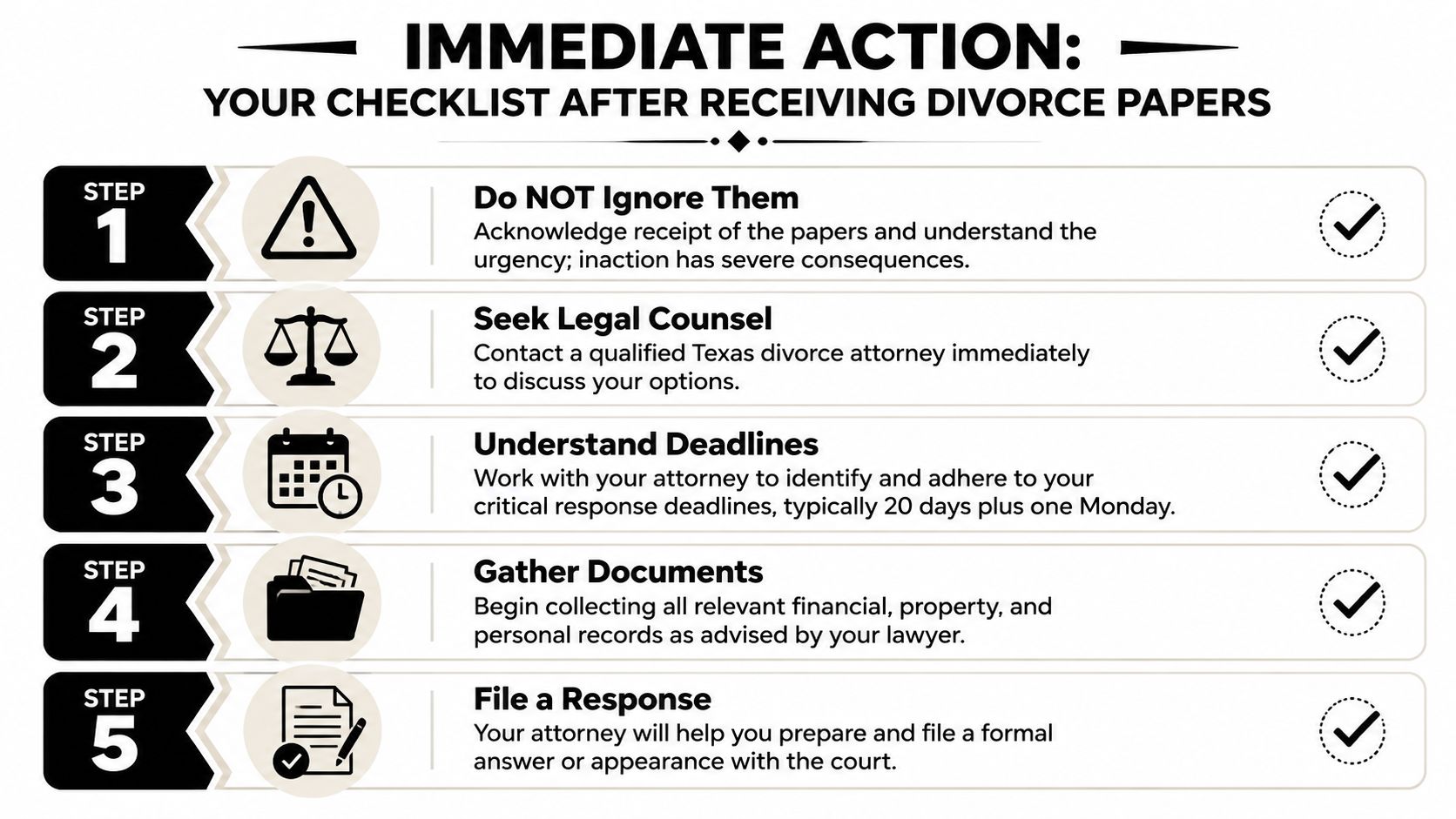
An Original Answer is the document that tells the court you are participating in the case. In many situations, filing it prevents a no-answer default. It does not mean you agree with the petition. It does not waive your objections. It keeps your seat at the table.
If you're trying to respond quickly and correctly, this guide on how to respond to a divorce petition in Texas is a useful starting point.
A practical response plan
-
Read the papers carefully
Confirm what was filed, where it was filed, and whether there are any requests involving children, property, exclusive use of a home, or urgent temporary relief. -
Calendar your deadline immediately
Don't rely on memory. Put the answer deadline on your phone, your work calendar, and a written checklist. -
Collect the documents that matter most
Start with tax returns, pay records, bank statements, retirement account statements, mortgage information, business records, and any existing court orders involving your children. -
Get legal guidance before you react emotionally
Don't text threats, don't hide money, and don't move out based on panic alone. Early advice usually prevents expensive mistakes.
For firms and legal teams trying to improve client response at the very start of a case, a structured intake process matters too. If you're comparing ways legal practices handle fast-moving family law inquiries, this resource on how to Hire legal intake specialist offers useful context on why quick, organized communication can keep urgent matters from slipping through the cracks.
Here is a short video that walks through the issue in a practical way:
Where mediation fits
Responding doesn't lock you into a courtroom fight. Many Texas divorce cases still settle through negotiation or mediation after both sides appear. Mediation can be especially helpful when you need workable parenting terms or a business-focused property solution that a standard courtroom process may not craft as carefully.
The Law Office of Bryan Fagan, PLLC provides Texas family law representation that includes guidance on answering petitions, negotiating temporary arrangements, preparing for mediation, and litigating when needed. The key is not which lawyer you choose first. The key is that you choose to respond before your options narrow.
Options for Setting Aside a Default Judgment
If a default judgment has already been entered, you may still have a path forward. But this is the point where delay becomes costly very fast.
Texas courts may allow a party to ask for relief through a motion to set aside default judgment or a motion for new trial, depending on the posture of the case. Those requests are not automatic. Judges usually want a legally supported reason to reopen the matter, not just regret.
When a court may listen
A court is more likely to consider setting aside a default when the failure to respond was not intentional or the result of conscious indifference, and when reopening the case would let the dispute be decided on its merits rather than by silence alone. The exact argument depends on the facts.
Examples that often matter include:
- Service problems: You may have grounds to challenge the judgment if service was defective.
- Mistake or confusion: Some situations involve genuine error, but you will still need to explain it credibly.
- Meritorious defenses: Courts are more receptive when you can show that real disputes exist over property, children, or support.
- Prompt action: Waiting after learning about the default usually hurts your position.
The strongest set-aside requests don't just say, “I missed it.” They show why the default happened and why the outcome should be reconsidered.
What doesn't work well
Judges are usually not persuaded by explanations that amount to avoidance. Being angry with your spouse, refusing to deal with the papers, or assuming the case would stall are not strong reasons. Neither is a vague claim that the final orders seem unfair if you never took steps to participate when you had the chance.
Why legal help matters here
A motion to undo a default is more technical than filing a timely answer in the first place. You may need affidavits, a clear factual timeline, and a strategy that addresses both procedure and substance. If the decree involves a house, retirement assets, a family business, or parenting orders, the stakes are too high to guess.
If you've already missed the deadline, don't assume all is lost. Also don't assume the court will easily reopen the case. Both mistakes can cost you valuable time.
What to Do Next A Guide for Texas Families
When people ask what happens if you ignore divorce papers in Texas, they're usually asking a deeper question. They want to know whether doing nothing will buy them time, reduce conflict, or keep the divorce from becoming real.
It won't.
Silence can cost you your voice on property division, debt allocation, support, and parenting terms. Filing a response, by contrast, gives you the chance to negotiate, request fair orders, prepare for mediation, and present evidence if a judge needs to decide the disputed issues.
Key takeaway
- Ignoring the papers won't stop the divorce
- A timely answer can stop a no-answer default
- Default can affect your house, savings, debts, and time with your children
- Undoing a default is usually harder than preventing one
- Fast, informed action gives you the most control
If you're overwhelmed, that's normal. You do not need to solve every part of your divorce today. You do need to protect your right to participate.
The best next step is simple. Get the papers reviewed, confirm your deadline, and make a plan before the court moves forward without your input.
If you've been served with divorce papers in Texas, schedule a free consultation with Law Office of Bryan Fagan, PLLC. You can get clear guidance on your deadline, your response options, and the steps needed to protect your property, your parenting rights, and your future.