Skip to content
Your spouse disappears. The mortgage is still due, the retirement account still exists, the credit cards are still open, and your child still needs a parenting plan. In Texas, you can still get divorced if you cannot find your spouse, but you need to do it in a way that protects your property rights and avoids custody problems later.
Texas courts will let a divorce move forward after you make a diligent search and ask for an approved form of alternative service. The court is not doing you a favor. It is making sure your spouse received the notice the law requires, or that you did everything reasonably possible before using a backup method.
That distinction affects the outcome of the case. If you cut corners, you can end up with a divorce that leaves major property issues unresolved, limits what the judge can award, or creates openings for your spouse to come back and challenge parts of the final order. If your spouse may have crossed state lines, review best practices for serving Texas divorce papers across state lines before you decide how to proceed.
You also need to treat the search itself as evidence. Judges want specifics. They want to see where you checked, who you contacted, and what records you reviewed. That can include online records and leveraging property data to find addresses if your spouse may still own, rent, or receive mail somewhere.
The biggest mistake I see is simple. People focus only on getting permission to serve by publication or posting, then assume the rest of the divorce will take care of itself. It will not. When a spouse is missing, the main pressure points are the house, debts, bank accounts, retirement, and any custody orders involving the children. Those issues need a plan from day one.
The Diligent Search Requirement in Texas
A diligent search means you made real, documented efforts to find your spouse before asking the court to let you use a backup notice method. It is not a formality. It is the foundation of the case.
Texas courts treat this as a due-process issue. A divorce can proceed when a spouse can't be found, but the filing spouse usually must show a diligent search and then request alternative service, often by publication or posting, as explained in this Texas-focused legal discussion of missing-spouse divorce procedure.
What judges want to see
Judges want evidence that you tried. “I haven't heard from him in years” isn't enough by itself. You need a paper trail.
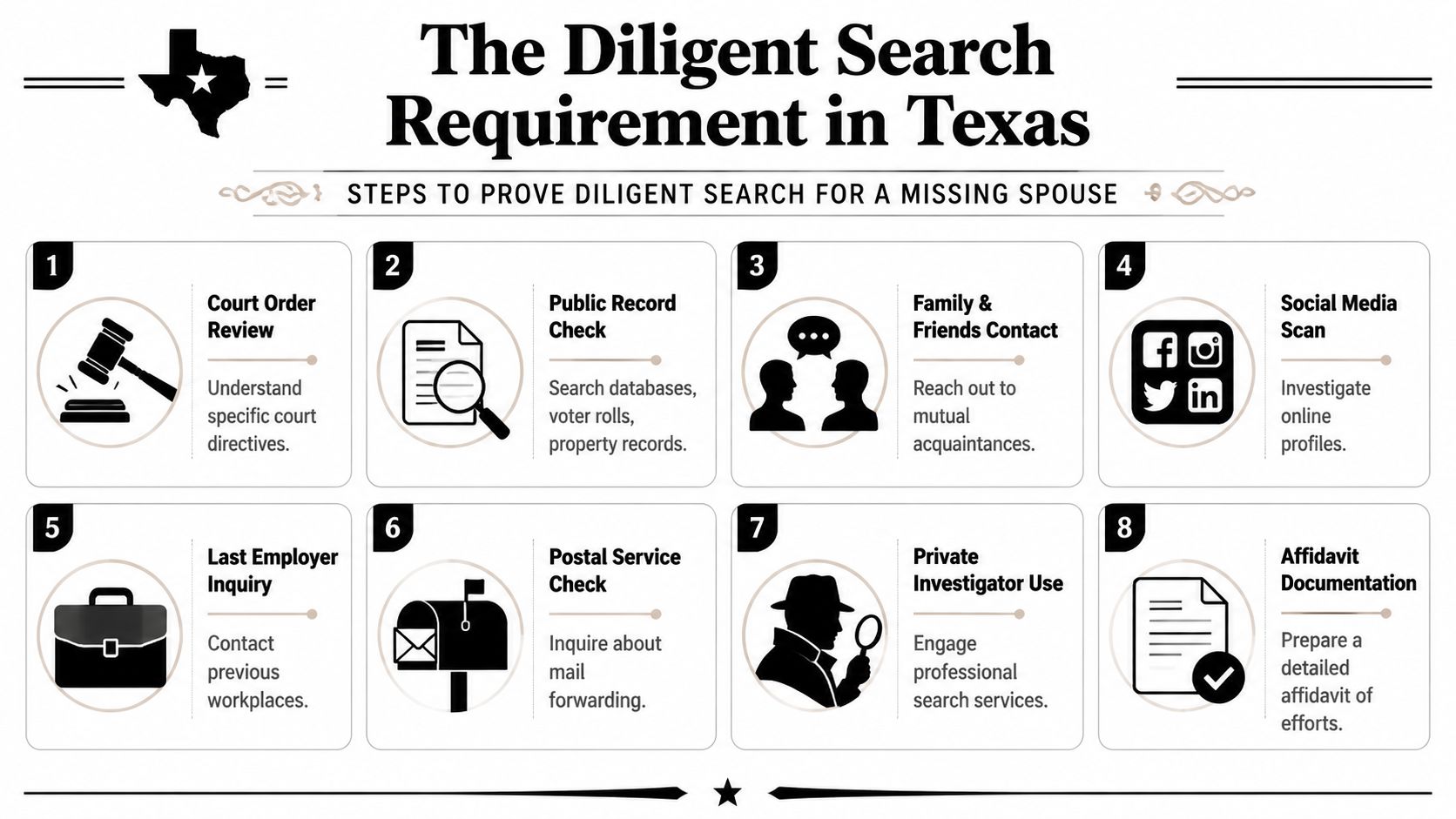
A solid search usually includes several kinds of effort:
- Last known address checks. Go back to the last place your spouse lived, worked, or received mail.
- Family and friend outreach. Contact relatives, close friends, and mutual acquaintances.
- Online review. Check social media profiles, professional listings, and public-facing account information.
- Public record searches. Property records, voter information, and court filings can point you to a current address.
- Employment leads. If you know where your spouse used to work, follow that lead.
- Mail clues. Returned mail can support your affidavit and show failed contact attempts.
- Professional help. In some cases, using a skip trace, investigator, or tools for leveraging property data to find addresses can strengthen your record.
- Written proof. Keep screenshots, returned envelopes, call logs, emails, text attempts, and notes.
Practical rule: If you can't hand a judge your search history in organized form, you probably haven't documented it well enough.
Your affidavit matters more than your frustration
You'll usually need an affidavit describing what you did, when you did it, and what happened. Specificity wins. Dates, names, addresses, and results matter. General complaints do not.
If your spouse may be outside Texas, don't skip the service details tied to location. This guide on serving Texas divorce papers across state lines is useful when the problem is not total disappearance, but uncertainty about where the spouse moved.
A weak search can stop your case cold. A strong search gives the court a reason to approve the next step.
Your Legal Options for Serving a Missing Spouse
Once you've shown the court that you tried to find your spouse, you ask for permission to use another method of service. Many people find this part confusing. Not every backup method is the same, and the choice affects what your case looks like later.
Think of service like giving legal notice in the most reliable way available. Personal service is hand delivery. That is the gold standard. Constructive service is notice the law accepts even when hand delivery is impossible. Courts prefer the first and tolerate the second only when you've earned it by showing real effort.
Comparing the main options
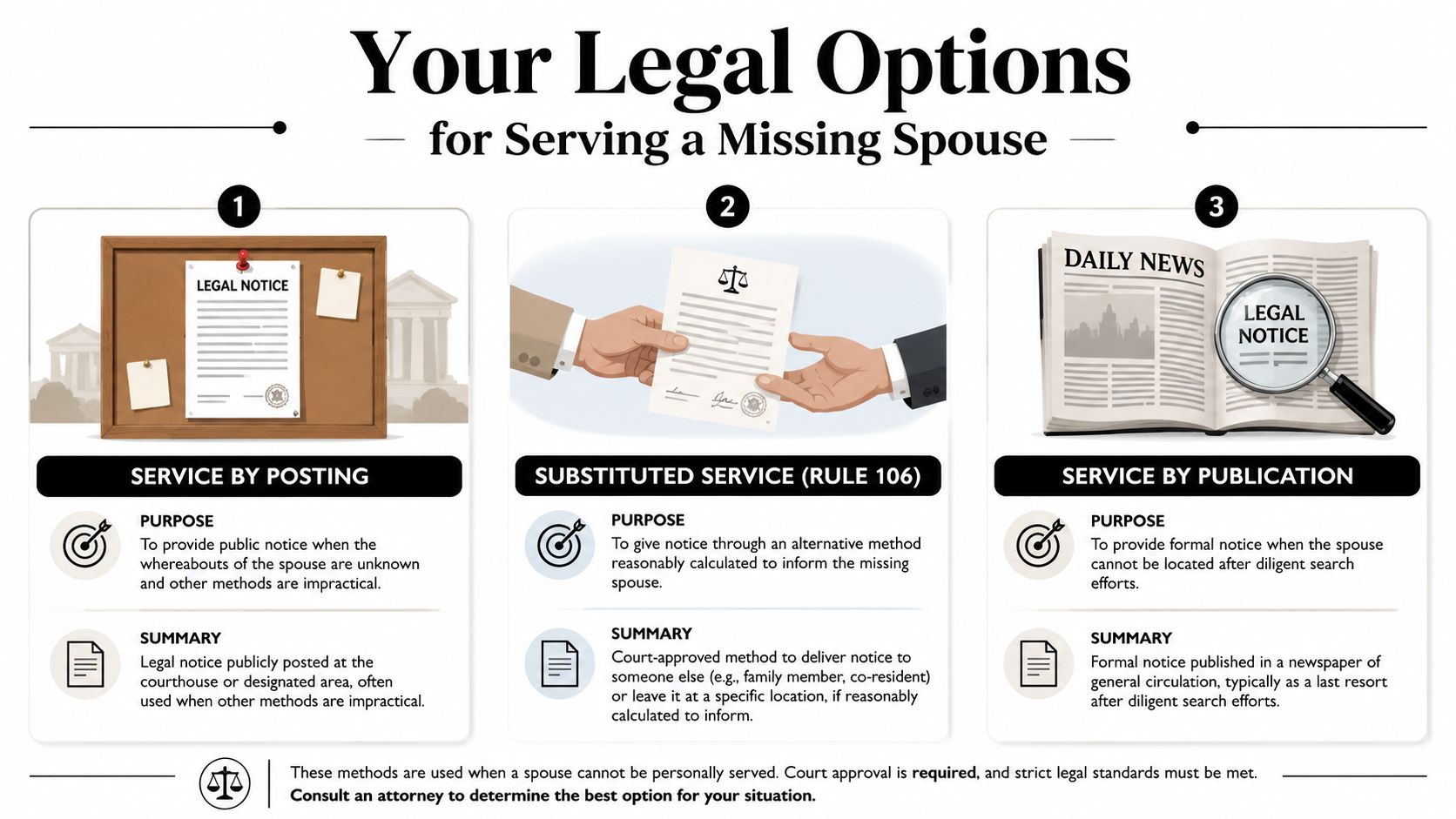
| Method | When it fits | What it looks like | Main concern |
|---|---|---|---|
| Substituted service | You have a usable address or place tied to your spouse | Court-approved delivery to a person or place reasonably likely to give notice | You must show the method is likely to reach them |
| Service by posting | Narrow Texas cases, usually simpler ones | Notice posted at the courthouse | Often limited and not suitable for more complex family issues |
| Service by publication | Last resort when location remains unknown | Legal notice published in an approved publication | Final orders may face limits if the spouse never appears |
Substituted service is usually better than publication if you have something concrete to work with. A judge is more comfortable approving a method tied to an actual address, employer, or household than a purely public notice.
Why judges care about the method
The weaker the notice, the more cautious the court becomes. That caution shows up later in property rulings, support enforcement, and any request that affects rights beyond ending the marriage.
The court is not trying to trap you. The court is trying to make sure your spouse's absence does not erase basic fairness.
This approach is not unique to Texas. In England and Wales, the government states that you can still get a divorce if you do not know where your partner is, and the standard filing fee is £612, with £53 for a government search in some cases and another £53 to ask the court to dispense with service if the partner still cannot be found, as outlined in the government process for divorce when a spouse is missing. The legal systems differ, but the principle is the same. Courts don't require impossible personal contact forever. They require reasonable efforts and lawful notice.
My recommendation
If you have any credible address, job lead, or family contact, push that lead first. Publication is useful, but it is not powerful. It ends the marriage more easily than it resolves the financial mess around the marriage.
That distinction matters.
The Divorce by Publication Process in Texas
A missing spouse creates a false sense of simplicity. You may be able to finish the divorce, but publication usually limits what the court is willing to do with property, debt, and children. That is why this stage needs careful work.

Publication is a court-approved backup method. It lets the case continue after stronger notice methods have failed, but it also puts the judge on guard. A judge who allows notice by newspaper or posting will look closely at any request involving a house, retirement account, debt allocation, child support, or custody terms.
How the process usually works
The sequence is usually straightforward if your paperwork is clean:
- File your divorce petition and make sure it asks for the relief you may need.
- Finish your search efforts and gather proof of every step you took.
- File the affidavit asking for citation by publication or posting, depending on what the court will allow.
- Get the court's order approving that method of service.
- Complete publication or posting exactly the way the order requires.
- Wait out the response period after notice is completed.
- Set the case for a final hearing if your spouse still does not answer.
- Prepare a decree the court can legally sign, especially if property or children are involved.
The paperwork matters because the limits of publication often show up at the end, not the beginning. If your petition is too thin or your proof of service is sloppy, the court may end the marriage but leave major financial problems unresolved.
Posting and publication are not interchangeable
Texas courts treat these methods differently. Posting is narrower and usually fits only simpler cases. Cases with children or meaningful community property draw more scrutiny because the absent spouse still has legal rights, even if that spouse has disappeared.
As noted in this Texas Law Help guide on service by posting in divorce cases without kids, posting is generally limited to certain divorces without children, and the court may require extra protection for the missing spouse when property is involved.
That caution affects your outcome. A weak notice method can leave you with a divorce decree that ends the marriage but does not fully solve title issues, debt disputes, or future enforcement problems.
Expect close court supervision
If the court appoints an attorney ad litem, cooperate and answer thoroughly. The ad litem is there to protect the absent spouse's legal interests and to test whether your notice efforts were real. That protects the enforceability of your final decree.
Expect questions about bank accounts, real estate, retirement plans, vehicles, children, and any reason to believe your spouse may still be reachable. Judges ask those questions for a practical reason. They do not want a missing spouse to reappear later and attack the decree because the process was weak or important facts were omitted.
A publication case is won by precision.
For a fuller explanation of the procedure, read this guide on divorce by publication when traditional methods fail.
Securing a Default Judgment to Finalize Your Divorce
You found a way to give legal notice, your spouse still did nothing, and now you want the judge to finish the case. That is reasonable. It is also the point where sloppy paperwork can cost you later.
A default judgment is the order that ends the marriage and sets the terms you will be stuck enforcing. In a missing-spouse case, that matters far beyond marital status. If the decree is vague or asks for relief your petition did not properly request, you can end up divorced but still fighting over debt, title to property, retirement funds, or parenting terms.
What default really means
Default means the court can proceed without your spouse because they were properly served and failed to answer. It does not give you a blank check.
At the final hearing, usually called a prove-up, you will give brief testimony under oath. The judge will want clean proof on a few points: residency, the date of marriage, the date of separation if relevant, how service was completed, whether the statutory waiting period passed, and exactly what orders you want in the final decree. If those pieces do not match your filed papers, the hearing can stall fast.
Your petition controls the result
Many people hurt their own case by filing a simple petition just to get the divorce started. They then show up at prove-up asking for detailed property terms, debt allocation, or custody provisions that were never clearly pleaded.
Judges do not like that, and they should not. Your spouse may be missing, but due process still applies.
If you may need the court to award the house, assign a vehicle loan, divide retirement, confirm separate property, or set conservatorship and child support, your petition and proposed decree need to say so with real specificity. A weak petition often produces a weak decree. A weak decree is how post-divorce problems start.
For a practical overview of the hearing and paperwork, review this guide on default divorce in Texas.
A short final hearing is usually a good sign. It means you handled the hard part before you walked into court.
Dividing Property and Handling Custody Without Your Spouse
Anxiety usually spikes in such situations, and for good reason. Ending the marriage is one thing. Untangling the life attached to that marriage is another.

A major risk in these cases is when the missing spouse controls finances or property records. Service by publication may allow the divorce to move forward, but property division and support issues can become complicated if the absent spouse was never personally served, creating downstream enforcement problems, as discussed in this analysis of the practical complications in missing-spouse divorce cases.
Property problems don't disappear because your spouse did
Texas is a community property state. That means the court still has to deal with the marital estate in a way that is just and right. But the court's comfort level changes when your spouse was not personally served and never appeared.
Common trouble spots include:
- Real estate. If the home is in both names, transferring title later may require additional steps.
- Retirement accounts. A decree may need very specific language, and later division can be harder if account information is incomplete.
- Debt allocation. Creditors are not bound the same way a divorce decree binds spouses. You may still have collection exposure even if the decree assigns the debt elsewhere.
- Business interests. Valuation and ownership records can be difficult to prove if the missing spouse handled them.
- Hidden accounts. You can't divide what you can't identify.
If there are children, the court still has to protect them
A missing spouse does not stop the court from making custody-related orders. If children are involved, the judge can enter conservatorship, possession, and child support orders based on the evidence available. But there is a practical limit. Orders are easier to sign than to enforce against someone you can't find.
That means you should think beyond the final hearing. Ask hard questions now:
- Do you need sole decision-making authority in specific areas?
- Is supervised possession even realistic if the other parent is missing?
- Do you have school, medical, and passport issues that require clear decree language?
- Is there a history of instability, addiction, or family violence that needs to be addressed directly in the orders?
Here's a helpful video overview on Texas family law issues that often overlap with divorce planning:
My blunt advice on money and kids
Do not file a generic petition and hope to “fix it later.” In a missing-spouse case, later may be expensive, limited, or impossible.
If you own a house, have retirement funds, run a business, or share children, your pleadings need to be specific. Your proposed decree needs to be specific. Your evidence needs to be organized. If records are missing, start rebuilding them now through statements, tax returns, title documents, payroll records, and beneficiary documents.
A court can end the marriage without your spouse's participation. That does not mean the court can clean up every practical consequence with the same ease.
What to Do Next and Common Pitfalls to Avoid
Start with a file. Put every address, message, returned envelope, social media screenshot, family contact, and financial record in one place. Then build your case from the ground up.
The mistakes that hurt people most
Some errors are procedural. Others are strategic. Both can damage the outcome.
- Rushing to publication too early. If your search is thin, the judge may deny alternative service or question the entire case.
- Asking for too little in the petition. If the petition doesn't request the right relief, the final decree may leave major issues unresolved.
- Ignoring title and account details. Houses, retirement plans, and debt need precise treatment.
- Assuming child support is the end of the custody analysis. Parenting orders need practical detail, especially when the other parent is unstable or absent.
- Overlooking military status. If your spouse may be on active duty, extra protections can apply. You cannot guess your way through that.
- Thinking reappearance changes nothing. If your spouse resurfaces later, weak service or incomplete disclosures can create challenges.
What I recommend you do now
Use a checklist, not hope.
- Gather your spouse's last known contact details.
- Start documenting every search effort.
- Pull together property, debt, and child-related records.
- Identify what final orders you need, not just the fact that you want a divorce.
- Get legal advice before you request alternative service.
For some people, mediation still plays a role in family law disputes, but not every missing-spouse case is a mediation case. If the person is gone, your focus should be valid service, a solid decree, and future enforceability.
This is one of the few areas where doing it yourself can look cheaper at the start and cost far more at the end. A publication divorce may sound simple because the other spouse is absent. In reality, it is more technical than many contested cases.
One practical option is working with the Law Office of Bryan Fagan, PLLC, which handles Texas divorce and family law matters, including cases involving property, custody, and enforcement concerns. The value in a case like this is not just getting papers filed. It is making sure the final order protects your life after the divorce.
What to Do Next
If you're asking, can you get divorced if you can't find your spouse, the answer is yes. But the smarter question is this: can you get divorced in a way that also protects your property, your parenting rights, and your ability to move forward without coming back to court later?
That answer depends on how carefully you handle the search, service, pleadings, and final decree.
Don't wait for your missing spouse to make your next move for you.
If your spouse has disappeared and you need a clear plan, schedule a free consultation with the Law Office of Bryan Fagan, PLLC. You can talk through your search efforts, service options, property concerns, custody questions, and what a workable final decree should include under Texas law.