Skip to content
When you're ready to move on and your spouse keeps slowing everything down, the divorce can feel less like a legal process and more like a trap.
A stalled Texas divorce usually doesn't stay stalled by accident. One spouse ignores discovery. Mediation gets canceled. Financial records never seem to arrive. Parenting disputes suddenly flare up right before a deadline. If that's happening in your case, you're not powerless, and you don't have to wait while the other side controls the pace.
Texas law gives you tools to push a case forward. Some are informal. Some are court-enforceable. The key is using the right remedy at the right time, with clean documentation behind it. That means understanding why the delay is happening, keeping a record that a judge can use, and knowing when to move from requests to motions.
Texas also has real timing rules. A divorce can't be granted immediately because there is a mandatory 60-day waiting period in Texas, and a final trial can generally be set with at least 45 days' notice according to Texas delay rules discussed here. So the question usually isn't whether delay is possible. It's whether the delay is legitimate, strategic, or sanctionable.
[Introduction] What to Do When Your Spouse Purposely Drags Out the Divorce
You may already know the pattern. You send what your lawyer needs. You respond on time. You show up for mediation or negotiation ready to make progress. Then your spouse cancels, goes silent, asks for another extension, or suddenly claims more documents are needed.

That kind of delay hurts in ways people don't always see at first. It drains money, keeps conflict alive, and leaves important issues unsettled. A widely cited 2024 estimate puts the average divorce at $7,000 to $15,000, with high-conflict cases costing more, as noted in these divorce cost and prevalence statistics. That matters because every extra month can mean more attorney communication, more hearings, more discovery fights, and more time spent tracking temporary parenting and financial problems.
What delay usually looks like in real life
A spouse who is dragging out the divorce on purpose often doesn't announce it. The conduct shows up in smaller acts:
- Missed financial disclosures that should have been routine
- Repeated requests for more time without a real case-related reason
- Canceled mediation sessions or refusal to commit to dates
- Unresponsive communication right when decisions need to be made
- Last-minute disputes about children or money that stop settlement progress
What actually helps
The most effective response is structured, not emotional.
Practical rule: Don't try to prove bad motives first. Prove the pattern first.
That means you should start documenting every missed step, preserve every communication, and work with counsel to convert open-ended delays into deadlines the court can enforce. In Texas, judges are much more likely to act when they can see a timeline, a rule that was ignored, and a request for a specific remedy.
If you're asking, "What if your spouse drags out the divorce on purpose?" the answer is that you gain influence with facts, not frustration.
Decoding the Stall The Real Reasons Your Spouse Is Delaying the Divorce
Most intentional divorce delay falls into one of a few categories. The reason matters because it shapes the best response. A spouse stalling for emotional reasons often behaves differently from a spouse stalling to control money or influence custody.

Financial leverage
This is one of the most common and most damaging motives. Delay can give one spouse more time to control accounts, use marital income, postpone support issues, or make assets harder to trace.
A 2024 literature review reported that in one study, 94% to 99% of intimate partner violence survivors also experienced economic abuse, which can include hiding assets or refusing to comply with financial obligations during divorce, according to this review on post-separation and economic abuse. Not every delayed divorce involves abuse, but the overlap between stalling and financial control is important to recognize.
If your spouse becomes evasive right before bank records are due, refuses to explain transfers, or keeps exclusive control of household funds while claiming the case "just needs more time," treat that as a legal problem, not just a personality problem.
Emotional punishment or control
Some spouses delay because they don't want the divorce to end on your timeline. They may not even care whether the delay helps them legally. The point is to keep you tied to the process.
This often shows up as inconsistent behavior. One week they sound cooperative. The next week they reverse course, refuse to sign agreed paperwork, or create fresh conflict over issues that were close to resolution. In high-conflict divorces, delay can become a way to keep emotional control after the relationship itself has broken down.
A spouse doesn't have to say, "I'm stalling." The pattern says it for them.
Avoiding the practical fallout
Not every delaying spouse is acting out of revenge. Some are avoiding hard realities such as moving out, paying support, disclosing debt, or facing a final parenting schedule.
That doesn't make the delay harmless. It means your strategy may need to focus less on argument and more on forced structure. Deadlines, status settings, and clear court orders work better than repeated informal requests.
Strategic legal positioning
Sometimes the delay is tactical. A spouse may be waiting to see whether income changes, business records become harder to interpret, or a temporary arrangement becomes the new normal.
Historical divorce patterns also show why timing matters. Our World in Data reports that the probability of divorce within 10 years was more than twice as high for couples married in 1995 as for those married in 1965, and divorce rates have generally increased since the 1970s in many places, as discussed in this marriage and divorce data overview. In practical Texas litigation, that means timing affects property values, schedules with children, and negotiating advantage.
If you want a broader look at how local courts handle timing issues, this guide on Texas divorce court scheduling and delays helps explain the court-side part of the problem.
Building Your Case How to Document Intentional Divorce Delays
Judges don't act on general frustration. They act on specifics.
If you believe your spouse is dragging out the divorce on purpose, start building a delay log. This is not a diary. It's a case tool. Your goal is to create a clean timeline that shows what was required, what happened, and how the delay affected the case.
What your delay log should include
Use a spreadsheet, notes app, or shared file with your lawyer. Keep it simple and consistent.
Date and event
Record each deadline, mediation date, hearing setting, document request, or agreement deadline.What was expected
Note the required action, such as producing tax returns, responding to discovery, confirming mediation, or exchanging proposed parenting terms.What happened
Write down whether your spouse failed to respond, canceled, produced incomplete information, or asked for another extension.Supporting proof
Save emails, text messages, attorney letters, notices, and screenshots.Effect on the case
Note whether the issue caused extra fees, delayed negotiation, required a rescheduled hearing, or affected parenting or finances.
Save evidence in a form your lawyer can use
Don't forward random screenshots without context. Label them. Keep records by issue. If the dispute is over income, keep income-related records together. If the dispute is over possession schedules, organize by parenting incidents.
If discovery is part of the problem, this guide to discovery in a Texas divorce case gives useful background on how document requests, interrogatories, and related deadlines fit into the larger process.
Legitimate Delay vs. Intentional Stalling Tactics
| Tactic | Potential Legitimate Reason | Red Flag for Intentional Delay |
|---|---|---|
| Missing one document deadline | Illness, document access issue, attorney scheduling problem | Repeated missed deadlines with no clear explanation |
| Canceling mediation once | Genuine emergency or conflict | Multiple cancellations close to the date, especially after preparation is complete |
| Asking for an extension | Complex records or newly discovered issue | Serial extension requests that don't produce actual progress |
| Changing lawyers | Real breakdown in attorney-client relationship | Repeated counsel changes that reset the case again and again |
| Producing incomplete financial records | Records are still being gathered | Key records stay missing after repeated requests and reminders |
| Slow response to parenting issues | Temporary work or travel conflict | Unresponsiveness used to create instability or later blame you |
What not to do
Don't flood the court with complaints before you have a pattern. One delay rarely proves bad faith. Several related delays, carefully documented, often do.
Case habit: If you can't explain the delay in three clear sentences with attachments to back it up, tighten the record before asking the court for relief.
That discipline protects your credibility. In family court, credibility matters almost as much as the paperwork itself.
The Texas Legal Playbook for Forcing Your Divorce Forward
Once the delay is documented, the next question is what to file and when. In Texas, the strongest approach usually moves from informal pressure to court-enforceable deadlines. You don't start with sanctions unless the record supports it. You build toward them.
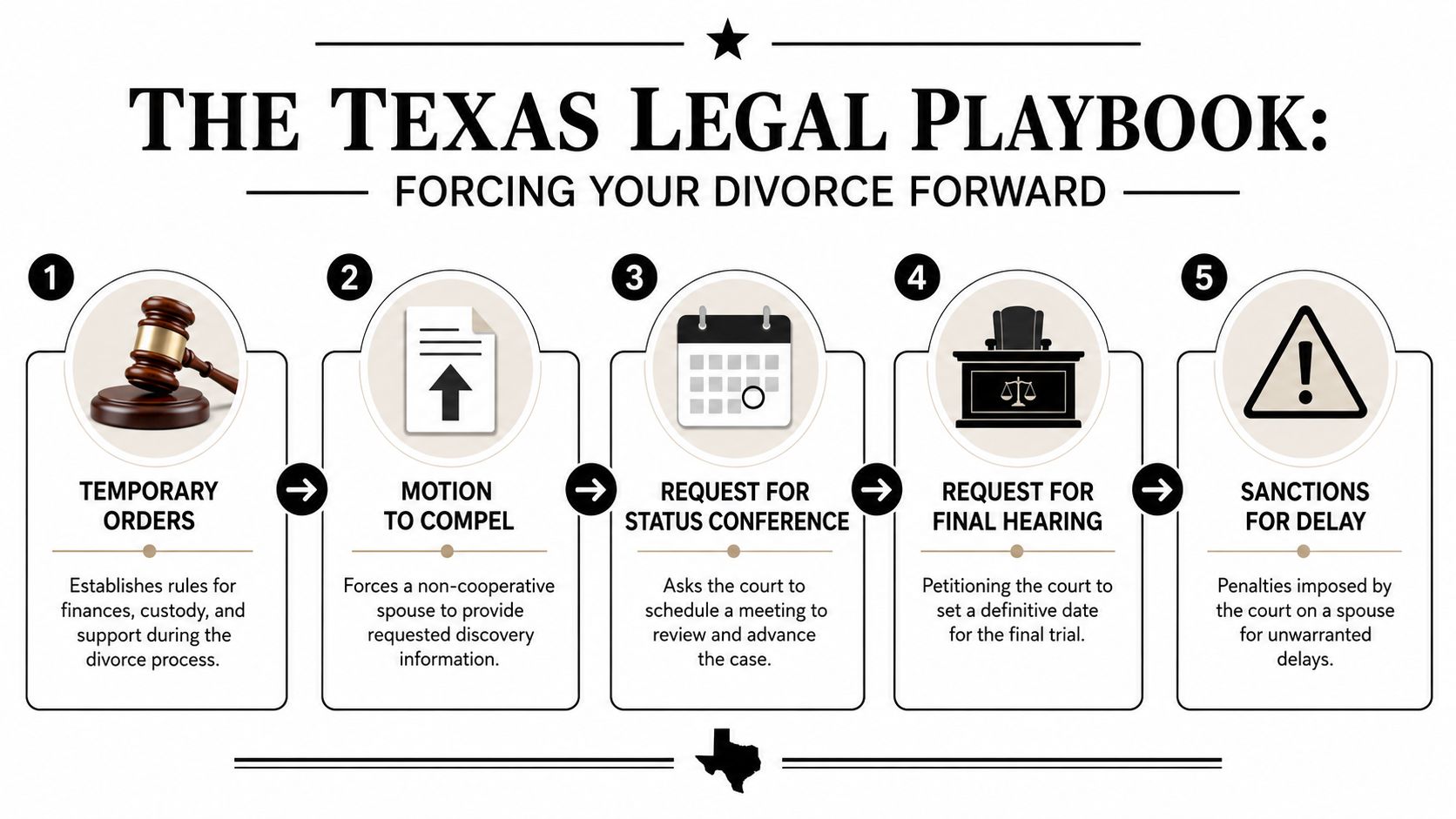
Step one, secure temporary orders when needed
Temporary orders are often the first line of defense in a contested Texas divorce. They can establish who pays which bills, where the children stay, how parenting time works, and whether temporary support is owed while the case is pending.
When nothing is stabilized, delay becomes more dangerous. If your spouse is using the extra time to keep control of money, housing, or the children, temporary orders can reduce the damage while the rest of the case moves forward.
In plain English, temporary orders are short-term rules that stay in place until the court signs a final decree or changes them later.
Step two, serve discovery early
The most effective anti-delay workflow is to convert vague scheduling into court-enforceable milestones. Serve discovery early, document every missed response, and then ask the court to step in if needed, as explained in this discussion of intentional delays and case-management strategy.
Discovery is where many stalling cases reveal themselves. A cooperative spouse may object to a request, ask for clarification, or need limited extra time. A stalling spouse often does something different. They ignore deadlines, produce partial records, or answer in ways that force repeated follow-up.
Step three, file a motion to compel
A motion to compel asks the court to order your spouse to do what the rules already require. Most often, this means producing documents, answering discovery, or complying with prior requests.
Use a motion to compel when:
- Documents are missing after proper requests and follow-up
- Discovery responses are incomplete or evasive
- A spouse ignores obligations that should not require repeated informal reminders
A motion to compel is not punishment. It's a push for compliance. In many cases, it's the correct first escalation because it gives the court a clean chance to impose a deadline.
Step four, ask for a status conference or trial setting
Sometimes the case needs a court date more than another letter between lawyers. A status conference can bring everyone before the judge to address what is blocking progress. A trial setting creates a deadline that is much harder to ignore.
Texas procedure generally allows a final trial to be set with at least 45 days' notice, and that timing can be a useful pressure point when the other side keeps drifting. Once the case is on a real court track, vague delay often becomes more expensive and less effective.
If your spouse refuses to participate after service and proper notice, there may also be situations where default divorce in Texas becomes relevant.
Step five, seek sanctions when the pattern is clear
A motion for sanctions is different from a motion to compel. Sanctions ask the court to penalize misconduct, not just order compliance.
That might include a request that the court require the delaying spouse to pay attorney's fees caused by the noncompliance, or impose other consequences allowed under the rules. Courts can also penalize noncompliance in Texas-focused guidance on delayed divorce litigation, including attorney's fees and temporary support remedies, as discussed in this analysis of how long a spouse can drag out a divorce.
Courtroom reality: Judges usually respond best when you show a sequence. Request. Missed deadline. Follow-up. Another failure. Motion to compel. Continued noncompliance. Then sanctions.
That sequence matters because it shows the court you tried to solve the problem before asking for penalties.
What usually doesn't work
Some responses feel satisfying in the moment but hurt the case later:
- Fighting every minor slight instead of building one strong record
- Sending angry messages that distract from the core issue
- Making unsupported accusations about hidden motives
- Waiting too long to escalate after clear noncompliance begins
The Law Office of Bryan Fagan, PLLC offers Texas family law representation that can help clients move from informal delay complaints to formal court action when the facts support it. In these cases, structure wins. Evidence wins. Deadline-driven litigation wins.
Protecting Your Finances and Custody Rights from Delay Tactics
A delayed divorce isn't only a litigation problem. It's a day-to-day risk problem. While the case stays open, your spouse may keep spending, keep controlling records, or keep trying to shape a parenting routine that benefits them later.

Protect your financial position early
The harm from delay is not just about attorney's fees. It is also about financial and evidentiary damage. A stalling spouse can use extra time to hide assets or gain an advantage, which is why early documentation matters before evidence goes stale, as noted in the Texas-focused discussion above.
Take practical steps now:
- Gather statements for bank accounts, credit cards, retirement accounts, loans, and insurance
- Track bill payments so you can show who paid what during the case
- Monitor joint accounts for unusual withdrawals or transfers
- Preserve business records if a company, partnership, or professional practice is involved
- Collect property records for homes, vehicles, deeds, and major purchases
If you're also sorting through debt pressure and timing questions, this resource on navigating financial decisions during divorce can help you think through the bigger picture.
Watch for signs that delay and money control are linked
When delay lines up with financial secrecy, take it seriously. For example, if your spouse resists settlement talks until after account balances change, avoids producing records tied to a business, or keeps sole access to insurance and benefit information, the case may need faster intervention.
For high-value estates and business-owner divorces, this issue gets more serious. Delay can blur valuation dates, complicate tracing, and make reimbursement or waste claims harder to prove if the records aren't preserved.
Keep a running file of account statements and major transactions. That file often becomes more important than memory.
Protect your custody and parenting position
If children are involved, don't wait for final orders to start acting like the record matters. It does.
Focus on stability:
- Follow temporary orders exactly, even when your spouse doesn't
- Keep communication child-focused and brief
- Document missed exchanges or denied access without editorializing
- Track school, medical, and activity involvement so your role stays visible
- Avoid retaliatory schedule changes unless safety requires immediate action
A parent who stays organized, calm, and child-centered usually presents better than a parent who reacts to every provocation.
This short video gives additional context on dealing with delay and conflict during divorce:
Use mediation carefully
Mediation can still be useful in a delayed case, but only if the basic information is available and both sides are prepared. If financial disclosures are missing or one parent is using custody to gain an advantage, mediation without structure can waste time and money.
In those situations, it often makes more sense to secure temporary rulings, finish key discovery, and mediate after the case has a firmer foundation.
Taking Back Control Your Next Steps and Realistic Timelines
A delayed divorce starts to feel endless when nothing on the calendar seems firm. In Texas, the better way to look at it is this: your case has procedural pressure points, and your goal is to reach each one with a clean record and a specific request for relief.
The 60 day waiting period sets the earliest point for finishing a divorce in most cases. After that, timing usually depends on service, temporary orders, discovery, mediation, the court's docket, and whether your spouse keeps ignoring deadlines. Some counties move faster than others. Some judges set firm scheduling orders early. Others require repeated status conferences before they will set a trial. That is why two divorces filed on the same day can end on very different timelines.
What matters is momentum.
If your spouse is stalling, the next steps should be deliberate, documented, and tied to a remedy the court can grant.
A practical next-step sequence
Start by asking where the case is stuck. The answer should lead the strategy.
If disclosures are missing, the next step may be a motion to compel. If orders are already in place and your spouse keeps violating them, sanctions may be appropriate. If the case is drifting without deadlines, a status conference or trial setting request may matter more than another round of angry emails.
A useful sequence often looks like this:
Identify the current bottleneck
Pin down the specific problem. No responses to discovery, missed mediation, failure to produce bank records, canceled hearings, or refusal to follow temporary orders.Match the problem to the right filing
Use the least aggressive tool that has a real chance of working. Judges usually respond better when the record shows you tried to solve the problem before asking for penalties.Update your evidence file before each hearing
Bring the timeline, emails, notices, missed deadlines, and proof of prejudice. Show the court exactly what happened and what relief you want.Ask for deadlines you can enforce
A vague order often creates another round of delay. A dated production deadline, a make-up possession schedule, or a firm mediation deadline gives the judge something concrete to enforce later.Reassess after each court response
If the court orders compliance and your spouse still refuses, the case may be ready for stronger remedies.
That sequence saves money in some cases. In others, it increases short-term legal work. I still prefer it to passivity, because a documented escalation path gives the court a reason to act.
Realistic timelines, not false promises
Some delayed divorces can still settle within a few months after temporary issues are stabilized and missing information is produced. Others take much longer because the dispute is not just about delay. It is about hidden income, business valuation, separate property tracing, relocation, or a serious custody fight.
That difference matters. A spouse who is merely disorganized calls for one response. A spouse who is using delay as strategy calls for a tighter record and firmer court intervention.
Expect the timeline to depend on four things:
- how quickly your spouse was served
- whether temporary orders are needed
- how much financial discovery is still outstanding
- how crowded your court's docket is
If your spouse keeps forcing continuances, ignoring discovery, or creating custody conflict, the court can address that. It usually will not do so based on frustration alone. It acts on proof.
Keep the pressure where it belongs
Do not measure progress only by whether the case is finished. Measure progress by whether you are converting chaos into enforceable deadlines.
That can mean getting a discovery cutoff on the calendar. It can mean securing temporary support. It can mean narrowing the issues enough that mediation has a real chance to work. In some cases, it means building the record for sanctions so the cost of delay starts landing on the person causing it.
Digital evidence sometimes becomes part of that process. If subscriptions, online income, or adult-content spending are relevant in your case, a niche resource on verifying OnlyFans for divorce cases may help you evaluate how that evidence should be preserved and presented.
You do not need to answer every provocation. You need a documented pattern, a realistic court request, and follow-through.
Key takeaway
A spouse can drag out a divorce. They cannot control the entire process if you document the pattern and ask the court for targeted relief at the right time.
Stay organized. Ask for specific deadlines. Use motions in the right order. Keep your credibility intact.
If your divorce feels stuck and your spouse's conduct is costing you time, money, or peace of mind, it's time to talk through a concrete plan. The Law Office of Bryan Fagan, PLLC helps Texans address contested divorce, custody disputes, property division, mediation, support, and enforcement issues with a practical court-focused strategy. Schedule a free consultation to discuss what's happening in your case, what remedies may fit, and how to move your divorce toward a final resolution.