Skip to content
You're trying to protect your children, your finances, and your peace, then a judge orders you and your spouse to attend counseling even though you believe the marriage is already over. Texas Family Code § 6.505 can create that situation, but it doesn't give the court unlimited power to delay or control your divorce.
When a Texas Judge Sends You to Counseling Mid-Divorce
A Houston parent may receive divorce papers, attend a temporary orders hearing, and then learn that the judge has directed both spouses to meet with a counselor. The order can feel personal, especially when one spouse has already accepted that reconciliation isn't realistic. It's natural to ask whether attendance is mandatory, who pays the counselor, and whether private conversations will be repeated in court.
The short answer is that § 6.505 gives the judge discretion. The court may direct counseling while the divorce remains pending, but the statute doesn't require every divorcing couple to attend. The provision is designed to give the court limited information about whether reconciliation is reasonably possible, not to force you to stay married.
The order may arise after a request from one spouse, on the court's own initiative, or during a hearing involving temporary arrangements. A temporary orders hearing can also address possession of the home, temporary support, and parenting issues. You can learn more about that process in this guide to what happens at a temporary orders hearing in a Texas divorce.
What the order doesn't mean
A counseling order doesn't automatically mean the judge doubts your reasons for filing. It also isn't the same as a custody evaluation, a psychological evaluation, or a requirement that you disclose every detail of the marriage. The counselor's role is limited by the statute and the written order.
If counseling is ordered, you may still proceed toward divorce after the counseling period ends. Texas law expressly limits the court to moving forward with the divorce once that period has concluded. For families considering counseling voluntarily, a resource on evidence-based family therapy approaches may help explain how structured sessions can differ from informal attempts to repair conflict.
The possible outcomes are limited. The counselor may report that reconciliation appears reasonably possible, that additional counseling could help, or that reconciliation isn't reasonably expected. None of those findings, by themselves, decides property division, conservatorship, child support, or the final decree.
What Texas Family Code 6.505 Actually Says
The statute's language matters because it defines both the court's authority and its boundaries. Under Texas Family Code § 6.505, the court may direct spouses to counseling “as in the discretion of the court seems advisable.” That wording makes counseling permissive, not automatic. You can review the statutory text in Texas Family Code Section 6.505.
In practical terms, the law works this way:
- The court may order counseling while the divorce is pending. The judge can name a counselor or otherwise identify the counseling provider.
- The counselor must provide a written report. The report must be delivered before the final hearing.
- The report has a narrow subject. It may address whether reconciliation is reasonably possible and whether additional counseling would be useful.
- Any additional counseling is limited to 60 days. The statute creates a hard outer limit for an extension after the initial report.
- Child-related issues may be included. If the spouses have a child under 18 born or adopted during the marriage, counseling must also address issues affecting that child in a suit affecting the parent-child relationship.
What § 6.505 is not
Section 6.505 isn't a general license for the judge to investigate every allegation in the divorce. It isn't a substitute for a custody evaluation, and it doesn't decide which spouse is truthful about misconduct. It also isn't a permanent pause button.
The statute's purpose is reconciliation-oriented. The counselor's report is supposed to help the judge decide whether a short additional effort could reasonably help, not to provide a detailed treatment record or a full recommendation about property and custody.
The provision should also be distinguished from other family-law procedures. Parenting education, social studies, mediation, and counseling in a child-access dispute serve different purposes and may arise under different statutes or orders. A complete explanation of How to File for Divorce in Texas: Step by Step follows the larger sequence from petition to final decree.
You shouldn't assume that every statement made in counseling is automatically protected from disclosure or that every report is automatically confidential. Ask your attorney and the counselor what the order permits, what the counselor will report, and how the report will be handled in your particular court.
Who Can Be Ordered to Attend and When Courts Use It
Section 6.505 primarily reaches both spouses in a pending divorce. When the spouses have a child under 18 born or adopted during the marriage, the statute adds child-focused issues involving the parent-child relationship. That doesn't mean the court can turn the counseling appointment into an unlimited investigation of the child or a substitute for every custody procedure.
Judges may consider the family's circumstances and the availability of counseling services. A judge might be more inclined to consider counseling when the spouses have minor children, when one spouse contests the divorce, or when the court believes a short pause could reduce conflict. Those factors don't create a mandatory rule, and no single fact guarantees an order.
The timing can overlap with the mandatory divorce waiting period. Texas Family Code § 6.702 generally prevents the court from granting a divorce before the 60th day after the suit was filed. You can review that timing rule in Texas Bar materials on the Texas divorce waiting period. Counseling may be ordered during that pending period, but it doesn't replace the filing, service, disclosure, negotiation, or final-hearing requirements.
Related tools serve different jobs
| Tool | Statute | Purpose | Who Attends | Typical Duration | Outcome |
|---|---|---|---|---|---|
| Court-ordered counseling | § 6.505 | Assess possible reconciliation and related child issues | Both spouses, with child-related focus when applicable | Initial period, with additional counseling capped at 60 days | Written report to the court |
| Mediation | § 6.602 | Help parties negotiate a settlement | The parties and their representatives | Set by the mediation process and order | Agreement or unresolved issues |
| Parenting education | Varies by order and case type | Improve parenting and reduce conflict | One or both parents | Set by the court or program | Course completion or education record |
| Social study | Family-law custody procedure | Gather information relevant to conservatorship and possession | Family members and other relevant participants | Set by the appointment and investigation | Social study report |
| Amicus attorney | Family-law appointment | Represent the child's interests in appropriate circumstances | Attorney interviews relevant people | Continues as ordered | Advocacy or recommendations concerning the child |
Mediation is different because it focuses on resolving disputed issues. Under Texas Family Code § 6.602, a court may refer a divorce to mediation on the parties' written agreement or on its own motion. A mediated settlement agreement can become binding when it contains the required prominent nonrevocation statement and is signed by each party. A party may also file a written objection before the final mediation order based on family violence committed by the other party. The TexasLawHelp explanation of divorce and mediation provides an accessible overview.
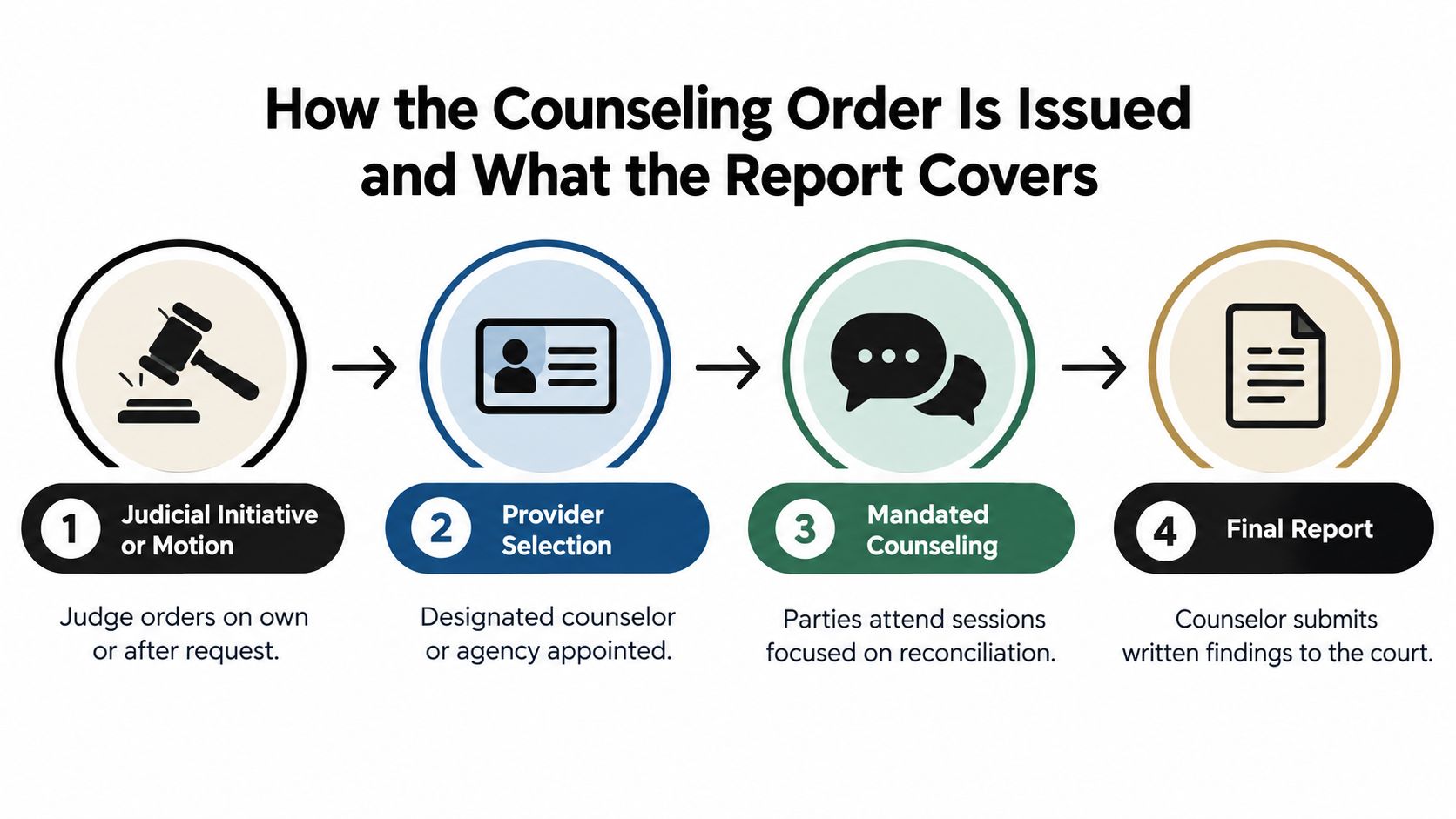
How the Counseling Order Is Issued and What the Report Covers
A § 6.505 order usually becomes important because it is written. Read the document carefully rather than relying on what someone said in the courtroom.
The usual sequence
First, the judge issues or signs an order. The court may act on its own initiative or after a party requests counseling. The order may be entered at a temporary orders hearing or after the case has been filed and brought to the judge's attention.
Next, the provider is identified. The order may name a particular counselor, a court-approved provider, or a method for selecting one. It should identify who must attend and any deadlines or scheduling requirements.
Then, the parties attend. The sessions are meant to address reconciliation and, when the statutory child-related condition applies, issues affecting the child in the parent-child relationship. You should not treat the appointment as a casual conversation. Follow the order and keep records of attendance.
Finally, the counselor prepares a written report. The statute limits the report to whether reconciliation is reasonably possible and whether more counseling would help. The report must be provided before the final hearing.
Practical rule: Read the order's exact wording before discussing payment, scheduling, attendance, or objections with the provider.
The statute doesn't establish one universal fee arrangement. The order may assign responsibility, divide the expense, or leave payment to be resolved between the parties. Ask for written clarification before missing an appointment because you're unsure who pays.
A report isn't a custody evaluation or a property inventory. It shouldn't become a detailed narrative about every marital disagreement. If your case also involves specialized custody evidence, psychological evaluations and counseling under § 6.505 should be kept conceptually separate. This article on how parent psychological evaluations impact custody decisions in Texas addresses a different type of evidence.
Complying With the Order Versus Contesting It
A written counseling order is a court directive. If you plan to comply, contact the named counselor promptly, confirm the appointment requirements, and ask how attendance and payment will be documented. If you believe the order is improper, don't ignore it. Discuss a written objection or motion with a Texas family-law attorney and identify the actual deadline in your case.
The statute itself provides a limited counseling framework, but the objection period may depend on the order, service, local practice, and the procedural posture. The often-cited objection windows in family cases aren't a substitute for reading your specific order. A court may also require you to continue complying unless it changes or vacates the order.
| Factor | Complying | Contesting |
|---|---|---|
| Immediate action | Contact the counselor and attend as ordered | Review deadlines and prepare a written filing |
| Cost | Pay as assigned by the order or agreed by the parties | Incur legal and filing costs while seeking relief |
| Court relationship | Shows attention to a signed directive | Requires a focused legal basis, not general frustration |
| Divorce timing | May allow the case to move forward without a compliance dispute | May create another hearing or delay |
| Risk | Emotional difficulty and expense | Risk of denial if the objection lacks evidence |
| Evidence | Keep proof of attendance and communications | Gather records supporting safety, religious, cost, or procedural concerns |
Family violence requires special attention. If you're worried about safety, tell your attorney immediately and preserve protective-order records, police reports, medical records, or other reliable documentation. Do not place yourself in danger to appear cooperative.
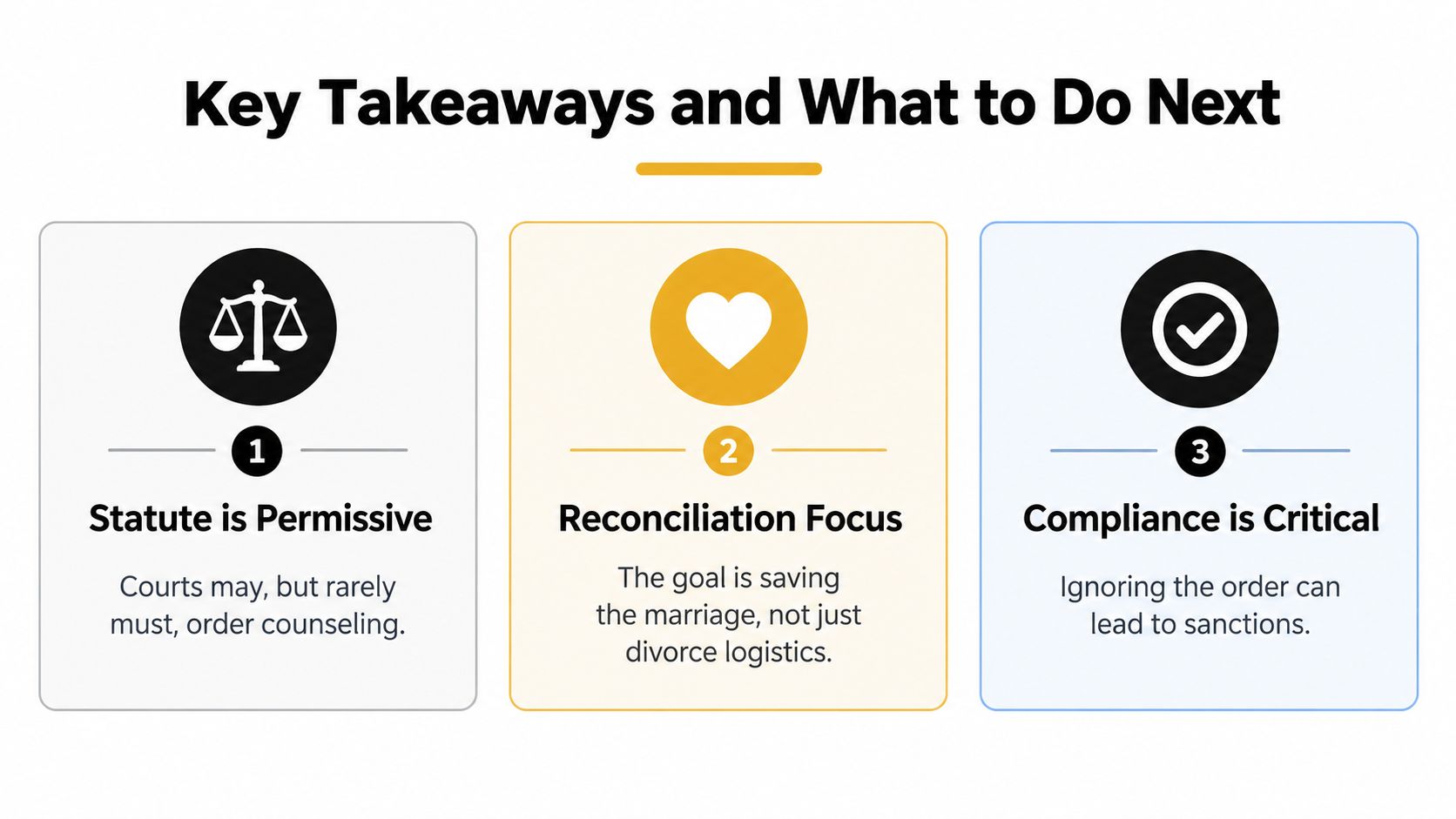
A failure to attend can create a separate court problem. Depending on the facts and the order, willful noncompliance may lead to sanctions or contempt proceedings. It can also affect how the judge views your reliability in related family matters. If the dispute involves an existing order, review the firm's information on a motion to enforce.
Common Objections and Defenses That Hold Up
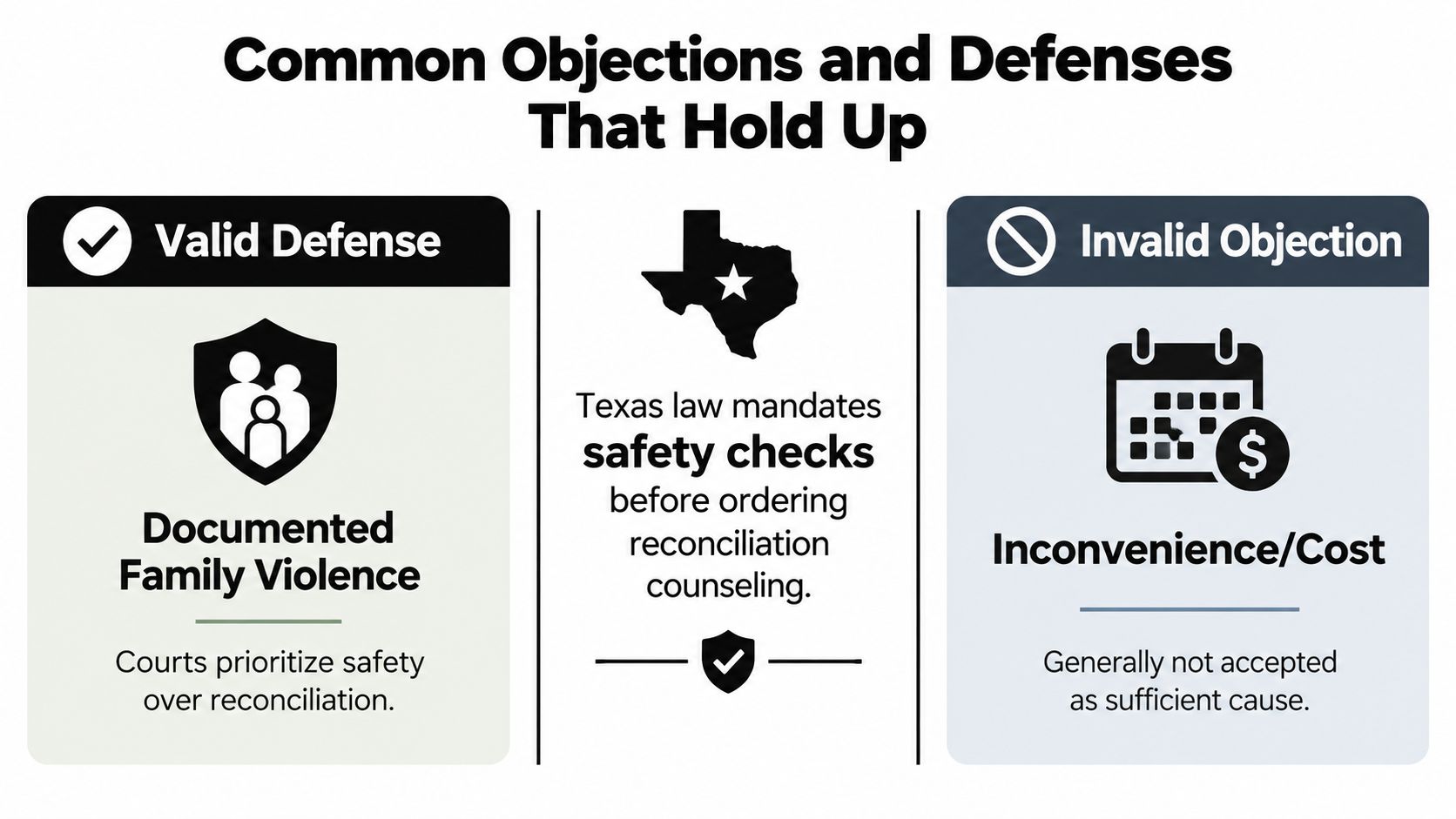
The strongest objection usually connects the facts to the statute's limited purpose. If reconciliation counseling would place someone at risk, undermine a protective arrangement, or ignore documented abuse, the court has a concrete reason to reconsider the order. General anger about the divorce is different from evidence that the counseling process is unsafe or legally inappropriate.
Objections that deserve careful development
- Documented family violence: Safety concerns can directly conflict with a reconciliation-focused process. Provide concrete records and explain the risk rather than relying only on a general allegation.
- A sincere religious objection: A genuine belief may deserve consideration, but you'll need credible support. The court may consider a narrower arrangement instead of granting a complete exemption.
- Prior counseling for the same marriage: If you already completed meaningful reconciliation counseling, records may show that the statutory purpose has already been addressed.
- Cost or logistics: Work schedules, distance, transportation, disability, and childcare can support a request for a different provider, remote attendance, or a narrower schedule. These concerns may change the order without eliminating counseling.
A spouse who says, “I don't like counseling,” has a weaker position. So does an objection based only on blame, resentment, or the claim that the other spouse is unreasonable. Those arguments may explain your feelings, but they don't show why the court's limited statutory purpose can't be served.
A persuasive objection gives the judge a workable alternative. It may request a safer provider, separate sessions, a different schedule, or no counseling because documented circumstances make reconciliation counseling inappropriate.
You should also distinguish between objecting to the order and objecting to how the counselor is handling the process. Those are separate issues. Preserve emails, appointment notices, payment demands, and attendance records, then present the concern through the proper legal channel.
Step-by-Step Roadmap and Sample Order Language
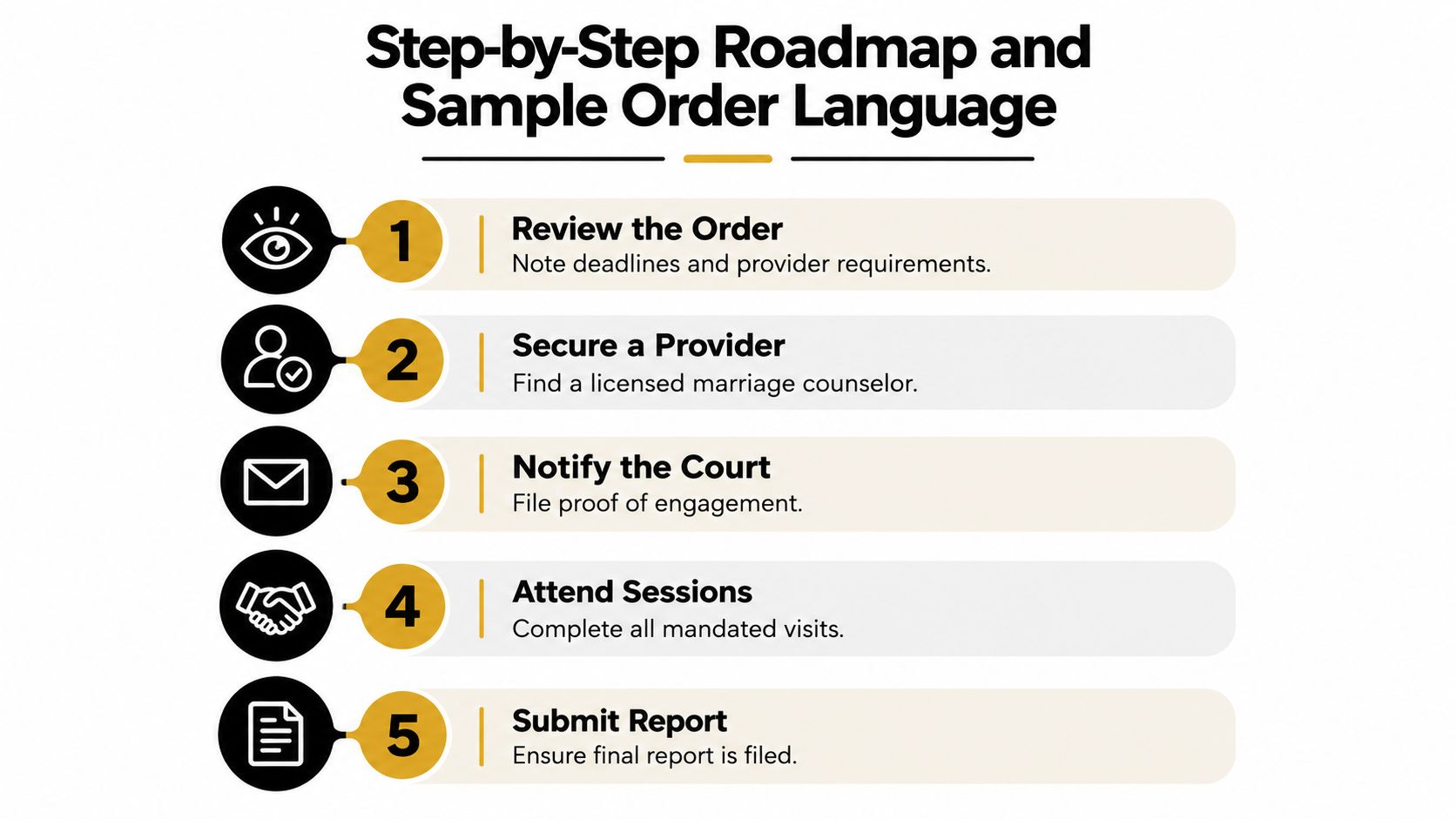
Start with the order itself. Identify the case number, the named counselor, the required participants, the expected schedule, the payment provision, and every filing or attendance deadline. Don't assume that a phone call with the counselor changes a court deadline.
If you intend to comply
- Contact the designated provider promptly. Confirm availability, location, format, payment expectations, and cancellation rules.
- Keep a written record. Save appointment confirmations, receipts, attendance notices, and communications with the counselor.
- Prepare a focused history. Bring the information your attorney recommends, including relevant marriage, parenting, and prior counseling records. Don't use the session to make unsupported accusations.
- Attend every required session. If an emergency prevents attendance, notify the counselor and your attorney immediately.
- Ask about the report process. Your attorney can help you understand what the counselor may submit and whether a copy will be available before the final hearing.
A sample order might state:
IT IS ORDERED that the parties attend counseling with the counselor designated by the Court while this divorce remains pending, and that the counselor provide a written report before the final hearing as permitted by Texas Family Code § 6.505.
That language is only an example. The wording in your signed order controls.
If you intend to contest
Calendar the objection deadline as soon as you receive the order. Your filing should identify the requested relief, explain the statutory or constitutional basis, and attach supporting evidence such as affidavits, protective-order records, prior counseling records, or documentation of a serious access barrier.
A redacted example could read:
Respondent objects to the counseling order because documented family violence creates a safety concern inconsistent with reconciliation-focused counseling. Respondent requests that the Court vacate the order or modify it to protect the parties and the child.
Bring organized records to your attorney, including marriage documents, pay information, prior counseling records, and relevant parenting or safety documents. Business owners and people with significant estates should also identify financial records early because counseling doesn't resolve valuation, tracing, characterization, or division disputes.
Key Takeaways and What to Do Next
Section 6.505 is narrow but important. The court may order counseling, but the statute doesn't make counseling automatic. The court's authority is discretionary, and the stated purpose is to evaluate whether reconciliation is reasonably possible, not to punish you or force you to abandon a valid divorce case.
The counselor's report has a defined role. It should address reconciliation and whether more counseling could help, with child-related issues included when the statutory condition applies. You should still treat every session seriously because your attendance, communications, and response to the order can affect how the court views your cooperation in the broader case.
Keep these points in front of you:
- The order is a legal document. Follow its instructions unless the court changes them.
- The objection window can be short. Confirm the deadline from the order and service records instead of guessing.
- Safety comes first. Tell your lawyer about family violence or coercive control before attending joint counseling.
- Counseling doesn't decide the whole divorce. Property division, custody, support, and enforcement require their own legal analysis.
- Your records matter. Save attendance proof, payment communications, reports, and notices.
Your next steps are practical. Calendar every deadline, gather your financial and marital documents, and schedule a confidential consultation before you respond to or comply with the order. You don't have to face a counseling directive, custody concerns, business interests, or high-value property division without guidance.
The Law Office of Bryan Fagan, PLLC offers Texas family-law guidance for divorce, custody, mediation, support, property division, and enforcement disputes. Schedule a free consultation so you can understand your § 6.505 order, protect your rights, and choose a careful response based on your family's circumstances.