Skip to content
That notice of hearing can make your stomach drop. One minute your divorce feels like paperwork, and the next it feels like a courtroom, a judge, and decisions that affect your kids, your home, and your paycheck.
If you're asking what happens at a temporary orders hearing in Texas divorce cases, the short answer is this: the court creates a workable set of rules for daily life while the case is still pending. This isn't the final divorce trial. It's the first major point where a judge may decide who stays in the house, how parenting time will work, who pays which bills, and what support should be paid until the case is finished.
It's understandable to feel anxious because you don't know what to expect. That's normal. The good news is that this hearing follows a recognizable pattern, and once you understand that pattern, the process becomes much less mysterious.
Your First Court Date An Introduction to Temporary Orders Hearings
For many people, the hearing notice is the moment the divorce becomes real. You may be wondering whether this is the day the judge ends your marriage, decides everything permanently, or expects you to know courtroom rules you've never seen before. Usually, it isn't any of those things.
A temporary orders hearing is an early court hearing in a Texas divorce or custody case. The purpose is practical. The judge puts short-term rules in place so your family can function while the larger case moves forward.
Think about a common example. A couple separates, one spouse moves out, the kids are confused, the mortgage is due, one car is titled in only one name, and both people are worried the other will drain an account or stop paying bills. The court can't wait until the final decree to address those immediate issues. Temporary orders are how Texas courts bring structure to a chaotic moment.
Texas Law Help explains that a Temporary Restraining Order can last 14 days or until the temporary orders hearing, whichever is sooner, and then the judge hears from both parties before issuing temporary orders that stay in place until final judgment or modification, according to Texas Law Help's explanation of temporary orders and TROs.
Why this hearing feels bigger than it sounds
The word "temporary" sometimes misleads people. It sounds minor. It isn't.
These orders often shape your everyday life for a long stretch of the case. They can affect your parenting routine, your monthly budget, where you sleep, and how you communicate with the other side. If you have children, they may also create the first court-ordered schedule everyone is expected to follow.
Practical rule: Treat a temporary orders hearing like it matters, because it does.
What the hearing is not
It helps to clear up a few common misunderstandings:
- It isn't the final divorce trial. The judge usually isn't dividing everything forever at this stage.
- It isn't just lawyers talking. Your testimony and documents may matter a great deal.
- It isn't only about conflict. Many hearings are about creating stability, not punishing one spouse.
If you're preparing well, speaking clearly, and focusing on facts rather than emotion, you're already doing what the court needs to see.
Why Temporary Orders Hearings Are a Critical First Step
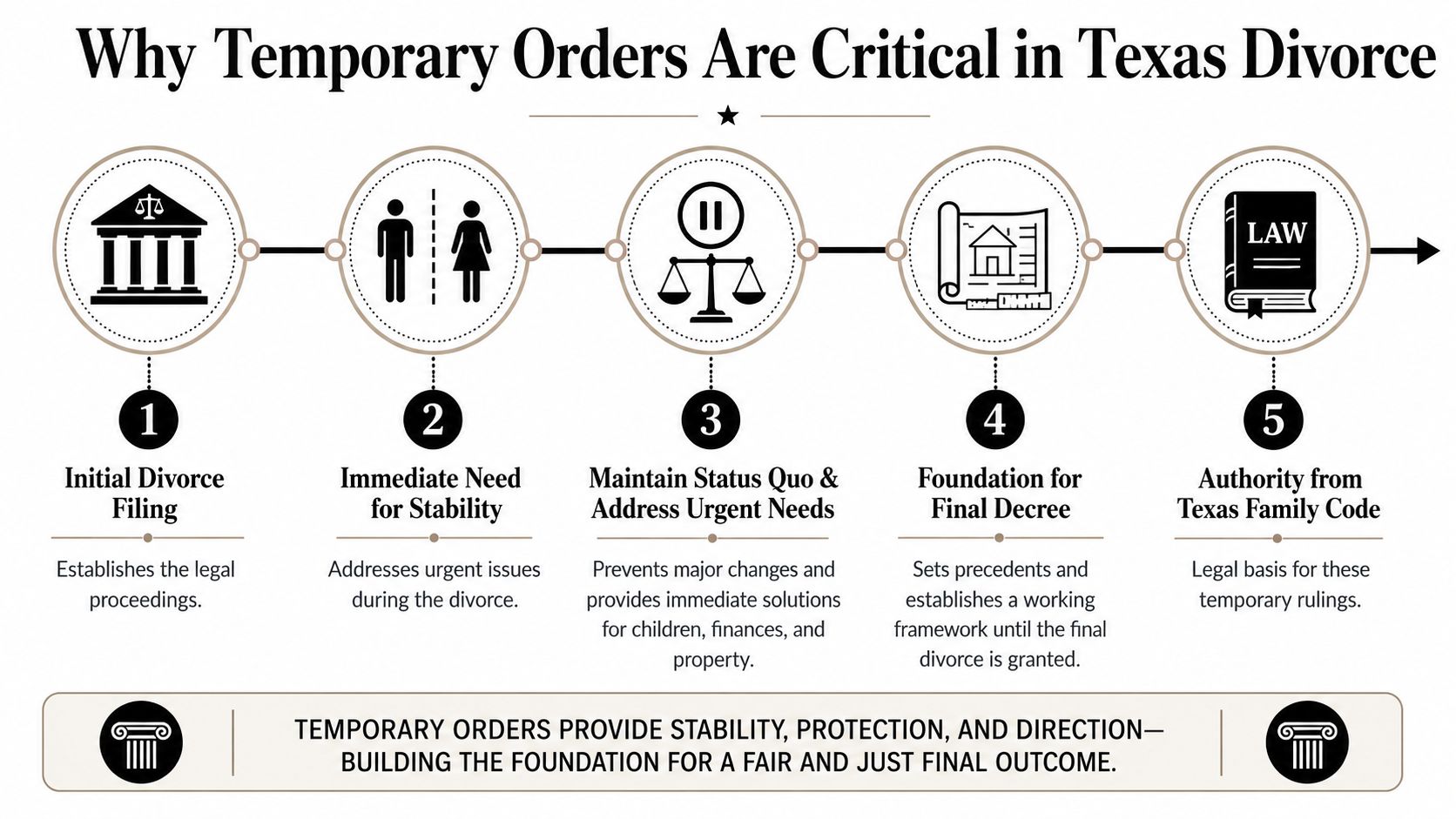
A divorce case doesn't pause your real life. Rent is still due. Children still need a weekday routine. Someone has to carry insurance, make car payments, and pick up from school. Temporary orders exist because families need answers before the final decree is ready.
The court is building a bridge
The easiest way to understand temporary orders is to think of them as a bridge. On one side is the filing of the case. On the other side is the final decree. In the middle is a stretch of uncertainty that can last much longer than anyone wants.
Temporary orders help you cross that stretch safely.
Texas uses this process as an early, expedited proceeding. Texas Law Help notes that a TRO often lasts only 14 days or until the hearing, whichever is sooner, and the judge then issues temporary orders on matters such as custody, support, and property use that remain in effect until final judgment. You can read more in this Texas overview of temporary restraining orders in divorce cases.
What the judge is trying to protect
Judges handling temporary orders are usually looking for a practical arrangement that keeps life steady and protects children. In plain English, that often means preserving the status quo where possible and fixing urgent problems where needed.
A judge may be asking questions like these:
- For the children: Who has been taking them to school, helping with homework, and handling doctor visits?
- For the finances: Which bills must be paid right away to avoid harm?
- For the household: Who needs use of the home or a vehicle to keep work and parenting on track?
- For the process: Are there safety concerns, spending concerns, or communication problems that need immediate boundaries?
Why this stage can shape the rest of the case
Temporary orders don't usually decide the entire divorce forever, but they can influence momentum. Once a parenting schedule or financial arrangement is working, courts are often reluctant to disrupt children without a good reason. That doesn't mean early rulings are impossible to change. It means your first hearing matters because it creates a lived routine.
Stability is persuasive in family court. If a temporary arrangement protects the children and works in daily life, that arrangement can become an important reference point later.
For business owners and people with substantial assets, temporary orders can also protect operations and prevent short-term financial damage. The court may need to decide who manages certain accounts, who pays ongoing obligations, or how to avoid disruption to a family business while the case proceeds.
What a Judge Can Decide at Your Hearing
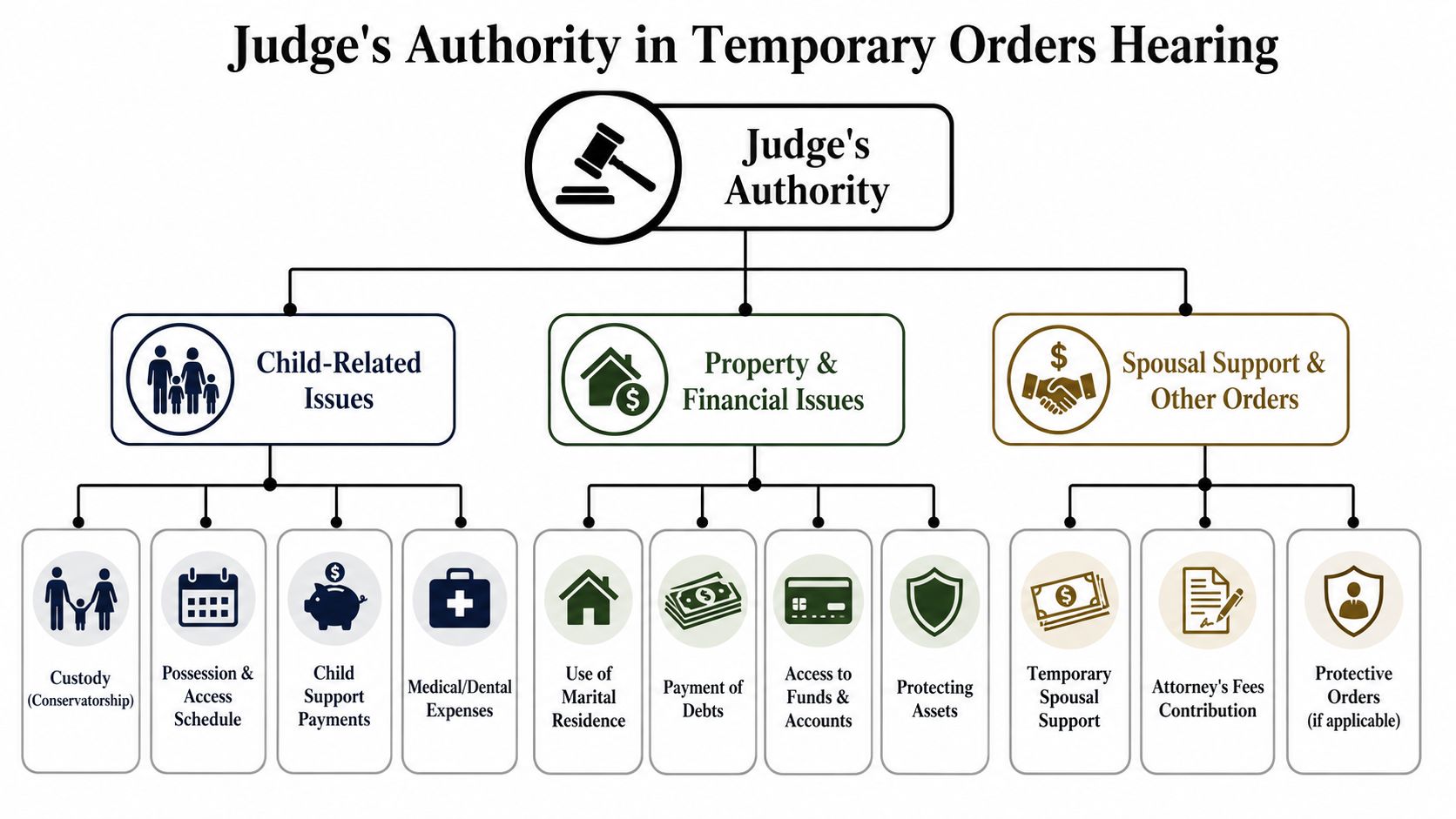
At a temporary orders hearing, the judge has broad authority to address the issues that can't wait. The court isn't trying to resolve every last detail of the divorce. The court is deciding how life will function starting now.
Child-related decisions
If you and your spouse have children, this is usually the most emotional part of the hearing.
The judge can make temporary rulings about where the children primarily live, when each parent has possession, and how exchanges happen. In Texas family law, you'll often hear terms like conservatorship, possession, and access. In plain language, that means decision-making rights and the parenting schedule.
The court can also address support for the children, including regular child support and responsibility for medical or dental needs. If you're dealing with an urgent parenting issue and want a broader comparison of how emergency custody concepts work in another state, this discussion of Florida emergency custody orders can help you see how courts generally separate immediate child-safety concerns from longer-term custody decisions.
If your case centers on parenting time, this guide to temporary custody during a Texas divorce can help you understand what courts look for in day-to-day caretaking arrangements.
Property and household use
A lot of people are surprised that temporary orders can cover property use before the divorce is final.
That may include who stays in the marital residence, who uses a vehicle, who has access to certain funds for ordinary living expenses, and who must avoid selling, hiding, or misusing property while the case is pending. The point isn't to award everything permanently. The point is to keep the situation from getting worse.
For example, if the children have been living in the family home and one parent has been their main day-to-day caregiver, a judge may decide that parent should have temporary use of the home so school and routines continue with less disruption.
Bills, debts, and support between spouses
A temporary orders hearing can also address immediate financial responsibilities between the adults.
That may include:
- Household bills: Mortgage, rent, utilities, insurance, and minimum debt payments
- Vehicle costs: Car note, fuel, insurance, and basic transportation needs
- Temporary spousal support: Short-term support when one spouse needs help meeting reasonable living expenses during the case
- Attorney's fees: In some cases, one party may request temporary help paying fees so both sides can participate fairly
When safety is part of the case
Some temporary hearings also involve requests tied to harassment, intimidation, or family violence concerns. If safety is an issue, tell your lawyer immediately. The right request and the right evidence matter.
The judge isn't grading who is more upset. The judge is deciding what order is supported by credible facts and what arrangement protects children, property, and immediate stability.
Inside the Courtroom A Step-by-Step Walkthrough
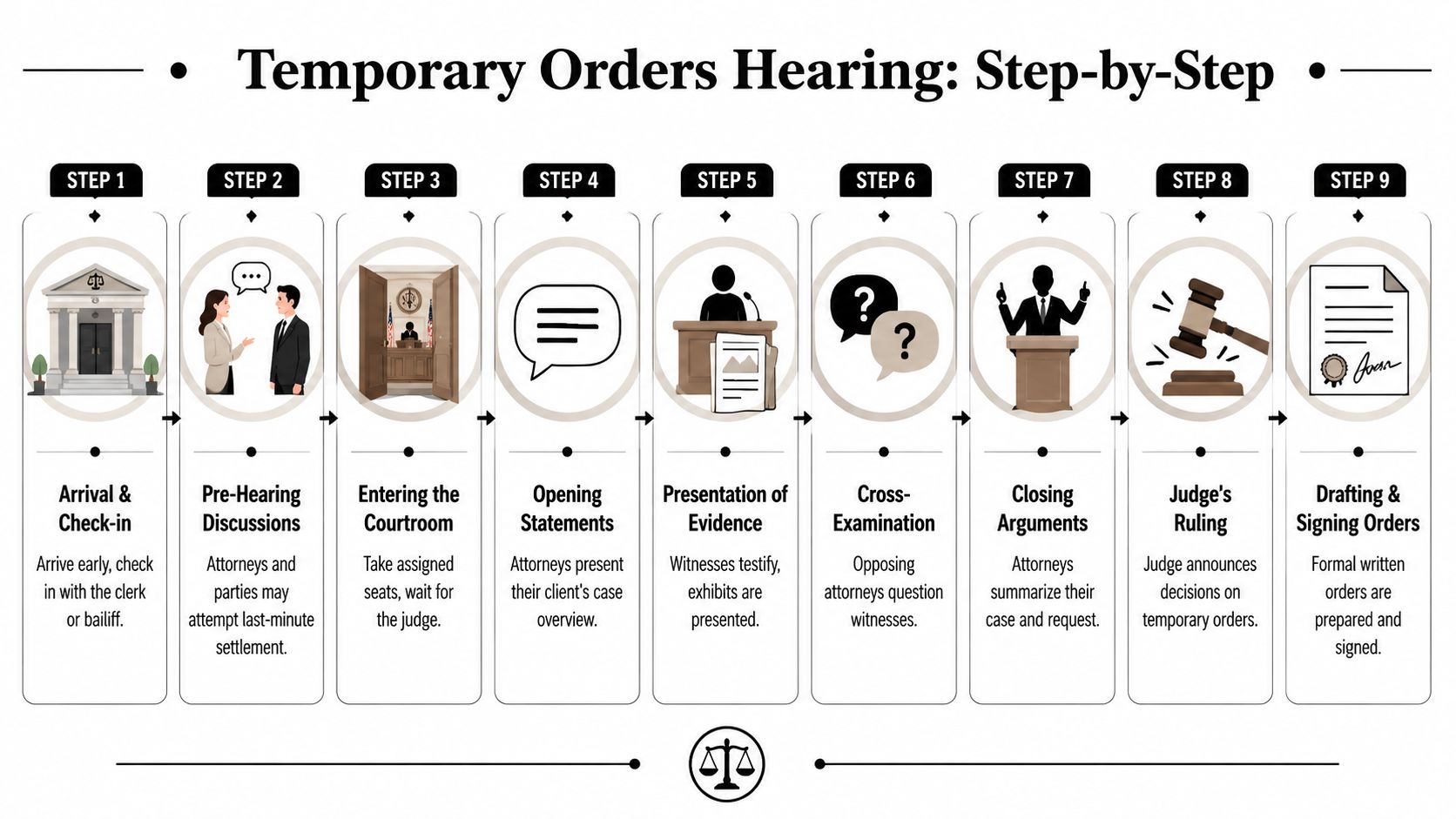
Walking into court is easier when you know the sequence. Most temporary orders hearings follow a basic structure, even though each court has its own style.
A helpful overview is below.
Before the judge takes the bench
You, your spouse, the lawyers, the judge's staff, and often a bailiff will be involved. A court reporter may also be present. That matters because this kind of hearing is often transcribed, and that record can matter later if someone changes their story at trial.
You should expect to arrive early, go through security, check in, and wait. In many cases, the attorneys will still talk before the hearing starts to see whether any issues can be agreed upon.
Later in the section, watch this short video for a visual explanation of the process.
How the evidence comes in
A temporary orders hearing is usually an evidentiary proceeding. That means the judge decides based on testimony, exhibits, and witness questioning, not just lawyer speeches.
A typical flow looks like this:
- The case is called. Everyone identifies themselves for the record.
- One side presents first. Usually the party asking for relief starts.
- Witness testimony begins. That may include you.
- Documents are offered. Financial records, calendars, messages, or other relevant exhibits may be admitted.
- Cross-examination happens. The other lawyer gets to ask questions.
- The other side presents its evidence.
- Lawyers summarize the requests.
- The judge rules or takes the matter under advisement.
What your testimony feels like
When you're on the stand, your lawyer will ask questions first. This is your chance to explain the facts clearly. Focus on concrete details. Who takes the children to school. Which bills are due. Why a schedule works. What expenses you pay.
Then the other lawyer may cross-examine you. That often feels more stressful because the questions may be short, leading, and designed to expose inconsistency. Stay calm. Listen carefully. Answer only the question asked.
Answer with facts, not speeches. Judges often trust the witness who stays measured under pressure.
Why time pressure changes everything
Some Texas courts move these hearings quickly. One Harris County family-law source reports that some courts set two-hour limits for temporary orders hearings, giving each side roughly one hour to present its case, as described by this discussion of Texas temporary orders hearing time limits.
That limited time affects strategy. Your lawyer can't present every frustration from the marriage. The hearing has to stay focused on the issues the judge must decide now. The strongest cases usually rely on organized proof, a clear parenting plan, and testimony that sounds real rather than rehearsed.
What the judge is really watching
The judge is watching more than your words. The court notices whether you interrupt, whether your story matches your documents, whether your proposed schedule makes practical sense, and whether you seem child-focused or grievance-focused.
If you have children, the judge often wants to know which parent is offering stability, consistency, and a workable routine. If finances are disputed, the judge wants to see records, not vague accusations.
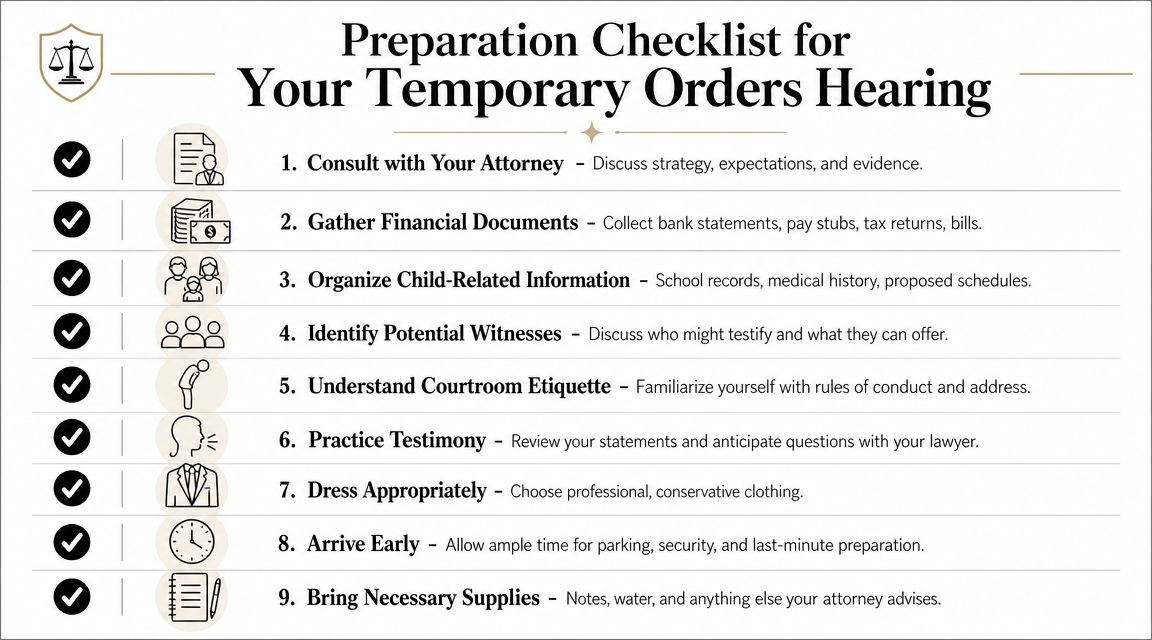
How to Prepare for Your Temporary Orders Hearing
Preparation wins more temporary hearings than emotion does. If you show up with organized facts, a realistic plan, and documents that match your testimony, you give the judge something usable.
Build your evidence file
Because this is an evidentiary hearing, proof matters. A Texas temporary orders hearing is decided through live testimony, cross-examination, and admitted exhibits, and a court reporter often transcribes the hearing, which makes witness consistency and document quality important, as explained in this discussion of evidentiary temporary orders hearings in Texas.
Start with the basics:
- Income records: Recent pay stubs, tax returns, proof of self-employment income, and any documents showing bonuses or irregular earnings
- Banking information: Bank statements, account summaries, and records showing automatic payments
- Monthly obligations: Mortgage or rent, utilities, insurance, child-related expenses, debt payments, and medical costs
- Parenting proof: School schedules, medical appointment records, activity calendars, and notes showing who handles daily care
- Communications: Only if relevant and admissible. Save messages that show scheduling, threats, agreement, or refusal to cooperate
If you're a business owner, gather the records that show what the business must pay to keep operating and what you draw for personal use. If you have a high-value estate, identify what must be preserved immediately and what spending patterns need explanation.
Prepare your request, not just your complaint
Judges need a proposal. They don't just need to hear what has gone wrong.
You should be ready to state:
- Where the children should stay
- What possession schedule you want
- Who should pay specific bills
- Who should stay in the house or use a vehicle
- Whether temporary support is needed
- What temporary restrictions should apply to money or property
A good proposal is detailed enough to work on Monday morning, not just broad enough to sound fair.
Practice how you speak
Your testimony should sound clear, grounded, and specific. It should not sound like a closing argument.
Use this approach:
| Focus | Better answer | Weaker answer |
|---|---|---|
| Parenting | "I take our daughter to school, handle speech therapy appointments, and help with homework." | "I'm the better parent." |
| Bills | "I pay the mortgage, electric bill, and health insurance from my checking account." | "I pay for everything." |
| Schedule | "This exchange time works because of my work schedule and the children's school routine." | "This is what I want." |
For a practical planning guide before any divorce court appearance, review how to prepare for divorce court in Texas step by step.
Don't overlook presentation and logistics
Small things affect how calm and credible you appear.
- Dress conservatively: Court isn't the place for casual or flashy choices.
- Arrive early: Give yourself time for parking, security, and a final conversation with counsel.
- Bring your materials: Keep your documents neat and easy to find.
- Stay off social media: Assume anything you post could become part of the conflict.
- Follow your lawyer's outline: If you're represented, trust the hearing plan.
One practical option for people who want focused help with this stage is a temporary orders attorney service, such as the one offered by Law Office of Bryan Fagan, PLLC, which assists Texas clients with preparing evidence, hearing strategy, and proposed temporary relief.
Common Outcomes and What Happens Next
When the hearing ends, many clients expect immediate closure. What usually comes instead is a new set of temporary rules and the next phase of the case.
The ruling
Sometimes the judge rules from the bench that day. The judge may state who has temporary possession of the children, who pays certain bills, whether support is ordered, and who gets use of the home or vehicles.
Other times, the judge takes the matter under advisement and issues a ruling later. After that, someone must draft the written temporary orders for review and signature. The written order is what controls, so you need to read it carefully and make sure it matches the ruling.
How long temporary orders last
Temporary orders usually remain in effect until the divorce is finalized or the court changes them. That means you should treat them as binding instructions, not suggestions. If something becomes unworkable, the answer is to address it through the legal process, not ignore it.
This part of the case often teaches an important lesson. The temporary hearing may feel like a crisis point, but it's also the beginning of the roadmap.
The case keeps moving
After temporary orders, most contested divorces continue through several familiar stages:
- Discovery: Formal exchange of information and documents
- Negotiation: Lawyers and parties try to narrow disputes
- Mediation: Many Texas courts expect or require serious settlement efforts before trial
- Final trial or settlement: The case ends in a signed Final Decree of Divorce
If you want a broader perspective on thinking ahead rather than reacting emotionally, this article on legal strategy in divorce cases offers a useful reminder that good results often come from preparation, discipline, and timing.
Temporary orders don't finish your case. They set the conditions under which the rest of the case will be fought, negotiated, or resolved.
For parents, the period after the hearing is especially important. Follow the order. Keep records. Show up on time. Communicate carefully. A parent who consistently follows the temporary plan often strengthens their credibility for mediation and trial.
Take Control of Your Case Today
A temporary orders hearing can feel intimidating, but it becomes manageable when you know what the court is deciding and how to prepare. The judge is looking for credible facts, workable solutions, and a plan that protects children and stabilizes finances while the divorce is pending.
If you're heading into this hearing, focus on what you can control. Gather your records. Think through a realistic parenting plan. Understand your budget. Practice telling the truth clearly and calmly. Don't walk into court expecting the judge to sort through chaos without help. Give the court organized proof and a practical proposal.
This is especially important if your case involves children, a family business, separate property claims, significant debt, or a spouse who isn't likely to cooperate. Early orders can shape the tone of the entire divorce.
You don't have to guess your way through it. Clear legal advice before this hearing can change how prepared and confident you feel when your case is called.
If you're facing a temporary orders hearing, schedule a free consultation with Law Office of Bryan Fagan, PLLC. You can talk through your facts, your concerns, and the immediate steps that may help protect your children, your finances, and your position in the case.