Skip to content
You may be lying awake wondering whether your spouse is about to outmaneuver you on money, the house, or the kids.
Take a breath. A contested divorce in Texas isn't won by panic, outrage, or one dramatic day in court. It's won by making the right decisions early, backing them with proof, and refusing to let emotion drive strategy.
Redefining Winning in a Texas Divorce
Many individuals walk into divorce thinking “winning” means punishing the other side. That mindset costs people cases.
In real life, winning means protecting your children, your finances, your credibility, and your advantage. If you keep those four goals in view, your decisions get better fast. If you chase emotional revenge, you usually hand the other side openings they didn't earn.
Texas gives you a very specific set of rules to work within. A spouse generally must have lived in Texas for at least 6 months and in the filing county for at least 90 days before filing, Texas recognizes 7 divorce grounds including 1 no-fault ground, insupportability, and 6 fault-based grounds, and Texas is a community-property state rather than an equitable-distribution state, as explained by Texas Law Help's divorce guide. Those aren't technical side notes. They are the rules that shape your entire case.

Start with the rules, not the emotions
If you file in the wrong place, your strategy can stall before it starts. If you don't understand how community property works, you can make bad assumptions about what is yours, what is marital, and what needs proof. If you throw out fault allegations without evidence, you weaken your credibility.
That's why I tell clients to stop asking, “How do I make the judge see I'm right?” and start asking, “What does the court need to decide?”
The court is deciding things like:
- Whether the case is properly filed: Residency and county requirements come first.
- How to divide marital property and debt: In Texas, characterization matters. You need to know what is community property and what may be separate property.
- Whether fault matters strategically: Allegations like adultery or cruelty can affect negotiations and can matter in disputes over property, support, or overall settlement posture.
Practical rule: A strong case starts with facts you can prove, not feelings you can explain.
No-fault or fault is a strategy choice
Many people assume filing on no-fault means evidence doesn't matter. That's wrong. Evidence still matters because courts and opposing counsel look at conduct, finances, parenting history, and credibility throughout the case.
Fault grounds can matter, but they aren't a free weapon. If you raise adultery, cruelty, or another fault ground, you need proof and a reason for using it. Otherwise, you've just added conflict without gaining an advantage.
Here's the cleaner way to understand it:
| Issue | Bad approach | Strong approach |
|---|---|---|
| Filing | Rush to file without checking residency | Confirm jurisdiction and venue first |
| Property | Assume everything is “mine” or “theirs” | Identify what needs characterization and documentation |
| Fault allegations | Use them to vent anger | Use them only if they support a concrete legal objective |
A lot of spouses also waste time obsessing over whether they'll “settle or fight.” That's the wrong first question. The right question is what puts you in the strongest position. If you're weighing that choice, this discussion of whether you should settle or go to trial in a Texas divorce is worth reading.
What winning actually looks like
Winning may mean keeping a stable parenting schedule in place. It may mean forcing full financial disclosure. It may mean protecting your separate-property claim. It may mean preventing your spouse from controlling all the cash while the case drags on.
That's real power. That's what matters.
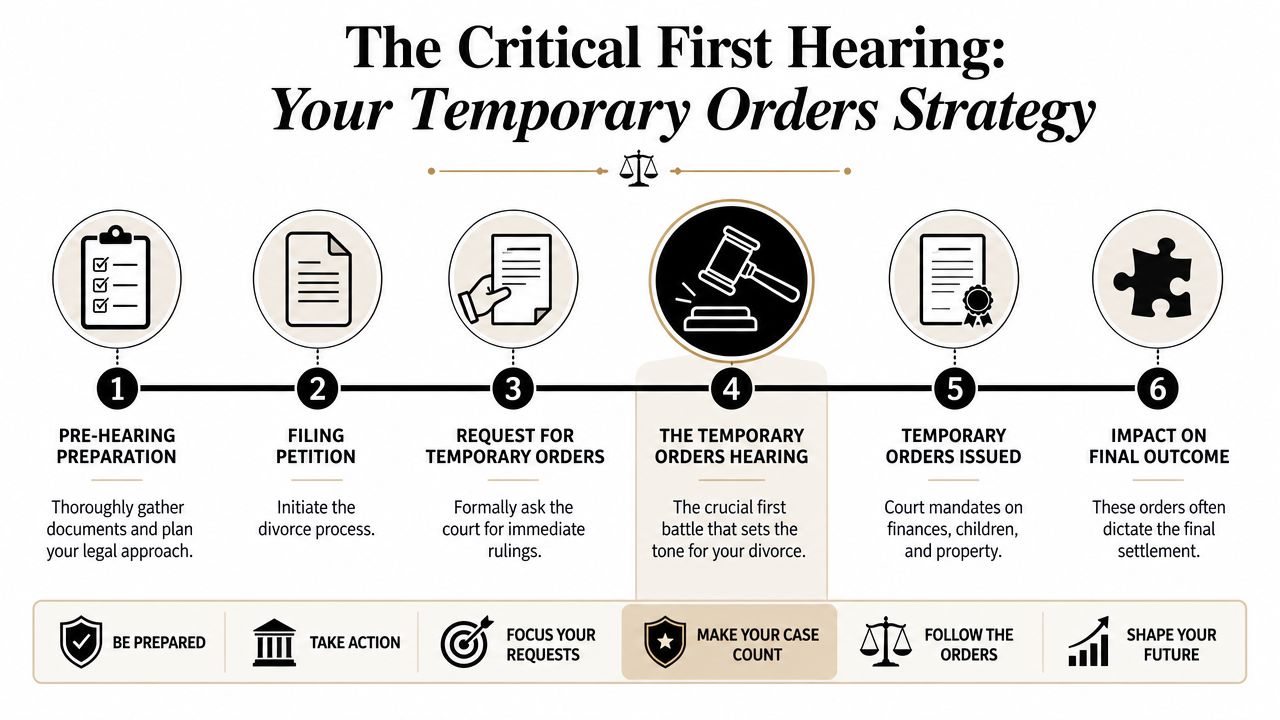
The Critical First Hearing and Your Temporary Orders Strategy
The most important fight in many contested divorces isn't the final trial. It's the hearing that happens much earlier, when the court decides how life will work while the case is pending.
That's where temporary orders come in. In practice, these orders can determine who stays in the home, who pays ongoing bills, and who controls access to the children while the case is pending. As discussed in this review of the steps in a contested Texas divorce, winning often comes less from trial theatrics and more from advantage gained from temporary relief, documentation, and mediation pressure.
Why temporary orders carry so much weight
Temporary doesn't mean unimportant. Temporary orders often create the day-to-day reality that everyone gets used to. Judges notice what has been working. Mediators work from the current status quo. Opposing counsel uses it as a pressure point.
If your spouse gets temporary control of the house, the accounts, and the children's routine, you may spend the rest of the case trying to claw back ground you should have protected from the start.
That's why I push clients to prepare for temporary orders with the same seriousness they would bring to trial.
What the court may address early
A temporary orders hearing can shape major issues fast. The court may decide interim arrangements involving:
- Children: Where they stay, when each parent has possession, and how day-to-day contact works.
- Money: Who pays which bills, whether support is paid, and who has access to funds during the case.
- Property use: Who remains in the residence and how key property is managed while the divorce is pending.
Temporary orders don't just manage the waiting period. They often shape bargaining power for everything that follows.
How to prepare for the hearing
You need evidence that is organized, relevant, and easy to understand. The judge does not need your life story. The judge needs a clear reason to enter orders that create stability.
Bring structure to your preparation:
- Build a timeline: Important dates, separation events, child-care patterns, account access problems, and any urgent changes.
- Collect financial proof: Bank statements, pay records, recurring bills, mortgage or rent information, and evidence of unusual spending if that is an issue.
- Document parenting facts: School involvement, doctor visits, transportation, meals, homework, bedtime, and who has been doing the work.
- Clean up your communications: If your texts and emails are hostile, sarcastic, or chaotic, you're damaging your own case.
A spouse who sounds reasonable usually beats a spouse who sounds furious.
The mistake I see most often
People wait too long. They assume things will calm down, or they think asking for temporary relief looks aggressive. It doesn't. It looks prepared.
If the other side is controlling money, limiting access to the children, withholding records, or trying to lock in a one-sided routine, you need to act. Waiting often gives that behavior time to harden into the new normal.
If you need a practical look at what this hearing involves, review this guide to a temporary orders hearing in a Texas divorce.
Gathering Ammunition Through Discovery and Evidence
A contested divorce turns on proof. Not suspicion. Not assumptions. Proof.
Texas courts decide disputes over custody, property division, and support, and the strongest evidentiary approach is to focus on those issues using early document collection, communication logs, and witness testimony. If a parent can't document day-to-day caregiving, school involvement, and medical participation, the court may have less concrete proof to support that parent's requested custody schedule, as noted by Justice Law Firm's discussion of contested divorce evidence.

Formal discovery gets records you don't already have
Discovery is how you force disclosure through the legal process. If your spouse controls the money, the business records, or the account access, discovery matters.
Common tools include:
- Requests for Production: Used to obtain documents such as statements, tax records, loan records, contracts, account records, and business materials.
- Interrogatories: Written questions that require formal answers.
- Depositions: Sworn testimony taken before trial, often used when a witness's story needs to be pinned down.
This part of the case isn't glamorous. It wins cases anyway.
Informal evidence can be just as important
You probably already have evidence that matters. You just haven't organized it.
Start building folders for:
- Texts and emails: Keep the messages that show parenting involvement, financial control, threats, admissions, or refusal to cooperate.
- Photos and calendars: Use them to show routines, school events, medical appointments, exchanges, and household responsibilities.
- Social media posts: Save only what is relevant. Courts care about conduct, spending, instability, or contradictions, not gossip.
Don't edit screenshots in ways that invite a fight over authenticity. Save them cleanly and keep originals.
Evidence test: If a document doesn't help prove custody, property, support, credibility, or compliance, it probably doesn't belong at the center of your case.
Parents need a parenting record, not a speech
If children are involved, keep a simple, factual parenting journal. Not a rant. A record.
Useful entries include school pickups, homework help, doctor visits, medication issues, extracurricular attendance, bedtime routines, and communication with teachers or providers. Short, consistent entries beat dramatic essays every time.
Here's a useful split:
| Evidence type | Why it matters |
|---|---|
| School and medical records | Shows real caregiving and follow-through |
| Communication logs | Shows tone, cooperation, and reliability |
| Financial documents | Supports property and support positions |
| Neutral witnesses | Adds credibility beyond your own testimony |
If you're a business owner or have a high-value estate, this gets more technical. You may need records that show when an asset was acquired, how it was funded, whether marital labor increased its value, and whether a reimbursement claim exists. That work has to start early because once records disappear, recreating them gets harder and more expensive.
For a closer look at the proof courts care about, review what evidence matters most in a Texas divorce case.
Strategic Negotiation and Mediation Tactics
You do not win a contested divorce at mediation by talking more than your spouse. You win by arriving with a clear plan, clean numbers, and enough trial readiness that the other side takes your position seriously.
Mediation is often where the case direction becomes clear. A weak early strategy produces rushed concessions here. A disciplined strategy from day one gives you bargaining power, because the other side can see what happens if they refuse a reasonable deal.
Texas divorces cannot be finalized immediately, and contested cases often drag on while fees, stress, and uncertainty keep building. That is one reason mediation matters, as explained in The Mendez Law Group's overview of contested versus uncontested divorce in Texas.

Preparation decides whether mediation works
Mediation is a business meeting about your future. The mediator does not award points for outrage, long speeches, or recycled marital history. Results come from preparation.
Show up able to prove your position on the issues that matter most:
- What you want
- Why it is reasonable under the facts
- What documents support it
- What you will ask the judge to do if settlement fails
That last point matters. Settlements happen when the other side believes you are organized enough to finish the case in court.
Put numbers and proof behind every demand
Vague positions get punished in mediation. Specific, documented positions get taken seriously.
A custody proposal should be tied to the child's routine, your caregiving history, school and medical involvement, and a parenting schedule that a judge could sign without rewriting it.
A property proposal should be tied to account statements, debt balances, tracing records, business records if needed, and proof of unusual spending or hidden transfers if those issues exist.
A support proposal should be tied to income records, recurring expenses, benefits, bonuses, self-employment records, and credibility. If your numbers shift every time someone asks a hard question, expect a bad mediation day.
If online conduct is part of the conflict, targeted digital research can help you spot leads worth preserving before they disappear. In that narrow context, PeopleFinder helps detect online infidelity and may help you identify online behavior to review with your lawyer.
Decide your settlement range before you walk in
Do not make major decisions in the room for the first time. That is how people agree to terms they regret.
Go into mediation with three categories already defined:
- Required outcomes
- Terms you can negotiate
- Lower-priority items you can exchange for better terms on custody, property, or support
This keeps you focused on long-term results instead of emotional skirmishes. It also prevents a common mistake in Texas divorce cases. Giving up something important early just to feel temporary relief.
This video gives more context on how divorce cases often resolve outside a final courtroom showdown:
Control yourself and you protect your position
Calm wins deals. Anger clouds judgment.
Your spouse may posture, insult you, or make an offer designed to provoke a reaction. Ignore the performance. Stay focused on terms, documents, and consequences. The spouse who stays disciplined usually makes better decisions, spots bad language in draft terms faster, and avoids giving away ground out of frustration.
You are not there to be understood. You are there to leave with an enforceable result that protects your children, your property, and your financial stability.
Preparing for Court and the Final Decree
If mediation doesn't resolve the case, the court will. At that point, your job is simple. Be organized, credible, and ready.
Trial isn't the place to invent a strategy. It's where your earlier strategy gets tested. The spouse who prepared all along usually looks composed. The spouse who delayed, hid records, or treated the case like a personal grudge match usually doesn't.
What the courtroom rewards
Judges value clarity. They want relevant testimony, usable exhibits, direct answers, and adults who can follow instructions.
That means you should:
- Dress conservatively: You want the court focused on your testimony, not your presentation.
- Answer the question asked: Don't argue with the lawyer and don't give speeches.
- Stay controlled: Eye-rolling, muttering, and courtroom theatrics hurt you.
The court is always assessing credibility. Your behavior while waiting for your turn matters almost as much as your answers on the stand.
How your case is presented
A contested divorce trial usually involves witness testimony, document exhibits, and argument from counsel about what orders the judge should sign.
Your lawyer will work to present your side in a way that is easy to follow. That means your documents should be organized before trial, your testimony should be practiced enough to be clear, and your requested outcome should be realistic and specific.
If children are involved, keep your testimony child-focused. If property is disputed, know what asset is at issue, why it matters, and what documents support your position. If support is contested, understand the financial records tied to that request.
The final decree is not a formality
Once the judge rules, the Final Decree of Divorce has to match those rulings. Read it carefully.
Make sure it accurately addresses property division, debt responsibility, conservatorship terms, possession schedules, support obligations, and any special provisions the court ordered. A vague or sloppy decree creates enforcement problems later.
Here's the practical point. You don't win because the hearing ends. You win when the signed orders protect what the court awarded.
What to Do Next A Strategic Action Plan
You don't need to solve your whole divorce this week. You do need to take control of the next move.
Start with the basics. Confirm filing eligibility. Gather financial records. Build a parenting timeline if children are involved. Save key communications. Stop sending emotional texts that can be used against you. If immediate issues exist over the house, money, or the children, ask whether temporary orders should be requested now instead of later.
Your next moves in the right order
Use this sequence:
- First, secure documents: Statements, tax returns, loan records, retirement information, business records, deeds, and insurance documents.
- Next, identify urgent risks: Restricted access to children, blocked accounts, disappearing money, missing records, or pressure to sign something quickly.
- Then, define your real goals: Stable parenting plan, fair property division, separate-property protection, support structure, or a workable settlement path.
That order matters. Strategy breaks down when people skip the document stage and jump straight into demands.
Don't let anxiety run the case
A contested divorce puts your nervous system on high alert. That's normal. But anxiety makes people overreact, freeze, or obsess over minor battles.
If that's happening, it may help to read about breaking the overthinking cycle. You still need legal action, not just emotional support, but clear thinking will help you make stronger decisions.
Bottom line: The spouse who acts early, stays organized, and keeps the case focused on provable facts usually holds the stronger position.
Key takeaway
If you want to know how to win a contested divorce in Texas, stop thinking about one final showdown. Think in stages.
Winning starts when you treat filing rules seriously. It gets stronger when you handle temporary orders aggressively and intelligently. It improves when you collect evidence that fits what Texas courts decide. It often pays off in mediation. And if trial becomes necessary, you walk in prepared instead of desperate.
You don't need more noise. You need a plan.
If you're facing a contested divorce, child custody dispute, or high-conflict property fight, Law Office of Bryan Fagan, PLLC offers free consultations to help you assess your options and build a strategy for your specific Texas case. You can speak with an attorney about temporary orders, mediation, support, property division, enforcement, and what steps to take now to protect your children, finances, and future.