Skip to content
When your marriage is ending and your bank account is already stretched, the question usually isn't abstract. It's immediate. How am I supposed to pay for this and still keep my life together?
Facing Divorce When Money is Tight
A lot of people who ask how to get a free divorce in Houston aren't looking for a shortcut. They're trying to solve a real problem. Rent is due. Kids need school clothes. You may be covering two households already, or you're worried your spouse controls the money and you can't access what you need to file.
That fear is valid.
In Harris County, there are real ways to reduce the cost of divorce, and in some situations, to eliminate court filing fees completely. But you need to go in with a clear head. "Free" can mean different things, and the difference matters. If you expect a free lawyer for every divorce case, you'll probably be disappointed. If you understand what the courts will waive, what you can do yourself, and where local help exists, you'll have a much better shot at getting through the process without costly mistakes.
I've seen people freeze because they assume divorce is impossible unless they can pay a lawyer upfront. That's often wrong. Some people can file on their own using court-approved forms. Some qualify for a fee waiver. Some can get help from legal aid. And if your finances are damaged from the marriage, it may also help to work on related issues like your ability to get mortgage-ready credit in Houston once the divorce is behind you.
You don't need to have everything figured out today. You do need to avoid waiting so long that a fixable problem gets worse.
What a Free Divorce Really Means in Houston
The phrase "free divorce" is often used loosely. That's the first mistake.
In Houston, a free divorce usually means you may be able to avoid paying the court filing fee. It usually does not mean a private attorney will handle your case at no charge from start to finish. Those are two very different things.

Court costs and attorney fees aren't the same
Receiving a free ticket to an event offers a parallel scenario. While you've cleared the front gate, you still face parking, transportation, and all other day-related elements. Divorce functions in much the same manner.
According to Houston legal aid and pro bono listings on Justia, over 60% of Texas divorce applicants face court fees of $250–$300, and the Affidavit of Indigency only waives those fees, not attorney costs. The same source also notes that people often misunderstand free divorce services in Houston because pro bono help often only covers qualifying low-income filers in uncontested, no-children divorces.
That distinction matters if your case involves:
- Children and custody disputes
- Retirement accounts or a house
- A family business
- A spouse who won't cooperate
- Claims of separate property
- Protective order issues or family violence
When a free divorce is realistic
A low-cost or nearly free divorce is most realistic when your case is uncontested. That means you and your spouse agree on the major terms, including property division and, if children are involved, conservatorship, possession, and support.
Texas courts still require a proper legal process. Under Texas Family Code Section 6.702, there's a mandatory waiting period before a divorce can be finalized. If children are involved, courts also focus on the child's best interest in custody decisions. And if property is divided, Texas follows a just and right division standard rather than an automatic 50-50 split.
Reality check: Free usually means the system may waive a filing fee. It doesn't mean the system will remove all complexity from your divorce.
If you're a parent, a business owner, or someone with substantial assets, you should be especially careful. Saving money on filing costs can be smart. Losing rights because you guessed your way through a decree is not.
Qualifying for a Court Fee Waiver in Harris County
If your goal is to avoid paying court filing fees, start with the correct form and file it the right way. In Texas, the key document is the Statement of Inability to Afford Payment of Court Costs.
Legal term: "Affidavit of Indigency" is the older phrase many people still use. Texas courts now commonly use Statement of Inability to Afford Payment of Court Costs.
Texas allows fee waivers under Texas Rule of Civil Procedure 145. According to this Texas divorce fee waiver guide, divorce filing fees in Texas typically range between $350 and $420, but those costs can be fully waived for people who qualify. The same guide explains the three main paths to qualify: receiving government benefits, having income below 125% of the federal poverty guidelines, or showing you can't pay fees without depriving your dependents of basic necessities.
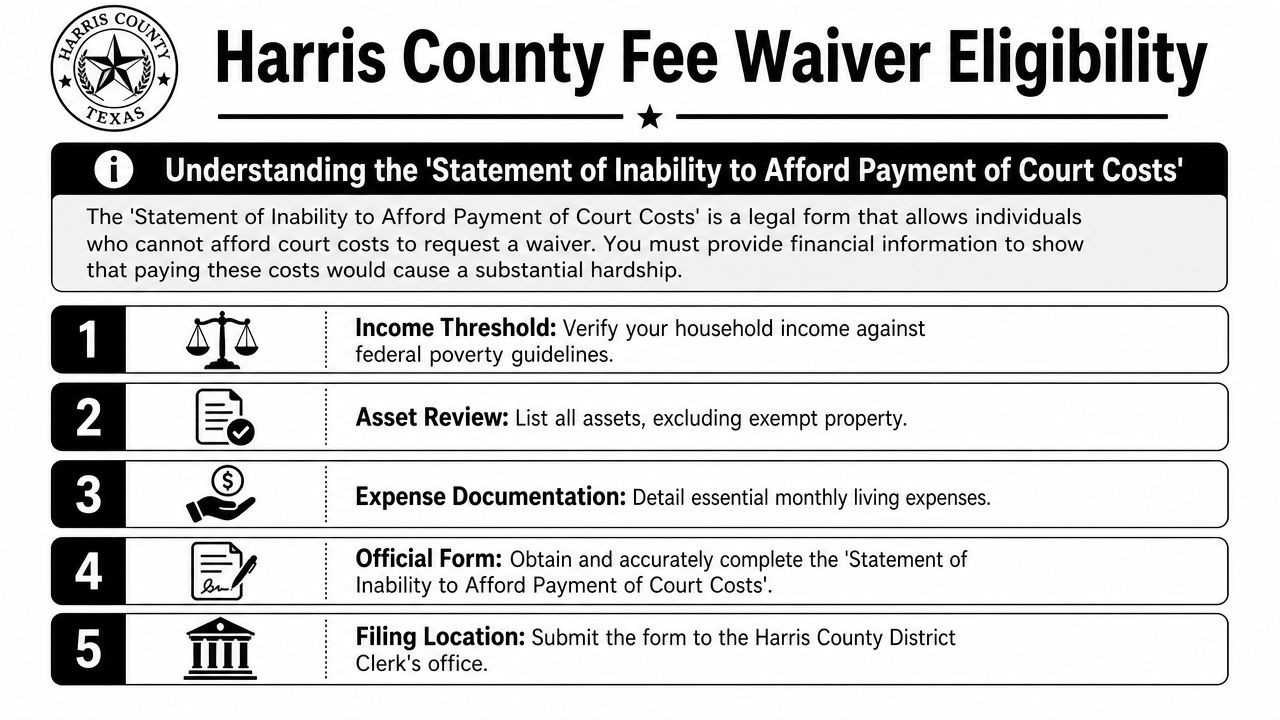
The three ways people usually qualify
-
You receive government benefits
If you're already getting qualifying public benefits, that often supports your request for a waiver. -
Your income is below the guideline threshold
The court looks at your household income, not just whether money feels tight. -
Paying the fee would keep your family from basic needs
This is the practical hardship route. If paying court costs would take money away from housing, food, transportation, or similar necessities, the court can consider that.
What the court wants from you
Judges don't grant these waivers just because you ask. You need to be complete and honest.
- List your income clearly: Include what comes into the household.
- Show your expenses: Regular bills matter because they show whether you can realistically absorb the filing cost.
- Include proof when available: Benefit letters and similar records can help.
- Be accurate: Sloppy or incomplete forms create delay and suspicion.
A lot of rejected filings happen because people rush this step.
If you want a more detailed walk-through of the process, this guide on understanding divorce fee waivers, how to qualify, apply, and navigate the process is a useful next read.
If your case needs temporary rules
Some people trying to save money ignore urgent issues because they think asking the court for anything extra will complicate things. Sometimes it will. Sometimes it's necessary. Temporary Orders During a Texas Divorce explain how the court sets the rules while the divorce is pending, including practical issues like use of property, parenting schedules, or who pays certain bills.
The Pro Se Path Preparing and Filing Your Own Divorce
If you qualify for a fee waiver and your case is straightforward, handling your divorce pro se means you're representing yourself. This can work. It can also go badly if you treat the paperwork like a formality.
Texas does give you a path. The Texas Supreme Court offers free, court-approved divorce forms through TexasLawHelp.org, and those forms can help with an uncontested divorce when your situation fits the available packets. After filing, Texas Family Code Section 6.702 requires a 60-day waiting period before the divorce can be finalized, and many counties handle the final prove-up hearing briefly once the case is ready.
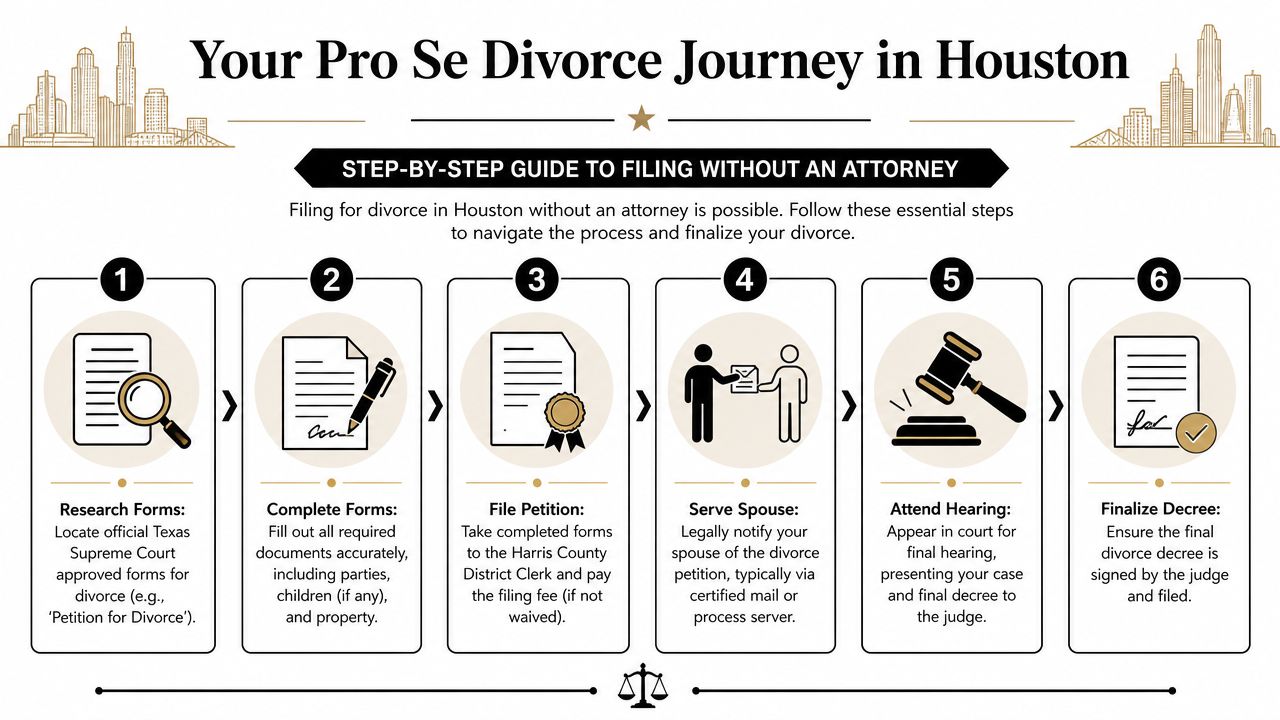
The basic filing sequence
According to this Houston divorce fee waiver article, if you want a divorce in Houston without paying court fees, you must file the Statement of Inability to Afford Payment of Court Costs before the Original Petition for Divorce. The same source says the waiver can be denied if you don't provide proof and financial details, and if approved, the standard filing fee of approximately $250–$325 is waived.
Here is the practical order I recommend:
-
Check that your case fits a self-filed path
If your spouse is combative, hiding assets, or you have a complex custody situation, stop and get advice first. -
Get the right forms
Use the official Texas forms, not random templates from the internet. -
Complete the petition carefully
Names, dates, children, and property descriptions need to be right. -
File the fee waiver request first if you need it
Timing matters. -
File the petition with the Harris County clerk
If your filing is rejected, your case hasn't really started. -
Serve your spouse properly or get a valid waiver of service
This step causes a lot of avoidable trouble. -
Wait the required time and prepare your final decree
The judge signs the decree, not your agreement alone.
Where people get into trouble
The forms look simple until they aren't. A decree can decide who keeps the house, who pays debt, whether retirement language is complete, and what parenting schedule controls after the divorce. If you leave out something important, the problem doesn't disappear. It follows you after the case ends.
For a county-specific guide, review filing a divorce in Harris County.
Practical rule: If you and your spouse disagree on even one major issue, don't assume you still have an easy pro se divorce.
Mediation can still matter
People often think mediation is only for expensive contested cases. That's not true. Divorce Mediation in Texas: How It Works covers why most contested Texas divorces settle in mediation. Even if you're trying to keep costs down, a focused settlement effort can be cheaper than fixing a bad court order later.
For parents, remember that custody and support aren't side notes. Texas courts look at the child's best interest. Conservatorship, possession, and child support deserve careful attention. For business owners and high-asset spouses, self-filing is usually where cheap becomes expensive.
Finding Free Legal Help and Resources in Houston
A lot of Houston divorces stall for one simple reason. The person filing thinks "free help" means someone will take over the whole case. Usually, it means something narrower. You may get forms, a clinic, limited advice, or help with one hearing. That can still be useful, but only if you choose the right resource for the problem you have.
If you are a low-income Houston-area resident, Houston Volunteer Lawyers and Lone Star Legal Aid are often the first places to check for pro bono or reduced-cost family law help. They may help with certain divorce matters, and they are usually a better fit for simpler cases than for fights over custody, property, or safety.
If you need a starting point to compare lower-cost options, review this guide on legal aid and affordable divorce representation in Texas. It helps you sort out whether you need brief advice, document help, or full representation.
Match the help to the case.
- Simple, uncontested divorce: A clinic, self-help forms, or a short lawyer consultation may be enough.
- Domestic abuse or coercive control: Get legal help that includes safety planning, not just paperwork.
- Custody or child support disputes: Limited advice is better than guessing. Bad parenting orders can create long-term problems.
- Retirement accounts, a house, business interests, or heavy debt: Document assistance alone is rarely enough.
Help for survivors of domestic abuse
According to AVDA's Harris County divorce legal aid page, Harris County residents who are victims of domestic abuse can receive free, trauma-informed legal representation for divorce through AVDA, and the organization may also take divorce cases at little-to-no cost depending on income.
That kind of help matters because abuse changes more than the tone of the case. It can affect service, temporary orders, use of the home, financial control, and safe child exchanges. A standard pro se approach often misses those issues.
If your spouse has threatened you, controlled the money, stalked you, or made you fear for your safety, treat that as a legal problem and a safety problem at the same time.
There are also times when paying for counsel is the smartest financial choice available. The Law Office of Bryan Fagan, PLLC handles Texas family law matters involving divorce, custody, support, mediation, and enforcement. If your case goes beyond basic paperwork, even a paid consultation can prevent mistakes that cost far more to fix later.
Key Takeaways and How to Protect Your Rights
You are sitting at your kitchen table with court forms, trying to save money, and one bad assumption can put you right back at the start. In Houston divorce cases, "free" usually means waived filing fees or limited legal help. It does not mean the court fixes mistakes for you.
A fee waiver lowers the cost of getting into court. It does nothing for residency defects, improper service, missing decree language, or one-sided terms you do not catch before you sign. Those errors can delay the case, trigger dismissal, or leave you with orders that create expensive problems later.
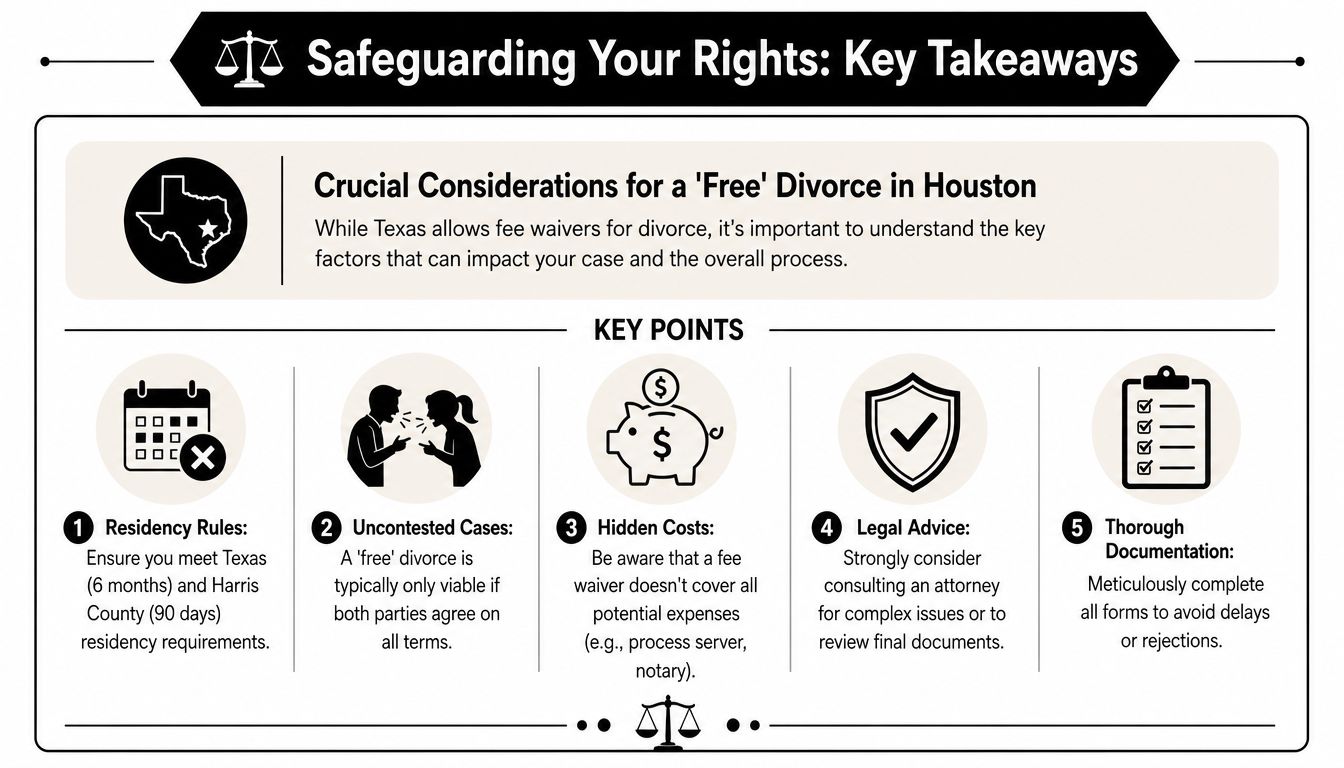
As noted earlier, two filing mistakes cause avoidable trouble again and again in Houston divorces. People file before they meet the Texas and county residency rules, or they fail to give the other spouse proper legal notice. Courts do not overlook those basics because money is tight.
What to do next
Use this checklist before you file:
- Confirm residency first: Make sure you qualify to file in Texas and in Harris County before you spend hours on forms.
- Treat service seriously: If notice is handled the wrong way, your case can stall or be thrown off course.
- Read the final decree line by line: Property terms, debt assignments, and parenting language need to be clear and complete.
- Be realistic about risk: Cases involving children, abuse, retirement accounts, a house, or serious debt are rarely good DIY cases.
- Get legal input early: Even a short consultation can spot problems before they become signed orders.
Here is the practical answer. A free divorce in Houston is sometimes possible if you qualify for a fee waiver and your case is simple. A safe divorce is the better goal. If your case has any real complication, paying for limited advice is often cheaper than fixing a bad decree after the fact.
If you are not sure whether your divorce can be handled with a fee waiver, court-approved forms, or limited legal help, schedule a free consultation with Law Office of Bryan Fagan, PLLC. You can get a clear Texas-specific assessment of your divorce, custody, property, mediation, or enforcement issues and decide on the next step with better information and less risk.