Skip to content
A DIY uncontested divorce is the cheapest way to divorce in Texas on paper, and it typically costs $300 to $800 total, with the main expense being the court filing fee. But the lowest upfront price isn't always the lowest total cost, especially if a paperwork mistake creates property, custody, or enforcement problems later.
You may be reading this after searching your county filing fees, worrying about rent, child expenses, or how you'll afford life in two households. That's normal. Divorce brings legal questions, but money is frequently the first pressure point.
If you're asking what is the cheapest way to divorce in Texas, the answer depends on more than the filing fee. It depends on whether you and your spouse agree, whether you have children, whether you own a business or a home, and whether you're comfortable signing documents that will control your property rights and parenting terms long after the case is over.
Texas law does give you low-cost options. Some people can file on their own. Some qualify for a fee waiver. Others save money by using a lawyer for a narrow, focused uncontested case instead of paying for a full courtroom fight. The smart choice is the one that keeps your upfront cost manageable while also protecting your future.
Facing a Divorce and Worried About the Cost
The money stress of divorce can feel immediate. You may be trying to pay regular bills while also thinking about court fees, moving costs, support obligations, and the fear of making one expensive mistake.
In Texas, a divorce starts with a petition filed in court. After that, the process can stay simple or become expensive fast. The difference usually comes down to conflict. If you and your spouse agree on property division, conservatorship, possession, support, and any spousal maintenance issues, the case is usually more manageable. If you disagree, attorney time, court settings, and motion practice start driving the bill.
What drives cost in real life
A low-cost divorce usually has three things in place:
- Full agreement: You both agree on all major terms, including community property, debt division, and if you have children, conservatorship and support.
- Clean paperwork: Your petition, waiver, decree, and any child-related documents are drafted correctly the first time.
- Limited court involvement: You avoid repeated hearings, emergency motions, and contested appearances.
Texas is a community property state, which means property acquired during the marriage is generally treated as belonging to both spouses for division purposes. That doesn't mean everything is split down the middle in every case. It means the court looks at the marital estate and expects a legally sound division. If children are involved, Texas courts also require terms that address conservatorship, possession and access, and child support in language the court can approve.
Practical rule: If you're trying to save money, your biggest cost decision isn't only whether to hire a lawyer. It's whether your case can stay uncontested from start to finish.
Financial pressure also pushes many people to look beyond legal fees. If debt is part of the problem, practical budgeting help matters too. Some clients find it useful to review resources on credit card hardship programs while they sort out immediate cash-flow issues during separation.
If paying court costs is the problem, Texas has a process for asking the court to waive them. A plain-English guide to divorce fee waivers in Texas can help you understand whether that path fits your situation.
Understanding DIY Uncontested Divorce in Texas
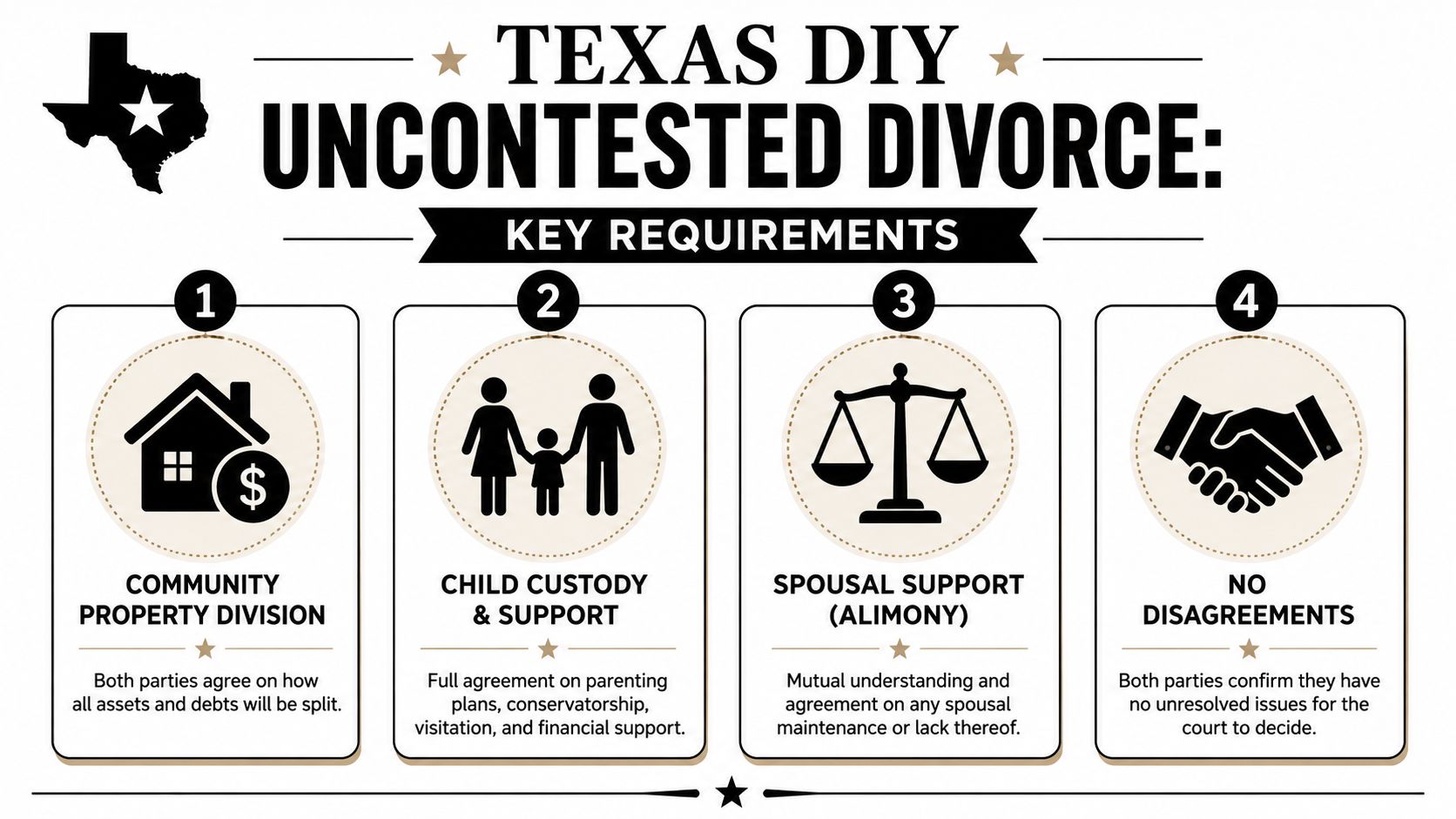
A DIY uncontested divorce means you represent yourself, which courts call proceeding pro se, and both spouses agree on every issue the divorce must resolve. The court doesn't decide who gets what. You do.
When this option actually works
A DIY uncontested case is best suited to couples who can calmly and completely agree on:
- Property and debt division: You both know what exists and agree on who keeps each asset and who pays each debt.
- Parenting terms: If you have children, you agree on conservatorship, visitation, and support.
- Spousal maintenance: You either agree that no maintenance will be paid or agree on legally acceptable terms.
- Case posture: Neither of you wants the judge to resolve disputes because there aren't any disputes left.
If any one of those points is unsettled, the case isn't uncontested. That's where many self-filed divorces start cheap but stop being simple.
The baseline cost
The lowest-cost path on paper is clear. According to this Texas divorce cost breakdown, the cheapest way to divorce in Texas is an uncontested, DIY divorce, which typically costs between $300 and $800 total, with the primary expense being the mandatory court filing fee ranging from $250 to $320 depending on the county. The same source explains that Texas Rule 145 allows a person who can't afford costs to file a Statement of Inability to Afford Payment of Court Costs, which can eliminate $250 to $400 in filing and service fees.
That fee-waiver option matters. For some Texans, it changes the math entirely.
If your income is tight, don't assume you have to give up on filing. Texas courts do allow fee-waiver requests, and that can remove the biggest upfront barrier.
What Texas courts expect in plain English
Texas Family Code rules shape what has to appear in a divorce decree, especially if your case involves children or property. For parents, the decree usually needs workable terms for conservatorship and possession and access. Conservatorship means parental rights and duties. Possession and access means the schedule for time with the child. Child support also has to be addressed in a way the court can approve.
For property, the decree must say who receives what, not just in broad language but with enough clarity to be enforceable later. Vague terms create future problems.
If you and your spouse are in full agreement and want to understand how agreed cases move through the court's timeline, Uncontested Divorce in Texas: The Faster Path gives a helpful overview of how these cases move efficiently through the 60-day floor.
How to File an Uncontested Divorce in Texas
The process is straightforward when the case is fully agreed, but each document matters. A small drafting mistake can delay the case or create issues after the divorce is final.
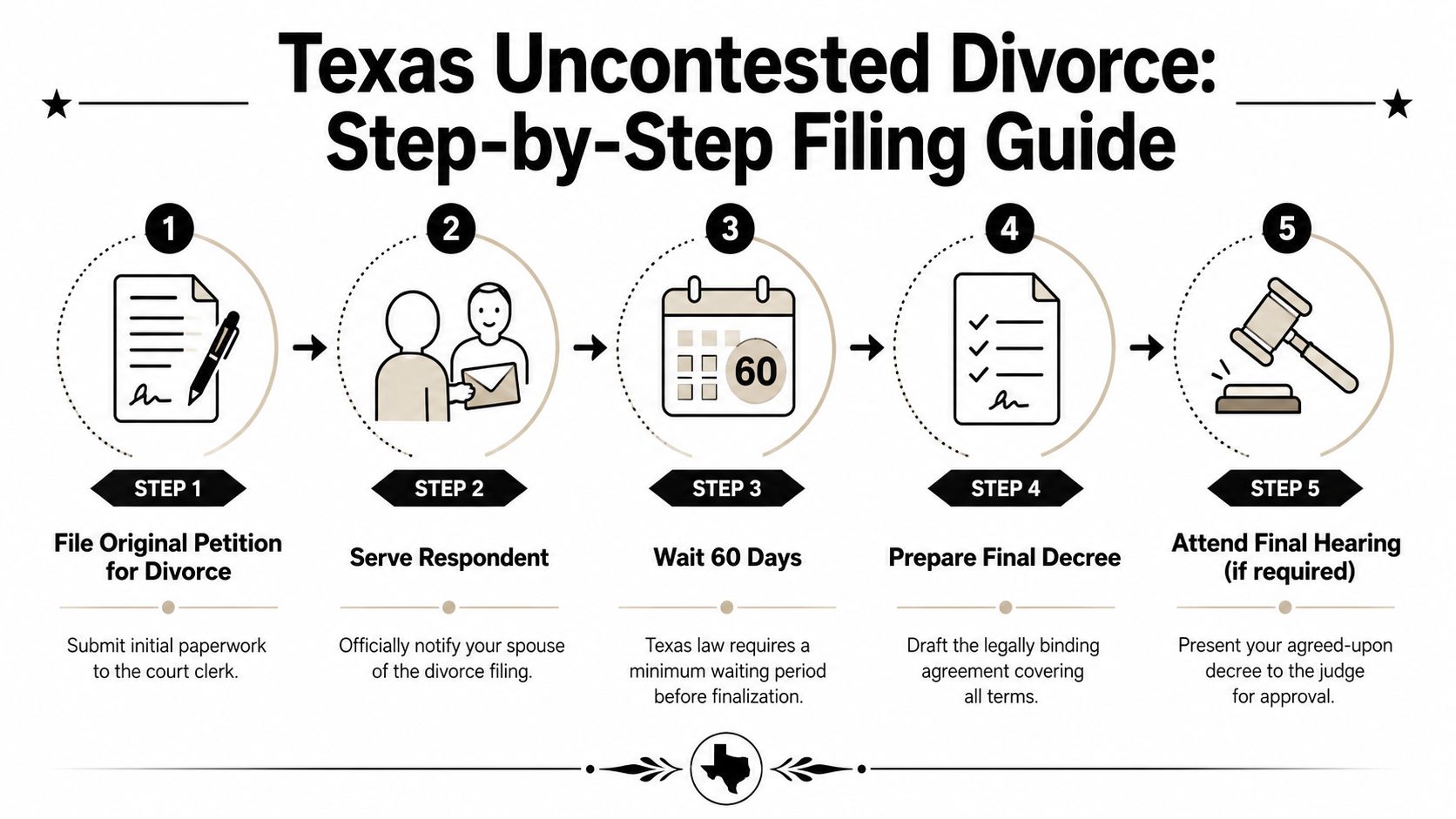
Start with the filing roadmap below.
Step 1 through Step 3
File the Original Petition for Divorce
One spouse, called the petitioner, files the case in the proper Texas court. This document tells the court that you want a divorce and gives the basic legal framework of the case.Handle service the low-cost way if appropriate
The other spouse, called the respondent, must be legally notified. In many agreed cases, the respondent signs a Waiver of Service instead of requiring formal service. That can save money and keep things moving.Wait through the required timeline
Texas has a mandatory waiting period. According to this discussion of Texas divorce timing and procedure, Texas Family Code § 6.702 requires a 60-day waiting period after filing before the court can finalize the divorce. The same source notes that the fastest and cheapest path remains an uncontested divorce filed correctly with e-filing and a Waiver of Service, and that TexasLawHelp.org offers free printable divorce paperwork.
A narrow exception exists for certain family violence situations involving documented violence or a protective order. In those cases, the timeline can be different because safety comes first.
Step 4 and Step 5
The next part is where many DIY cases run into trouble. The Final Decree of Divorce is not a summary. It's the enforceable order that controls rights and obligations after the marriage ends.
Prepare the Final Decree carefully
This decree should cover property division, debt allocation, child-related terms, and any other agreements. If you're a parent, the language must satisfy the court on conservatorship, possession, and support. If you own a business, retirement assets, or real property, the wording needs to be precise enough to avoid confusion later.Attend the final hearing if the court requires it
Many uncontested cases still require a short prove-up hearing. The judge confirms that the legal requirements are met and that the decree is appropriate. In cases with children, judges are often especially attentive to whether the parenting and support terms are clear and in the child's best interest.
Practical filing advice
Use this checklist before you file:
- Check county rules: Local filing procedures can differ, even in agreed cases.
- Review names and dates: Misspelled names, wrong dates of marriage, or bad notary work can cause avoidable delays.
- Be specific about property: List accounts, vehicles, real estate, and debts clearly enough that each side can carry out the decree.
- Think beyond today: If you're dividing a house, business interests, or retirement accounts, the short decree language you sign now may affect your finances for years.
- Know when court avoidance is realistic: If you want to minimize appearances, review how to file for divorce without going to court to understand when a simple agreed process is possible and when some hearing time is still likely.
Good uncontested divorces are simple because the issues are resolved, not because the paperwork is casual.
Why the Cheapest Option Can Cost You More
Low filing fees can make DIY divorce look like the clear winner. The problem is that divorce documents don't just end the marriage. They also assign future rights, obligations, and remedies.

Where self-filed cases go wrong
The most expensive mistakes usually show up in one of two places:
- Property language that isn't enforceable: The decree says who keeps an account or debt in a vague way, but doesn't state enough detail to make compliance clear.
- Child-related terms that are incomplete: Parents agree in conversation but fail to put enforceable terms into the order about conservatorship, possession, support, or decision-making.
That creates a second round of legal work. Instead of paying for careful drafting once, you may end up paying later for clarification, modification, or enforcement.
According to this analysis of hidden post-divorce costs in Texas DIY cases, 60% of self-represented Texans in amicable divorces incur hidden costs later due to improperly executed property division or custody clauses, averaging $1,200 to $3,500 in post-divorce modifications.
That doesn't mean every self-filed divorce ends badly. It does mean the cheapest upfront option carries a real risk that many people don't factor in.
The hidden costs people miss
Short-term savings can disappear when any of these problems show up:
| Risk area | What happens later |
|---|---|
| House or debt terms | One party doesn't refinance, transfer, or pay as expected, and the decree doesn't clearly solve the dispute |
| Parenting language | School, medical, or schedule disagreements turn into enforcement or modification issues |
| Business ownership | The decree doesn't define who controls operations, records, or valuation issues well enough |
| Retirement or complex assets | The parties discover the divorce decree alone isn't enough to carry out the intended division |
Parents, business owners, and spouses with substantial property should take this seriously. High-value estates often need tighter drafting because a vague sentence can affect multiple assets at once. If you own a company, partnership interest, or professional practice, even an amicable split can become expensive if the decree doesn't line up with how the business operates.
The cheapest divorce is the one you don't have to fix.
Comparing Mediation and Collaborative Divorce
A common Texas divorce situation looks like this. You and your spouse want to avoid a courtroom fight, but you also do not want to sign paperwork that creates expensive problems six months later. In that middle ground, the right process matters as much as the filing fee.
Attorney-assisted uncontested divorce
If you already agree on the major terms, attorney-assisted uncontested divorce is often the lowest total-cost option. You pay more upfront than a pure DIY filing, but far less than a contested case, and you reduce the chance of paying again later to fix unclear language, missing provisions, or court rejection issues.
A Texas divorce cost overview from Lishman Law explains the basic pricing gap between uncontested and contested cases. That gap exists for a simple reason. Careful drafting and targeted legal review usually cost much less than prolonged conflict, repeated hearings, and hours of dispute over avoidable mistakes.
That trade-off is especially important for spouses with children, a house, retirement accounts, or a small business. In those cases, the cheapest filing method is not always the cheapest divorce.
Some couples also compare this route with mediation before deciding. This guide on why divorce mediation could be a more cost-effective choice for Texas couples is useful if you are close to agreement but still need help resolving a few terms.
Mediation and collaborative divorce
Mediation and collaborative divorce can both reduce conflict, but they serve different kinds of cases.
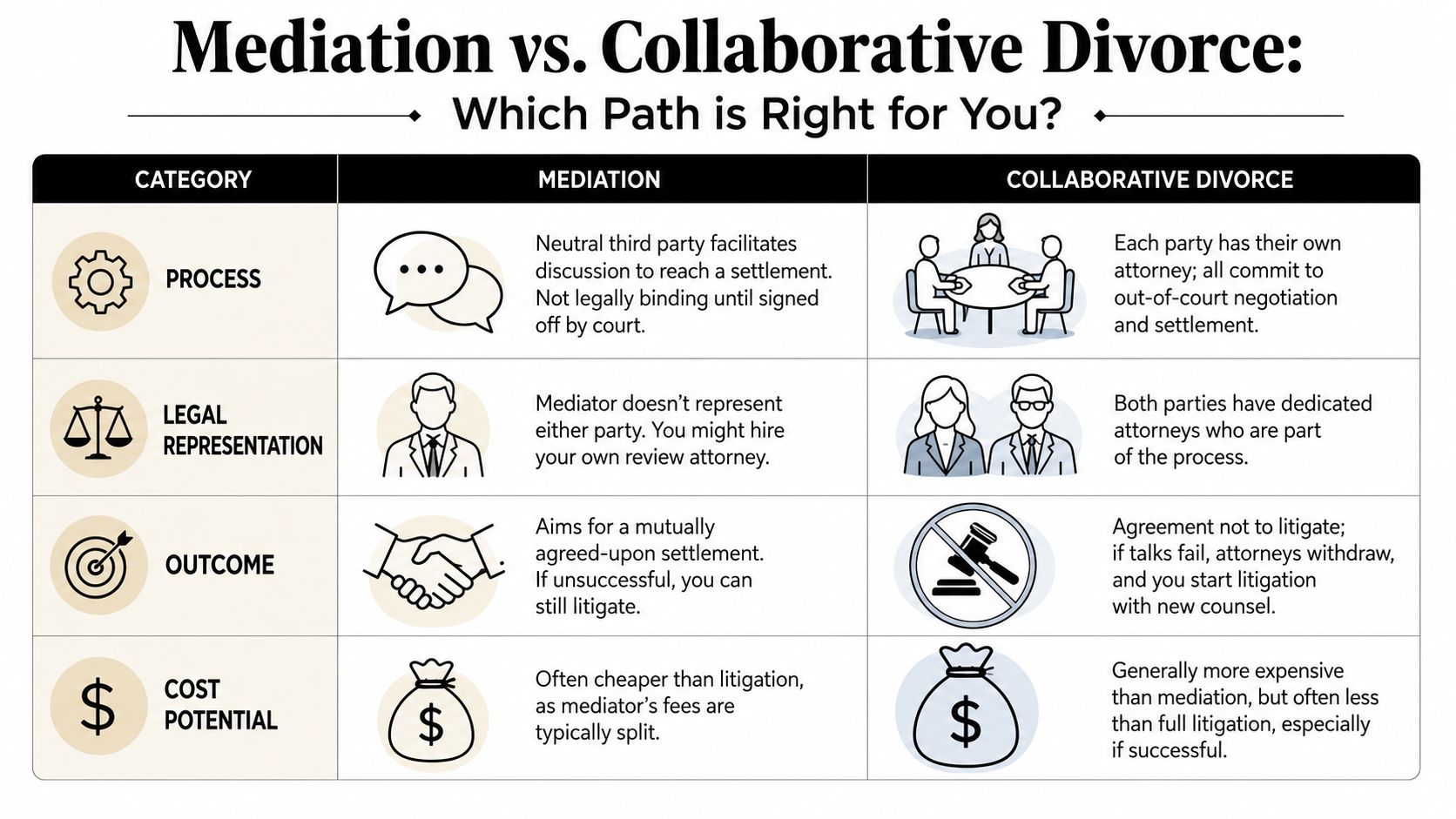
Mediation puts both spouses in front of a neutral mediator who helps them work through disagreements and try to reach a settlement. The mediator does not represent either side. If you settle, someone still has to turn that agreement into court-ready documents that accurately divide property, address parenting terms, and fit Texas procedure.
Collaborative divorce is more structured. Each spouse has a lawyer, and everyone commits to trying to resolve the case outside of court. This approach can work well when both people want privacy and problem-solving, but the issues are too layered for a simple agreement.
The practical difference usually comes down to cost, complexity, and how much support you need.
- Choose mediation if you agree on most issues and need help closing a few gaps.
- Choose collaborative divorce if you want attorney guidance throughout settlement talks and the finances or parenting issues need closer attention.
- Choose attorney-assisted uncontested divorce if you already have a full agreement and want the paperwork prepared correctly the first time.
In my experience, collaborative divorce can be a good fit, but it is rarely the cheapest option in absolute dollars because both spouses usually have counsel involved from start to finish. Mediation often costs less than collaborative divorce. Attorney-assisted uncontested divorce often costs less than both when the agreement is already in place.
Law Office of Bryan Fagan, PLLC handles contested, uncontested, mediation, and high-asset divorce matters. That reflects a practical truth in Texas family law. The right process depends on your facts, your level of agreement, and the financial risk of getting the final order wrong.
Key Takeaways and Your Next Steps
If you're still asking what is the cheapest way to divorce in Texas, the honest answer is this: DIY uncontested divorce is the cheapest upfront, but attorney-assisted uncontested divorce is often the most cost-effective overall when you factor in the risk of errors.
What to do next
Use this checklist to decide where you fit:
- You may be a good DIY candidate if you have a very simple estate, no unresolved disagreements, and you're comfortable preparing and reviewing court documents on your own.
- You should strongly consider legal help if you have children, real property, retirement accounts, business interests, support questions, or any concern that your spouse may not follow through after the decree is signed.
- Mediation may fit if you're close to agreement but still need a neutral setting to resolve a few issues.
- A more formal attorney-led process makes sense if trust is low, finances are complex, or one spouse controls most of the information.
Texas law issues you shouldn't overlook
Even in a low-conflict case, Texas divorce orders carry long-term legal consequences.
For property division, your decree needs to clearly divide community property and debt. For custody, Texas uses terms like conservatorship, possession, and access because those terms control parental rights and the child's schedule. For support, the court needs language it can approve and enforce. If an order is vague, getting back into court later is often harder and more expensive than doing it right the first time.
If you're worried about future conflict, related family law issues often overlap with divorce. You may also need guidance on custody, support, mediation, or enforcement after the divorce is final. Those issues are often connected, especially for parents and business owners.
You don't need the most expensive process. You need the process that ends the case cleanly and protects you when life gets messy later.
The best next step is to get clear about your facts. Do you fully agree? Do you have children? Do you own a house, business, or significant retirement assets? Are you trying to save money now at the risk of paying more later?
If you want a practical answer based on your real situation, not a generic internet checklist, a one-on-one legal consultation can save you time, stress, and avoidable expense.
You don't have to figure this out alone. If you're considering divorce and want a cost-conscious plan that protects your property, your parenting rights, and your peace of mind, schedule a free consultation with Law Office of Bryan Fagan, PLLC. You'll get straightforward guidance on whether DIY, mediation, or an attorney-assisted uncontested divorce makes the most sense for your Texas case.