Skip to content
Facing a divorce is one of life's toughest journeys, and figuring out the right path forward can feel overwhelming. You might have heard about a pro se divorce—also known as a DIY divorce—where you represent yourself in court without hiring an attorney. This approach can work in Texas, but it's critical to understand that it's only a safe option if your situation is straightforward and completely uncontested.
Understanding When a Pro Se Divorce Makes Sense
Going pro se means you're in the driver's seat of your own legal case. The biggest draw is saving money on legal fees, but that savings comes at a cost: you must handle every single part of a complex legal process on your own. You will be responsible for filing the initial petition, drafting the final court order, understanding Texas law, and meeting strict deadlines.
This path is truly only suitable for couples who are in 100% agreement on every single issue. Before you consider proceeding without a lawyer, you and your spouse must be able to give a firm "yes" to all of these questions:
- Are we in total agreement? You both must agree on how to divide all your property and debts, down to the last detail.
- Do we have minor children? A pro se divorce becomes much more complex if you have children. Custody, visitation, and child support add layers of legal requirements that are difficult to navigate alone and require a judge’s approval.
- Is our financial situation simple? This route is best for couples with minimal assets, no shared businesses, and no complex retirement accounts like 401(k)s or pensions to divide.
While self-representation is on the rise—a 2018 study found that in many family court cases, 83% of plaintiffs and 93% of respondents appeared pro se—it doesn't mean it's the right choice for everyone.
When You Absolutely Need an Attorney
While saving money is tempting, the risk of making a mistake can be far more costly in the long run. If your divorce involves any of the following, hiring an experienced family law attorney isn’t a luxury—it's a necessity to protect your rights, your children, and your financial future.
A flawed Final Decree of Divorce can trigger years of financial disputes and legal battles. Getting it right the first time is crucial for protecting your assets, your parental rights, and your peace of mind.
This decision tree can help you visualize whether going pro se actually fits your circumstances.
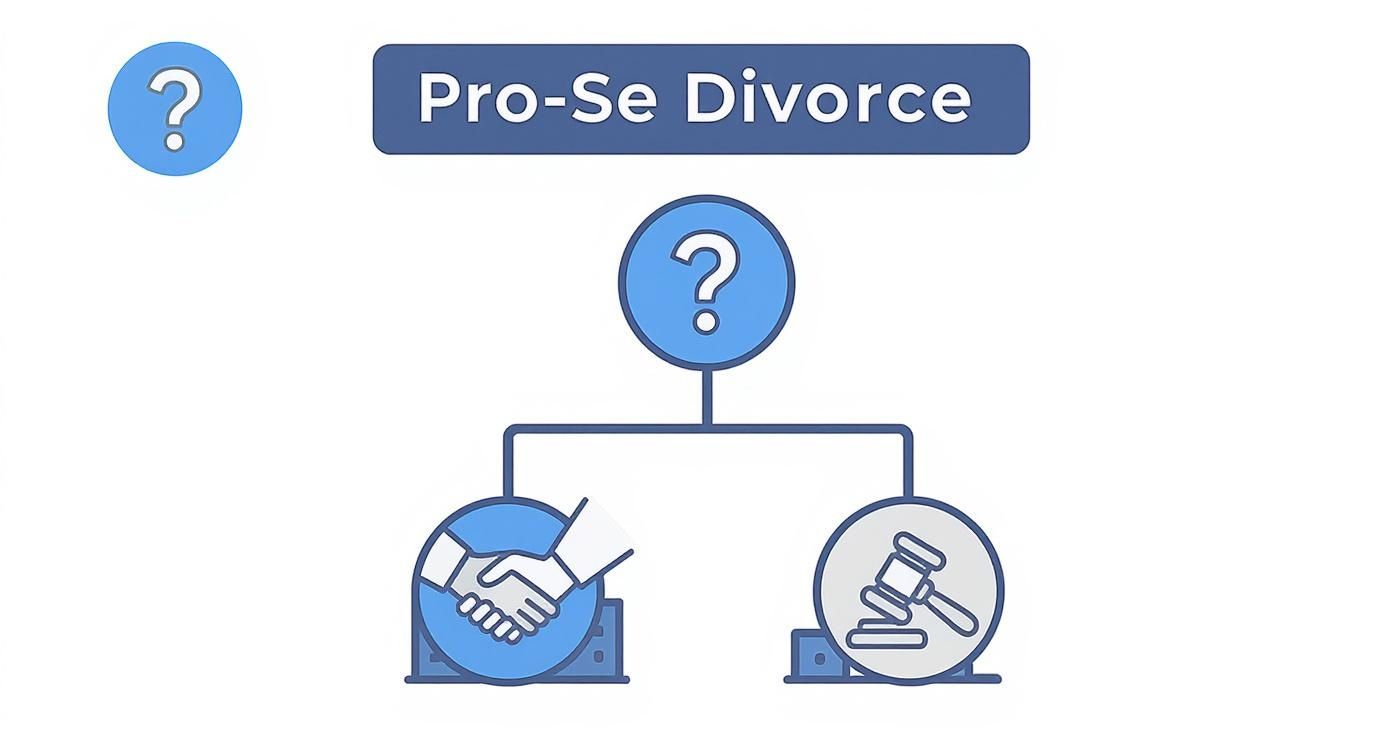
As the guide shows, the moment disagreement, children, or complex assets enter the picture, the path points directly toward getting legal guidance. Even if you think your situation is simple, it's always wise to learn more by checking out our guide on DIY divorce and empowering yourself before making a final decision.
Pro Se Divorce vs. Attorney-Led Divorce: A Quick Comparison
This table helps you quickly assess whether a pro se divorce is suitable for your situation by comparing key factors against a traditional attorney-led process.
| Factor | Pro Se Divorce (Best For) | Attorney-Led Divorce (Recommended For) |
|---|---|---|
| Complexity | Extremely simple cases with no disagreements, no children, and minimal assets. | Any level of complexity, especially cases involving children, businesses, real estate, or retirement accounts. |
| Agreement Level | 100% amicable and cooperative. Both spouses agree on every single detail. | Situations with any disagreement, lack of trust, or potential for conflict. |
| Cost | Low upfront costs (filing fees only). | Higher initial investment but protects against costly future mistakes. |
| Risk Level | High risk of errors in legal documents, which can be expensive or impossible to fix later. | Low risk, as the attorney ensures all documents are correct, deadlines are met, and your rights are protected. |
| Time Commitment | Requires significant personal time for research, paperwork, and court filings. | Saves you time, as your legal team handles all procedural and administrative tasks. |
| Legal Knowledge | You are responsible for understanding all relevant Texas laws and court rules. | You benefit from an expert's knowledge of the law, strategy, and local court procedures. |
Ultimately, while a pro se divorce can work for a select few, an attorney-led process provides a critical safety net for the vast majority of people navigating this difficult time.
Preparing and Filing Your Divorce Petition
Getting started is often the hardest part, but breaking it down into clear, manageable steps can make the process feel much less intimidating. Beginning your pro se divorce in Texas is about understanding the rules and getting the right documents in order. This first move is crucial—it sets the stage for your entire case.

Meeting Texas Residency Requirements
Before you fill out a single form, you must meet the state's residency requirements. This is a non-negotiable rule from the Texas Family Code, and the court will verify this before your case can proceed.
To file for divorce in Texas, at least one of you must have:
- Lived in Texas for the last six months.
- Lived in the county where you plan to file for the last 90 days.
So, if you want to file in Harris County, either you or your spouse must have been a resident of Harris County for the last three months and a Texas resident for the last six.
Gathering and Completing the Right Paperwork
The single most important document you'll handle at this stage is the Original Petition for Divorce. This is the form that officially starts the legal process. It tells the court who you are, who your spouse is, and that you want to end your marriage. It also outlines the basic facts about any children you share or property you own.
Filling out this petition accurately is critical. A small mistake, like a misspelled name or an incorrect address, can cause the District Clerk to reject your filing, forcing you to start over. Take your time and double-check everything.
The accuracy of your initial petition sets the tone for the rest of your case. A clean, correctly filled-out form shows the court you are taking this seriously and helps you avoid needless delays.
While you can find family law templates online, it's vital to have a firm grasp of all the paperwork involved. For a full checklist, take a look at our guide on the essential documents for filing for divorce in Texas.
The Filing Process With the District Clerk
Once your Original Petition for Divorce is complete, you’ll file it with the District Clerk's office in your county. You can usually do this in person, but most counties now use the state’s electronic filing system, eFile Texas.
Filing isn't free. You should expect to pay a filing fee, which typically runs between $250 and $350, depending on the county.
If you cannot afford the fee, you can file a Statement of Inability to Afford Payment of Court Costs. You’ll need to provide information about your income and expenses, and a judge will review it to decide whether to waive your filing fees.
Once the clerk accepts your petition, it will be stamped with a case number and assigned to a specific court. At this point, your divorce case has officially begun, and the clock starts on Texas's mandatory 60-day waiting period.
Serving Papers and Navigating the Waiting Period
Filing your divorce petition is a huge milestone, but the next step is just as important. You must legally inform your spouse that a case has been opened. This formal notification is called service of process, and Texas law is very strict about getting it right. Any misstep here can stall your case, so it's vital to handle this carefully to keep your pro se divorce on track.
The person who files the petition is the "Petitioner," and the other spouse is the "Respondent." The Respondent must receive a copy of the lawsuit. You cannot simply hand them the papers yourself; the law requires a formal method to ensure there's official proof of delivery.
How to Properly Serve Divorce Papers
You have a couple of options, and your choice depends on how cooperative your spouse is.
-
Personal Service: This is the standard method if there's any tension or uncertainty. You can hire a sheriff, constable, or a private process server to physically hand-deliver the papers. Afterward, they will file a "Return of Service" with the court as official proof that your spouse was notified.
-
Waiver of Service: If your divorce is truly amicable, this is the simplest path. You give your spouse a copy of the filed petition along with a Waiver of Service Only form. They sign this document in front of a notary, and once it's filed with the court, it confirms they've received the petition and waive the need for formal service.
Using a waiver saves time, money, and stress, but it only works if you are both cooperating fully.
A correctly executed Waiver of Service is the gold standard for an uncontested pro se divorce. It signals to the judge that both parties are working together, which can help streamline the final hearing.
Understanding the 60-Day Waiting Period
The moment your petition is filed, a mandatory countdown begins. Under Texas Family Code § 6.702, a judge cannot finalize a divorce until at least 60 days have passed. This is a required "cooling-off" period designed to give couples a moment to reflect.
It's crucial to understand this is a minimum timeframe. Very few divorces are finalized on day 61. For anyone handling their own divorce, this 60-day window is the perfect time to get your affairs in order.
Don't just wait. Use this period to:
- Negotiate the Details: Work with your spouse to finalize the division of all your property and debts. Create a detailed inventory of every asset and liability—from the house and cars to credit card balances.
- Draft Your Final Decree: This is the most important document in your divorce. The Final Decree of Divorce is the legally binding court order that spells out every detail of your agreement. It must be thorough, clear, and enforceable.
This waiting period is your opportunity to do the real work of crafting your divorce agreement. For a deeper dive into this timeline, you can learn more about navigating the Texas divorce 60-day waiting period in our detailed guide.
Drafting a Rock-Solid Final Decree of Divorce
This is it—the document that makes the end of your marriage official. Drafting your Final Decree of Divorce is the most empowering part of handling your own divorce because it puts you in control of the final outcome. This isn't just another piece of paper; it’s the legally binding court order that maps out your new life. Your job is to make sure it's clear, thorough, and enforceable.

Every agreement you've made with your spouse gets locked into this document. Any fuzzy language or missed details can create years of headaches and expensive trips back to court. Getting this right the first time is essential for a clean break.
Detailing Your Community Property and Debt
Under the Texas Family Code, everything you and your spouse acquired during your marriage is considered community property. The law requires this property to be divided in a "just and right" manner, which doesn't always mean a 50/50 split. Your decree must list every asset and every debt and state exactly who gets what.
Vague descriptions are your worst enemy. "The family car" won't cut it. You need to be specific to prevent future arguments.
Here's an example:
- Vague: "Wife gets the Honda."
- Specific: "Jane Doe is awarded the 2021 Honda CR-V, Vehicle Identification Number (VIN) 1HGCRV123456789, as her sole and separate property."
- Vague: "Husband takes the credit card debt."
- Specific: "John Doe is ordered to pay, and to indemnify and hold Jane Doe harmless from, the entire balance owed on the Capital One credit card ending in -4321 as of the date of divorce."
This level of detail is necessary for everything—from the house (which needs a full legal description) to bank accounts and furniture. An incomplete property division is one of the most common and costly mistakes in pro se divorces.
Your Final Decree is the ultimate rulebook for your post-divorce life. If an asset isn't specifically awarded to someone in the decree, it remains jointly owned, leaving the door wide open for future legal battles.
Addressing Children in the Decree
If you have minor children, your decree will be much more detailed. It must include comprehensive orders for custody, visitation, and support. Texas courts are guided by one principle: the "best interest of the child." You cannot invent your own rules; you must work within the framework of the Texas Family Code.
Your decree absolutely must include:
- Conservatorship: This section names the parents—usually as "Joint Managing Conservators"—and designates which parent has the exclusive right to decide where the child lives.
- Possession Order: This is the detailed visitation schedule. Most people use the Texas Standard Possession Order, which lays out a clear schedule for weekends, holidays, and summer breaks that judges can easily enforce.
- Child Support: This part must state the exact dollar amount of monthly child support, as well as orders for medical and dental support. The amount is determined by a formula based on the paying parent's income. Simply agreeing to "no child support" without a compelling, legally sound reason is a quick way to get your decree rejected.
These provisions are complex and must be worded perfectly to hold up in court. If you need help, our firm has extensive experience in child custody matters.
Special Considerations for Business Owners and High-Value Estates
A DIY divorce is a minefield when complex assets are involved. If you or your spouse own a business, have retirement accounts like a 401(k) or pension, or own multiple properties, trying to divide these on your own is a recipe for financial disaster.
These assets often require specialized documents, like a Qualified Domestic Relations Order (QDRO) for retirement plans, and expert valuation to ensure a fair split. A mistake here could cost you tens or even hundreds of thousands of dollars.
If you are a business owner, how do you value the business? What part is community property? Getting these questions wrong could cripple your company or leave you with an unfair settlement. Protecting your business demands an attorney's guidance.
Finalizing Your Divorce in Court
Walking into a courtroom can feel intimidating, but even in the most straightforward pro se divorce, a brief court appearance is required to make things official.

This final hearing is often called a "prove-up." This is where you turn your drafted decree into a legally binding order. Knowing what to expect can turn anxiety into confidence. This isn't a dramatic trial; in an uncontested case, the hearing is a short formality that might only last a few minutes. The purpose is for you to give brief testimony under oath, confirming for the judge that you've met all of Texas's legal requirements.
Preparing for Your Day in Court
Preparation starts before you arrive. Dress in business-casual attire to show respect for the court. Give yourself plenty of extra time to get through security, find your courtroom, and check in with the clerk or bailiff.
When the judge calls your case number, you will walk to the front of the courtroom and be sworn in, promising to tell the truth. From that point on, always address the judge as "Your Honor."
Your demeanor in court really matters. A calm, respectful, and prepared attitude helps the judge see that you've taken this process seriously.
The Testimony: What You Will Be Asked
The judge's questions are designed to get key facts on the record. Be ready to answer questions like:
- "Please state your name for the record."
- "You are the Petitioner in this case, correct?"
- "Have you been a resident of Texas for the last six months and this county for the last 90 days?"
- "Is your marriage insupportable because of discord or conflict that has destroyed the legitimate ends of the marriage?"
- "Have you and your spouse entered into an agreement on the division of your property and debts as set out in the Final Decree of Divorce you have presented?"
- "Do you believe this agreement is a just and right division of your assets and liabilities?"
If you have children, the judge will also ask questions to confirm that your parenting plan is in their best interest.
The Final Step: Getting the Judge's Signature
After your testimony, you will present your completed Final Decree of Divorce to the judge for their signature. Before you head to court, double-check that you have these documents ready:
- The Original Final Decree of Divorce: This is the copy the judge will sign.
- Copies of the Decree: Bring at least two extra copies—one for you and one for your spouse.
- A Valid Photo ID: The court needs to verify your identity.
Once the judge signs the decree, your marriage is legally over. The last step is to file the signed original with the District Clerk's office. This officially records your divorce and allows you to get the certified copies you'll need. If you ever have issues later, you can learn more about enforcing your decree to protect your rights.
Essential Steps to Take After Your Divorce
The moment the judge signs your Final Decree is a huge relief, but your work isn't finished. There are a few crucial tasks you need to handle to protect yourself and move forward with a truly clean slate. Overlooking these final steps is a common pitfall in a pro se divorce that can cause major headaches.
First, head to the District Clerk's office and get several certified copies of your Final Decree. You’ll need these official copies for many administrative tasks, so getting at least three to five right away is a smart move.
Updating Your Financial and Legal Life
With your certified decree in hand, it's time to update your records and separate your legal and financial identity from your former spouse.
Here’s a checklist of what to tackle immediately:
- Change Your Beneficiary Designations: Go through all your life insurance policies, 401(k)s, IRAs, and other retirement or investment accounts and update the beneficiaries.
- Retitle Your Property: Any property awarded to you, like a car or house, must be formally retitled in your name only. For real estate, this will likely involve filing a Special Warranty Deed to remove your ex's name.
- Update Your Will: Your divorce almost certainly changes your estate planning wishes. Update your will, powers of attorney, and other documents to reflect your new status.
Failing to update beneficiaries is one of the most devastating—and common—post-divorce mistakes. If your ex-spouse is still listed, they could inherit your assets, regardless of what your decree or a new will says.
Finalizing Practical and Parental Responsibilities
Beyond the big legal and financial updates, a few other practical matters need your attention.
If your decree orders child support, those payments must be set up through the Texas Child Support Disbursement Unit. This creates an official payment record, which protects both you and your co-parent.
You also need to update your personal information everywhere. Practical steps like changing your address with the post office, DMV, and your employer are essential to ensure important documents find their way to you.
Taking care of these final steps is non-negotiable. It solidifies the independence you worked so hard to achieve and prevents frustrating legal tangles in the future.
Got Questions? We've Got Answers
Stepping into a divorce on your own is bound to bring up questions. Let's walk through some of the most common concerns we hear from people handling a pro se divorce in Texas so you can move forward with confidence.
Can I Change My Mind and Hire an Attorney Later?
Yes, absolutely. You can bring an attorney on board at any point in the divorce process. Many people start pro se to keep costs down but realize they need help when a disagreement arises or they see how complex the final decree is. It is never too late to get professional help to protect your rights.
What if My Spouse Won't Sign the Papers?
This is a common concern. If your spouse refuses to sign a Waiver of Service or the Final Decree, your case is no longer uncontested. You cannot finalize a pro se divorce without their cooperation. The case then becomes a contested matter, which almost always requires an attorney to navigate successfully.
Once cooperation breaks down, the risks of representing yourself increase dramatically. An uncooperative spouse can complicate every step, making legal guidance essential to protect your interests.
What Is the Total Cost of a Pro Se Divorce?
While you save on attorney's fees, a DIY divorce isn't free. You'll have to pay court filing fees, which usually run between $250 to $350, depending on your county. You may also have smaller costs for a process server (if needed), notary services, and certified copies of your final decree.
How Long Does a Pro Se Divorce Take in Texas?
Texas law has a mandatory 60-day waiting period, so the absolute fastest a divorce can be finalized is 61 days after filing. Realistically, even a smooth pro se divorce often takes closer to 90-120 days to account for preparing documents, filing them, and getting a final hearing date.
Key Takeaway: What to Do Next
A pro se divorce is a tool designed for only the simplest, most amicable separations. If there is any hint of conflict, a shared business, significant debt, or children involved, the risk of a costly error is just too high.
Your next step should be an honest assessment of your situation. If any complexity exists, the wisest move is to seek professional legal advice to ensure your rights and your future are protected.
Don't leave your future to chance. The Law Office of Bryan Fagan, PLLC, is here to provide the clarity and confidence you need. Schedule a free, no-obligation consultation with our experienced attorneys today to discuss your specific situation and learn how we can protect your interests. You can reach us at https://texasdivorcelawyer.us.