Skip to content
Texas is a one-party consent state for audio recording, so you can generally record a conversation if you're part of it. But if your conduct crosses into covert surveillance, private spaces, or tracking, you could face a Class A misdemeanor, up to 1 year in jail, and a $4,000 fine.
When your marriage feels unstable, hitting record can seem like the fastest way to get the truth. You may be thinking about a tense kitchen conversation, a late-night phone call, or a suspicion that your spouse is hiding money, seeing someone else, or setting you up for a custody fight.
That instinct is understandable. It's also where people make expensive mistakes.
In Texas divorce and custody cases, the main question usually isn't just can you record your spouse in Texas. It's whether recording helps your case, hurts your credibility, or creates legal trouble that distracts from the issues that matter, such as conservatorship, possession, child support, property division, temporary orders, and the final decree. Texas family courts care about proof, but they also care about how that proof was obtained and whether it's relevant to the decisions in front of the court.
If you're heading toward divorce, the smarter move is usually risk management. Protect yourself. Preserve lawful evidence. Use formal discovery. Get advice before you turn yourself from a potential petitioner or respondent into someone dealing with criminal exposure too.
Tempted to Hit Record on Your Spouse
If you're reading this, there's a good chance something already feels off. Maybe arguments keep happening behind closed doors. Maybe your spouse says one thing to you and another thing to the children. Maybe you suspect cheating, hidden spending, or manipulation, and you want proof before you file for divorce or ask for temporary orders.
That urge to document everything is common. Smartphones make it easy, and if you've even looked up screen recording audio tips, you're already in the mindset of collecting evidence. The problem is that family law strategy isn't the same as consumer tech advice. What your phone can do and what you should do are two different questions.

Why people reach for recordings
Most spouses don't start by trying to break the law. They're trying to solve a problem. They want to:
- Prove dishonesty so they feel less vulnerable in court
- Capture threats or intimidation before a hearing on temporary orders
- Confirm an affair or hidden relationship that explains sudden changes at home
- Protect themselves in a custody dispute when they fear false accusations
Those concerns are real. In Texas, divorce can involve child custody under the Texas Family Code, property division, requests for temporary relief, mediation, and eventually a final decree. If children are involved, the court may decide conservatorship, parenting time, and support based on the child's best interests. If a business, retirement account, or separate-property claim is involved, documentation matters even more.
Practical rule: Evidence only helps if you gather it lawfully, preserve it properly, and use it on issues the judge actually cares about.
The dangerous part
Secret recording often feels like control. In practice, it can hand control to the other side.
A spouse who secretly records in the wrong setting can create side litigation over privacy, admissibility, and misconduct. A judge who sees sneaky behavior may start asking whether that same person will respect boundaries in co-parenting. A case that should focus on bank statements, parenting history, and settlement options can get hijacked by a fight over your methods.
If you're early in the process, remember how Texas divorce usually works. One spouse files. The other is served or waives service. Temporary orders may be requested. Information is exchanged formally. Many cases go to mediation before trial. What wins these cases is rarely a dramatic audio clip. It's consistent, admissible, organized evidence and a strategy that doesn't backfire.
Understanding Texas Recording Laws The One-Party Consent Rule
The short legal answer is straightforward. Texas is a one-party consent state for audio recording, which means a spouse can lawfully record a conversation if they are a participant, according to the Texas State Law Library's audio recording guidance. That same guidance also warns that legality still depends on whether the speakers had a reasonable expectation of privacy, and recording without the required consent can be a crime under Texas and federal wiretapping laws.
What one-party consent means in plain English
If you are part of the conversation, Texas law is generally more permissive than many people expect. You usually don't need your spouse's permission to record your own conversation with them.
But that doesn't give you a blanket right to record everything connected to your marriage.
A simple way to think about it is this:
| Situation | General legal risk |
|---|---|
| You record a conversation you are personally part of | Lower risk |
| You record other people talking when you are not part of it | Much higher risk |
| You use hidden devices in private settings | High risk |
| You combine recording with broader surveillance behavior | High risk |
Reasonable expectation of privacy matters
This particular aspect often causes problems. The law doesn't only ask, “Were you there?” It also looks at privacy.
A conversation in an open, public setting may be treated differently from a conversation in a private bedroom. Texas law sources also warn that even inside a shared marital home, placing a device to record a spouse without their knowledge can be illegal. Shared ownership of the home doesn't automatically erase privacy concerns.
A shared address does not mean every room in that home is legally fair game for secret recording.
That distinction matters in divorce and custody disputes. A recording you made lawfully may still be something your attorney can review and assess. A secretly made recording in a private setting can create criminal exposure and civil liability before your divorce strategy even gets off the ground.
Audio and video are not the same thing
People often blur audio and video together. That's a mistake.
The one-party consent rule discussed above applies to audio recording. Video raises separate privacy concerns, especially if the recording happens in a space where someone expects privacy. If the recording moves into visual surveillance in places like bedrooms or bathrooms, you are no longer dealing with a simple “I recorded my own conversation” issue. You are in a much more dangerous category.
From a family law perspective, that difference matters because divorce cases already involve stress, conflict, and close living quarters. The same conduct that feels like documenting the truth to you may look like invasive monitoring to a judge.
When Recording Your Spouse Becomes a Crime
Some surveillance choices don't live in a gray area at all. They are exactly the kind of decisions that can turn a family law problem into a criminal one.
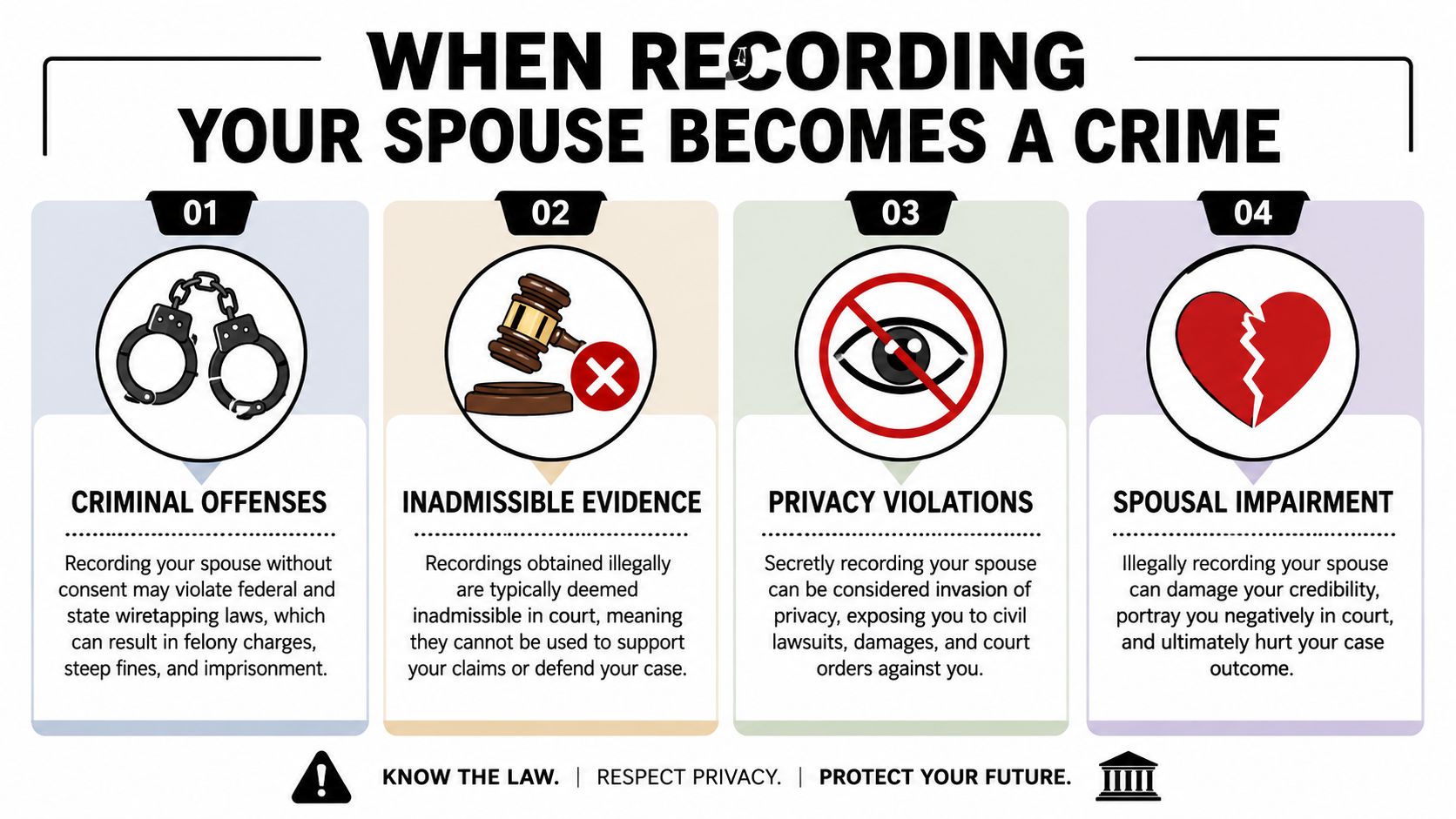
Texas law treats some spouse-surveillance tactics far more harshly than ordinary conversational recording. Under Texas Penal Code §16.06 discussed here, installing a GPS tracker on a spouse's vehicle without effective consent can be a Class A misdemeanor, punishable by up to 1 year in jail and a $4,000 fine. The same source notes that recording in private areas such as bathrooms or bedrooms can violate Texas Penal Code §21.15, which targets invasive visual recording.
Conduct that creates real exposure
The legal risk usually spikes when a spouse moves from documenting conversations to covert monitoring. Examples include:
- Installing a tracker on a vehicle without effective consent
- Placing hidden cameras in private areas of the home
- Leaving devices behind to capture conversations you are not part of
- Accessing phones or accounts to collect private communications
Some people justify this by saying, “It's my spouse,” or “It's our house,” or “The car is community property.” Those facts don't make invasive conduct safe. Marriage doesn't create a license to monitor every movement, every message, or every private moment.
Criminal risk is only part of the problem
A spouse who takes these steps may also face civil claims tied to invasion of privacy or misuse of information. That's one reason I caution people to slow down before they act. The short-term emotional payoff of “catching” someone can be overwhelmed by long-term legal damage.
If you think you need outside help gathering information, there are lawful ways to do it. Before you improvise surveillance on your own, read about the legal and ethical considerations of hiring a private investigator in a divorce case. A licensed professional working within legal limits is very different from a spouse planting devices in the home or on a car.
If your evidence plan could leave you explaining your conduct to law enforcement, it's a bad family law strategy.
Why this matters in divorce and custody
Texas divorce cases often involve emergency emotions and long memories. If your spouse's lawyer can show you engaged in stalking-type conduct, intrusive surveillance, or private-space recording, the focus shifts quickly. Instead of discussing parenting schedules, bank records, business valuation, mediation, or a fair division of the marital estate, you may be defending your own behavior.
That shift can affect temporary hearings and settlement advantage. It can also shape how the judge views your judgment, especially when children are involved.
Will a Recording Help You in Your Divorce Case
Many people assume that if a recording is legal, it will automatically help in court. That isn't how family court works.
Texas sources note that secretly recording inside the home, accessing phones without consent, or recording conversations you are not part of can trigger criminal exposure and civil liability, and unlawfully obtained recordings are likely to be excluded from evidence in family court. Even beyond that, a recording still has to clear ordinary evidence problems before it does you any good.
Judges care about relevance, not drama
A recording may feel explosive to you because you lived through the marriage. A judge sees something else. The judge asks whether the recording proves a fact that matters to the pending issue.
For example:
| Recording content | May matter less than you think |
|---|---|
| Admission of an affair | Often less important than financial or parenting evidence |
| Angry argument between spouses | May show conflict, but not who should receive what relief |
| General insults | Often more heat than proof |
| Vague statements about money | Weaker than actual bank, payroll, or account records |
In a property case, financial documents usually carry more weight than a heated clip. In a custody case, the judge is often looking for patterns tied to the child's best interests, not one dramatic exchange.
Hearsay and foundation issues
Even a lawfully made recording can run into technical problems. If someone offers an out-of-court statement to prove what it says, hearsay objections may come into play. The lawyer offering the recording may also need to show who made it, when it was made, whether it is complete, and whether it accurately reflects what happened.
That means your “gotcha” file can become a side battle over authentication, context, and fairness.
A recording is not a shortcut around the rules of evidence. It's just another item that has to survive them.
Family court is often about patterns
Divorce in Texas is not usually won by surprise. It's built through organized proof over time.
If you're dealing with children, the court may focus on routines, communication, safety, school involvement, and each parent's ability to support a stable schedule. If you're dealing with property, the court may focus on accounts, debts, reimbursement claims, business records, and whether assets are separate or community. In mediation, the practical value of evidence often comes from how clearly it supports a negotiation position.
A recording can occasionally fit into that picture. Often, it doesn't move the case nearly as much as clients expect.
The Hidden Costs of Playing Private Detective
Even when a spouse avoids criminal charges, covert recording can still damage the case in quieter ways. Those are the consequences many people don't think about until it's too late.
It can wreck co-parenting before the decree is signed
If you have children together, you are not just litigating a divorce. You are building a future structure for decision-making, exchanges, school issues, medical choices, and communication. Secret monitoring can poison that relationship fast.
A spouse who learns they were recorded or tracked often becomes less cooperative in mediation and more guarded during temporary-order negotiations. Settlement gets harder. Every text becomes sharper. Every pickup feels loaded.
If the stress is overwhelming, protect your own mental footing instead of trying to control your spouse's conduct. Some people find it helpful to read about seeking mental health help privately when they're balancing confidentiality concerns with the need for support.
It can make you look worse than the behavior you were trying to expose
This is the strategic point many people miss.
Judges expect divorcing spouses to be upset. They do not automatically reward a person who takes matters into their own hands. Secret recordings, account snooping, and home surveillance can make you look manipulative, impulsive, or controlling. In a custody dispute, those impressions matter.
That's especially true if your spouse's lawyer argues that you escalated conflict instead of using lawful court tools.
It can burn money on side issues
Every fight over hidden recordings costs time. Your lawyer may have to review the facts, evaluate legality, assess evidentiary issues, respond to objections, and handle the blowback. That drains attention from the primary issues in your divorce.
If finances are already tight, side disputes can have ripple effects. They can change how much you spend before mediation and influence broader settlement pressure. You can see how costs affect strategy in a divorce by reviewing how private investigator fees can affect your divorce settlement. The lesson applies even more strongly when the evidence-gathering method is risky from the start.
Good strategy narrows the dispute. Secret surveillance usually widens it.
Smarter Ways to Gather Information for Your Case
You do not have to choose between doing nothing and secretly recording your spouse. Texas divorce procedure gives you tools that are stronger, cleaner, and far more useful in court.

Use the evidence you already lawfully have
Start with what is in front of you and legally accessible to you.
- Financial records: bank statements, credit card statements, tax returns, pay stubs, loan documents, retirement statements
- Written communications: emails, texts, calendar entries, and messages you are lawfully part of
- Parenting records: school notices, attendance issues, medical records you are entitled to access, and exchange logs
- Property information: deeds, mortgage statements, business records, insurance documents, and appraisals
This kind of evidence often matters more than a recording because it connects directly to support, custody, reimbursement, waste claims, business valuation, and division of community property.
Formal discovery is where the truth usually comes out
In a Texas divorce, the legal system gives you structured tools to gather information.
Some of the most effective are:
Interrogatories
Written questions your spouse must answer.Requests for Production
Demands for documents such as statements, contracts, emails, or business records.Requests for Disclosure
Basic case information that helps define claims and defenses.Depositions
Sworn testimony taken outside the courtroom.Subpoenas
Orders directed to banks, employers, phone providers, or other third parties for records. If you need records from outside your spouse's control, learn how a subpoena in a Texas divorce can be used strategically.
Evidence gathering comparison
| Factor | Secretly Recording Spouse | Using Formal Legal Discovery |
|---|---|---|
| Legality | Can become risky fast | Built into court process |
| Admissibility | Often challenged | Better foundation for court use |
| Relevance | May be emotionally powerful but legally weak | Targets financial and parenting issues directly |
| Cost efficiency | Can trigger side disputes | Focuses resources on provable issues |
| Effect on settlement | Often inflames conflict | Usually supports negotiation and mediation |
Where legal counsel fits in
A family law attorney can help you decide what evidence matters, what to preserve, what to stop doing, and when to use discovery tools. In some cases, a lawful private investigator may be appropriate. In others, the better move is immediate temporary orders, a preservation plan for digital records, or targeted subpoenas.
The Law Office of Bryan Fagan, PLLC handles Texas divorce, custody, property division, mediation, support, and enforcement matters, which is exactly where these evidence decisions arise. The value of legal guidance here isn't theatrics. It's knowing how to gather proof without damaging your case.
What to Do Next Protect Yourself and Your Case
If you were about to hit record, pause. You may save yourself from a mistake that follows you long after the divorce is final.
Start with these steps
- Stop any covert recording or monitoring now: If you're using hidden devices, trackers, or account access methods you shouldn't be using, stop before the situation gets worse.
- Secure your own accounts and devices: Change passwords, use strong security settings, and preserve access to your own lawful records.
- Gather documents you already have a right to access: Focus on bank statements, tax records, employment information, school records, and key communications.
- Write a timeline: Note dates, events, witness names, and specific concerns involving children, finances, or safety.
- Don't discuss legal strategy with your spouse: Don't announce what evidence you're trying to collect or what your next filing will be.
- Get legal advice before you act again: A short consultation can prevent a long cleanup project.
Remember what actually moves a Texas divorce
Texas divorce procedure is not built around surprise audio clips. It's built around pleadings, service, temporary orders, disclosures, discovery, negotiation, mediation, and, if needed, trial. In custody cases, the court looks at the child's best interests. In property cases, the court examines the marital estate, debts, separate-property claims, and fairness under Texas law. In support and enforcement matters, documentation and procedure matter more than drama.
If you suspect abuse, threats, or immediate danger, your response may need to focus on safety measures and emergency legal relief, not secret recordings. If you suspect hidden money, the answer is usually discovery, subpoenas, and focused case strategy.
The strongest move is usually the least dramatic one. Preserve what you lawfully have, stop taking risks, and let the legal process do its job.
If you're dealing with a divorce, custody dispute, or concerns about what evidence you can safely use, schedule a free consultation with Law Office of Bryan Fagan, PLLC. You can get clear guidance on what to stop doing, what to preserve, and how to build a case that protects your rights without creating new legal problems.