Skip to content
It’s one of the most frustrating things that can happen after a divorce or custody case: you have a court order meant to bring stability, and your ex is flat-out ignoring it. When that happens, filing a motion for contempt is your most powerful tool in Texas to get a judge’s attention and force your ex to comply.
This isn't just about tattling; it's about holding someone accountable for violating a direct order from a judge and getting your family’s life back on track.
Understanding Your Power When a Court Order Is Broken

When you walk out of a Texas family courtroom with a signed order—whether it’s for divorce, custody, or child support—that piece of paper is not a suggestion. It’s a legally binding command.
So when your ex-spouse or co-parent decides to disregard it, they aren't just disrespecting you; they are defying the court itself. This is exactly why the Texas Family Code gives you a remedy: the ability to file a motion for contempt.
A motion for contempt is your formal request asking the judge to enforce their own order. You're putting the court on notice that a violation has occurred and asking it to step in. The law provides this specific legal tool to make sure court-ordered arrangements are followed, protecting the stability your family was supposed to have.
The Two Types of Contempt in Texas Family Law
In Texas, contempt isn’t a one-size-fits-all concept. It’s broken down into two types, and each has a very different goal. Knowing the difference helps you and your lawyer map out the right strategy for your case.
-
Civil Contempt: The goal here is to coerce future compliance. Think of it as the court saying, "You need to start following this order, and we're going to hold a consequence over your head until you do." It's forward-looking. For instance, if your ex is behind on child support, a judge could order them to jail until they make a specific payment to "purge" the contempt and get released. The point isn't just punishment—it's getting the payments flowing again.
-
Criminal Contempt: This is all about punishment for past, willful disobedience. It addresses violations that have already happened and can't be undone. The court is essentially saying, "You knowingly broke our order, and there's a price to pay for that." Sanctions can include a fixed jail sentence of up to 180 days per violation, a fine, or both. This is often used when a parent intentionally withholds visitation—an act that you can't get back but must be punished to stop it from happening again. For more on this specific problem, check out our guide on what to do if your ex is withholding visitation in Texas.
Whether your ex has failed to pay support, refused to hand over property as ordered, or denied your court-ordered time with your children, filing a motion for contempt sends an unmistakable message: these actions have serious legal consequences.
Deciding if a Contempt Motion Is Your Best Option
It’s deeply frustrating when your ex simply ignores a court order—an order that was supposed to create stability and end the conflict. Before you rush to the courthouse, though, it’s critical to pause and think strategically. Filing for contempt isn't just about being right; it's about being able to prove you're right to a Texas judge.
To win a contempt action, you have to prove four key elements. Think of them as the four legs of a table—if even one is missing, your entire case can come crashing down.
The Four Pillars of a Contempt Motion
You and your attorney will need to build a rock-solid case showing the judge that your ex didn't just violate the order, but did so without a good reason.
-
A Clear and Unambiguous Order: The court order itself has to be crystal clear. If the language is vague or open to multiple interpretations, a judge is unlikely to hold your ex in contempt. For example, an order that gives you "reasonable" possession time is probably too vague. An order stating you get possession on "the first, third, and fifth weekends of the month" is specific and enforceable.
-
Knowledge of the Order: You have to show the judge that your ex actually knew what the court commanded them to do. This one is usually easy to prove, since they were likely in court when the order was made or were properly served with a signed copy.
-
The Ability to Comply: This is where many contempt cases are won or lost. You must prove that your ex had the financial or physical ability to follow the order. If your ex was ordered to pay $1,000 a month in child support, you’ll need evidence showing they had the income or resources to make that payment.
-
Willful Violation: Finally, you have to demonstrate that their failure to comply was a deliberate choice, not an accident or something beyond their control. It must be an intentional act (or failure to act).
When Is a Contempt Motion the Right Choice?
Let's look at a classic scenario: Your ex-spouse has a stable, well-paying job but has suddenly decided to stop paying court-ordered child support. You can pull their employment records and bank statements to prove they absolutely had the ability to pay but simply chose not to. This is a textbook example of a willful violation and a perfect situation to file a motion for contempt.
Another clear-cut case is when a parent repeatedly and intentionally blocks your court-ordered weekend visits, giving you one flimsy excuse after another. Their consistent actions create a pattern of willful non-compliance that judges take very seriously.
The threat alone is often enough. The goal of civil contempt is compliance, not just punishment. In many cases, simply serving the other party with a motion is enough to get them to correct their behavior immediately.
When Should You Pause and Reconsider?
Contempt is a serious legal tool, but it’s not always the best first move. If the violation was minor and seemed unintentional—like your ex being 15 minutes late for a pickup one time—filing for contempt might look overly aggressive to a judge. It could also do serious damage to your co-parenting relationship.
Likewise, if your ex genuinely cannot comply because of a sudden, verifiable event like a serious illness or an unexpected job loss, a contempt motion is likely to fail. In those situations, your ex lacks the ability to comply, which is a crucial element of your case. A motion to modify the existing order would be a much more appropriate step.
Here’s a quick way to think through some common situations.
Should You File for Contempt? Common Scenarios
This table can help you evaluate whether a particular violation is strong enough to warrant filing a contempt motion in a Texas family court.
| Violation Scenario | Is a Contempt Motion Appropriate? | Key Factor to Prove |
|---|---|---|
| Missed Child Support | Yes, if they had the money. | Ability to Pay: Show they had income or assets but chose not to pay. |
| Denied Visitation | Yes, especially if it's a pattern. | Willful Violation: Document each denial and the excuses given. |
| Refusal to Pay Medical Bills | Yes, if the order is specific. | Clear Order: The order must clearly state who pays what percentage. |
| One-Time Lateness (15 mins) | No, probably not. | Minor Violation: This often isn't seen as a willful, serious breach. |
| Violation Due to Job Loss | No, a modification is better. | Lack of Ability: They can't be held in contempt if they truly can't comply. |
| Refusal to Sign a Car Title | Yes, if ordered by the decree. | Willful Violation: This is a direct refusal to follow a clear command. |
Ultimately, filing a motion for contempt has proven to be an effective enforcement tool in family law. Research shows that in many states, the mere threat of sanctions prompts most non-paying parents to settle their debts quickly, with very few cases resulting in actual jail time. You can read more about the effectiveness of these motions in family law cases to understand just how powerful this tool can be.
Navigating the Process of Filing Your Motion
Feeling ready to move forward is a big step, but the legal paperwork can feel intimidating. Don't worry. This is a step-by-step breakdown of how to file a motion for contempt in Texas, so you know exactly what’s happening. This isn't about complicated legal maneuvers; it's about following a clear path to get a judge's attention.
The goal is to present a clean, precise, and powerful case to the court, and that all starts with drafting the right documents.
Step 1: Drafting a Strong Motion for Enforcement
Your first move is to create the "Motion for Enforcement," which is the formal name for a contempt motion in Texas. Think of this document as your official story to the judge. It needs to be written with absolute clarity because any vagueness could give your ex an easy way out.
You have to build your case brick by brick. For every single violation, you must specifically state:
- What provision was violated: Quote the exact part of the court order that was ignored. For example, "Paragraph 5.2 of the Final Decree of Divorce, signed on June 15, 2023."
- How it was violated: Describe exactly what the other person did or failed to do. Something like, "Respondent failed to pay the court-ordered child support of $1,200."
- When it was violated: Provide the specific date of each failure. For instance, "on September 1, 2024."
You must do this for every single violation. If your ex missed six child support payments, your motion will list six separate violations, each with its own date and details. This level of precision isn't just a good idea—it's legally required and paints a clear picture for the judge of the ongoing non-compliance.
Step 2: The Sworn Affidavit and Proposed Order
Your motion is just one piece of the puzzle. To make your filing complete and truly effective, you need two other critical documents.
First is a sworn affidavit. This is your signed, notarized statement testifying under oath that every fact you've alleged in the motion is true and correct. It adds serious legal weight to your claims and is a mandatory part of the process.
Second, you'll attach a "Proposed Order" for the judge. This is basically a template of the order you want the judge to sign if you win. It will list the violations and include the specific relief you're asking for, whether that's jail time, fines, or an order for your ex to pay your attorney's fees. Providing this makes the judge's job easier and clarifies exactly what you're seeking.
By preparing a detailed motion and proposed order, you are not just complaining to the court—you are providing a solution. This proactive approach is often well-received by judges who appreciate having a clear roadmap for enforcement.
This visual shows the simple, but crucial, elements you must prove: that a clear order existed, that it was violated, and that the violation was intentional.
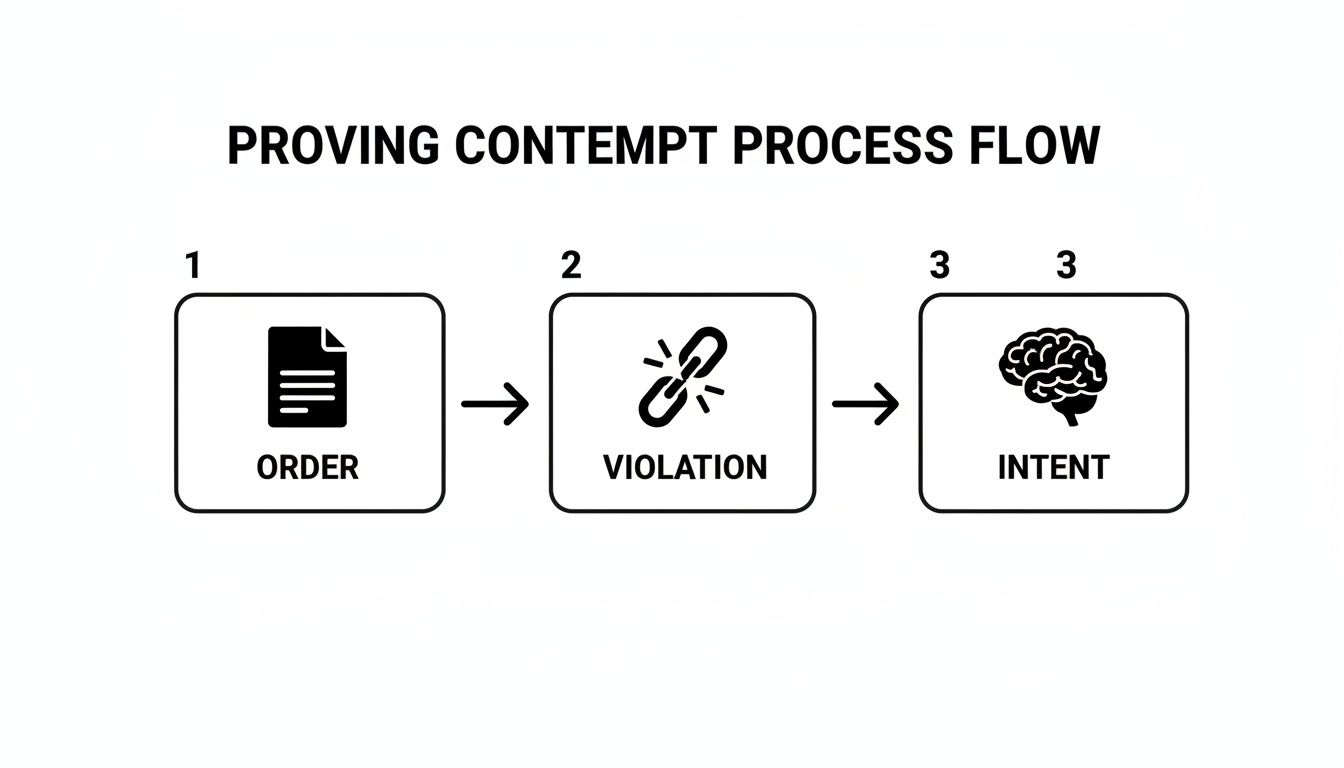
Successfully proving these three points is the foundation of every single contempt action in Texas.
Step 3: Filing and Serving the Motion Correctly
Once your documents are drafted and your affidavit is notarized, the motion must be officially filed with the district clerk in the county where your original order was issued. This usually involves paying a filing fee.
After filing, the next step is perhaps the most critical: service. You can't just email or text the documents to your ex. Texas law demands formal "personal service," which means a neutral third party—usually a sheriff's deputy or a private process server—must physically hand-deliver a copy of the filed motion and a citation to the other party.
This step is completely non-negotiable. It ensures your ex has proper legal notice of the hearing and satisfies their due process rights. Without proof of proper service, the judge cannot and will not hear your contempt case.
Finally, remember that local court rules and timelines can differ. Courts in Harris County might have different scheduling procedures than those in Dallas or Travis County. An experienced local family law attorney understands these nuances, ensuring your motion is filed correctly and your case moves forward without hitting unnecessary speed bumps. This local knowledge can be invaluable in getting your case heard and resolved efficiently.
Getting Ready for Your Contempt Hearing
Filing the motion is a big step, but the real work starts now. Your focus needs to shift entirely to preparing for your day in court. This is where you’ll build a rock-solid case that proves to the judge, beyond a shadow of a doubt, that your ex deliberately ignored a clear order.

This prep work isn't just about winning; it's about walking into that courtroom feeling organized, confident, and ready. The hearing is your chance to present the facts calmly and clearly, with solid proof to back you up.
Gathering Your Evidence: The Foundation of Your Case
You can’t just walk in and tell the judge your ex violated the order; you have to show them. Tangible evidence is what turns your complaints into undeniable facts. Your mission is to gather every single piece of documentation that supports each violation you listed in your motion.
Here’s a practical rundown of the kind of evidence that really makes a difference in a Texas family court:
- Financial Records: For unpaid child support or medical bills, you need bank statements, pay stubs, and copies of cancelled checks. These documents can show both the failure to pay and, just as importantly, the other person's ability to pay.
- Written Communications: This is often where the gold is. Text messages, emails, and even social media messages can be incredibly powerful. A text that says, "You're not seeing the kids this weekend, I don't care what the order says," is a smoking gun—a direct admission of a willful violation.
- Visitation Logs: Keep a detailed calendar or journal. Document every single missed visit, every late pickup or drop-off. Note the date, the time, and any excuse that was given. Over time, this creates a clear pattern of non-compliance that's hard for a judge to ignore.
- Third-Party Witness Testimony: Sometimes, the most powerful evidence comes from someone neutral. Think about teachers, coaches, or family friends who might have witnessed a denied exchange or heard the other party refuse to follow the order. Their testimony can be incredibly compelling.
The key is to organize all this evidence chronologically for each specific violation. This makes it easy for the judge to follow the narrative and grasp the full extent of the disobedience.
Understanding the Courtroom and Your Role
Walking into a courtroom can feel intimidating, but knowing what to expect makes all the difference. A contempt hearing is a formal proceeding. The judge will listen to both sides, look at the evidence, and then make a decision.
The hearing will have a clear structure. First, you (or your attorney) will present your case. This means showing your evidence and giving clear, concise testimony about the violations. Stick to the facts—what happened, when it happened, and how it broke the specific terms of the order. Avoid getting emotional; let the proof do the talking.
A Judge's Perspective: Judges in contempt hearings are looking for two things above all: clarity and proof. They need to see a specific part of the court order that was violated and irrefutable evidence that the violation was willful. A well-organized, factual presentation makes their job easier and your case much stronger.
After you've presented your side, your ex gets their turn to respond and present any defenses or evidence they might have. They might be questioned by your attorney, and you might be questioned by theirs. It's absolutely critical to stay calm, answer truthfully, and always direct your answers to the judge. Let your lawyer handle the legal back-and-forth.
The importance of following proper procedure isn't unique to family law. For instance, in a major bankruptcy case, a company co-founder managed to avoid contempt sanctions by proving his non-U.S. nationality, showing how a technically correct response can be a complete defense. It’s a good reminder that, just like in family law, responding effectively to violations is key to enforcement. You can discover more about how procedural responses impact contempt rulings in complex legal cases.
Success in a contempt hearing really comes down to preparation. Organize your proof meticulously, tying each piece of evidence to a specific violation from your motion. When it's your turn to testify, be calm and stick to the facts. Your job is to give the judge a clear, undeniable record of what happened. When you do that, you give the court the power it needs to enforce its own order and protect your rights.
What Happens When a Judge Finds Someone in Contempt?
The moment a Texas judge says, "I find you in contempt," is a powerful one. It’s the culmination of all your hard work gathering evidence and presenting your case—a formal acknowledgment that the court's authority was defied. But what happens next? This is where the judge's enforcement powers come into full force, with a range of sanctions designed to correct the wrong and ensure it doesn't happen again.
When a judge finds your ex in contempt, they have a broad toolkit of remedies available under the Texas Family Code. These aren't just about punishment; they are primarily aimed at achieving justice and compelling the other party to finally follow the order. The specific outcome will depend on whether the contempt was civil or criminal, but the message is always clear: court orders are not optional.
Remedial Orders to Force Immediate Compliance
Often, the judge's first priority is to fix the immediate problem. These are known as remedial orders, and they are designed to make you whole and get things back on track as quickly as possible. The goal is practical and solution-focused.
For example, if your ex is behind on child support, the judge can:
- Order a lump-sum payment to catch up on all arrears.
- Establish a payment plan with an income withholding order to ensure future payments are made directly from their paycheck.
- Require them to pay for your attorney’s fees and court costs, so you aren't financially penalized for having to enforce your rights.
If the issue was denied visitation, a remedial order might grant you make-up possession time to compensate for the weekends or holidays you lost with your children. These orders are direct, actionable, and focused on correcting the specific harm caused by the violation.
Coercive Sanctions: Fines and Jail Time
When remedial orders aren't enough or the violation was particularly defiant, a judge can turn to more severe, coercive sanctions. These are the teeth behind the contempt process and what truly motivates compliance.
The two main coercive tools are fines and jail time. Under the Texas Family Code, a judge can sentence a person to jail for up to 180 days for a single violation of the court order. For someone who has missed ten child support payments, the potential jail time can add up quickly. Additionally, the judge can impose a fine of up to $500 per violation.
It is critical to understand that jail time in civil contempt is not purely punitive; it is coercive. The judge's order will often state that the person can "purge" the contempt and be released from jail by performing a specific act—like paying the full child support arrears. They literally hold the keys to their own cell.
This power isn't just limited to family law. In high-stakes international disputes, financial sanctions can be immense, as when a U.S. federal court ordered Romania to pay escalating weekly fines starting at $25,000 for defying a court order. These cases illustrate the serious financial bite of contempt powers, a principle that echoes in Texas family courts.
Community Supervision as an Alternative
Judges often prefer to avoid jail if possible, especially if it means a parent will lose their job and be unable to pay support. In these cases, a judge can place the non-compliant party on community supervision (probation) for up to ten years.
This allows the person to remain out of jail, but they must strictly follow the judge’s conditions, which could include making regular payments, attending counseling, or reporting to a probation officer. If they violate the terms of their probation, the judge can revoke it and order them to serve the original jail sentence. This gives the court long-term oversight and a powerful incentive for ongoing compliance.
Being on the receiving end of a contempt motion is a serious matter, and there are specific ways to defend against an accusation. If you're facing this situation, it is vital to understand your rights and the defenses that may be available to you. Learn more by protecting your rights when accused of contempt of court in a Texas divorce.
What to Do When It's Time To Enforce Your Rights
It feels defeating when you have a court order—the exact document that’s supposed to bring stability and predictability to your life—and the other parent is completely ignoring it. It can make you feel powerless, but you’re not. You have the right to hold them accountable, and filing a motion for contempt is a powerful, direct way to do just that.
When your ex-spouse or co-parent refuses to follow the rules, it’s not just about a single missed visit or late payment. It’s about a fundamental lack of respect for you, your children, and the court itself. While the legal road ahead might seem complicated, it's a well-traveled one designed to protect you and get things back on track.
You Don't Have to Do This Alone
At The Law Office of Bryan Fagan, PLLC, we understand. We’ve guided countless Texas families through this exact process, helping them stand up for their rights and restore order when the other side won't cooperate. We have the experience to navigate every step with confidence.
A contempt motion is a serious tool, and it's often part of a bigger legal strategy. For a complete picture of your enforcement options, our detailed guide on the motion to enforce is a great place to start.
What to Do Next
Your peace of mind is worth fighting for. The stability of your family shouldn’t be left to chance or the whims of a non-compliant co-parent. Taking decisive action is the first step toward getting the resolution you deserve and reminding everyone that a court order isn't just a suggestion—it's the law.
If you’re ready to hold your ex accountable and enforce your court order, we are here to help. Schedule a free, no-obligation consultation with our team. Let us be your partner in protecting your family, your rights, and your future. We’re here to give you the clear, authoritative guidance you need to move forward.
Common Questions About Contempt Motions
When you're facing a contempt action, a lot of specific questions can pop up. Here are some straightforward answers to the concerns we hear most often from our clients in Texas.
How Much Does It Cost to File a Motion for Contempt in Texas?
The costs can vary. You’ll have court filing fees, which are different in every county, plus your attorney's fees, which depend on how complex your case is.
But here’s the good news: the Texas Family Code gives judges the authority to order the non-compliant party to cover your attorney’s fees and all court costs if they’re found in contempt. This rule exists so that you aren’t financially penalized for simply trying to enforce your rights.
Can My Ex Be Ordered to Pay for My Attorney?
Yes, absolutely. If the court finds your ex-spouse in contempt of the order, it's a common and powerful remedy for the judge to order them to reimburse you. This includes all reasonable attorney's fees you had to spend to bring the enforcement action in the first place. It’s a key part of holding them accountable.
What If My Ex Files for Bankruptcy to Avoid Paying Child Support?
This is a common fear, but thankfully, the law is on your side here. Child support and spousal support are considered domestic support obligations, which are generally non-dischargeable in bankruptcy.
Filing for bankruptcy won't erase these critical debts. A contempt action can still move forward to enforce them.
How Long Does the Contempt Process Usually Take?
The timeline really depends on the court's schedule and the specifics of your case. Typically, after filing a motion for contempt, a hearing gets set within a few weeks to a couple of months. An experienced attorney can help push the process along as efficiently as possible, especially in time-sensitive situations like denied visitation.
While this article is all about contempt motions, these issues often stem from other family law matters. For a better understanding of related legal documents that can come into play, you might find it helpful to explore resources on understanding prenuptial agreements.
You don't have to navigate this complicated process alone. At The Law Office of Bryan Fagan, PLLC, our experienced attorneys are ready to help you enforce your court order and protect your family's stability. Schedule a free, no-obligation consultation today by visiting https://texasdivorcelawyer.us to discuss your case and learn how we can help you move forward with confidence.