 Skip to content
Facing a divorce is tough, but when military service is involved, the path forward can seem especially uncertain. A military divorce lawyer in Texas is more than just a family law attorney; they are a specialist who understands the unique intersection of federal military regulations and the Texas Family Code. With the right guide, you can navigate this challenging time with confidence and a clear plan for your future.
The Unique Path of a Texas Military Divorce

When you or your spouse is a service member, your divorce isn't just governed by Texas law. It's also subject to a complex web of federal rules that can dramatically change the outcome of your case. This dual layer of legal authority makes military divorce a highly specialized field, where a small oversight can have massive, long-term consequences.
Unlike a typical civilian divorce, your case will be shaped by powerful federal statutes like the Servicemembers Civil Relief Act (SCRA) and the Uniformed Services Former Spouses’ Protection Act (USFSPA). These aren't just minor regulations; they are designed to address the unique realities of military life, from overseas deployments to the division of hard-earned retirement benefits.
Navigating State and Federal Laws
Think of it like this: The Texas Family Code is the main highway for your divorce, setting the rules for property division, child custody, and support. Federal laws, however, act as critical detours and overpasses that only apply to military families. An attorney who doesn't know this landscape can easily get you lost.
Here are a few practical examples of how this plays out:
- Protecting Your Rights During Deployment: The SCRA is a game-changer. It allows active-duty service members to request a temporary pause, or "stay," in divorce proceedings if their military duties make it impossible to participate fairly. This ensures you aren't put at a disadvantage simply for serving your country.
- Dividing Military Retirement: The USFSPA is what gives Texas courts the authority to treat military retired pay as community property. Without a lawyer who deeply understands this act, you could risk an unfair division of what is often a couple's most valuable asset.
- Figuring Out Where to File: Constant PCS moves can make it tough to know which state has jurisdiction. An experienced attorney knows how to determine the correct place to file based on your legal "domicile" versus your temporary duty station—a crucial first step that can make or break a case.
Unique Stressors Facing Military Families
The demands of military life create unique pressures on a marriage. The endless cycle of deployments, long separations, and the stress of reintegrating into family life can wear down even the strongest couples. These aren't just personal challenges; they have real legal implications.
When you're planning your new future, you'll also need to consider practical matters like specialized military moving and relocation services. An attorney who understands the military lifestyle can help you account for these details in your final decree.
Military divorce rates have often been higher than civilian rates, a direct reflection of these unique pressures. Statistics have shown that 3% to 3.4% of military marriages end in divorce each year, with female service members experiencing even higher rates. This data underscores why specialized legal support isn't a luxury—it's a necessity.
Ultimately, a military divorce is more than just a legal battle. It’s a life-altering transition that requires a specific kind of support. You need an advocate who not only knows the law inside and out but also truly respects the sacrifices that military families make every single day.
Where to File Your Case: Nailing Down Jurisdiction in Texas
https://www.youtube.com/embed/wBonUkZWj8c
One of the very first hurdles you'll face is figuring out, "Where can we actually file for divorce?" For military families, the answer isn’t always as simple as looking at a map. Constant moves can blur the lines, but thankfully, Texas law provides clear rules to bring certainty to this crucial first step.
To file for divorce in Texas, you have to meet specific residency requirements. The Texas Family Code is very clear on this: at least one spouse must have lived in the state for a minimum of six months, and in the specific county where you plan to file for at least 90 days, before submitting the petition.
This rule often triggers immediate questions for service members. What if you're stationed at Fort Cavazos (formerly Fort Hood) but still have your driver's license from back home? Or what if you're deployed overseas, but your spouse and kids are living in San Antonio? This is where a critical legal distinction comes into play.
Domicile Versus Residence
In the eyes of a Texas court, your residence is simply where you are currently living. Your domicile, on the other hand, is your permanent, legal home—the place you consider your true home base and intend to return to. For military members, your duty station is your residence, but your legal domicile might be the state where you enlisted, own property, or are registered to vote.
This distinction is a powerful tool for military families. It means:
- You can file in Texas even if you're stationed elsewhere. If you can prove that Texas is your legal domicile and you meet that six-month requirement, you can file here even if you're on a base in California or Germany.
- Your non-military spouse can file in Texas. If your spouse has lived in Texas for the required six months and 90 days in the county, they can file for divorce here, no matter where you are currently stationed.
Proving domicile isn't just about what you say; it's about what you do. It involves showing intent through actions like voting in Texas, paying state taxes, or maintaining a Texas driver's license. Working with a military divorce lawyer can help you pull together the right evidence to confidently establish jurisdiction. You can learn more about how this works in our detailed guide on understanding personal jurisdiction in a Texas divorce.
How the SCRA Protects Active-Duty Members
Once you've figured out where to file, another federal law offers a critical layer of protection for the service member: the Servicemembers Civil Relief Act (SCRA). This law was specifically designed to ensure that military duties don't unfairly sabotage your legal rights back home.
The SCRA allows an active-duty service member to request a temporary pause, known as a "stay," in civil proceedings like divorce. If your deployment or other duties materially affect your ability to respond to a lawsuit or appear in court, a judge can grant a stay for at least 90 days.
This isn’t a get-out-of-divorce-free card, but it is a vital safeguard. It ensures you have a fair chance to participate in your own case and prevents a "default judgment" from being entered against you simply because you were serving your country and couldn't respond in time.
Of course, this protection can be waived if both parties agree to move forward. But understanding your rights under the SCRA is absolutely essential to prevent being put at a serious legal disadvantage.
What to Do Next
Getting jurisdiction right is the foundation of your entire divorce case. A mistake here can get your case thrown out, wasting precious time and money. Before you file a single piece of paperwork, it's vital to confirm that you meet the Texas residency and domicile requirements.
A quick consultation with an experienced attorney can clear up any confusion in minutes. We can analyze your specific situation—whether you're stationed at Lackland AFB, deployed abroad, or living apart from your spouse—and give you a clear, strategic path for moving forward in the correct court.
Don't let jurisdictional confusion add to your stress. Schedule a free, confidential consultation with the Law Office of Bryan Fagan, PLLC today. Our team gets the nuances of military life and is ready to help you navigate this process with confidence and clarity. Call us to protect your rights and secure your future.
Dividing Military Retirement and Key Benefits
Your military retirement pay is more than just a number on a statement. It represents years of dedication and sacrifice, and it's often the most significant financial asset you and your spouse have built together. Figuring out how to divide it in a Texas divorce can feel overwhelming, as it sits at the complicated intersection of federal law and state community property rules. But with the right approach, you can navigate this process confidently and protect your financial future.
The entire process is governed by a federal law called the Uniformed Services Former Spouses’ Protection Act (USFSPA). This is the key that unlocks the door, giving Texas courts the authority to treat military retired pay as community property. This means the portion earned during the marriage can be divided in a "just and right" manner.
Without the USFSPA, state courts would have no power to touch this crucial asset. That would leave many former spouses without a share of the benefits they helped support through years of moves, deployments, and uncertainty. A skilled military divorce lawyer is essential for applying this law correctly to your unique situation.
Understanding the Famous 10/10 Rule
One of the biggest points of confusion in a military divorce is the “10/10 Rule.” Many people mistakenly believe this rule determines if a former spouse gets a piece of the retirement pie. That's not true at all.
Think of the 10/10 Rule as a payment method, not an eligibility requirement. It simply dictates how the former spouse gets paid. For the Defense Finance and Accounting Service (DFAS) to send payments directly to the former spouse, two things must be true:
- The marriage lasted for at least 10 years.
- There was an overlap of at least 10 years of creditable military service during the marriage.
If you meet the 10/10 Rule, DFAS cuts the check. If you don't, the service member is still on the hook to pay their ex-spouse directly from their own bank account. The rule is about the logistics of payment, not the right to it.
This infographic breaks down some of the other core requirements you'll face when starting a military divorce in Texas.
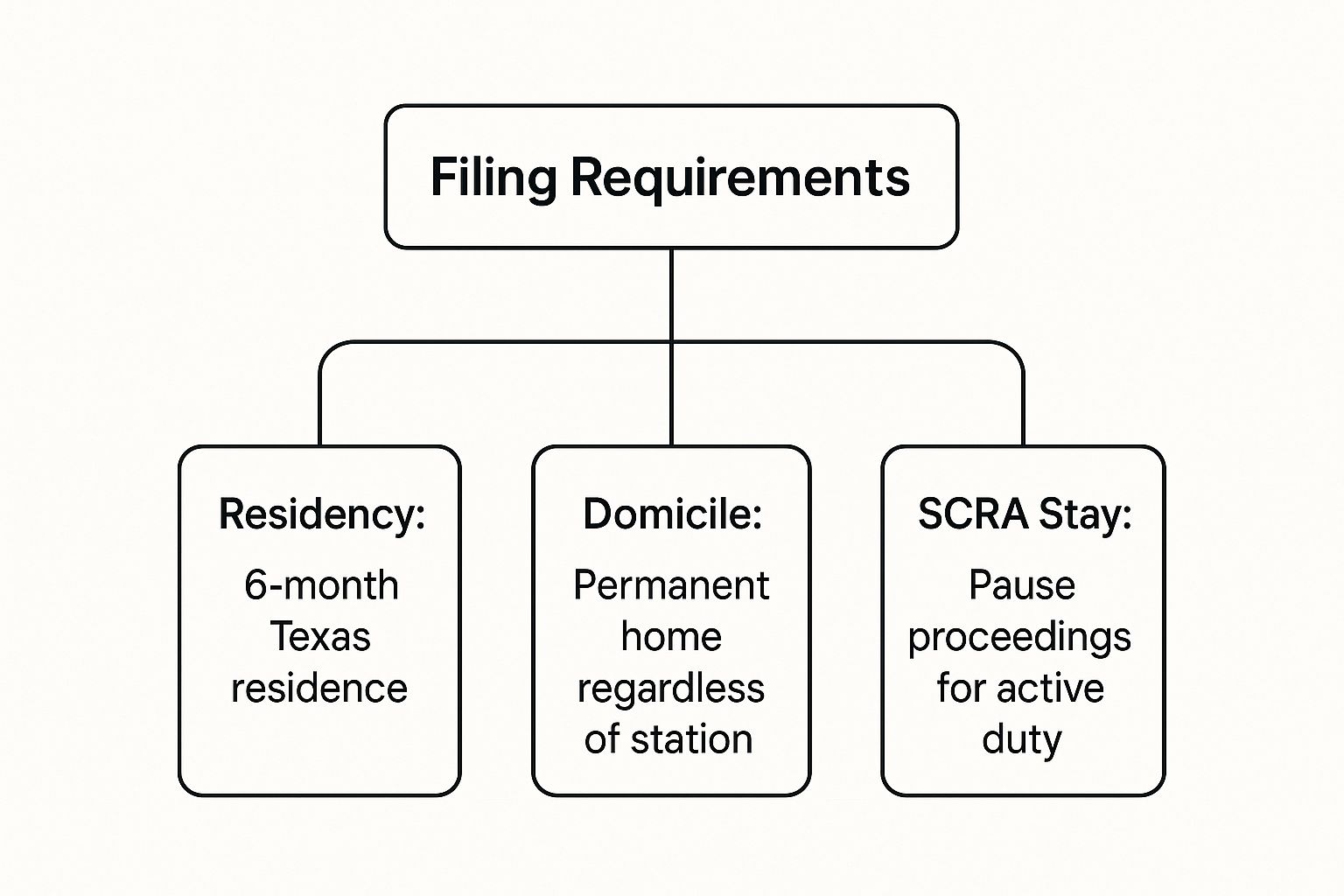
As you can see, understanding residency rules and military-specific protections like the SCRA is just as critical as knowing how benefits are divided.
Beyond Retirement: Disposable Retired Pay
When it's time to divide the military pension, Texas courts can only touch what's known as "disposable retired pay." This isn't the gross amount that shows up on a paystub. Instead, it's the total retired pay minus a few key deductions—most importantly, any pay waived to receive VA disability benefits.
Key Takeaway: If a service member waives a portion of their retirement to receive non-taxable VA disability benefits, that waived amount cannot be divided by the court. This is a critical detail that can significantly reduce the amount available for division and is a frequent source of costly legal errors.
This is often one of the biggest challenges in a Texas military divorce. The USFSPA allows the court to treat the pay as a divisible asset, but federal law also protects VA disability benefits from division. Getting this calculation wrong can have devastating financial consequences for years to come.
Other Essential Benefits to Consider
While retired pay gets all the attention, it's not the only military benefit that needs to be addressed in your divorce decree. Forgetting about these can leave your financial future exposed.
- Thrift Savings Plan (TSP): This is the military's version of a 401(k). Any contributions made to a TSP during the marriage are considered community property. A special court order, similar to a Qualified Domestic Relations Order (QDRO), is required to divide these funds properly and without tax penalties.
- Survivor Benefit Plan (SBP): This is an annuity that can provide a former spouse with a portion of the retired pay after the service member passes away. This is not automatic. The court must order the service member to elect "former spouse" SBP coverage, and there's a strict deadline—specific paperwork must be filed with DFAS within one year of the divorce.
Navigating the division of these complex assets is why we've dedicated so much time to creating helpful resources. If you're interested in learning more about how retirement assets are handled in a divorce, you should read our guide on navigating retirement assets and benefits in divorce.
Below is a quick summary of how some of the most common military benefits are handled.
Key Military Benefits in a Texas Divorce
When you're dealing with a military divorce, it's not just about the pension. A variety of other benefits are on the table, each with its own set of federal and state rules. Understanding how Texas courts treat these assets is the first step toward a fair settlement.
| Benefit Type | How It's Divided in Texas | Key Federal Law/Rule |
|---|---|---|
| Military Retired Pay | The community property portion (earned during marriage) of "disposable retired pay" is divisible. | Uniformed Services Former Spouses’ Protection Act (USFSPA) |
| VA Disability Pay | Not divisible as property. Pay waived to receive disability benefits is also not divisible. | 10 U.S.C. § 1408 (Mansell v. Mansell) |
| Thrift Savings Plan (TSP) | The community portion is divisible via a specific court order similar to a QDRO. | 5 U.S.C. § 8435(c) |
| Survivor Benefit Plan (SBP) | Not divisible property, but a court can order a service member to elect the former spouse as a beneficiary. | 10 U.S.C. §§ 1447–1455 |
This table is just a starting point, but it highlights the importance of working with an attorney who understands the nuances of both federal military regulations and Texas community property law.
What to Do Next
Protecting your share of military retirement and benefits demands precision and proactive planning. A single mistake or omission in your Final Decree of Divorce can be irreversible, potentially costing you tens or even hundreds of thousands of dollars over your lifetime.
- Gather Your Documents: Start collecting statements for all retirement accounts, including your Leave and Earnings Statements (LES) and TSP account information.
- Understand Your Eligibility: Figure out if your marriage meets the 10/10 Rule for direct DFAS payments. This will help you plan for how you'll receive your funds.
- Discuss SBP Coverage: Talk to your attorney about whether securing Survivor Benefit Plan coverage is the right move to protect your long-term financial security.
You don't have to figure this all out on your own. At the Law Office of Bryan Fagan, PLLC, we have guided countless military families through this exact process. Let us help you build a clear strategy to protect what you've earned.
Creating a Stable Custody Plan for Your Children

When military service is the backdrop of your family life, the idea of creating a child custody schedule can feel overwhelming. For military parents, the goal is exactly the same as any other family: give your children stability and security. The difference is that getting there requires a parenting plan tough enough to handle deployments, relocations, and the unique challenges of long-distance co-parenting.
In any custody case, Texas courts operate under one guiding principle: the “best interest of the child.” This isn't just a phrase; it's the legal standard woven throughout the Texas Family Code that forces judges to prioritize your child's physical and emotional well-being above all else. A sharp military divorce lawyer in Texas will help you frame your proposed custody plan to show the court exactly how it meets that standard, even with the unpredictability that military life throws your way.
Building a Plan for Military Realities
A cookie-cutter Texas possession order just won't cut it for a military family. You need something custom-built—detailed enough to provide structure but flexible enough to bend when your service demands it. This means thinking ahead about situations civilian families almost never have to consider.
A solid military parenting plan should always cover:
- Deployments: Spell out exactly what happens to the possession schedule when the service member is deployed. This should include how often and by what method (video calls, emails) you'll communicate while they're gone.
- Permanent Change of Station (PCS): Have a game plan for how custody will be handled if one parent gets orders to move. Will the child relocate? How will long-distance visitation work? Answering this now saves a huge headache later.
- Long-Distance Communication: Get specific about how the non-possessory parent will maintain a strong bond. Schedule regular video and phone calls, and figure out travel logistics for school breaks.
- Travel Arrangements: Decide who pays for and handles the logistics of getting the child back and forth for long-distance visits.
Planning for these things now means you can avoid expensive and stressful trips back to court every time you get a new set of orders.
Designating a Temporary Guardian During Deployment
One of the most important moves a deploying parent can make is protecting their parental rights while they're gone. Under Texas Family Code Chapter 153, a parent facing deployment can ask the court to temporarily designate someone—like a grandparent, stepparent, or another trusted relative—to step in and exercise their possession time with the child.
This is a critical safeguard. Without this court order, the non-deploying parent could legally block grandparents or other family from seeing the child. This designation ensures your child maintains those vital family connections while you are serving your country.
This isn't just a handshake agreement; it has to be a formal court order. An experienced attorney makes sure the paperwork is filed correctly, protecting your visitation rights and your child's relationships while you're away.
Communication Protocols: The Key to Co-Parenting
When you live hundreds or thousands of miles apart, clear and consistent communication is non-negotiable. Your parenting plan needs to be your co-parenting rulebook, leaving no room for guesswork and reducing the chance for conflict.
Think about including specific protocols for:
- Decision-Making: How will you make joint decisions on big things like education, non-emergency healthcare, and religious upbringing?
- Information Sharing: Create a rule that both parents must share things like report cards, medical records, and info on extracurriculars.
- Emergency Contacts: Make sure both parents always have current contact information for each other and any emergency caregivers.
These might seem like minor details now, but they are the bedrock of a stable and predictable environment for your kids, no matter where your military career takes you.
What to Do Next
Your children’s stability is the top priority, and a thoughtfully drafted custody plan is the best tool you have to protect it. Don't let your family settle for a generic order that ignores the realities of military life.
At The Law Office of Bryan Fagan, PLLC, we know how to craft flexible, enforceable parenting plans that actually work for service members. We can help you see around corners, anticipate challenges, and create solutions that protect your relationship with your children. Schedule a free, confidential consultation with us today to start building a secure future for your family.
Why a Specialized Military Divorce Lawyer Matters

You might think any good family lawyer can handle your divorce, but when military service is part of the equation, that assumption can be a costly mistake. A military divorce isn't just a standard Texas divorce with a few extra forms. It's a unique legal field where state and federal laws collide, and trying to navigate it without an expert is like trying to cross an ocean on a river raft—you're just not equipped for the journey ahead.
Choosing the right advocate isn't just about representation; it's about securing your future. A specialized military divorce lawyer in Texas brings a depth of knowledge that a general family law attorney simply can't match. This expertise becomes your shield against common—but devastating—errors that can affect your finances and parental rights for years to come.
Preventing Costly Errors in Property Division
One of the biggest minefields in a military divorce is the division of military retirement benefits. An attorney who doesn't live and breathe the Uniformed Services Former Spouses’ Protection Act (USFSPA) can make critical mistakes. They might miscalculate the marital share of the pension or draft a court order that the Defense Finance and Accounting Service (DFAS) will flat-out reject.
Imagine thinking your Final Decree of Divorce secured a portion of your spouse's retirement, only to discover years later that the order is worthless because it wasn't drafted correctly. It happens more than you'd think. A specialist ensures every document is airtight, complying with both Texas law and strict military regulations, so you get the share you’re entitled to without any surprises down the road.
This unique blend of legal systems is precisely why a specialist isn't a luxury—it's a necessity.
Protecting Your Parental Rights Across State Lines
For military parents, child custody is loaded with potential issues that most civilian families never face. What happens when you get PCS orders to move out of state? How do you enforce visitation rights during a year-long deployment?
A general family lawyer might draft a standard Texas possession order that falls apart the second a PCS move is announced. A military divorce specialist, on the other hand, sees these challenges coming. They will help you craft a detailed and flexible parenting plan that anticipates the realities of military life, including provisions for:
- Relocation: Clear rules for handling a move that protect the parent-child relationship across long distances.
- Deployments: Specifics on communication and how to designate a temporary guardian for your possession time.
- Long-Distance Visitation: Precise schedules and travel arrangements to ensure you maintain consistent, meaningful contact.
This forward-thinking approach saves you from running back to court every time your service demands a change, which in turn saves you an immense amount of stress, time, and money. Knowing how to choose the right divorce lawyer with this specific experience is one of the most important decisions you will make.
What to Do Next
Hiring a lawyer is a big step, and it's vital to find someone who truly gets what's at stake in your military divorce. You need an attorney who speaks the language—who knows what a PCS, LES, and SCRA are without you having to explain. This isn't just about knowing the law; it's about understanding your life.
Your peace of mind is worth the investment in specialized expertise. Don’t risk your financial future or your relationship with your children on an attorney who is learning as they go. The best next step is to schedule a consultation with a firm that has a proven track record of guiding Texas military families through this unique process.
Common Questions About Military Divorce in Texas
When you’re facing a military divorce, it’s natural to have a mountain of questions. The process can feel overwhelming, and the fear of the unknown is unsettling. Getting clear, straightforward answers is the first step toward getting your feet back on solid ground. Here are some of the most common questions we hear from military families in Texas.
Can the SCRA Stop My Divorce if My Spouse Is Deployed?
This is a big one. The short answer is no, the Servicemembers Civil Relief Act (SCRA) can't stop a divorce forever, but it can hit the pause button. Think of the SCRA as a shield, not a permanent roadblock.
If a servicemember’s military duties genuinely prevent them from participating in their own divorce case, they can request a temporary delay, or a "stay." A judge can postpone the proceedings for at least 90 days to give them a fair shot. It’s a critical protection designed to make sure that serving the country doesn’t mean sacrificing your rights at home.
What Is the Difference Between Disposable and Total Retired Pay?
Getting this right is absolutely crucial—it can make or break the fairness of your property division. "Total retired pay" is the gross, pre-tax amount a military retiree sees on paper each month. But Texas courts can't just split that number down the middle.
Instead, they can only divide what’s called "disposable retired pay."
Disposable retired pay is what’s left after certain deductions are taken out. The most significant of these is any retirement pay the servicemember waives to receive VA disability benefits. Because VA disability is not considered community property, this calculation can dramatically change the amount a former spouse is legally entitled to receive.
Honestly, messing this up is one of the most common and costly mistakes we see. It’s a perfect example of why you need a lawyer who truly understands the unique financial landscape of a military divorce lawyer in Texas.
Will I Keep My Military ID and TRICARE Benefits After Divorce?
Whether you can keep your military ID and benefits like TRICARE and commissary access depends entirely on the "20/20/20 Rule." It’s a strict, all-or-nothing test.
To qualify for these benefits as a former spouse, you have to meet all three of these conditions:
- The marriage lasted for at least 20 years.
- The servicemember has at least 20 years of military service.
- The marriage and the military service overlapped for at least 20 years.
If you fall short on any of those three points, you won’t be able to keep those specific benefits long-term. However, you might qualify for temporary coverage under the Continued Health Care Benefit Program (CHCBP), which can act as a bridge while you find new insurance. It’s vital to plan for this transition early in the divorce process.
Key Takeaways: What To Do Next
Navigating a military divorce in Texas requires a clear head and a solid strategy. The choices you make now will have a lasting impact on your financial future and your family's stability. Here’s how you can take control and move forward with confidence.
Your Step-by-Step Action Plan:
- Confirm Jurisdiction: Before anything else, determine if you meet Texas residency requirements. Speak with an attorney to confirm your "domicile" and ensure Texas is the right place to file.
- Gather Key Documents: Collect your Leave and Earnings Statements (LES), TSP statements, deployment orders, marriage certificate, and your children's birth certificates. Being organized will save you time and money.
- Understand Your Rights: Familiarize yourself with your protections under the SCRA and how the USFSPA will affect the division of your retirement assets.
- Draft a Military-Specific Parenting Plan: If you have children, start thinking about a custody plan that addresses deployments, PCS moves, and long-distance communication.
- Schedule a Consultation: The most important step is to speak with a lawyer who specializes in Texas military divorce. They can answer your specific questions, explain your options, and help you create a clear path forward.
You don’t have to figure all this out by yourself. At The Law Office of Bryan Fagan, PLLC, our team has the specialized knowledge to guide you through every unique turn of a military divorce. We're here to give you the clarity and confident representation you need to protect your rights and build a secure future.
Take the first step toward a stable new beginning and schedule your free, confidential consultation today.


