 Skip to content
Facing a divorce is overwhelming, and when military service is part of your family’s story, it adds another layer of complexity. A military divorce in Texas is a unique blend of our state's family laws and specific federal rules designed to protect service members, and you deserve a clear path forward. This guide will walk you through the key differences, breaking down complex laws into plain English so you can feel confident and in control of your next steps.
The Path of a Military Divorce in Texas

When you or your spouse wears a uniform, your divorce must navigate both Texas law and a unique set of federal regulations. At its core, a Texas military divorce deals with the same issues as any other: dividing your property, figuring out child custody, and setting support. However, federal laws like the Servicemembers Civil Relief Act (SCRA) and the Uniformed Services Former Spouses’ Protection Act (USFSPA) introduce rules that civilian divorces simply don't have.
Key Differences in a Texas Military Divorce
The unique demands of military life—long deployments, frequent moves, and the stress of separation—can take a toll on a marriage. Because of these unique circumstances, your divorce will involve special considerations you need to be aware of:
- Jurisdiction and Filing: Just figuring out where to file can get complicated. If a service member is stationed out of state or even overseas, you have to determine which court has the legal authority to handle the divorce.
- Serving Divorce Papers: You can't just hand divorce papers to a service member who is deployed overseas. There are specific rules for how to properly "serve" an active-duty spouse.
- Child Custody and Relocation: Parenting plans have to be built for military life. They need enough flexibility to handle deployments and Permanent Change of Station (PCS) moves while always putting the child’s best interests first.
- Division of Military Benefits: Military retirement, disability pay, and even healthcare benefits are major assets. How they get divided is dictated by a very specific set of federal and state rules.
To really get a feel for the statutes and case law that shape these divorces, it helps to know how to conduct legal research effectively. This can empower you to better understand the arguments and strategies your attorney might use in your case.
Where to File: Establishing Jurisdiction in Texas

Before your divorce can move forward, the first question you must answer is: where do we file? Figuring out which state has the authority to handle your case is a critical first step. This legal concept is called jurisdiction, and it's a hurdle you must clear before a court can even look at your case, let alone issue any orders.
In Texas, the rules for a civilian divorce are straightforward. The Texas Family Code requires one spouse to have lived in the state for the last six months and in a specific Texas county for the last 90 days. But for military families, life is rarely that simple. Orders can send you or your spouse to another state or even overseas, making it feel impossible to meet those strict residency timelines.
This is where Texas law provides a crucial exception designed specifically for the realities of military life.
How Residency Works for Military Families
Texas law understands that a service member's physical address is dictated by military orders, not personal choice. Because of this, Texas allows you to file for divorce here using your military "domicile" or "home state of record," even if you aren't physically living in the state at the time.
So, what does that mean for you? If you're a service member who has always considered Texas your permanent home—perhaps you enlisted here, own property, pay state taxes, or keep your Texas driver's license—you can file for divorce in Texas. This is true even if you're currently stationed at Fort Liberty in North Carolina or on a base in Germany. The same rule applies if your spouse is the service member with Texas as their home of record.
You can learn more about the specific nuances in our detailed guide to Texas divorce residency requirements.
This provision is incredibly important. It prevents military families from getting stuck in legal limbo, unable to file for divorce anywhere simply because they're following orders. It ensures you have a clear path to begin the process in a state you actually consider home.
To make this clearer, let's break down the differences between the standard civilian rules and the considerations for military personnel.
Texas Residency Requirements for Divorce
| Requirement | Civilian Standard | Military Consideration |
|---|---|---|
| State Residency | One spouse must have lived in Texas for at least 6 months before filing. | A service member (or their spouse) can use Texas as their domicile or "home of record" to meet this requirement, even if stationed elsewhere. |
| County Residency | One spouse must have lived in the specific county of filing for at least 90 days. | The 90-day county requirement still applies, but filing can be based on the county associated with the Texas domicile. |
| Physical Presence | Physical presence in Texas is generally required to meet the 6-month and 90-day rules. | Physical presence is not required if filing is based on military domicile. The service member can be deployed or stationed out of state. |
This table highlights how Texas law adapts to the unique circumstances of military life, providing a stable legal home base for divorce proceedings regardless of where duty calls.
Protections Under the Servicemembers Civil Relief Act
Once you've confirmed that Texas is the right place to file, another critical federal law comes into play: the Servicemembers Civil Relief Act (SCRA). This law isn't about where you file, but about fairness and timing. The SCRA is designed to protect active-duty service members from being at a disadvantage in civil court cases—including divorce—when their military duties make it impossible for them to respond.
Imagine a service member gets served with divorce papers while deployed in a combat zone. The SCRA allows them to request a "stay," which is just a legal term for a temporary pause on the proceedings.
- Initial Stay: A judge will typically grant an initial stay for at least 90 days.
- Purpose of the Stay: This delay gives the service member a fair chance to find an attorney and prepare a response without their military duties getting in the way of their legal rights.
- Not a Dismissal: It's vital to understand that a stay doesn't make the divorce go away. It only pauses the timeline to ensure the process is fair for the spouse who is actively serving.
This protection ensures a divorce can't be pushed through unfairly against a service member who is literally unable to participate. It strikes a balance between the rights of both spouses, allowing the divorce to move forward while respecting the unique demands of military service.
Dividing Military Retirement Pay and Benefits

For most military families, retirement pay isn't just a number on a statement—it's the financial bedrock you've spent a career building together. When a marriage ends, the thought of untangling that asset can feel overwhelming. You both contributed to that career, whether in uniform or holding down the home front, so it's only right that you both share in the outcome.
Texas is a community property state. Think of it like a shared basket: any asset, income, or benefit earned by either person during the marriage goes into that basket. Military retirement pay is no different.
The portion of the retirement earned between your wedding day and the day your divorce is finalized is considered community property. A Texas court will divide that marital portion in a way it deems "just and right"—which, in most cases, means a 50/50 split of the benefits earned during the marriage.
Understanding the USFSPA and Community Property
You'll hear the acronym USFSPA a lot in military divorce cases. It stands for the Uniformed Services Former Spouses’ Protection Act, and it’s the federal law that gives Texas courts the authority to treat military retired pay as a divisible marital asset. Without it, state courts couldn't touch these benefits.
The USFSPA is essentially the bridge between federal military regulations and Texas community property law. It allows the court to apply its "shared basket" principle to the retirement pay earned during your marriage.
It’s crucial to remember that the USFSPA doesn't automatically give a former spouse a piece of the pie. It simply permits the state court to do so. The actual division is dictated by Texas law, guided by your unique circumstances.
Demystifying the 10/10 Rule
One of the biggest points of confusion in military divorce is the "10/10 Rule." A common myth is that if you weren't married for 10 years of military service, you get nothing. This is completely false.
The 10/10 Rule has nothing to do with entitlement. It’s purely about logistics—who sends the check.
Here’s how it works. If your marriage lasted at least 10 years and that decade overlapped with at least 10 years of creditable military service, the Defense Finance and Accounting Service (DFAS) can pay the former spouse's share directly.
- If you meet the 10/10 Rule: DFAS will cut a check and send your court-ordered portion of the retirement pay directly to your bank account every month.
- If you don't meet the 10/10 Rule: You are still entitled to whatever share the Texas court awards you. The only difference is how you get paid. The service member receives the full retirement payment and is then responsible for paying you your portion directly.
A Texas court can award you a share of the retirement benefits earned during the marriage regardless of how long you were married. The 10/10 Rule only changes who cuts the check.
Other Important Military Benefits to Divide
Retirement pay is a major asset, but it's not the only benefit on the table. Several other valuable assets need to be addressed in your divorce decree to protect your financial future.
- Thrift Savings Plan (TSP): This is the military's version of a 401(k). Any contributions and earnings that accumulated during the marriage are community property and must be divided.
- Survivor Benefit Plan (SBP): This is an annuity that provides a continued stream of income to a former spouse after the service member’s death. Designating a former spouse as the SBP beneficiary is often a major negotiating point in a divorce, as it provides crucial long-term security.
- TRICARE and Post-Divorce Healthcare: Under the "20/20/20 Rule," a non-military spouse might keep their TRICARE benefits if the marriage lasted 20 years, the military service was 20 years, and the overlap between the two was also 20 years. If you don't meet that, you may be able to get temporary coverage.
Properly dividing these assets requires a sharp understanding of both Texas and federal law. For a deeper look, you can explore our guide on how divorce impacts retirement in Texas.
Creating a Custody Plan for Military Families
When you have kids, their well-being is everything. For military families, creating a custody plan that offers real stability is paramount, especially when you have to account for challenges like deployments and Permanent Change of Station (PCS) moves.
In Texas, the family court system’s starting point is to keep both parents deeply involved in their children's lives. This philosophy is written into the Texas Family Code, which presumes that naming parents as Joint Managing Conservators is in the child's best interest.
What Joint Managing Conservatorship Means for You
Being named Joint Managing Conservators doesn't mean your child will spend exactly 50% of their time with each parent. It’s not about splitting time down the middle; it’s about sharing the rights and responsibilities of raising your children.
Think of it as being co-CEOs of your child's life. As Joint Managing Conservators, you and your ex-spouse will generally share the power to make crucial decisions about your child's:
- Education: Choosing schools and being part of their academic journey.
- Medical Care: Making non-emergency healthcare choices together.
- Religious Upbringing: Guiding your child's moral and spiritual development.
Even with shared rights, one parent is typically named the "primary" conservator. This is the parent who establishes the child's legal residence (often within a specific geographic area) and receives child support payments.
The infographic below breaks down the three essential pillars of a solid military custody agreement.
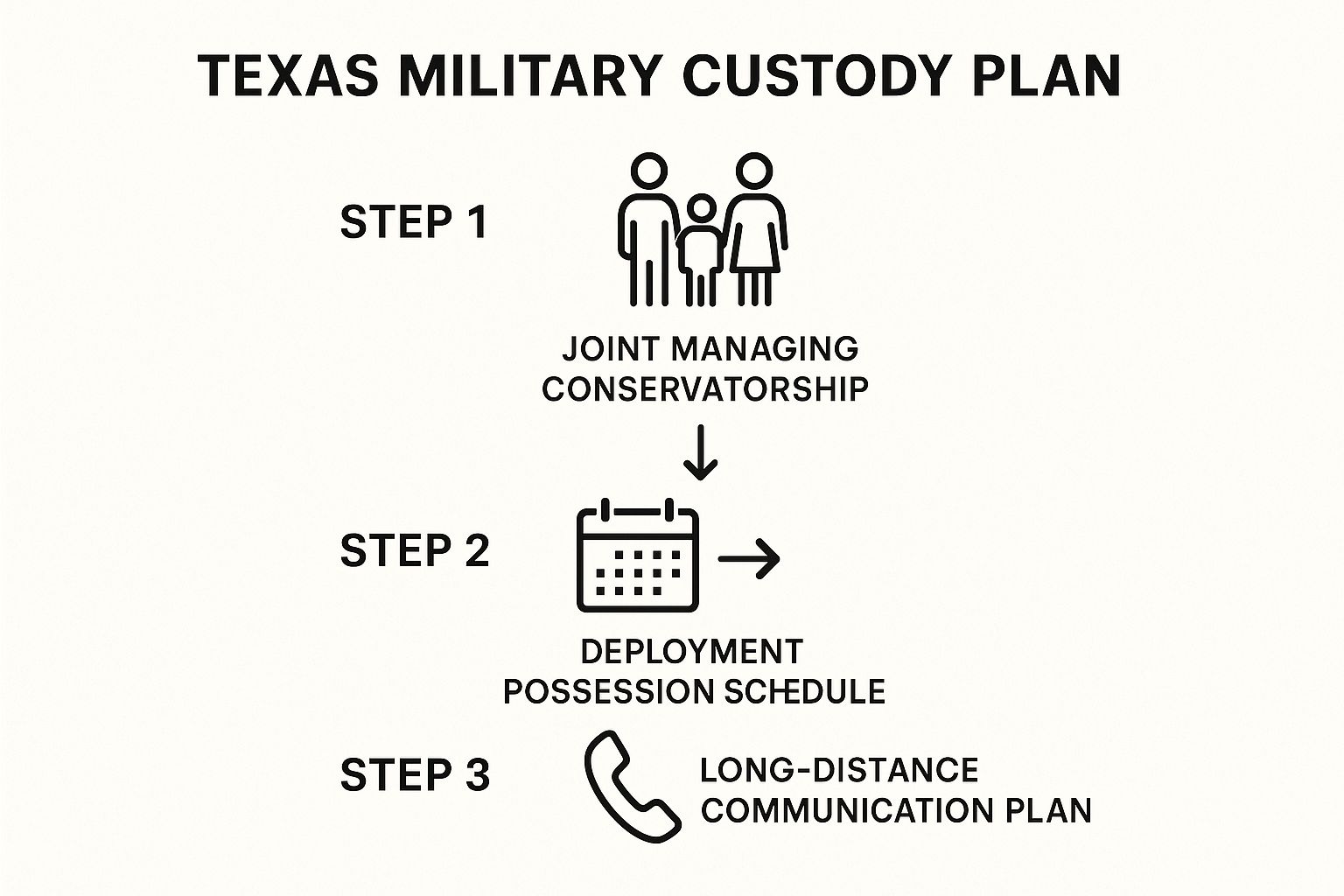
As you can see, a successful plan is about more than just a schedule. It has to cover legal roles, what-if scenarios for deployment, and, most importantly, how you’ll keep the parent-child bond strong across any distance.
Planning for Deployment and Relocation
For military families, a standard possession schedule just won’t work. Your custody order—called a possession order in Texas—needs to be a flexible, detailed roadmap that anticipates the realities of military service. An effective military parenting plan will have specific, clear provisions for these exact situations.
- Deployment Schedules: The order should spell out what happens to the service member's parenting time during deployment. A key point to consider: can a trusted family member, like a grandparent or new spouse, step in to exercise visitation on their behalf?
- Make-Up Parenting Time: Your agreement should include a clause that allows the service member to have make-up possession time with the children once they return from deployment.
- Long-Distance Communication: Get specific about how, and how often, the deployed parent can connect with the kids. This means outlining expectations for video calls, phone calls, and emails to ensure that connection stays strong, no matter the miles.
Hammering out these details from the start can save you future conflict and expensive trips back to court. To get a better sense of how to structure this, check out our guide on the best practices for parenting plans and co-parenting agreements.
To help you organize your thoughts, here's a look at the most important issues to address.
Key Custody Considerations for Military Families
When you're building a parenting plan around military life, a standard agreement won't cover all your bases. The table below highlights the critical, military-specific issues you need to address to create a plan that’s both fair and functional for the long haul.
| Issue | What to Address | Why It's Important |
|---|---|---|
| Deployment | How will the service member's parenting time be handled? Can a relative exercise visitation on their behalf? | Provides stability for the children and protects the service member's parental rights while they are away. |
| Relocation (PCS) | What happens if the service member receives orders to move? How will the possession schedule be modified? | Prevents future litigation by creating a clear, agreed-upon process for handling a move, which is a near-certainty in military careers. |
| Communication | What are the specific expectations for video calls, phone calls, and emails during deployment or TDY? | Maintains the parent-child bond across long distances, which is crucial for the child's emotional well-being. |
| Make-Up Time | How much make-up parenting time will the service member receive upon returning from deployment? | Ensures the service member can reconnect with their children and make up for lost time, reinforcing their role in the child's life. |
Addressing these points upfront is the key to a durable parenting plan that truly serves your children's best interests while respecting the demands of military service.
A proactive, detailed parenting plan is your best tool for protecting your relationship with your children. By addressing military-specific issues upfront, you provide the predictability and stability your children need to thrive.
How Texas Calculates Child Support for Service Members
In Texas, child support calculations follow a specific formula laid out in the Texas Family Code. The court looks at the paying parent's "net monthly resources" and applies a set percentage based on how many children need support. A huge question for you as a service member is what counts as "income" in this calculation. Texas casts a wide net.
For a service member, this almost always includes:
- Base Pay
- Basic Allowance for Housing (BAH)
- Basic Allowance for Subsistence (BAS)
- Specialty pays and bonuses
It's absolutely crucial that these allowances are factored into the calculation to get a fair and accurate child support order. Military pay stubs can be complicated, so working with an attorney who understands these nuances is essential. It ensures the final amount is calculated correctly, protecting both your financial stability and your child's right to support.
The Texas Military Divorce Process Step-by-Step
Facing a divorce can feel like staring at a mountain, but knowing the path forward makes the climb manageable. The divorce process in Texas follows a structured sequence of events, giving you a predictable framework for what lies ahead.
Step 1: Filing the Petition and Serving Your Spouse
The first official step is filing an Original Petition for Divorce. This document opens your case with the court and lays out the basic facts of your marriage and what you are asking for regarding property and children.
Next, you must formally notify your spouse through a process called service. Your spouse must be personally given a copy of the petition and a legal notice called a citation. If your spouse is deployed, the SCRA can come into play, potentially pausing the timeline. However, if you and your spouse are on amicable terms, they can sign a Waiver of Service. This document tells the court they’ve received the petition and agree to participate, saving you significant time and money.
Step 2: Setting Ground Rules with Temporary Orders
The period before your divorce is final can feel like limbo. Who will stay in the house? Who pays the bills? What will the parenting schedule look like? Temporary Orders answer these questions and set stable ground rules while the case is ongoing. Either you or your spouse can request a hearing where a judge will make decisions on temporary custody, child support, spousal support, and how bills will be managed.
Step 3: Gathering Information Through Discovery
The next phase is discovery, the formal process of exchanging information. This is where you and your spouse provide each other with all relevant financial documents—bank statements, pay stubs (including Leave and Earning Statements), tax returns, and retirement account information. The goal is to ensure both of you have a complete and honest picture of your community property before making final decisions.
Step 4: Reaching an Agreement Through Mediation
Before you ever see the inside of a courtroom for a trial, most Texas counties require you to attend mediation. This is a confidential meeting where you, your spouse, and your respective attorneys sit down with a neutral third-party mediator. The mediator’s job is to help you negotiate and find common ground on all the sticking points. If you reach an agreement, your attorneys will draft a Mediated Settlement Agreement (MSA). Once signed, this agreement is binding and becomes the blueprint for your Final Decree of Divorce.
Your divorce cannot be finalized until at least 60 days have passed since you first filed the petition. This is a mandatory waiting period in Texas.
What to Do Next
Going through a military divorce can feel isolating, but you are not alone. By understanding the core principles of Texas military divorce laws—from jurisdiction and property division to creating a resilient parenting plan—you have armed yourself with the knowledge to move forward with confidence. The choices you make in the coming weeks will shape your family’s future, and you deserve a strategy designed to protect it. An experienced attorney can take everything you've learned here and turn it into a clear, actionable strategy for your family's specific situation. They act as your advocate, guiding you with compassion and strength every step of the way. As you plan for life after divorce, exploring life insurance options for veterans is a smart move to ensure your dependents have crucial security. The dedicated attorneys at The Law Office of Bryan Fagan, PLLC, are ready to help you secure your family’s well-being. We invite you to schedule a free, confidential consultation to talk about your circumstances and map out a clear plan for moving forward.
Frequently Asked Questions About Military Divorce
Going through a military divorce brings a unique set of questions to the table, and you deserve clear, straightforward answers. We've put together some of the most common concerns we hear from service members and their spouses here in Texas to give you some clarity.
Can Deployment Stop a Divorce in Texas?
A deployment can't stop a divorce for good, but it can definitely press the pause button. Under the Servicemembers Civil Relief Act (SCRA), if a service member's duties genuinely prevent them from responding to a divorce petition, a judge can grant a "stay." Think of it as a temporary postponement of the case. This initial stay usually lasts for at least 90 days, giving the service member enough breathing room to find an attorney and figure out their next steps. It doesn't make the divorce go away; it just ensures everyone gets a fair shot.
Am I Entitled to Retirement if We Were Married Less Than 10 Years?
Yes, you absolutely can be. This is probably one of the biggest myths in military divorce, and it all comes down to the "10/10 Rule." Many people believe this rule means you get nothing if the marriage didn't last a decade. That's not what the rule is about. The 10/10 Rule simply dictates how the retirement gets paid out. If your marriage lasted at least 10 years and that time overlapped with 10 years of creditable military service, the Defense Finance and Accounting Service (DFAS) can pay your share directly to you.
Crucial Takeaway: The 10/10 Rule is about the payment method, not your entitlement to the money. A Texas court can—and will—award you a share of the retirement benefits earned during the marriage, no matter how long you were married. If you don't meet the 10/10 Rule, the court will simply order your ex-spouse to pay your share to you directly each month.
How Does a PCS Move Affect Our Custody Order?
In military life, a Permanent Change of Station (PCS) is a certainty. A well-drafted Texas custody order should be built with this reality in mind. Most orders will establish a geographic restriction, a designated area where the child must primarily live. If a service member receives PCS orders to move outside that restricted zone, they can't just pack up and go with the kids. They either need to get the other parent's written agreement or go back to court and formally ask a judge to modify the order. The best parenting plans tackle this head-on and include specific provisions for handling a potential relocation, what a long-distance visitation schedule will look like, and clear rules for travel and communication.
Navigating the complexities of military divorce laws in Texas requires a legal team that understands both state and federal regulations. The experienced attorneys at The Law Office of Bryan Fagan, PLLC are here to provide the compassionate guidance and authoritative representation you need. To protect your rights and secure your family's future, schedule a free, confidential consultation with us today.


