Skip to content
When you're facing a divorce or custody battle, it can feel like the ground is shifting beneath your feet. A Temporary Restraining Order (TRO) in Texas is a legal tool designed to bring immediate stability during a chaotic time. Think of it as a court-ordered "pause button" that prevents either you or your spouse from making sudden, damaging moves with your children, property, or finances right at the start of your case.
Understanding the Purpose of a TRO
As soon as a divorce or custody case begins, the uncertainty can be overwhelming. You might worry your spouse will drain the bank accounts, sell shared property, or interfere with your time with the children. A TRO is a powerful legal tool that addresses these fears head-on, giving you and your family crucial breathing room.
Hitting the Legal Pause Button
A TRO is an emergency, short-term measure. Its main purpose isn't to decide who is right or wrong but simply to freeze the current situation. Under the Texas Family Code, a judge can issue a TRO to prevent "immediate and irreparable harm"—often before the other person even has a chance to appear in court.
This is what’s known as an ex parte order. It’s granted on an emergency basis because waiting for a full hearing could allow the very damage the order is meant to stop. For instance, if you have good reason to believe your spouse is about to cash out a 401(k), waiting two weeks for a hearing is simply too late.
What Does a TRO Prohibit?
At its core, a TRO lays down a clear set of ground rules that both you and your spouse must follow. It’s essentially a list of "don'ts" meant to keep things fair and stable while the legal process gets underway. These orders are incredibly common at the start of any Texas family law case.
A typical TRO will prohibit either party from:
- Harassing or Threatening: This includes making threats, causing physical harm, or disturbing the peace of the other person or your children.
- Hiding or Selling Assets: A TRO stops either spouse from selling, transferring, or hiding community property without mutual agreement. This is especially critical if you are a business owner or have a high-value estate.
- Changing Insurance Policies: It prevents one spouse from dropping the other—or the children—from health, life, or auto insurance plans.
- Incurring Unusual Debt: This stops one person from taking out large loans or maxing out credit cards that would damage your shared estate.
- Disrupting the Children's Lives: The order can also stop one parent from pulling the children out of their current school or moving them out of state.
A TRO is not a final decision on who gets the house or who has primary custody. It is a temporary shield, usually lasting only 14 days, designed to protect your family and assets until the court can hold a more detailed hearing for Temporary Orders. Understanding what a temporary restraining order in Texas can do is the first step toward regaining control. It creates a legally enforceable structure that prevents chaos, allowing you and your attorney to build a solid strategy for what comes next.
TROs vs. Protective Orders and Temporary Injunctions
When you’re going through a divorce, legal terms can make an already overwhelming time feel even more confusing. You might hear about a TRO, a protective order, and a temporary injunction, and it's easy to assume they’re all the same. They are not. It’s critical to understand how they differ, as each is a specific tool designed for a different job. Knowing which one you need is key to protecting your family, finances, and rights.
Let's break down these three common Texas court orders.
The Emergency Stopgap: The TRO
The Temporary Restraining Order (TRO) is the fastest tool in your legal toolkit. As we’ve covered, its main job is to hit the "pause button" at the very beginning of a divorce or custody case. It’s designed to stop one person from making sudden, harmful moves—like draining a bank account or taking the kids out of state.
What makes a TRO unique is that it can be issued ex parte. This means a judge can grant it based on your attorney's request without the other party even knowing about it yet. Because of its emergency, one-sided nature, it’s extremely short-lived, typically lasting only 14 days. Its entire purpose is to maintain the status quo until a formal hearing can be held with both sides present.
The Shield from Harm: The Protective Order
A Protective Order, on the other hand, is built for one specific and serious purpose: to address family violence. This is a much more serious and longer-term legal tool. Under the Texas Family Code, a judge will only grant a Protective Order when there is clear evidence that family violence has occurred and is likely to happen again.
Here’s how it’s fundamentally different from a TRO:
- Purpose: Its sole focus is preventing future acts of violence, harassment, stalking, or abuse.
- Duration: Protective Orders provide long-term safety, lasting for up to two years.
- Legal Standard: The bar is much higher. You must prove to the court that family violence has already happened.
- Consequences: Violating a Protective Order is a criminal offense and can lead to immediate arrest.
While a TRO might include a clause against harassment, it's a civil order in a family case. A Protective Order is the specific legal shield for situations involving domestic abuse. You can learn more about the critical differences between a protective order vs a restraining order in our detailed guide.
The Case Rulebook: The Temporary Injunction
After a TRO is issued, the next step is a temporary orders hearing. If the judge agrees that the rules put in place by the emergency TRO should continue, those rules are converted into a Temporary Injunction. This order essentially extends the protections of the TRO, but with one major difference: it’s no longer an emergency, ex parte order.
A Temporary Injunction is put in place only after both you and your spouse have had the chance to present your case and evidence to a judge. It establishes the ground rules for custody, child support, property use, and financial matters for the entire duration of your case, right up until the final decree is signed.
Think of it this way: the TRO is the emergency brake you pull to stop a crisis. The Temporary Injunction is the official rulebook that governs everyone’s conduct for the months until your divorce is finalized.
To make these distinctions clearer, here’s a quick comparison:
Comparing Texas Court Orders: TRO vs. Protective Order vs. Temporary Injunction
| Feature | Temporary Restraining Order (TRO) | Protective Order | Temporary Injunction |
|---|---|---|---|
| Main Purpose | Prevent immediate harm to finances, property, or children; maintain the status quo. | Protect individuals from family violence, stalking, and harassment. | Set the rules for custody, support, and property use during the case. |
| Legal Standard | Requires showing that harm will occur if the order isn't granted. Can be issued ex parte. | Requires proof that family violence has occurred and is likely to occur again. | Requires showing a probable right to relief and probable injury after a hearing. |
| Duration | Very short-term, typically 14 days. | Long-term, up to two years. | Lasts for the entire duration of the divorce or custody case. |
| How It's Issued | Can be granted without a hearing, based on one party's request (ex parte). | Granted only after a formal hearing where both parties can present evidence. | Granted only after a formal hearing where both parties can present evidence. |
| Violation Penalty | Contempt of court (civil penalties, fines, possible jail time). | Criminal offense, potentially leading to immediate arrest. | Contempt of court (civil penalties, fines, possible jail time). |
Knowing these differences empowers you to have a much clearer conversation with your attorney about which legal tool is the right fit for your situation.
How to Obtain a Temporary Restraining Order: A Step-by-Step Guide
Knowing you need to protect your family is one thing; navigating the courthouse to make it happen is another. While the process of getting a temporary restraining order in Texas can feel daunting, it’s a well-defined path designed for speed when you need it most. Let's walk through the exact steps you and your attorney will take to put these critical protections in place.
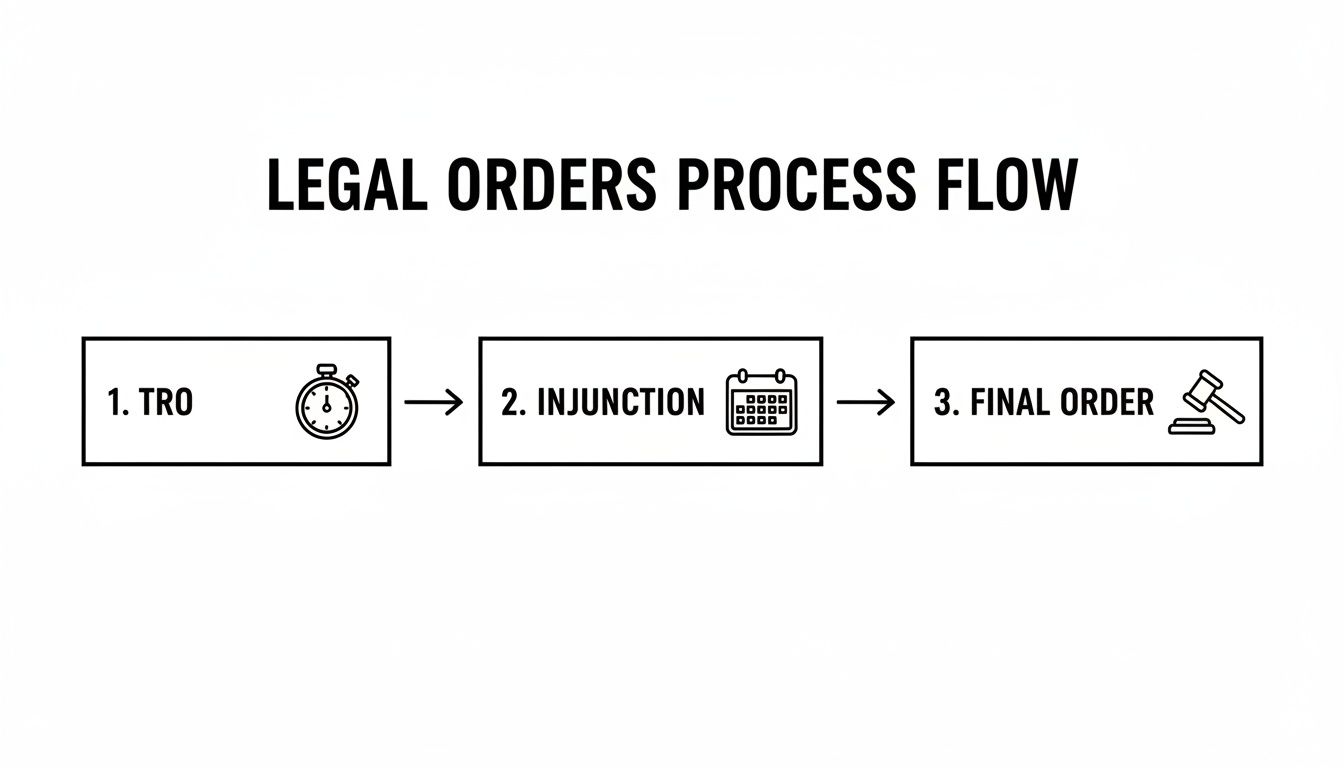
As you can see, a TRO is the immediate first step. It holds things steady until the court can hear from both sides and consider a more comprehensive injunction, which will eventually lead to the final orders in your case.
Step 1: Filing Your Initial Lawsuit Documents
Your journey starts when you sit down with a family law attorney. You’ll explain what’s happening and why you believe an emergency order is critical. Your attorney will then draft the foundational legal paperwork needed to open your case and request the TRO.
These documents typically include:
- Original Petition for Divorce (or a Suit Affecting the Parent-Child Relationship): This is the formal document that officially starts your case with the court.
- Application for a Temporary Restraining Order and Temporary Injunction: This is the specific motion asking the judge to grant an immediate TRO and to schedule a follow-up hearing for a temporary injunction.
Step 2: Preparing a Sworn Affidavit
This is the most important piece of the puzzle. An affidavit is your story, told in a formal, written statement that you sign under oath. By signing it, you are swearing that everything you've stated is true to the best of your knowledge.
Your affidavit must be crystal clear about why you need the TRO. Vague fears won't be enough. You must provide specific, concrete facts that show a real risk of "immediate and irreparable harm."
For example, don't just say, "I'm afraid he'll drain our bank account." Instead, state the facts: "On May 15th, my spouse transferred $20,000 from our joint savings into a private account I cannot access, telling me he was moving it 'where I'll never find it.'" Specific dates, dollar amounts, and direct quotes give your request the weight it needs.
Step 3: Getting the Judge's Signature
Once the petition, application, and your sworn affidavit are ready, your attorney will file them with the district clerk in the correct county. They will then ask a judge for an ex parte hearing. As we covered earlier, "ex parte" means the hearing happens without the other person there.
In this quick meeting, your attorney presents your affidavit to the judge, highlighting the urgency. The judge will review the facts to see if they meet the legal standard for an emergency order. If the judge agrees that there's a credible threat, they will sign the TRO on the spot. Under Section 83.001 of the Texas Family Code, judges are empowered to issue these orders to stop a bad situation from getting worse. You can learn more about the specifics of temporary orders and restraining orders in Texas.
Step 4: Serving the Other Party
A signed TRO has no legal power until the other person is officially notified. This crucial step is called service. Your attorney will hire a constable, sheriff, or private process server to personally hand-deliver copies of every document filed with the court—including the judge's signed TRO—to the other party.
Service ensures they are fully aware of the court's orders and the rules they must now follow. The TRO document will also include the date and time for the temporary orders hearing, typically set within 14 days. That hearing is the next vital step, where both you and the other party will have the chance to tell your sides of the story to the judge.
From TRO to Temporary Orders: The Hearing That Sets the Rules
A signed temporary restraining order in Texas is a powerful shield, but it’s a temporary one, typically expiring after just 14 days. This short timeframe is intentional—it’s designed to push everyone toward the next critical step: the temporary orders hearing.
Think of the TRO as an emergency "pause." The temporary orders hearing is where the real work begins. It’s the first formal court appearance where a judge listens to both you and your spouse and creates a detailed rulebook that will govern your lives for the entire length of your case.
What Happens at a Temporary Orders Hearing?
This is a formal court proceeding. You and the other party, along with your attorneys, will appear before the judge. Each side will have the opportunity to present evidence, call witnesses, and make legal arguments about what the temporary “rules” of your case should be. The judge’s goal is to establish a stable and fair environment that serves the best interest of your children while the case is ongoing.
Key issues decided at this hearing often include:
- Child Custody and Visitation: Who will be the primary conservator (the parent the children live with most), and what will the visitation schedule look like for the other parent?
- Child Support and Medical Support: Who pays child support and how much will it be? Who is responsible for keeping the children on health insurance?
- Exclusive Use of the Marital Home: Who gets to live in the family house while the divorce is pending?
- Spousal Support: Will one spouse need to pay temporary financial support to the other?
- Payment of Debts: How will bills like the mortgage, car payments, and credit cards be handled?
Preparing Your Case with Evidence
Success at this hearing comes down to evidence. Your attorney will be your partner in gathering compelling proof to back up your requests. This isn't about winning an emotional argument; it's about presenting clear, undeniable facts.
Types of evidence that judges find persuasive include:
- Financial Documents: Pay stubs, tax returns, and bank statements are the backbone of any decision about finances.
- Communications: Relevant text messages, emails, or social media posts can reveal patterns of behavior or co-parenting styles.
- Witness Testimony: Testimony from neutral third parties like teachers or counselors can provide powerful context.
- Photographs and Videos: Visual evidence can be incredibly impactful.
The judge has a limited amount of time to make these massive decisions. Being organized, clear, and focused on the facts is the most effective way to present your case.
The Critical Role of TROs in Family Safety
Temporary restraining orders are more than just paperwork; they are essential tools for safety. Statistics underscore their critical role, especially with the rise of family violence. According to the Texas Advocacy Project, 1 in 3 Texans will experience domestic violence in their lifetime. A TRO, issued under the Texas Family Code, provides that immediate, 14-day shield, halting potential harm and giving you a crucial window to get to the temporary orders hearing safely. You can find more information about the impact of protective orders from the Texas Advocacy Project.
This hearing is your opportunity to convert the emergency protections of a TRO into a comprehensive set of rules that provide stability and security. With the right preparation and solid legal guidance, you can approach this step with confidence.
What Happens If a TRO Is Violated?
It can be infuriating and terrifying to discover the other party has ignored a judge's direct order. A temporary restraining order in Texas isn't a suggestion—it's a legally binding command. When someone violates it, they are defying the court, and Texas law takes that very seriously. Knowing what to do when this happens is critical for enforcing your rights and staying safe.
A Violation Is Contempt of Court
When your spouse or co-parent does something the TRO explicitly forbids—like making harassing calls or trying to drain a joint bank account—they are in contempt of court. Because this is such a serious matter, the penalties are designed to be a powerful deterrent. If a judge finds the other party in contempt, they could face:
- Significant Fines: The court can impose steep financial penalties for each violation.
- Jail Time: For extreme or repeated offenses, a judge has the authority to order jail time.
- Payment of Your Attorney's Fees: The court can order the person who violated the TRO to pay for the legal costs you incurred to enforce the order.
Your First Steps After a Violation
How you respond in the moments after a violation is crucial. Your actions create the very evidence needed to hold the other party accountable.
1. Document Everything: Immediately write down exactly what happened. Note the date, time, and location. Save any text messages, emails, photos, or voicemails that prove the violation occurred.
2. Avoid Direct Confrontation: Your safety is the number one priority. Do not engage with the other person or try to enforce the order yourself. That’s the court’s job.
3. Contact Your Attorney Immediately: As soon as you are safe, call your lawyer. Give them the detailed documentation you’ve gathered so they can advise you on the next legal step.
Do not dismiss a "small" violation. A pattern of minor infractions can be powerful evidence for a judge, demonstrating a willful disregard for the court's authority.
Filing a Motion for Enforcement
To formally bring the violation to the court's attention, your attorney will file a Motion for Enforcement. This legal document lays out exactly how the TRO was violated, presents the evidence you collected, and asks the judge to hold the other party in contempt.
Once the motion is filed, the court will schedule a hearing. This is why your detailed documentation is so vital—it will be the foundation of your argument.
The need for these legal protections is significant. Data from the Texas Advocacy Project reveals a sobering reality: about 1.9 million adult Texans have been sexually assaulted in their lifetime, and for female victims, 58% knew their perpetrator. This underscores why enforceable court orders are so critical in family disputes. You can discover more insights from the Texas Advocacy Project data on protective orders.
When someone violates a temporary restraining order in Texas, the law is on your side. By acting quickly, documenting everything, and working with your attorney, you can ensure the court’s orders are upheld. Our team can guide you through filing a motion for contempt of court to protect your rights.
Key Takeaways and What to Do Next
Getting a temporary restraining order is a critical first move, but it's just that—a first move. It’s a powerful shield, but what comes next builds the foundation for your family's future. The path forward requires a clear strategy and experienced guidance. From this point on, it’s crucial that all communication with the other party goes exclusively through your attorney to prevent missteps that could harm your case.
Practical Steps for Parents and Business Owners
- Protect Your Children from Conflict: Do everything you can to keep your kids out of the adult legal disputes. Their emotional well-being must come first. You can learn more about how to file for temporary custody in our guide.
- Document Everything: Start a journal. Write down every interaction, keep track of relevant expenses, and log any incident related to your case. Meticulous records are your most powerful evidence.
- Secure Your Assets: If you are a business owner or have a high-value estate, work closely with your lawyer to account for all assets and ensure nothing is sold or transferred without authorization.
While a temporary restraining order in Texas provides an essential shield, it’s not a permanent solution. The next phase—the temporary orders hearing—is where the court will decide the rules for custody, support, and property use until your case is finalized. This is a complex journey, and you shouldn’t have to walk it alone.
The single most important step you can take right now is to arm yourself with experienced legal guidance. Building a solid plan with a compassionate attorney is the best way to regain control and safeguard your family’s future.
Don't wait to get the answers and support you deserve. Contact The Law Office of Bryan Fagan, PLLC today to Schedule your free, confidential consultation today with our experienced family law attorneys. Let us help you build a strategy that protects your family, your finances, and your peace of mind.
Questions We Hear All the Time About Texas TROs
When you’re facing a potential legal fight, your mind is probably racing with a hundred different questions. You deserve clear, straightforward answers. Here are some of the most common questions we get about temporary restraining orders in Texas.
Can I Get a TRO Without Filing for Divorce?
Yes, but it must be attached to a lawsuit. A TRO isn't a standalone document. It has to be part of an underlying family law case, such as a Suit Affecting the Parent-Child Relationship (SAPCR) if you aren't married but have children together.
How Much Does a Temporary Restraining Order Cost?
The cost can vary. You’ll have standard court filing fees for your county, plus fees to have the other person officially served with the lawsuit. The largest variable is usually attorney's fees, which depend on the complexity of your case and the time required to draft documents and represent you in court.
What Specific Actions Can a TRO Prohibit?
A TRO is incredibly specific and can be tailored to your situation. The goal is to maintain the status quo—the way things are right now—and prevent anyone from causing immediate and irreversible harm.
Common prohibitions include:
- Hiding or selling off community property.
- Removing a child from their current school or daycare.
- Sending harassing, threatening, or disruptive communications.
- Changing insurance policies or removing a spouse as a beneficiary.
Does a TRO Show Up on a Criminal Background Check?
No, a standard temporary restraining order in Texas from a family law case is a civil court order, not a criminal one. It will not appear on a criminal background check. This is different from a Protective Order, which is issued in cases involving family violence and can have criminal consequences.
Figuring out the complexities of a TRO is a critical first step in protecting your family and your assets. The Law Office of Bryan Fagan, PLLC is here to offer the compassionate and authoritative guidance you need. Schedule your free, confidential consultation today and start taking control of your future.