Skip to content
When your child’s world is turned upside down by a divorce or custody dispute, your first instinct is to create safety and stability—and fast.
This is exactly where a temporary custody order comes in. It's the crucial first step to setting clear, court-ordered rules for parenting time, decision-making, and financial support while your case is resolved. A temporary order brings immediate structure and protects your child’s best interests from day one, giving you both a clear path forward.
Securing Your Child's Stability with Temporary Custody
The time between filing a family law case and getting a final order can feel like an eternity. Without clear legal guardrails, you and the other parent can end up arguing over everything from weekend schedules to doctor's appointments. This constant uncertainty is precisely what temporary custody orders are designed to prevent.
Think of a temporary order as the official rulebook for co-parenting while your case is active. It's a legally binding document signed by a judge that locks in a temporary status quo. The whole point is to minimize disruption for your child and create a stable routine until a permanent solution is reached. These orders are a fundamental part of the process laid out in the Texas Family Code, which always puts the "best interest of the child" above all else.
Why Are Temporary Orders So Important?
For many parents, the arrangements made in temporary orders end up setting a powerful precedent for the final outcome. If a judge sees that a particular schedule is working well and your child is thriving, they’ll be far less likely to make significant changes later. This reality makes that first hearing one of the most critical moments in your entire case.
Seeking a temporary order is the right move in many common situations:
- Establishing a consistent schedule: It spells out which parent the child will live with most of the time (the primary conservator) and sets a clear visitation schedule for the other parent. No more arguing over who has the kids this weekend.
- Preventing instability: If one parent is threatening to move out of state with the child or is making big decisions about school or healthcare without your input, a temporary order can put a stop to it.
- Ensuring financial support: The order will almost always include provisions for temporary child support and medical support, making sure your child's financial needs are covered right away.
- Protecting your child: In serious situations involving family violence, neglect, or substance abuse, an emergency temporary order can provide immediate, powerful protection for your child's physical and emotional safety.
Recognizing the underlying reasons for instability, like the subtle or obvious signs of unhealthy relationships, often highlights just how necessary these orders are. When you proactively seek a temporary order, you're sending a clear message to the court that you are a committed, responsible parent focused on creating a secure home for your child. To dig deeper into the legal framework, you can learn more about Texas child custody laws in our detailed guide.
A temporary custody order isn’t just a placeholder; it’s a strategic tool that brings immediate calm to a chaotic situation and demonstrates your dedication to your child's welfare.
Ultimately, knowing when and how to get temporary custody is about taking decisive action to protect your child and your parental rights. It transforms an unpredictable, stressful situation into a structured one, giving your family a clear path forward while the legal details are worked out.
Navigating the Different Kinds of Temporary Custody Orders
When you realize your child needs a stable routine right now, the next question is always: which legal tool fits my situation? Texas law doesn’t offer a one-size-fits-all solution. Instead, you have different types of orders designed for different levels of urgency. Understanding which one you need is the first strategic step in building your case.
The path you take depends entirely on what’s happening in your family. For many, it starts with a standard request to set some ground rules while the case moves forward. But for others facing an immediate threat, a much faster, more powerful approach is necessary.
This decision tree breaks down the basic logic: when conflict puts a child’s stability at risk, a court order is the only way to protect their best interests.
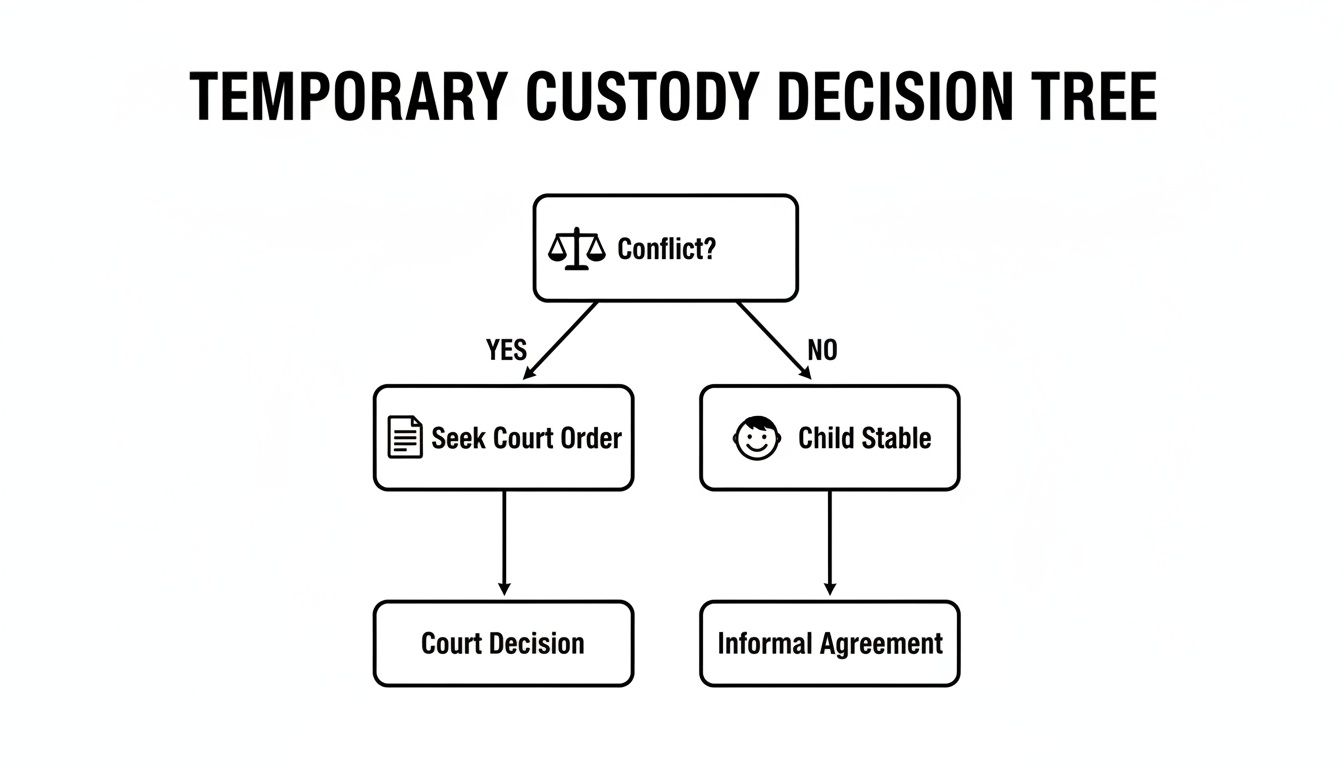
As you can see, serious conflict is what usually triggers legal action. It’s the fork in the road that leads you to seek temporary orders and restore some calm for your child.
To help you see the differences at a glance, here’s a quick comparison of the most common types of temporary orders. This table can help you pinpoint the right legal tool for what you're facing.
Comparing Texas Temporary Custody Orders
| Order Type | When It's Used | Typical Timeline | Key Requirement |
|---|---|---|---|
| Standard Temporary Orders | During any divorce or custody case to set rules for the duration. | 2-4 weeks until a hearing. | A pending lawsuit (divorce or SAPCR). |
| Temporary Restraining Order (TRO) | To prevent a parent from taking disruptive action before a hearing. | Effective immediately for 14 days. | Evidence of potential harm or disruption. |
| Emergency/Ex Parte Order | When a child is in immediate physical or emotional danger. | Signed by a judge immediately, without notice to the other parent. | Credible, sworn evidence of an imminent threat. |
Each of these orders serves a very specific purpose. Let's break down what they do and when you might need them.
Standard Temporary Orders
This is the workhorse of Texas family law. It's the most common type of temporary order filed in a divorce or a Suit Affecting the Parent-Child Relationship (SAPCR). Think of these orders as the official "rules of the road" that everyone has to follow while the case is sorted out. They are essentially a temporary version of a final custody decree.
A judge issues these orders after a formal hearing where both you and the other parent get to present evidence and make your arguments. They cover all the big issues:
- Conservatorship: Deciding who has the right to make key decisions for the child.
- Possession and Access: Laying out a detailed visitation schedule, often mirroring the Texas Standard Possession Order.
- Child Support: Figuring out who pays child support and how much.
- Geographic Restrictions: Setting rules about where the child can live, which is usually limited to a specific county and its neighbors.
The goal here is to bring predictability to a chaotic time. Instead of arguing over who gets the kids this weekend, you have a clear, court-enforced plan.
Temporary Restraining Orders (TROs)
Sometimes you need to hit the pause button before a hearing can even be scheduled. This is where a Temporary Restraining Order (TRO) comes in. A judge can sign a TRO without notifying the other parent, which makes it a powerful tool for stopping someone from doing something destructive.
A TRO can prevent the other parent from doing things like:
- Pulling the child out of their current school or daycare.
- Hiding the child from you.
- Emptying the joint bank account or selling off shared property.
- Bad-mouthing you in front of your child.
A TRO is usually only good for 14 days. During that time, the court will schedule a temporary orders hearing where the judge will hear from both sides and decide whether to make the TRO's rules a "temporary injunction" that lasts for the rest of the case.
A TRO is like a legal stop sign. It prevents immediate damage and keeps things stable until a judge has a chance to hear the full story. It’s a crucial first line of defense in volatile situations.
Emergency Orders (Ex Parte)
When things are truly urgent, you need the strongest tool available: an emergency order, often called an "ex parte" order. You seek this when a child is in immediate physical or emotional danger. Because of the urgency, a judge can grant an emergency order based only on your sworn statement (an affidavit), without the other parent even being there.
Under Section 105.001 of the Texas Family Code, a court will only grant an order like this if there’s clear evidence that a child is in imminent danger. These are not handed out lightly. You must provide specific, believable proof of a real and immediate threat. We see these orders in situations involving family violence, child abuse, severe neglect, or a parent's serious substance abuse issues. If you believe your child is in this kind of danger, it's critical to act fast and know the requirements. You can learn more about how to secure an emergency custody order in Texas in our detailed guide.
Choosing the right order is a strategic decision. It requires a hard look at your family's circumstances, the level of conflict, and any risks to your child. An experienced family law attorney can help you map out the most effective path to protect your child and create the stability they need right now.
Your Step-by-Step Guide to Filing for Temporary Custody
The idea of facing a mountain of legal paperwork is enough to make anyone freeze. But getting your case in front of a judge is a series of clear, manageable steps. This is more than just filling out forms; it's about building a strategic case to protect what matters most: your child. Let's break down the legal jargon into a straightforward action plan.

Step 1: File the Right Initial Documents
Your journey into the family court system kicks off with two foundational documents: the Original Petition and the Motion for Temporary Orders.
Think of the petition as the key that unlocks the courthouse door. It's the document that officially opens your case, whether you're filing for divorce or a Suit Affecting the Parent-Child Relationship (SAPCR). It tells the court who's involved and what you’re ultimately asking for, like dissolving the marriage or establishing a formal custody arrangement.
The Motion for Temporary Orders, on the other hand, is your request for immediate help. This is where you lay out exactly why you need the judge to step in right now and what specific rules you want in place until the case is finalized. It’s your first real chance to tell your story, so it needs to be clear, concise, and laser-focused on your child's best interests.
What Goes into Your Motion for Temporary Orders
Your motion needs to be incredibly specific. This is not the time to be vague. You have to ask the court for exactly what you want, item by item. A strong motion typically asks the judge to:
- Designate you as the parent with the exclusive right to decide where the child lives.
- Establish a specific possession and access schedule (what most people call visitation).
- Order temporary child support and require medical support.
- Set a geographic restriction, usually limiting the child’s residence to their current county and the ones touching it.
The more detailed you are, the easier it is for a judge to see what’s needed to create a stable, predictable environment for your child. A good family law attorney knows how to draft this motion to be as compelling and effective as possible.
Step 2: The Critical Step of Legal Notice or "Service"
Once you’ve filed your petition and motion, you are legally required to notify the other parent. This formal process is called "service," and it’s a non-negotiable step in Texas law. You simply cannot have a hearing until the other parent has been properly served.
Service isn't just you handing them the paperwork. It must be done by a neutral third party, like a sheriff's deputy or a private process server, who personally delivers a copy of the lawsuit to the other parent. This delivery is their official notice and serves as proof to the court that they know about the case and have a chance to respond. Trying to skip this step will only create delays and could seriously damage your case.
A huge mistake people make is thinking that a text message or a phone call is enough. The court demands formal, documented service to protect everyone's constitutional right to due process. Without it, the judge literally has no power to make any orders.
Step 3: Setting the Hearing and Understanding the Timeline
After the other parent is served, your attorney will work with the court coordinator to get a date on the judge's calendar for the temporary orders hearing. The timeline can vary quite a bit depending on the county and how busy that particular court is, but the goal is always to get in front of a judge as quickly as the system allows. Texas courts rightly prioritize cases involving children, because everyone understands the need for swift action.
The whole system is designed to provide immediate protection when a child's well-being is on the line, a principle baked into the Texas Family Code. In my experience, most courts work hard to hear these cases quickly, often scheduling a hearing within 2-4 weeks of the request. This efficiency is critical, especially when conflict is high. If you're curious about local court activity, you can often find useful information by looking into Texas family court dockets.
Now, preparing for that hearing becomes your next critical mission. This is your chance to present your evidence and argue why your proposed plan is truly in your child's best interest. With solid preparation, you can walk into that courtroom feeling ready and confident.
How to Prepare for Your Temporary Orders Hearing
Walking into a courtroom can feel intimidating. But your temporary orders hearing is your first real chance to show the judge that you're the stable, focused parent your child needs. This isn't the time for high drama or emotional appeals; it's about presenting a clear, fact-based picture of why your requests are truly in your child's best interest. Success here boils down to one thing: meticulous preparation.

This hearing is your first—and often most important—opportunity to make your case. The decisions made here can set the tone for the rest of your legal journey. It's not a minor step; it's a critical one that provides stability when your family needs it most.
Gather Your Evidence
Judges operate on facts, not just feelings. It's your job to give them tangible evidence that backs up everything you're asking for. Vague statements like "they're a bad parent" will get you nowhere. Specific, documented examples are what win cases.
Start pulling together any documents and communications that paint a clear picture. Think about anything that proves your deep involvement in your child's life or anything that raises legitimate concerns about the other parent's judgment or stability.
Here are the types of evidence that are most effective in court:
- Communication Records: Print out relevant text messages and emails. Don't just bring your phone. Highlight the key exchanges where the other parent is uncooperative, makes threats, or admits to behavior that could put your child at risk.
- School and Medical Records: Grab recent report cards, attendance records, and any notes from teachers. Gather documents from doctor's appointments to show you're the one managing your child’s health and well-being.
- Financial Documents: Pay stubs, tax returns, and bank statements are absolutely essential. These are used to determine child support and demonstrate your own financial stability.
- A Detailed Calendar: Create a simple timeline of recent, relevant events. Note specific dates when the other parent missed visitation, was significantly late, or when any incidents of concern happened.
This collection of evidence tells a story. It shows the judge you're the parent providing structure, making your requests seem reasonable and necessary for your child.
Select Credible Witnesses
While documents are powerful, the right witness can provide crucial context that paper can't. A good witness isn't just someone who likes you; it's someone who has personally and recently observed you with your child or has firsthand knowledge of concerning behavior from the other parent.
So, who makes a strong witness?
- Teachers or Daycare Providers: They can speak objectively about your child's behavior, which parent handles drop-offs and pick-ups, and who attends parent-teacher conferences.
- Family Friends or Neighbors: Someone who sees you interacting with your child regularly can testify to your parenting skills and the bond you share.
- A Family Counselor or Therapist: If your child sees a therapist, their professional insight can be invaluable (though this requires following specific legal procedures to get them to testify).
Avoid using a new partner or a close relative who clearly has a biased perspective. A judge will see right through that. The most credible witnesses are often neutral parties who can speak calmly and factually about what they've personally seen and heard.
The judge’s goal is to make a quick, accurate assessment of what will keep the child’s life as stable as possible. They are looking for the parent who is calm, credible, and focused on the child—not on punishing the other parent.
Understand the Courtroom Experience
A temporary orders hearing is usually quick—often lasting less than an hour, sometimes much less. You simply won't have time to tell your entire life story. You and your attorney must be incredibly organized and get straight to the point. The judge wants to know about the current situation and what is needed right now to maintain stability for your child.
Be ready to answer direct questions from the judge and the other parent's attorney. The key is to stay calm, be respectful, and be honest. Answer only the question you're asked. Don't volunteer extra information or let yourself get drawn into an argument. Your composure under pressure says a lot about your ability to handle the stresses of co-parenting.
For a deeper dive into what to expect, check out our guide on how to prepare for a custody hearing in Texas.
The work you put in before the hearing is the most important investment you can make in your case. By gathering solid evidence, lining up credible witnesses, and understanding what the judge needs to hear, you can present yourself as the confident, child-focused parent a court is looking for.
After the Hearing: What to Do Next
Walking out of the courtroom with a signed temporary order in your hand feels like a massive relief, but your work isn’t over. What you do next is just as important as how you prepared for the hearing. This period is your chance to prove to the court that the new arrangement works and provides the stability your child needs—something that will heavily influence the final custody outcome.

Think of this order as the new law for your family. A judge has laid out specific rules for possession, access, child support, and decision-making. Your compliance is not optional. Following every single detail to the letter shows your respect for the legal process and, more importantly, your commitment to co-parenting responsibly.
Follow the Order Perfectly
Your number one priority now is to follow that temporary custody order exactly as it is written. This is not the time for handshake deals or casual verbal agreements with the other parent to deviate from the plan, no matter how small the change might seem.
If the order says exchanges happen at 6:00 PM, you need to be there at 5:55 PM. If child support is due on the 1st of the month, make sure it's paid. This consistency builds a powerful track record of stability and cooperation that will be invaluable as your case moves forward.
The temporary orders period is an audition for the final orders. A judge will be much more inclined to make the temporary arrangement permanent if they see it’s working well and you are following the rules without any issues.
What if Circumstances Change?
Life happens. Sometimes, a temporary order that worked initially is no longer practical or in your child's best interest down the line. The good news is that the Texas Family Code allows you to ask the court to change the order—but you must have a very good reason.
To modify a temporary order, you have to prove there has been a "material and substantial change" in the circumstances of the child or one of the parents. This is a high legal standard to meet.
So, what counts as a material and substantial change? It could be things like:
- A parent losing their job and being unable to pay the ordered child support.
- A parent developing a substance abuse problem that endangers the child.
- The child's school schedule changing dramatically, making the current possession schedule unworkable.
You can't just go back to court because you've changed your mind or disagree with the judge's original decision. You must have new facts to present. If you believe your situation meets this standard, your attorney can file a Motion to Modify the temporary orders and get you a new hearing.
Handling Violations by the Other Parent
What happens if you're doing everything right, but the other parent isn't? It’s incredibly frustrating when they're consistently late for exchanges, miss child support payments, or simply refuse to follow the possession schedule.
Your first step is to document everything. Keep a detailed log of every single violation, including dates, times, and any communication you had about the issue. This creates a factual, objective record that your attorney can use as evidence.
If the violations keep happening, your attorney can file a Motion for Enforcement. This is a serious legal action that asks the judge to force the other parent to comply. A judge has several tools to enforce an order, including ordering make-up visitation time, levying fines, and in severe cases, even ordering jail time for contempt of court.
This phase is all about demonstrating your reliability. By sticking to the court's plan and handling any problems through the proper legal channels, you're building the strongest possible case for your family's future.
Common Questions About Temporary Custody in Texas
When you're fighting for your child's stability, it's only natural to have a million questions running through your mind. The legal process can seem overwhelming, but getting clear answers is the first step toward feeling in control. Here are some of the most common questions we hear from parents in your exact situation, with direct answers to give you clarity and confidence.
How Much Does It Cost to Get Temporary Custody in Texas?
This is usually the first question on every parent's mind, and the honest answer is: it varies. The single biggest factor that drives the cost up or down is whether you and the other parent can reach an agreement without a major court battle. An uncontested process through mediation is always going to be more affordable than a contested court hearing.
So, what are you actually paying for? The main expenses typically include:
- Court Filing Fees: Every county charges a fee just to open a new case and get it on the docket.
- Service Fees: You have to pay a sheriff's deputy or a private process server to legally notify the other parent that you've filed a suit. This isn't optional.
- Attorney Fees: This is the most variable cost. It really depends on the complexity of your case and whether it requires a heavily contested, multi-hour hearing in front of a judge.
At The Law Office of Bryan Fagan, PLLC, we believe in being upfront about costs. That’s why we offer a free consultation to talk through your specific situation, map out potential expenses, and focus on efficient, cost-effective strategies to protect both your family and your finances.
Can I Get Temporary Custody if We Were Never Married?
Absolutely. In Texas, a parent's rights have nothing to do with marital status. The law is built to protect the child's relationship with both parents, regardless of whether you ever said, "I do."
If you're an unmarried parent, the case you'll file is called a Suit Affecting the Parent-Child Relationship (SAPCR). Think of it as the legal framework for establishing custody, visitation, and child support for unmarried couples. The process for requesting and getting temporary orders inside a SAPCR case is virtually identical to how it works in a divorce.
At the end of the day, the court's primary focus is always the same: what is in the best interest of the child.
What if We Agree on a Temporary Custody Arrangement?
If you and the other parent can work out an agreement, you're in a fantastic position. This is the best-case scenario. It dramatically reduces conflict, saves a huge amount of time, and keeps your legal costs way down. More importantly, it sets a positive, cooperative tone for the rest of your case.
Reaching an agreement on temporary orders is a powerful first step. It allows you and the other parent to retain control over the outcome, rather than leaving these critical decisions in the hands of a judge who knows very little about your family.
Once you have a deal, the process is pretty simple. Your attorneys will draft a formal document called an "Agreed Temporary Order." This legal document spells out every detail of your arrangement—from the possession schedule and holiday exchanges to child support payments.
This document is then submitted to the judge for their signature. As long as the agreement serves the child's best interest (which it almost always does if both parents agree), a judge will nearly always sign it without ever needing a formal, contested court hearing.
How Long Do Temporary Custody Orders Last?
It's crucial to understand that "temporary" in a legal context doesn't mean "short-lived." A temporary order is designed to stay in place for the entire duration of your case. This could be several months or, in some highly complex cases, even over a year.
These orders create the new normal for your family until one of two things happens:
- You and the other parent reach a final settlement agreement, often through mediation.
- Your case goes to a final trial and a judge issues a Final Decree.
The rules laid out in your temporary order are legally binding and fully enforceable for this entire period. But what if something major happens? Life changes, and the law recognizes that. If there has been a "material and substantial change" in circumstances, you can petition the court to modify the order. This ensures the arrangement continues to serve your child's best interest as your family’s situation evolves.
What to Do Next
Navigating the complexities of temporary custody can feel daunting, but you don't have to do it alone. The right legal guidance provides the clarity and strategy you need to protect your child's future and restore peace to your life. The attorneys at The Law Office of Bryan Fagan, PLLC have helped countless Texas families establish stable, predictable routines during difficult times. We are here to help you understand your rights and take decisive action.
If you're ready to create stability for your child, schedule a free consultation with us today. Let's build a plan to protect your family.