Skip to content
Facing a divorce or custody battle often brings a wave of uncertainty about your financial future and your children's well-being. When it comes to providing for your kids, you need clarity, not confusion. In Texas, the process for calculating child support is designed to be straightforward, relying on a set formula that considers the non-custodial parent's monthly net resources and the number of children needing support. This structured approach aims for consistency and fairness, ensuring your child’s needs are met reliably.
The Foundation of Texas Child Support

To understand how Texas calculates child support, it helps to see it as a clear, three-step process. The law doesn't focus on gender; it focuses on which parent has the children most of the time (the "custodial parent") and which parent will be paying support (the "non-custodial parent," also known as the "obligor").
The entire framework is laid out in the Texas Family Code, which gives judges a logical path to follow. While every family’s circumstances are unique, the starting point for the calculation is always the same. This creates a dependable standard across the state, with the ultimate goal of establishing a support order that is fair to you and, most importantly, serves the best interest of your child.
A High-Level Overview of the Process
Breaking the process down into its core components can make it feel much less intimidating. At its heart, the Texas child support formula involves three main steps, which we'll explore in detail:
- Calculating Monthly Net Resources: This is the most critical step. You'll determine the total income from all sources and then subtract specific, legally allowed deductions to find the net amount the court will use.
- Applying Guideline Percentages: Next, the court applies a fixed percentage to those net resources. This percentage is directly tied to the number of children you have a legal duty to support.
- Factoring in Additional Costs: Finally, the calculation accounts for essential expenses like the child's health insurance premiums, which can adjust the final support amount up or down.
The Texas Family Code, specifically Chapter 154, governs all child support calculations. Its purpose is to ensure children receive predictable financial support from both parents, regardless of their marital status.
When you see it laid out this way, you can see that the system is not arbitrary. It’s a structured calculation designed to provide for your children’s needs. As we move forward, we’ll walk through each of these steps so you can feel prepared for what's ahead.
How to Calculate Your Monthly Net Resources
Figuring out what you might owe or receive in child support can feel like trying to hit a moving target, but in Texas, it all comes down to one key number: your monthly net resources. This isn't just your take-home pay; it's a specific legal figure defined by the Texas Family Code. Getting this calculation right is the single most important step in understanding what a court is likely to order.
Think of it like building a house. Your total income is the land. The legally allowed deductions are the foundation. What’s left—the finished structure—is your net resources.
Starting with Your Gross Income
First, the court will add up all the money you bring in from nearly every source. This total is your gross income, and it’s a much broader category than just your regular salary.
The Texas Family Code considers income to be:
- Wages and salary, including all your overtime, tips, commissions, and bonuses.
- Self-employment income, meaning your business revenue minus the ordinary and necessary expenses required to run it.
- Investment income, like interest, dividends from stocks, and any capital gains.
- Rental income from properties you own.
- Other income sources, such as retirement benefits, unemployment, Social Security (but not SSI), and workers' compensation awards.
The bottom line is that if it's money coming in, the court will almost certainly count it. This comprehensive approach is designed to get a true picture of your financial ability to support your child.
Applying the Required Deductions
Once your gross income is tallied, the next step is to subtract only the specific deductions that the state of Texas allows. This is where many people get confused because these are not the same deductions you take on your yearly tax return.
The only deductions allowed are:
- Federal income taxes (calculated as if you were a single person with one exemption)
- Social Security (FICA) and Medicare taxes
- State income tax (if you work in a state that has one)
- Union dues, but only if they are a mandatory condition of your employment
- The amount you pay for the child's health and dental insurance premiums
It's just as important to notice what isn't on this list. Things you might deduct on your taxes, like 401(k) contributions, or major expenses like car payments and personal loans, are not subtracted here. For a deeper dive into this, you might find our guide on whether child support is calculated before or after taxes in Texas helpful.
Example in Action:
Let's say your gross monthly income is $6,000.
- Federal Income Tax (single, 1 exemption): ~$750
- Social Security & Medicare Taxes: ~$460
- Child's Health Insurance Premium: ~$200
Your total deductions would be $1,410. Subtracting this from your gross income ($6,000 – $1,410) leaves you with monthly net resources of $4,590. This is the number the court will use to calculate the actual support amount.
Following this step-by-step process takes the mystery out of the math and gives you a realistic financial baseline to work from.
Applying The Official Texas Guideline Percentages
Knowing your monthly net resources is a huge step, but what you do with that number is what really matters. Once you have a clear picture of your income, the Texas child support calculation moves to a simple, percentage-based formula. This is where the law applies a specific percentage to your net resources based on how many children you are supporting.
This process is designed to be predictable. The Texas Family Code lays out these percentages so that parents in similar financial situations are treated consistently, which helps reduce conflict and gives you a clear idea of what to expect.
The Standard Guideline Percentages
For most parents, the calculation is straightforward. The court takes your monthly net resources and multiplies it by a percentage set by state law. The more children you are financially responsible for in this case, the higher the percentage.
This diagram breaks down the basic steps, showing how we get from your total gross income to the final net resources figure used in the calculation.
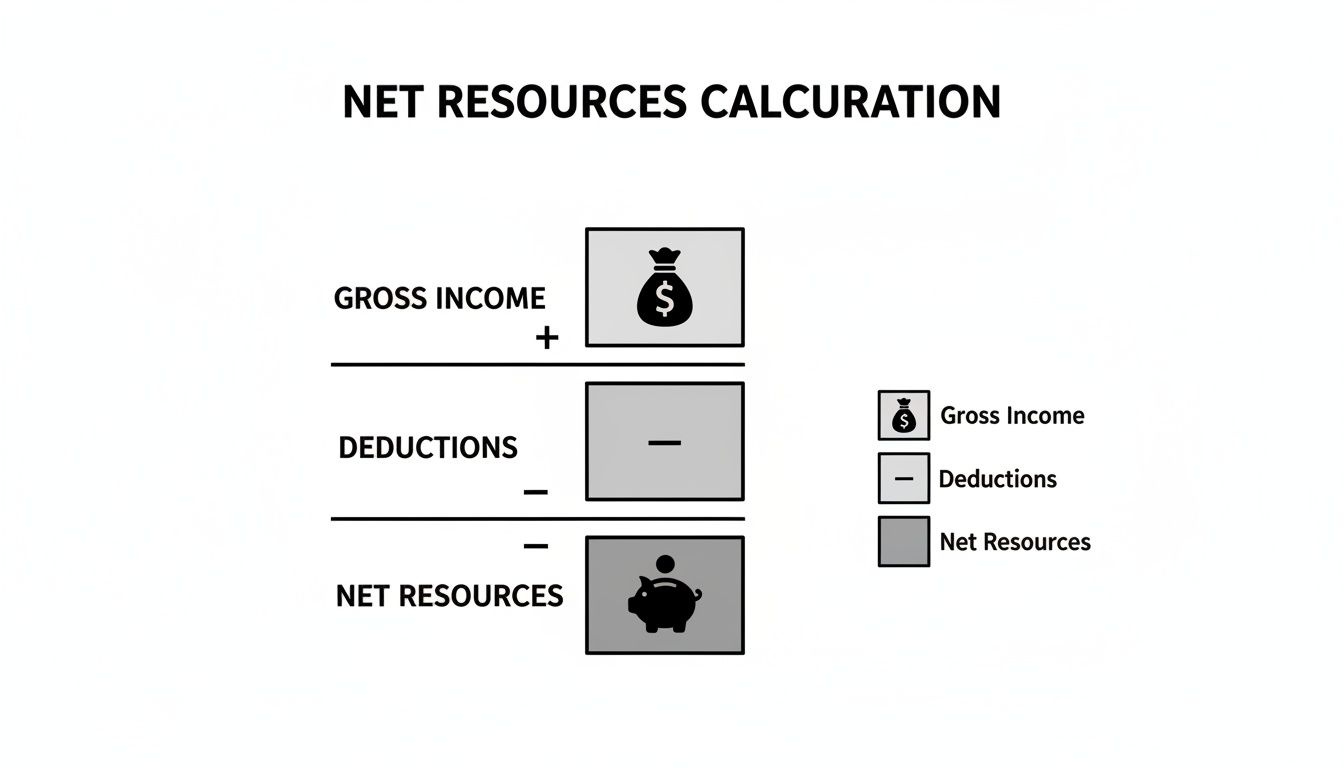
As you can see, the court starts with everything you earn, subtracts only specific, legally allowed deductions, and arrives at the net resources number used for applying the guidelines.
Now, let's look at the official percentages. These are presumed to be in the child's best interest.
| Texas Child Support Guideline Percentages | |
|---|---|
| Number of Children | Percentage of Net Resources |
| 1 Child | 20% |
| 2 Children | 25% |
| 3 Children | 30% |
| 4 Children | 35% |
| 5 or More Children | 40% |
So, if your monthly net resources are $5,000 and you have one child, your guideline child support would be $1,000 per month (20% of $5,000). It’s a direct and consistent formula that forms the foundation of Texas child support.
What Is The Income Cap On Child Support?
You might be wondering if these percentages apply no matter how high your income is. The short answer is no. Texas law sets a "cap" on the amount of net resources that the guideline percentages apply to.
This cap is adjusted for inflation every six years. The new income cap is $11,700 per month. You can learn more about how this impacts high earners from our legal peers' analysis of Texas child support calculations.
This means that if your net monthly resources are, say, $15,000, the standard percentages will only be applied to the first $11,700 of that income. A court can order more, but it must find that the proven needs of the child justify the higher amount.
How Other Children Affect Your Calculation
Life is often complicated, and many parents have a legal duty to support children from different relationships. The Texas Family Code recognizes this reality and adjusts the percentages accordingly to ensure fairness across the board.
If you are already paying court-ordered child support for another child, the court will apply a credit. The percentages are reduced to account for your pre-existing legal obligation.
For example, if you have one child from a previous marriage and are now calculating support for one child in your current case, the court won't use the standard 20%. Instead, it will use an adjusted percentage (typically 17.5%) to ensure both children are supported equitably based on your resources.
This system prevents a parent from being unfairly burdened and ensures that all of your children receive the financial support they are entitled to under the law. Understanding these adjustments is key, especially for blended families.
When Courts Bend the Rules on Child Support
It's completely normal to worry that a simple formula won't capture the unique reality of your child's life. The good news is, Texas law understands that no two families are the same. While the guideline percentages are always the starting point, judges have the flexibility to adjust the final child support amount. The goal is always to land on a number that's fair, just, and truly serves your child’s best interests.
This power to deviate isn't used lightly. A judge needs a good reason and must state that reason clearly in the final court order. Every decision comes back to one guiding principle: what is best for the child?
Factors That Justify a Different Approach
The Texas Family Code gives judges a specific list of factors they can look at when deciding whether to order more or less than the guideline amount. This is how the final order gets tailored to your family's actual circumstances.
Common reasons for a deviation include:
- The Child's Age and Needs: A teenager with expensive extracurriculars or a toddler in full-time daycare has different financial needs than a school-aged child.
- Extraordinary Expenses: If your child requires specialized medical care, expensive therapy, private tutoring, or has other educational needs that go beyond the norm, the court can adjust support to help cover those costs.
- Significant Travel Costs: When parents live far apart, the cost of flights or long drives for visitation can be substantial. A judge can tweak the support amount to help the non-custodial parent afford to stay active in the child's life.
- A Parent's Ability to Contribute: The court looks at the whole financial picture, including the assets and earning potential of both parents, not just the income of the one paying support.
Special Rules for Low-Income Parents
The state also recognizes that applying the standard percentages can create an impossible burden for parents with very low incomes. For this reason, Texas has a separate, reduced set of guidelines for these situations.
For noncustodial parents earning $1,000 or less in monthly net income, Texas law applies reduced percentages: 15% for one child, 20% for two, and so on, up to 35% for five or more children. This ensures that a support order is realistic and doesn't push a parent into a financial crisis.
What About 50/50 Possession Schedules?
One of the most frequent questions we get is how a 50/50 possession schedule affects child support. If you have your child half the time, do you still have to pay? The answer isn't a simple yes or no.
In Texas, having a 50/50 schedule does not automatically eliminate the child support obligation. The court will still look at both parents' incomes and the child's needs.
That said, an equal possession schedule is a very strong reason for the court to deviate from the standard guidelines. A judge might lower the amount significantly. In some cases, where both parents have very similar incomes, they may even order that neither parent pays support to the other.
If your family's situation has changed since your last order was put in place, it might be time to seek an adjustment. You can find more details in our guide on how to modify child support in Texas.
Covering Health Insurance and Childcare Costs
Once you’ve figured out the base child support payment, it might feel like you've crossed a major hurdle. But that number is just the starting point. A child’s real-world needs go beyond that guideline amount, and Texas law gets specific about two of the biggest ongoing expenses: health insurance and childcare.
These costs aren't lumped into the base support calculation. Instead, they’re handled as separate, but equally critical, parts of the total financial support package.

Understanding how these "add-ons" work is key to seeing the full financial picture. The court’s goal is to make sure your child’s total well-being is covered—from their basic necessities to their healthcare and the safe supervision they need while you're at work.
How Medical and Dental Insurance Are Handled
Under the Texas Family Code, every child support order must address the child's health and dental care. It's not optional. The court will order one or both parents to provide insurance coverage, usually assigning the responsibility to the parent who has access to the most affordable and comprehensive plan through their job.
The cost of these insurance premiums directly affects the child support numbers:
- Credit for the Paying Parent: If you are the non-custodial parent paying support and you're the one providing the child’s health insurance, that monthly premium is a deductible expense. The amount you pay for the child's portion of the coverage is subtracted from your gross income when calculating your net resources, which lowers your final child support obligation.
- Reimbursement for the Custodial Parent: If the custodial parent provides the insurance, the non-custodial parent is often ordered to reimburse them for the child's premium cost. This payment is made in addition to the base child support amount.
Beyond the court order, it's always wise to understand all healthcare options available. For some helpful context, you can check out this guide on health insurance for single mothers.
Dividing Necessary Childcare Expenses
In today's world, childcare is often one of a family’s biggest monthly bills. Texas law recognizes that for working parents, this cost is a necessity, not a luxury. That’s why work-related childcare costs are not covered by the base child support payment.
These expenses are typically divided between the parents on top of the guideline support amount.
The court will almost always order these costs to be split. While a 50/50 split is common, a judge has the discretion to order a different allocation if it’s in the child’s best interest, often looking at each parent's ability to pay.
This approach ensures the financial weight of childcare doesn't fall solely on the custodial parent. It’s a practical solution that reflects the real costs of raising a child. Of course, when these orders aren't followed, it can create major problems. You can learn more about your options in our article on how to enforce child support in Texas.
Common Questions About Texas Child Support
As you get a handle on how child support is calculated in Texas, it’s completely normal for a bunch of "what if" scenarios to start running through your head. Navigating the details can feel overwhelming, but you're not alone. Below, we'll walk through some of the most common questions we hear from families just like yours, with clear and straightforward answers.
Can We Agree to a Different Amount Than the Guideline Suggests?
Absolutely. You and the other parent can definitely agree to a child support amount that’s different from what the state guidelines calculate—whether it’s higher or lower. Many parents find success in negotiating a custom arrangement that better fits their family's unique situation.
However, any agreement you make has to be approved by a judge to be legally enforceable. The court's primary duty is to protect the child's best interests. A judge will only sign off on your agreement if it's fair and ensures the child's needs are properly met. Without that court order, a private agreement is not enforceable.
What Happens if the Paying Parent Is Self-Employed?
Calculating child support when a parent is self-employed can be more complex, but the goal is the same: determine their true income. Instead of just looking at a W-2, the court must analyze business records to determine the parent's actual monthly net resources.
This process involves:
- Analyzing Gross Revenue: The court starts by looking at all the money the business brings in.
- Subtracting Legitimate Expenses: From there, only the ordinary and necessary costs of running the business are deducted.
- Reviewing Financial Records: This often means a deep dive into tax returns, profit and loss statements, and bank records to get an accurate picture of what's really coming in.
Because there can be a lot of gray area in what counts as a "necessary" business expense, having an experienced attorney in your corner is vital to make sure the final income calculation is both fair and accurate.
How Often Can a Child Support Order Be Modified?
Life changes, and Texas law understands that. A child support order isn't necessarily set in stone and may need to be adjusted over time. You can ask a court to review and modify your support order, but only under specific conditions.
A modification may be possible if:
- It's been three years since the last order was set, AND the new guideline calculation would change the monthly payment by at least 20% or $100.
- There has been a "material and substantial change" in the circumstances of a parent or the child. This could be a significant, involuntary job loss, a major promotion, a change in the child's medical needs, or a shift in the custody arrangement.
Remember, an informal agreement to change the support amount isn't enough. You must go back to court to have the order legally modified. This protects both you and your child.
What to Do Next
Understanding the Texas child support formula is a powerful first step toward taking control of your family's future. You now know it’s a system based on clear rules from the Texas Family Code, not guesswork. This knowledge is your foundation for moving forward with confidence. However, applying these rules to your unique situation is where the right legal guidance becomes essential.
Key Takeaway: Turn Knowledge into Action
Your immediate priority should be getting organized. The entire child support calculation hinges on accurate financial information. Gathering your documents now will put you ahead of the game and prepare you for a productive conversation with your attorney.
Start by pulling together these essential documents:
- Recent Pay Stubs: Collect at least six months' worth to show a clear history of your gross pay, including any overtime or bonuses.
- Tax Returns: Your last two years of federal income tax returns, with all W-2s and 1099s, provide a complete picture of your annual income.
- Proof of Other Income: If you earn money from self-employment, investments, or rental properties, have those statements ready.
- Health Insurance Costs: Find the statement that shows the exact monthly premium you pay specifically for your child's health and dental coverage.
While the formula provides a framework, protecting your rights and your child’s future takes more than a calculator. At The Law Office of Bryan Fagan, PLLC, we believe an empowered client is a successful client. We are here to translate the complexities of the Texas Family Code into a clear strategy that fits your unique family situation.
Don’t navigate this process alone. Schedule your free, confidential consultation today to discuss your case with our dedicated team. We’ll listen to your story, review your finances, and help you understand all your options so you can move forward with clarity and confidence.