Skip to content
Feeling trapped by a child support order that no longer fits your life is an incredibly stressful experience. The good news is that you aren't stuck; Texas law provides a clear path forward when your circumstances change.
Knowing When You Can Change a Texas Child Support Order
Life rarely stands still after a divorce or custody case is finalized. Incomes rise and fall, kids' needs evolve, and what seemed fair one year can feel completely unworkable the next. The Texas Family Code understands this, which is why it allows you to ask a court to modify your child support obligations.
However, you can't request a change on a whim. To succeed, you must have solid legal grounds. The two main paths to get a modification are proving a material and substantial change in circumstances or showing it's been at least three years since the last order was signed and the support amount would now be different.
What Is a Material and Substantial Change?
This is the standard for most modification cases. While it sounds like legal jargon, it simply means a major life event has occurred that impacts your ability to pay support or changes what your child needs. The key is that the change must be significant and likely permanent—not just a minor, temporary hiccup.
So, what does that look like in the real world?
- A significant shift in income. This could be an involuntary job loss, a major promotion, or a significant pay cut. A small annual cost-of-living raise probably won't be enough, but a 25% increase or decrease in salary is the kind of change that gets a judge's attention.
- Your child's needs have changed. Perhaps your child was diagnosed with a medical condition that requires expensive treatments, or they now need specialized tutoring or different childcare arrangements.
- The custody schedule has changed. If the non-primary parent becomes the main caregiver, or if the possession schedule changes dramatically, the support order will almost certainly need to be adjusted to reflect that new reality.
- You or the other parent remarries. While a new spouse's income isn't directly plugged into the support formula, it can affect a parent's overall financial picture, which a court may consider as part of the bigger picture.
It's critical to remember that simply having one of these events occur doesn't guarantee a modification. You must prove it to the court. You can learn more about how Texas courts interpret these situations by reading our detailed guide on understanding material circumstances in Texas family law.
To help you see if your situation might qualify, here’s a quick rundown of the most common reasons a court will consider a modification.
Valid Reasons for Child Support Modification in Texas
This table outlines the primary legal grounds Texas courts recognize for changing a child support order, helping you quickly see if your situation qualifies.
| Grounds for Modification | Description | Common Examples |
|---|---|---|
| Material & Substantial Change | A significant, often permanent, event that affects a parent's finances or the child's needs. | Involuntary job loss, major promotion, new medical diagnosis for the child, or a significant change in the possession schedule. |
| Three-Year Review | An automatic review is allowed if it's been 3+ years and the new support calculation is significantly different. | A parent's income has slowly increased over several years, leading to a new calculation that is 20% or $100 different. |
| Change in Child's Residence | The child's primary residence has changed from one parent to the other. | The child moves in with the non-custodial parent full-time. |
| Medical Needs | The child's health insurance or medical expenses have changed substantially. | The cost of health insurance premiums has doubled, or the child requires new, ongoing expensive therapy. |
These are the core reasons a judge will agree to take a second look at your child support order. If your circumstances fit one of these categories, you likely have a strong case for modification.
The Three-Year Rule in Texas
Texas law also offers another, more straightforward path to modification that doesn't require you to prove a single, massive life event. Under Texas Family Code Section 156.401(a)(2), you can ask for a review if two conditions are met:
- It has been three years or more since the original order was signed or last modified.
- The new monthly support amount, based on current incomes, would be at least 20% or $100 different from what's currently being paid.
This "three-year rule" is a valuable tool, especially if your financial situation has changed gradually over time. It gives you a clear, numbers-based reason to ask the court for a fresh look without having to pinpoint one dramatic event.
This need for flexible child support is not unique to Texas. As family dynamics have shifted globally, the ability to modify support has become essential. The share of single-parent households across many OECD countries rose from 13.2% to 20.1% between 1995 and 2018, underlining the growing need for financial support systems that can adapt. You can find more insights on these trends in the OECD Family Database report.pdf).
Starting the Child Support Modification Process
Once you've determined you have solid grounds to change your child support order, you might be wondering, what now? Starting the legal process can feel daunting, but breaking it down into clear steps makes it far more manageable. The journey always begins with filing a crucial legal document to officially open your case.
In Texas, you don't just call the judge and ask for a change. You must file a formal document called a Petition to Modify the Parent-Child Relationship. This petition is your official request to the court. It lays out the basics—who you are, who the other parent is, and which child is involved—and then explains why you believe the current order needs an update.
This is the document where you tell the court that there has been a material and substantial change in circumstances or that it has been three years since the last order was set. Filing this petition is what sets the entire legal process in motion.
Filing the Petition and Notifying the Other Parent
Once your petition is ready, you’ll file it with the district clerk in the same county that issued your last child support order. This is a critical detail; you generally can't file in a new county just because you moved. After you pay a filing fee, the clerk will officially stamp your documents, and your modification case will begin.
But filing is only half the battle. Next, you must legally notify the other parent that you've started a lawsuit. This formal notification is called service of process. A text message or handing them the papers yourself won't count in court.
There are a few proper ways to accomplish this:
- Personal Service: This is the most common and legally sound method. A sheriff, constable, or private process server will personally hand-deliver a copy of the lawsuit to the other parent.
- Waiver of Service: If you and the other parent are on good terms, they can agree to sign a Waiver of Service. This document simply acknowledges they received the lawsuit, which saves you the cost and hassle of formal service.
This infographic helps visualize when a modification might be the right path for you.
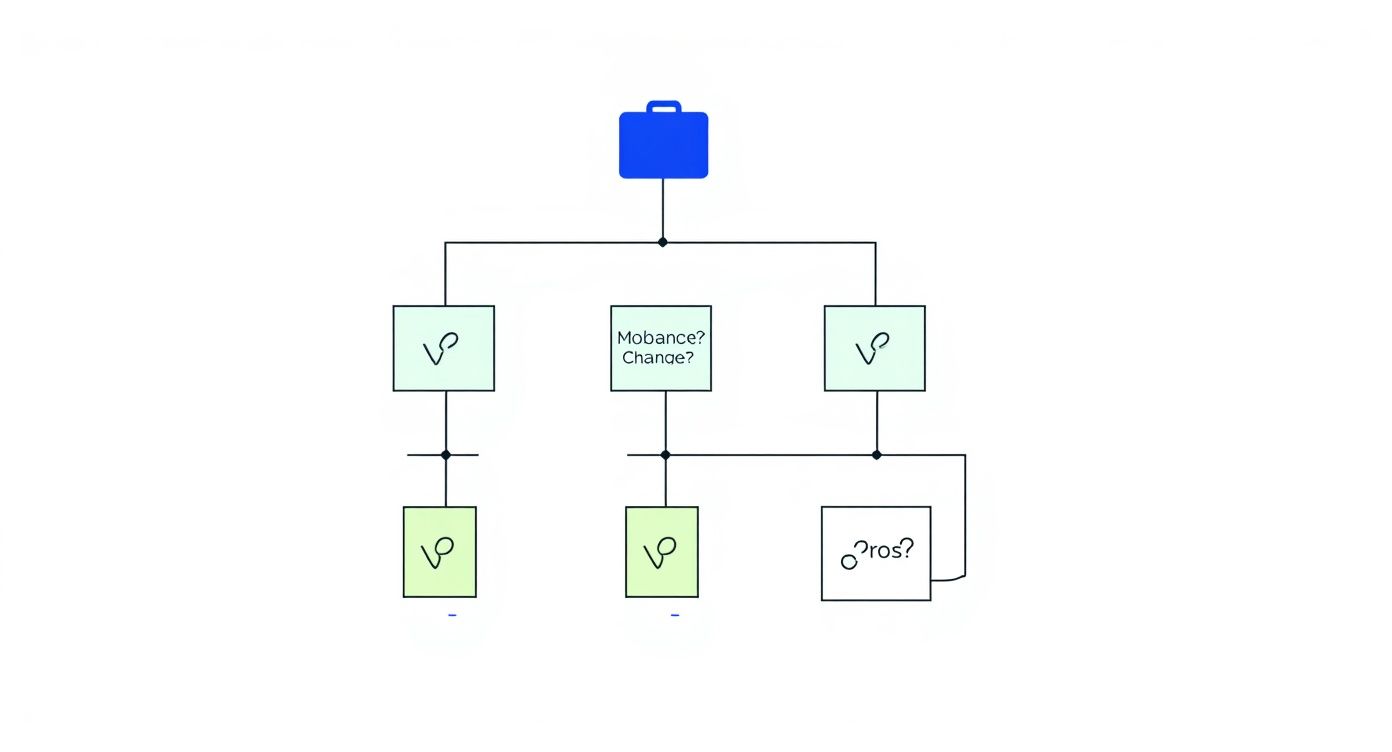
As the decision tree shows, either a significant life change or the simple passage of three years can open the door to seeking a new child support calculation.
What Happens After You File
Once the other parent has been properly served, the clock starts ticking. They have a specific deadline to file a legal response, known as an Answer, which is their official reply to your petition. If they fail to file an Answer on time, you could potentially get a default judgment, though this is rare in family law.
For parents looking for flexible and cost-effective legal help, exploring on-demand legal services can be a smart move. They can provide support for drafting initial documents without the commitment of a high retainer.
Getting these first steps right is non-negotiable. An error in filing or service can cause significant delays or even get your case dismissed, forcing you to start all over again. This is why many parents choose to work with an attorney from the very beginning.
The initial filing and service stages lay the foundation for your entire case. Getting these requirements right ensures you move forward on solid legal ground. The process can feel complicated, and knowing when to hire family law order modification lawyers in Texas can make all the difference. With the paperwork correctly filed and served, you're ready for the next phase: building your case with solid evidence.
Gathering Evidence to Support Your Modification Request
Filing your petition is the first step, but now you have to prove your case.
Winning a child support modification isn't about telling the judge a compelling story; it's about showing them the facts with clear, organized proof. The court needs to see undeniable evidence that a material and substantial change has occurred. Without it, your request is just your word against the other parent's, and that's not enough to change a legal order.

Proving a Change in Your Income
Whether your income went up or down, documentation is everything. A judge needs to see the numbers to understand how your financial reality has shifted. Start gathering these documents right away:
- Recent Pay Stubs: Collect at least two to three months of your most recent pay stubs to show your current earnings.
- Tax Returns: Your last two years of tax returns provide a broader picture of your financial history.
- W-2 or 1099 Forms: These are essential for showing your total annual income from employment or contract work.
- Proof of Job Loss: If you were laid off, have the termination letter, proof of unemployment benefits, and a log of your job search efforts.
- Bank Statements: These can help demonstrate changes in your monthly income and expenses.
A common mistake is thinking you can just tell the judge you lost your job. You must be prepared to show proof of your job search, proving that you are actively trying to remedy the situation and not just avoiding your obligation.
Documenting Changes in Your Child's Needs
If your modification request is based on the evolving needs of your child, you'll need a different set of documents. The goal here is to prove that the child's expenses have significantly increased since the last order was put in place.
Here’s what to collect:
- Medical Records and Bills: If your child has a new diagnosis, gather statements from doctors, therapy bills, and receipts for prescriptions.
- Health Insurance Premiums: Show proof of what you pay for the child's health, dental, and vision insurance. If the cost has jumped, highlight the difference.
- Educational Expenses: Collect invoices for private school tuition, receipts for tutoring, or costs for special educational programs.
- Childcare Costs: Provide receipts or invoices from daycare providers, especially if the cost or number of hours has changed.
This evidence paints a clear picture for the court, justifying why a new child support amount is necessary. It helps the judge see exactly where the money is going.
Special Considerations for Business Owners
If you're self-employed or own a business, proving your income gets more complicated. You can’t just show a pay stub. The court will want a much deeper look into your business's finances to determine your actual income available for support.
Be prepared to provide:
- Profit and Loss Statements (P&Ls): These should be current and cover at least the last year.
- Business Bank Account Statements: The court will review these to see cash flow and expenses.
- Business Tax Returns: Both personal and business returns are necessary.
Child support modifications are deeply tied to economic realities. A comparative study, for example, showed that in the U.S., when a father's income rises to 50% of the median wage, child support expectations can jump from around $180 to $431 monthly. This highlights how courts rely on detailed income assessments to ensure support meets the child's needs. You can explore more about these international comparisons in this study on income and child support.
All of this financial evidence is crucial for calculating the new support amount according to Texas guidelines. To better understand the specific formulas used, you can review our guide on how to calculate child support in Texas. This will help you anticipate what the court will be looking for in your documents.
Navigating Mediation and Courtroom Hearings
Once you've filed the lawsuit and gathered your evidence, the case moves into its next phase: resolving the dispute. This part can feel intimidating, but knowing what's coming will give you the confidence to handle it well. Most Texas family courts will require you and the other parent to try to find common ground before a judge will make a final decision.

This is where mediation enters the picture. Before you ever get a final hearing date, it’s almost guaranteed you'll be ordered to attend mediation. Think of it as a structured, confidential negotiation where you, the other parent, and your lawyers sit down with a neutral third-party mediator.
The mediator isn't there to pick sides or issue rulings. Their entire job is to facilitate a productive conversation, find areas of potential agreement, and guide both of you toward a resolution you can both live with.
Making the Most of Mediation
Mediation is your single best opportunity to control the outcome. It allows you to create a customized solution that actually fits your family's unique situation, rather than rolling the dice and letting a judge, who only knows you from a stack of paperwork, make the call.
To walk into mediation ready to succeed, you need to prepare:
- Know Your Numbers: Have all your financial documents perfectly organized. Be crystal clear on what the Texas child support guidelines say for your respective income levels.
- Define Your Goals: Figure out what your ideal outcome is, but also know where you're willing to be flexible. What is your absolute bottom line?
- Listen Actively: This can be challenging, but try to genuinely understand the other parent's point of view. You don't have to agree, but listening to their concerns can open up creative solutions you might not have considered.
If you reach a deal, it gets written into a Mediated Settlement Agreement (MSA). Once signed, an MSA is typically binding and cannot be revoked. This document becomes the blueprint for the final court order, saving everyone the stress, time, and expense of a courtroom battle.
Preparing for a Courtroom Hearing
What if mediation doesn't work out? If you can't find that middle ground, your case will be scheduled for a final hearing in front of a judge. This is a much more formal process where both sides present their evidence and make their arguments, leaving the final decision entirely in the judge's hands.
Walking into a courtroom can be nerve-wracking, but solid preparation is your best defense. While your attorney will lead the way, you have a vital role to play, especially since you'll likely be called to testify.
The judge's decision will be based only on the evidence presented in court and the requirements of the Texas Family Code. This is precisely why that document-gathering phase is so important—your testimony matters, but it needs to be supported by hard proof.
During the hearing, your lawyer will present your case, showing the judge the evidence you've collected—pay stubs, tax returns, receipts for your child's expenses, and other documentation. They'll ask you questions designed to highlight why a material and substantial change has occurred. After that, the other parent's lawyer gets a turn to cross-examine you.
What to Expect on the Witness Stand
When it's your turn to testify, the goal is simple: be clear, honest, and direct. The judge needs the facts to understand your situation, so stick to what you can prove.
Here are a few tips for testifying effectively:
- Answer Only the Question Asked: Don't volunteer extra information. Short, direct answers are always best.
- Stay Calm and Respectful: Even if the other attorney's questions feel pointed or accusatory, keep your composure. Your demeanor on the stand says a lot to the judge.
- Be Truthful: This is non-negotiable. Always tell the truth. Getting caught in even a small lie can shatter your credibility completely.
The judge will listen to both sides, review every piece of evidence submitted, and then make a ruling based on the Texas Family Code. Understanding how this all works demystifies the process, letting you focus on presenting your case as clearly and confidently as possible.
Finalizing Your New Child Support Order
You've made it through negotiations, mediation, or even a court hearing. That sigh of relief is well-deserved, but there's one last crucial step. Whether you reached an agreement or a judge announced a decision, that outcome isn't legally binding until it’s put into a formal, written document. This step turns a verbal ruling into an enforceable court order that will dictate your child support obligations for years to come.
This powerful document is called an Order Modifying the Parent-Child Relationship. It completely replaces your old child support order and sets the new legal standard for you and the other parent.
The Power of a Signed Written Order
Relying on a verbal agreement or a handshake deal to change child support is one of the biggest—and most common—mistakes people make. Without a written order signed by a judge, your old child support obligation remains in full effect.
Let that sink in. Even if you and your ex agreed to a lower payment, the other parent could legally take you back to court for enforcement down the road. You would be on the hook for the full original amount, plus interest, and there would be nothing you could do about it.
The judge's signature is everything. It's the final seal that makes your new child support amount legally binding and protects you from future disputes or claims of non-payment.
A signed order gives everyone clarity and security. It eliminates all doubt about what’s expected, stopping potential arguments before they can even start.
What Must Be Included in the Final Order
A proper modification order is meticulously detailed, leaving no room for guesswork. Your attorney will draft this document to ensure it contains all the precise legal language and specific details required by the Texas Family Code.
A correctly drafted order will clearly state:
- The New Monthly Payment Amount: This specifies the exact dollar amount of the new child support obligation.
- The Effective Date: The order will pinpoint the exact date the new payment amount begins. This is often retroactive to the date the other parent was served with the lawsuit.
- Retroactive Support (Arrears): If the new payment applies retroactively, the order will calculate the lump sum owed (or the credit you're due) and spell out how it will be paid.
- Payment Instructions: It details how payments are to be made, which is typically through wage withholding and processed by the Texas Child Support Disbursement Unit.
- Health and Dental Insurance: The order will reaffirm which parent is responsible for providing health and dental insurance for the child.
This kind of formalization is designed to create stability and predictability. In fact, some legal systems have found ways to reduce the need for constant court battles over these issues. The Netherlands, for example, uses an annual indexation process to adjust maintenance payments based on national wage trends. This approach helps keep support orders current with the economy. You can learn more about how other jurisdictions handle these adjustments.
Once the judge signs the order, it's filed with the district clerk, and copies are sent to you, the other parent, and your attorneys. This final document officially closes your modification case and sets a new, clear path forward for supporting your child.
Common Mistakes to Avoid When Modifying Child Support
Navigating a child support modification can feel like a maze, but a successful outcome often comes down to sidestepping a few common—and critical—missteps. The moves you make, and just as importantly, the ones you don't, can make or break your case.
One of the worst mistakes you can make is to stop paying your current child support just because you've filed a modification request. That original order is legally binding until a judge signs a new one. Failing to pay can trigger enforcement actions, damage your credibility with the court, and create unnecessary conflict.
Pitfalls That Can Derail Your Case
Another common mistake is relying on a verbal agreement with the other parent. It might seem easier to work things out with a handshake, but in Texas, those informal deals are completely unenforceable. If the other parent has a change of heart, you are left with no legal protection.
Finally, showing up to court unprepared is a recipe for disaster. You must walk in with all your financial documents organized and ready to go. Waiting too long to file your petition is another trap. A judge can only modify support retroactively to the date the other parent was served with the lawsuit, not the date your income actually changed. Every day you wait to file is a day of potential financial loss.
As you figure out what to do next, it can be really helpful to look at additional resources that explain the general process of how to modify child support.
What to Do Next
You don’t have to figure this out on your own. Trying to navigate Texas family law and avoid these common mistakes is a heavy burden, especially when you're already dealing with financial stress.
The path to a fair and sustainable child support order requires a smart strategy and a solid understanding of Texas family law. The Law Office of Bryan Fagan, PLLC is here to provide the guidance and advocacy you need. We invite you to schedule a free, confidential consultation with our experienced family law team to talk through your situation and build a plan to move forward with confidence.
Frequently Asked Questions About Modifying Child Support
Going through a child support modification brings up many questions. Getting clear, straightforward answers is the best way to understand your rights and know what to expect. Here are some of the most common questions we hear from parents in Texas.
How Long Does It Take to Modify a Child Support Order in Texas?
The timeline for changing child support can vary significantly. If you and the other parent agree on everything and can sign off on an order without a fight, the process might be finished in just a few months.
However, if your case is contested, you should prepare for a longer timeline. A disputed modification that involves mediation and a final court hearing can easily stretch from six months to a year, or sometimes longer, depending on the court's schedule and the complexity of your case.
Can a Child Support Modification Be Retroactive?
Yes, but there’s a limit. A Texas court can make the new support amount retroactive, but only back to the date the other parent was officially served with the modification lawsuit.
A judge cannot go back and change any payments that were due before the case was filed and served. This is a critical point—it means every day you wait to file is a day you could be losing money, one way or another.
What if My Ex Quits Their Job to Avoid Paying Support?
This is a scenario Texas courts are prepared for, and it's called intentional unemployment or underemployment. If a judge believes a parent quit their job or took a pay cut just to dodge their child support obligation, they can take action.
In these situations, the judge has the power to calculate child support based on that parent's earning potential—what they should be making based on their experience and qualifications—not their current, artificially low income.
Do I Need a Lawyer to Modify Child Support?
Legally, you are not required to have a lawyer. However, changing a court order is a complex legal process filled with potential pitfalls. An experienced family law attorney ensures your paperwork is filed correctly, helps you build a strong case with the right evidence, and advocates for your best interests in negotiations and in front of the judge.
Hiring a professional is especially critical in contested cases or if you are a business owner. It is an investment in securing a fair and lasting outcome for you and your child.
Understanding how to modify a child support order is the first step toward getting a fair result that reflects your life today. At The Law Office of Bryan Fagan, PLLC, our team is here to guide you through every stage with clarity and confidence. If you're ready to explore your options, we invite you to schedule a free, no-obligation consultation. Visit us at https://texasdivorcelawyer.us to get started.