Skip to content
When you’re facing a custody battle, the legal jargon alone can feel overwhelming and isolating.
Let's cut through the confusion and give you the clarity you need. The core difference between legal and physical custody is straightforward: legal custody is about who makes the major decisions for your child, while physical custody is about where your child lives day-to-day. Understanding this distinction is the first step toward regaining control and advocating for your family’s future with confidence.
Understanding the Two Types of Texas Custody
Facing a custody case is one of the most stressful experiences a parent can endure, but understanding the terminology is the first step toward taking control. In Texas, the courts use specific language you must know: "conservatorship" and "possession and access." While most people say "legal and physical custody," those aren't the official terms you'll find in a Texas court order.
This distinction is the foundation of every custody arrangement in the state. One part of your order will spell out who has the authority to make critical life decisions for your child. The other part will lay out the actual, physical schedule of when your child is with each parent.
Conservatorship is Legal Custody
In Texas, what everyone calls legal custody is officially known as conservatorship. This is the collection of legal rights and duties that gives you the power to make the big-picture decisions that will shape your child's life.
Think of it as your parental authority, as defined in the Texas Family Code. Key rights under conservatorship include making decisions about:
- Education: Choosing which school or school district your child will attend.
- Healthcare: Consenting to non-emergency medical, dental, and psychological treatment.
- Religion: Guiding your child's religious or moral upbringing.
Possession and Access is Physical Custody
What most people refer to as physical custody, the Texas Family Code calls possession and access. This part of your court order is essentially the parenting calendar. It details, often down to the hour, exactly when each parent will have the child in their care.
This schedule dictates everything from school nights and weekends to holidays, summer break, and birthdays. The goal is to create a predictable, stable routine that puts your child’s best interests first. For a deeper dive, you can explore our full guide to the nuances of Texas child custody laws.
This infographic helps break down the core difference between the decision-making power of legal custody and the day-to-day scheduling of physical custody.
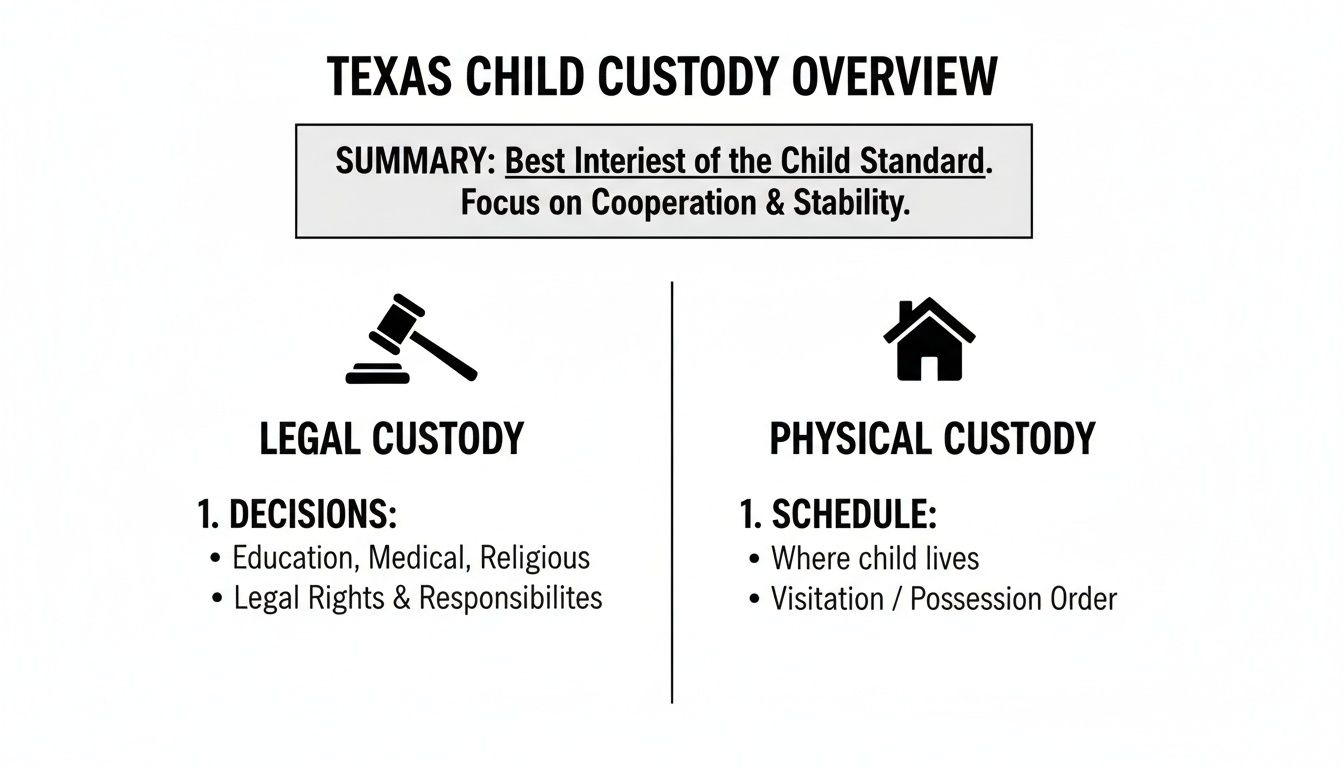
As you can see, the roles are clearly separate. The gavel represents the legal authority to make decisions, while the home symbolizes the physical schedule of where the child actually lives.
For a quick reference, here's a side-by-side comparison of how these concepts work in Texas.
Legal Custody vs. Physical Custody at a Glance
| Aspect | Legal Custody (Managing Conservatorship) | Physical Custody (Possession and Access) |
|---|---|---|
| Core Function | Grants the right to make major life decisions for the child. | Determines the child’s living arrangements and daily schedule. |
| Texas Legal Term | Managing Conservatorship | Possession and Access |
| Key Responsibilities | Education, non-emergency medical care, psychological treatment, and religious upbringing. | Daily care, housing, meals, transportation, and managing routine activities. |
| Common Arrangement | Joint Managing Conservatorship (parents share rights and duties). | One parent is designated primary and establishes residence; the other has a set visitation schedule (e.g., Standard Possession Order). |
Ultimately, knowing these terms helps you understand exactly what a judge is deciding. One part of the order gives you rights, and the other gives you time. Both are critical for your child's future.
Exploring Your Rights Under Legal Custody

As a parent, the big decisions are what keep you up at night. Legal custody—which Texas law calls Managing Conservatorship—is the legal framework that gives you the right to make those critical choices and shape your child’s future. It’s not about who has the child on a Tuesday night; it's about your authority to guide their life.
This authority is laid out in the Texas Family Code, Section 153.132, which lists the specific rights and duties a parent holds. Understanding these powers is the first step toward advocating effectively for yourself and your child.
What Decision-Making Powers Are Included
Legal custody gives you a seat at the table for the most important parts of your child's upbringing. These aren’t small, everyday choices but the fundamental decisions that will have a lasting impact.
Under a managing conservatorship, you typically have the right to:
- Make decisions about your child’s education, from school choice to tutoring.
- Consent to medical, dental, and surgical treatments that involve invasive procedures.
- Consent to psychological and psychiatric care.
- Represent your child in legal matters and make other big legal decisions on their behalf.
- Consent to their marriage or enlistment in the armed forces.
- Guide your child’s moral and religious upbringing.
Sharing these responsibilities means you have to be able to communicate and co-parent effectively. Your final court order will spell out exactly how these decisions must be made, especially when you and the other parent cannot agree.
Joint Managing Conservators vs. Sole Managing Conservators
Here in Texas, the court starts with the presumption that making both parents Joint Managing Conservators is in the child's best interest. This is the most common arrangement, where both parents share the rights and duties we just covered.
But "joint" doesn't always mean a 50/50 split on every single issue. In most Joint Managing Conservatorships, one parent is given the exclusive right to decide where the child lives, usually within a specific geographic area. This parent is often called the "primary conservator" or "primary parent" and is typically the one who receives child support. To get a better feel for these setups, check out our guide on the differences between joint custody vs. sole custody.
A Sole Managing Conservatorship is a much different and rarer outcome. A judge will only give one parent the exclusive right to make all major decisions if there's a history of family violence, substance abuse, or other serious issues that would put the child's physical or emotional well-being at risk.
While possession schedules are part of every custody order, the way legal rights are divided is a distinct and crucial piece of the puzzle that the court carefully considers.
Why the Primary Parent Designation Matters
Even in a joint arrangement, being the parent who establishes the child's residence is a big deal. This role often gives you the final say on which school the child attends, which can ripple out and affect many other parts of their life.
For example, if you have the right to designate your child’s primary residence, you’re the one enrolling them in local schools and building relationships with their teachers and doctors. That daily involvement naturally makes you the more informed parent on educational and medical topics, which can carry a lot of weight in future co-parenting discussions or modification requests.
At the end of the day, your legal custody rights are the tools you have to protect your child’s well-being and make sure they get the stable, supportive upbringing they deserve.
Navigating Physical Custody and Possession Schedules

Knowing you have the right to make decisions for your child is one thing, but figuring out the daily rhythm of co-parenting is where things get real. This is the domain of physical custody, which Texas law calls Possession and Access. It’s the calendar that will govern your family’s life after a divorce or separation, defining exactly where your child will be and when.
This schedule is far more than just logistics; it’s the practical framework for maintaining a strong, consistent relationship with your child. A well-structured possession order creates the predictability and stability that are so critical for a child’s well-being, especially during a time of major life changes.
The Texas Standard Possession Order Explained
In Texas, courts start with a default schedule that they presume is in the child’s best interest: the Standard Possession Order (SPO). For children over the age of three whose parents live within 100 miles of each other, this is the schedule used in the vast majority of custody cases.
The SPO provides a clear, detailed calendar that both you and your co-parent can rely on. It’s specifically designed to give the non-primary parent regular and continuous time with the child while providing a stable home base with the primary parent.
A typical SPO schedule includes:
- Weekend Possession: The non-primary parent has the child on the first, third, and fifth weekends of a month.
- Holiday Divisions: Major holidays like Thanksgiving and Christmas are alternated between parents each year, ensuring you both get to create those special memories.
- Summer Possession: The non-primary parent typically has the child for an extended period, usually 30 days, during the summer break.
This structured approach takes the guesswork out of scheduling and minimizes the potential for conflict. For a more detailed look at how these schedules work in practice, check out our comprehensive guide to the Standard Possession Order in Texas.
The core idea behind the SPO is to ensure both parents remain actively involved in their child's life. It balances the need for a primary home with the child’s right to have frequent and meaningful contact with both parents.
When the Standard Schedule Isn't the Right Fit
While the SPO is the default, Texas law is flexible enough to recognize it isn’t a one-size-fits-all solution. Every family is unique, and your possession schedule should reflect that reality. A judge can—and will—deviate from the standard order if there's good evidence that a different arrangement would be better for your child.
For instance, the SPO is often not appropriate for children under the age of three. Toddlers and infants need shorter, more frequent visits with each parent to develop secure attachments. Other situations that might require a custom schedule include:
- Significant Distance: When parents live more than 100 miles apart, the first, third, and fifth weekend structure just isn't practical. An expanded or custom plan becomes necessary.
- Parent's Work Schedule: If you work non-traditional hours as a first responder, medical professional, or shift worker, a standard schedule may simply not be feasible.
- Child's Special Needs: A child with significant medical or developmental needs might require a schedule that prioritizes consistency and minimizes transitions between homes.
Building a Case for a Custom Possession Plan
If you believe the SPO is not in your child’s best interest, you must provide the court with clear reasons and specific evidence to back up your position. A judge will consider several factors when deciding on a possession schedule.
They'll look at each parent's ability to provide a stable home, your child’s emotional and physical needs, and any history of conflict or instability. The key is to demonstrate how your proposed schedule better serves your child’s specific needs.
Over the years, cultural and legal shifts have dramatically changed how courts view physical custody. Joint legal custody awards have surged far ahead of shared physical arrangements. However, the trend toward shared parenting is undeniable. For example, in U.S. divorce cases, mother-sole physical custody plummeted from 74% in the early 1990s to 42% by 2008, while shared custody arrangements (both equal and unequal) exploded. This shift marked a milestone where non-mother-sole custody judgments finally outnumbered sole maternal ones. You can discover more insights about these custody trends from the Department of Justice Canada.
This trend highlights the courts' increasing willingness to consider varied possession schedules that truly reflect a child's best interest, moving away from older, more rigid models.
How Texas Courts Decide Your Custody Case
It’s a terrifying thought: a stranger in a black robe making the most personal decisions about your child’s life. When you and the other parent simply cannot agree, you have to place your family’s future in a judge’s hands. You need to understand exactly how they see your case.

In every Texas custody case, the judge is guided by a single principle that overrides everything else: the best interest of the child. This is the legal standard set by the Texas Family Code, Section 153.002. But what does that phrase actually mean inside a courtroom?
The Holley Factors a Judge Considers
To give judges a framework for determining a child’s best interest, the Texas Supreme Court established a list of criteria in a landmark case called Holley v. Adams. These are now known as the "Holley Factors," and they are the specific questions a judge will consider when looking at your family's situation.
While there’s no mathematical formula, your ability to present strong, clear evidence on these points is what will shape the outcome of your case.
The key Holley Factors include:
- The emotional and physical needs of the child now and in the future.
- Any emotional or physical danger the child may be in, now or in the future.
- The parental abilities of each person seeking custody.
- The programs available to assist parents in promoting the child's best interest.
- The stability of each parent’s proposed home.
- Any actions or failures to act that might show the existing parent-child relationship isn't a proper one.
- Any explanation for those actions or failures.
Essentially, a judge is trying to build a complete picture of your child’s world to figure out which parent is better equipped to provide a safe, stable, and loving environment.
Proving Your Case in Court
To persuade a judge that what you're asking for serves your child’s best interest, you have to show them, not just tell them. It's about presenting compelling, concrete proof.
For example, to demonstrate the stability of your home, you could provide your lease or mortgage statements, photos of your child's room, and testimony from neighbors. To show you're involved in their education, you can present report cards, emails with teachers, and proof of your attendance at school events.
The court wants to see a history of positive, consistent involvement. Your actions leading up to the custody case often speak louder than any words you say on the witness stand. The more you can document your role as an active, nurturing parent, the stronger your position will be.
The Role of Court-Appointed Professionals
In highly contested cases, a judge might not have enough information to make a decision based only on what you and the other parent say. To get an unbiased look into your family’s life, they can appoint neutral professionals to investigate and report back.
An amicus attorney is a lawyer appointed to represent the child’s best interests—not what the child wants, but what is objectively best for them. This attorney can interview you, your child, teachers, and counselors, and will make a recommendation to the judge. Their opinion often carries significant weight.
Statistically, custody arrangements have a profound impact on family well-being. Shared physical custody, for example, is linked to better academic performance in children in 65% of studies, yet it remains less common than shared legal custody. This highlights a critical difference in custody decisions, as the stress of disputes can also affect custodial parents, with 20% facing mental health challenges. You can read more about these findings on shared parenting.
Understanding how a judge thinks—by focusing on the Holley Factors and your child's best interest—is your best tool for preparing a strong and persuasive custody case.
Putting Custody Concepts into Practice: Real-World Examples
It's one thing to read about legal terms; it's another to see how they work for families like yours. Let's walk through a few common scenarios to see how a custody order can be tailored to fit your unique circumstances in Texas.
Scenario 1: The Business Owner with an Unpredictable Schedule
You own a business that requires frequent, last-minute travel. A rigid Standard Possession Order feels impossible to follow, and you're worried about losing precious time with your kids.
- The Solution: A customized possession order with built-in flexibility. Your attorney can help you draft an order that includes clauses like a "Right of First Refusal," which requires your co-parent to offer you parenting time before calling a babysitter, or "makeup time" provisions that allow you to reschedule missed weekends. This approach protects your career and your relationship with your children.
Scenario 2: High-Conflict Co-Parenting Over Big Decisions
You and your ex can handle the daily routine but clash on every major decision, like schooling or medical care. You’re both Joint Managing Conservators, but every important conversation ends in a stalemate, leaving your child caught in the middle.
- The Solution: A structured conservatorship plan that assigns specific decision-making powers. Your order can give one parent the final say on education while giving the other the final say on non-emergency healthcare. It can also require you both to attend mediation with a parenting coordinator or facilitator before either of you can take the issue back to court, saving you time, money, and stress.
Scenario 3: The Military Parent Facing Deployment
As a service member, you face the unique challenge of a potential deployment. The Texas Family Code has specific protections to ensure your service doesn't negatively impact your parental rights.
- The Solution: An order that leverages military family protections under Texas Family Code Chapter 153. Your plan can temporarily delegate your possession time to a trusted family member (like a grandparent), guarantee regular video calls with your child, and ensure your original schedule is reinstated immediately upon your return. This gives you peace of mind that your bond with your child is secure while you serve.
What to Do Next: Secure Your Child’s Future
Understanding the difference between legal and physical custody is a critical first step. Now, it’s time to take action to protect your rights and build the stable future your child deserves.
Key Takeaways
- Know the Texas Terms: "Conservatorship" is legal custody (decision-making), and "Possession and Access" is physical custody (the schedule).
- "Best Interest" is Everything: A judge's final decision will be based on the "best interest of the child," as defined by the Holley Factors.
- Customization is Possible: The Standard Possession Order is the default, but you can negotiate a customized plan that fits your family's specific needs, especially for business owners, first responders, or military families.
- Preparation is Power: Your best chance for a positive outcome is through preparation, whether for mediation or trial. Gather your documents, outline your ideal plan, and know your non-negotiables.
The decisions you make now will shape your family’s life for years to come. You don’t have to walk through this complex and emotional process by yourself. The stakes are simply too high to risk your relationship with your child. The compassionate, experienced family law attorneys at The Law Office of Bryan Fagan, PLLC are here to give you the guidance and advocacy you deserve.
We invite you to schedule a free, no-obligation consultation with our team. Let us help you protect your family and your future. Call us or visit https://texasdivorcelawyer.us to get started.
Answers to Your Top Texas Custody Questions
When you're heading into a Texas custody case, it's natural to have a ton of questions. Getting straight answers can make a world of difference in how prepared you feel. Here are some of the most common questions we hear from parents in your exact situation.
Can a Parent Get Sole Legal Custody but Not Be the Primary Parent?
This question really gets to the heart of the difference between legal and physical custody. While it's technically possible, this kind of arrangement is incredibly rare in Texas courts. A judge would only consider granting one parent sole managing conservatorship (sole legal custody) if there's powerful evidence of family violence, serious neglect, or substance abuse.
In those situations, the court's number one job is to shield the child from a dangerous parent's decision-making. But if that same parent is somehow considered safe enough for supervised visits (a form of physical possession), it creates a very contradictory and unusual scenario. The reality is that Texas courts strongly prefer to name parents as Joint Managing Conservators, which keeps both involved in the major decisions for their child.
How Does the Possession Schedule Affect Child Support Calculations?
Child support and possession schedules are tied at the hip. Under the Texas Family Code, the formula for child support is mainly driven by the non-primary parent's net monthly income and how many children are involved.
The parent who is named the primary conservator—the one with the exclusive right to decide where the child lives—is almost always the parent who receives child support payments. This holds true even in schedules that look a lot like a 50/50 split. The law works on the assumption that the primary parent is shouldering a bigger piece of the everyday costs of raising a child, from the mortgage and electricity to groceries and school supplies.
At What Age Can My Child Decide Who They Want to Live With?
This is easily one of the biggest myths in all of Texas family law. The truth is, there is no magic age where a child gets to legally decide which parent they live with. The judge always, always makes the final call based on what's in the child's overall best interest.
However, the Texas Family Code does have a specific rule on this. Under Section 153.009, if a parent makes the request, a judge is required to interview a child who is 12 years of age or older in their private office. This gives the child a chance to speak freely and state their wishes directly to the judge, away from the pressure of having their parents in the room.
While a judge will absolutely listen to and weigh the child’s preference, it is just one piece of the puzzle. A child's wishes are not the final word, and the judge will balance them against all the other evidence about the child's physical and emotional well-being before making a final decision.
Knowing the real answers to these questions helps you set realistic goals and build a smarter legal strategy from the start.