Skip to content
Facing divorce often brings the unnerving question of spousal support, a topic that can feel riddled with anxiety and uncertainty.
The answer to when you have to pay spousal support in Texas, however, is far more specific and limited than most people realize. You are only required to pay under two distinct circumstances: if a judge orders it under very strict legal conditions, or if you and your spouse agree to it yourselves. Understanding the difference is the first step toward navigating your divorce with confidence.
Spousal Support in Your Texas Divorce
The idea of financially supporting an ex-spouse often brings up fears fueled by TV dramas or stories from other states. It’s critical to understand that Texas law handles this issue very differently. You are not automatically required to make payments just because you were the primary breadwinner during the marriage.
Instead, Texas sets a very high bar for a court to order these payments. The law, found in the Texas Family Code, draws a bright line between two types of support:
- Spousal Maintenance: This is what a judge can order one spouse to pay the other after the divorce is finalized, and it's anything but a given. The spouse asking for it must prove they’ve made a good-faith effort to earn an income or develop job skills but still cannot meet their own "minimum reasonable needs."
- Contractual Alimony: This is a voluntary agreement you and your spouse can create, usually during mediation. Unlike court-ordered maintenance, this type of support is flexible and can be tailored to your specific financial situation. Once you both agree, it becomes a legally binding contract.
The most important thing to remember is this: A Texas judge's power to order spousal support is strictly limited by law. A judge simply cannot force you to pay unless your spouse meets very specific eligibility requirements outlined in the Texas Family Code.
This distinction is everything. If your spouse cannot prove they meet the tough legal standards for court-ordered maintenance, a judge’s hands are tied. This provides a clear and predictable framework for you to work within as you plan your next steps.
Understanding this difference is the first step toward replacing uncertainty with confidence. You can get a more detailed look at how Texas defines alimony in our comprehensive guide, which will help you prepare for the financial realities of your divorce. Our goal is to give you a solid foundation of knowledge so you can see a clear path forward and make informed decisions that protect your future.
The Four Paths to Spousal Maintenance Eligibility in Texas
The question of whether you'll have to pay spousal support is one of the biggest stressors in a divorce. In Texas, it's not something a judge can grant on a whim. Your spouse has to first prove they are eligible under a set of very specific, and frankly, quite high legal standards.
Think of it this way: eligibility is like a locked door. Your spouse needs one of four specific keys from the Texas Family Code to open it. Without one of those keys, the door to court-ordered maintenance stays firmly shut.
Let's walk through each of these four paths so you have a clear picture of what the law requires.
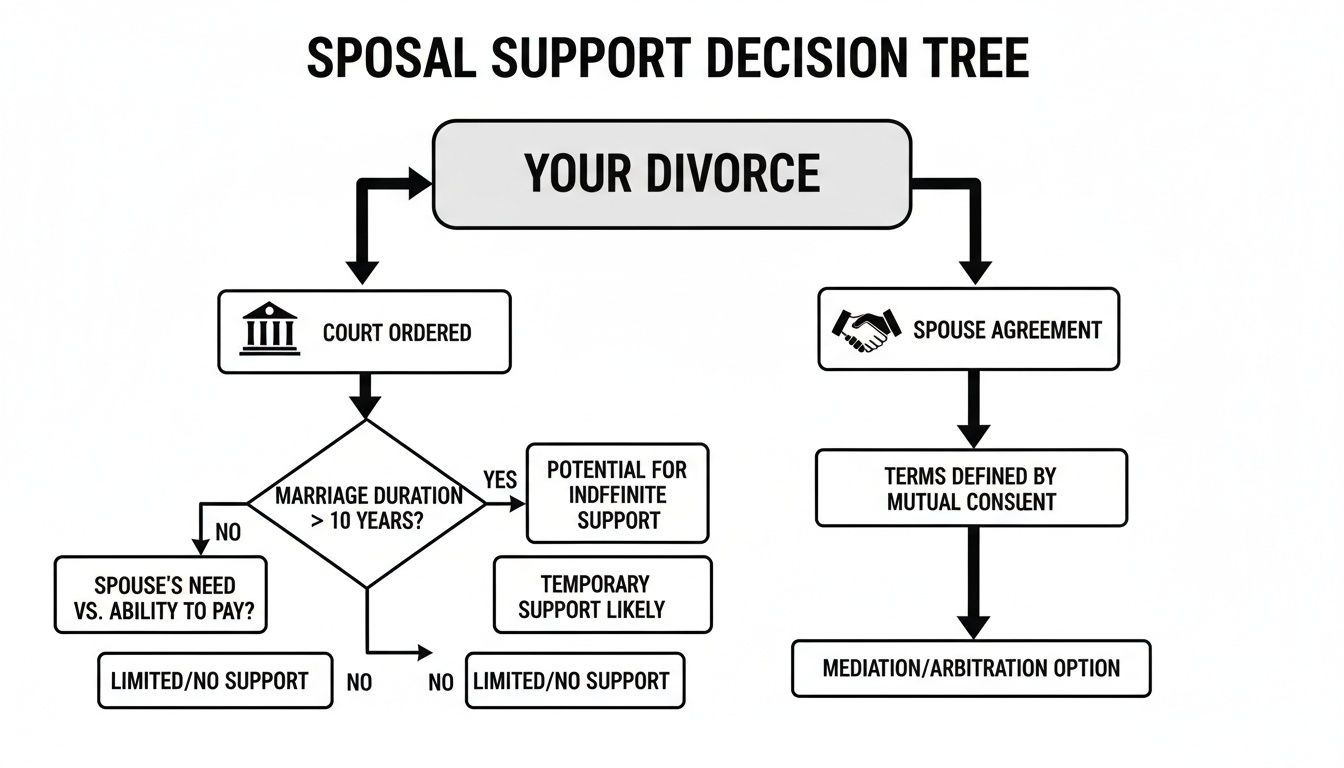
The takeaway here is simple but powerful: you can either let the court make the call based on these rigid legal tests, or you and your spouse can take control during mediation and work out your own agreement.
The 10-Year Marriage Rule
This is by far the most common way a spouse might qualify for maintenance. If you've been married for 10 years or longer, the court has the authority to consider spousal maintenance. But that’s only the first step.
The requesting spouse must also prove they lack the ability to provide for their own “minimum reasonable needs.” This isn't about maintaining a certain lifestyle; it's about covering the absolute basics. They need to show the court that they've actively tried to earn enough money or develop marketable skills but just haven't been able to become self-sufficient.
What does “minimum reasonable needs” actually mean? A judge will look at the specific facts of your case. It generally covers essential living expenses—like a modest place to live, utilities, food, and basic transportation—not luxuries or discretionary spending. This is a key part of the process, from filing the initial petition to the final decree.
The Family Violence Exception
The 10-year marriage rule isn't absolute. Texas law makes a critical exception in cases involving family violence. If the paying spouse was convicted of or received deferred adjudication for a criminal act of family violence, the marriage length requirement is waived.
To trigger this exception, the offense must have happened within two years of filing for divorce or during the divorce proceedings. This provision reflects a strong public policy: no one should be financially trapped in an abusive relationship. Proving this requires hard evidence from the court process, like a criminal conviction.
The Spousal Disability Path
Eligibility can also be established if one spouse has an incapacitating physical or mental disability that prevents them from providing for their own minimum reasonable needs. For this path, there is no minimum marriage length requirement.
The key here is that the disability must be severe enough to make earning a living impossible. A spouse making this claim will need to back it up with solid medical evidence, which typically includes:
- Detailed reports from doctors or mental health experts.
- Official medical records diagnosing the condition.
- Expert testimony explaining why the spouse cannot work.
The Disabled Child of the Marriage Path
Finally, a spouse may be eligible for maintenance if they are the primary caregiver for a child of the marriage (regardless of age) who has a significant disability. The child's condition must require such substantial care and supervision that it prevents the parent from being able to work and earn a sufficient income.
Just like with the spousal disability path, there is no minimum marriage duration for this ground. The law recognizes that the child’s needs directly impact the parent's ability to be self-supporting, creating a basis for potential maintenance. This is a critical factor for parents navigating a divorce.
Texas Spousal Maintenance Eligibility at a Glance
This table breaks down the four eligibility grounds for court-ordered spousal maintenance in Texas.
| Eligibility Ground | Key Requirement (Texas Family Code) | What the Court Considers |
|---|---|---|
| 10-Year Marriage | Marriage lasted 10+ years, and the requesting spouse lacks the ability to provide for their minimum reasonable needs. | The spouse's efforts to find work or gain skills, and evidence of their basic living expenses. |
| Family Violence | Conviction or deferred adjudication for family violence within 2 years of the divorce filing or during the case. | A criminal record of the offense. The 10-year marriage rule is waived. |
| Spousal Disability | An incapacitating physical or mental disability prevents the spouse from earning a sufficient income. | Compelling medical evidence, such as doctor's reports and expert testimony. No minimum marriage length is required. |
| Disabled Child of the Marriage | The spouse is the caregiver for a disabled child, preventing them from working enough to be self-sufficient. | The child's specific needs and how caregiving impacts the parent's ability to work. No minimum marriage length. |
Understanding these four pathways is the first step in figuring out where you might stand. If you want to dig deeper into the kind of evidence and proof required for each, our guide on how you qualify for spousal support in Texas is a great next read.
How Courts Determine the Amount and Duration of Payments
Knowing your spouse might qualify for maintenance is one thing, but the next questions are often the most stressful: "How much am I going to have to pay?" and "For how long?" Staring into that unknown can feel paralyzing.
Fortunately, in Texas, the process isn't a mystery. The law lays out very specific formulas and time limits to guide how spousal support is determined.

Unlike some states with vague, open-ended alimony, Texas puts firm guardrails in place. The goal here isn't to bankroll a certain lifestyle indefinitely. It's about providing a temporary, reasonable bridge for a spouse who truly can’t meet their most basic needs on their own.
The Two Caps on Maintenance Amounts
When a judge awards spousal maintenance, they don’t just pull a number from a hat. The Texas Family Code puts a hard ceiling on how much can be ordered. The monthly payment is capped at the lesser of two specific figures:
- $5,000 per month
- 20% of the paying spouse's average monthly gross income
This is a critical point. The lower of the two numbers always wins. For example, if 20% of your monthly income is $8,000, the most a judge can order you to pay is $5,000. On the flip side, if your gross monthly income is $10,000, 20% of that is $2,000. In that case, the maximum award would be $2,000, not $5,000.
What exactly is "gross income"? This detail matters. Gross income includes all wages, salaries, commissions, tips, overtime, bonuses, interest, and dividends. It also covers self-employment income, rental income, and even some retirement and disability payments. For business owners, calculating this figure can be complex and requires careful accounting.
The court will look at all your income sources to calculate this average, which is why providing accurate and complete financial information during your divorce is so important.
Factors a Judge Must Consider
The statutory cap is just the maximum possible amount. To land on the final number, a judge has to weigh a list of factors laid out in the Texas Family Code. This is where the unique facts of your marriage and your financial lives come into play.
A judge will carefully evaluate things like:
- Each spouse’s financial resources after the divorce, including their separate property and their share of the community estate (property division).
- The education and job skills of both spouses, and how long it would take the requesting spouse to get training to find work.
- The duration of the marriage.
- The age, employment history, earning ability, and physical and emotional state of the spouse asking for support.
- Whether one spouse's ability to work is limited because they are the primary caregiver for a disabled child.
- Any acts of adultery or family violence by either spouse.
- The contributions one spouse made as a homemaker.
- Any hiding, wasting, or destruction of marital property.
The judge balances all these factors to arrive at an amount that is fair and just, while always staying under that legal cap. If you want to see how these factors might play out in different scenarios, our detailed guide on how much spousal support is in Texas offers more examples and in-depth explanations.
Strict Time Limits on How Long You Have to Pay
Perhaps the most important guardrail in Texas spousal support law is the one that limits how long payments can last. The law is very clear: maintenance is meant to be temporary, not permanent. The maximum duration is tied directly to how long you were married, with a Texas-specific timeline.
The time limits are set as follows:
- Five Years: For a marriage that lasted between 10 and 20 years. This also applies if the marriage was shorter but eligibility was based on a family violence conviction.
- Seven Years: For a marriage that lasted between 20 and 30 years.
- Ten Years: For a marriage that lasted 30 years or more.
There is a significant exception. If a spouse is unable to support themselves because of an incapacitating disability or because they are caring for a disabled child of the marriage, the maintenance order can last for as long as those conditions exist. For most people, however, these time limits are absolute.
These caps on both the amount and duration of payments give you a level of predictability. By understanding these legal boundaries, you can better anticipate the potential outcomes and work toward a fair resolution in your case.
Temporary Support vs. Post-Divorce Maintenance
Of all the financial worries that come with divorce, the fear of not being able to make ends meet while the case is ongoing is one of the most stressful. Texas law recognizes this reality and draws a sharp line between two types of support: temporary support paid while the divorce is pending, and post-divorce maintenance paid after it’s all over.
Understanding this distinction is absolutely critical. What you might get to help pay the bills for a few months is completely different from what you might receive long-term.
How Temporary Spousal Support Works
A divorce isn't a one-day event. It can take months, sometimes even over a year, from the day you file to the day you’re officially divorced. But the mortgage, car payment, and utility bills don’t take a break. A spouse with little income or no access to the marital bank accounts can find themselves in a tight spot, fast.
This is exactly why temporary orders exist. Here is a step-by-step breakdown of how it works:
- File a Motion: You or your spouse files a motion asking the court for temporary support.
- Attend a Hearing: This triggers a court hearing where a judge will look at both of your financial situations.
- Present Evidence: You will provide bank statements, pay stubs, and a monthly budget to show need versus ability to pay.
- Judge Issues an Order: The judge decides if short-term help is necessary to keep things financially stable until the divorce is final.
This type of support is granted far more often than post-divorce maintenance. Its goal is simply to prevent one person from facing financial ruin while the lawyers are working things out. Once the divorce is finalized, temporary support stops—automatically.
The Higher Bar for Post-Divorce Maintenance
The moment the judge signs that final divorce decree, the rules change dramatically. Temporary support doesn't just roll over and become permanent. To get spousal maintenance after the divorce, you have to prove you meet one of the very specific legal requirements we've already covered, like being married for 10 years or being a victim of family violence.
This is a point you can't afford to miss. A judge might easily grant temporary support to help someone get by for a few months but later deny post-divorce maintenance because that same person doesn't clear the high legal hurdles for long-term payments.
Let's break down the key differences:
| Aspect | Temporary Spousal Support | Post-Divorce Spousal Maintenance |
|---|---|---|
| Purpose | To cover a spouse's needs during the divorce. | To provide for a spouse's minimum reasonable needs after the divorce. |
| Eligibility | Based on immediate need and the other spouse's ability to pay. | Requires meeting one of the four strict statutory grounds (e.g., 10-year marriage). |
| Duration | Ends the day the divorce is finalized. | Limited by law, usually to 5, 7, or 10 years, based on how long you were married. |
| Commonality | Frequently granted to ensure financial stability during the case. | Much more difficult to get because of the strict legal standards. |
It's essential to see these as two completely separate tools in the legal toolbox. You have to be prepared to argue for (or against) each one at different points in your case, because what happens at a temporary orders hearing is no guarantee of the final outcome.
Using Contractual Alimony in Your Divorce Strategy
What happens when the rigid, one-size-fits-all rules for court-ordered maintenance just don’t work for your family? While Texas law is very strict about what a judge can order, it also gives you and your spouse the freedom to forge your own path with an incredibly useful tool: contractual alimony.
At its core, this is a private, voluntary agreement you and your spouse negotiate as part of your overall divorce settlement. Think of it as creating a custom-tailored financial blueprint for your post-divorce lives, designed by you instead of for you. It’s your chance to step outside the strict confines of the Texas Family Code and build terms that make real-world sense for your unique situation, often through mediation options.
Taking Back Control with a Private Agreement
Contractual alimony is all about maintaining control and finding creative solutions—a lifesaver in high-asset or particularly complex divorce cases. You and your spouse, usually with your attorneys guiding you through mediation, can agree to spousal support terms that a judge would have absolutely no power to order on their own.
This flexibility can be a complete game-changer. For instance, you could agree to things like:
- Payments Above the Legal Cap: If the statutory maximum—$5,000 or 20% of gross monthly income—simply isn't enough to cover realistic needs, you can agree to a higher amount.
- Longer Payment Durations: You have the power to extend support payments well beyond the five, seven, or ten-year limits imposed by the law.
- Unique Payment Structures: Your agreement could include a one-time lump sum payment or tie payments to specific life events, like a child’s college graduation or the sale of a family business.
For a business owner or high-net-worth individual, contractual alimony can be a brilliant strategic move to protect key assets. You might agree to more generous support payments in exchange for keeping your business interest, a specific investment portfolio, or the family home entirely intact. This practical advice is crucial for those with complex estates.
Why Would You Ever Agree to Pay More Than a Judge Could Order?
It might seem backward to voluntarily offer more spousal support than the law demands, but there are powerful strategic reasons why this happens all the time. Contractual alimony is often used as a critical bargaining chip to get a better overall outcome in the divorce.
By being more flexible on support terms, you might be able to negotiate a far more desirable result in another part of your divorce. For example, you could use it to secure a better split of your retirement accounts or to shield a valuable piece of separate property from a messy and expensive tracing claim. It’s all about looking at the entire financial picture, not just one single issue.
The Most Critical Detail: Can It Be Changed Later?
One of the biggest differences between court-ordered maintenance and contractual alimony comes down to what happens if life throws a curveball. A judge's order for spousal maintenance can usually be modified down the road if there's a major change in either spouse's life, like losing a job or getting a big promotion.
Contractual alimony, however, is a different beast entirely. It’s a binding contract. Because of that, it is generally non-modifiable and non-terminable unless you and your spouse specifically write the option to modify it into the agreement itself. This makes enforcement straightforward.
This gives both of you certainty and finality. It can be a massive relief for spouses who want to close this chapter for good, without worrying about being dragged back into court years later. This predictability is precisely why so many couples choose this route.
What to Do Next to Protect Your Financial Future
The idea of spousal support can be overwhelming. Whether you're the one who might be paying or the one who needs to receive it, the uncertainty can feel like navigating a maze in the dark. But you don't have to stay in a state of anxiety. It's time to take control by taking smart, strategic action.

Here's your step-by-step plan:
- Gather Financial Documents: Your first move is to become a financial detective. Start gathering every piece of financial information you can get your hands on—tax returns, pay stubs, bank statements, credit card bills, and records for any investments. A clear, complete picture of your marital finances is the bedrock of a solid legal strategy.
- Create a Realistic Budget: Next, it’s time to create a realistic post-divorce budget. This isn't just a simple list of bills. It's a detailed forecast of your "minimum reasonable needs." If you're the spouse asking for support, this budget proves your financial shortfall. If you might be paying, documenting your own income and expenses is just as critical to show the court what you can (or can't) afford.
- Document Your Efforts: If you are seeking support, meticulously document your job search. Keep a detailed log of every application, interview, and training course you've attended. This proves to the court that you are making a good-faith effort to support yourself, as required by the Texas Family Code.
- Get Professional Guidance: Trying to handle this process on your own is a gamble you don't need to take. The financial stakes are incredibly high, and the fine print in Texas spousal support law is full of nuances. Your single most important step is to get personalized advice from a legal professional who understands the system.
Key Takeaway
You don't have to face this uncertainty alone. An experienced family law attorney can break down your unique situation, explain your rights, and help you build a strategy to secure your financial future. We invite you to schedule a free, confidential consultation with the attorneys at The Law Office of Bryan Fagan, PLLC. Let us give you the clear answers and compassionate guidance you need to move forward with confidence.
Frequently Asked Questions About Texas Spousal Support
When it comes to spousal support, the "what-ifs" can feel overwhelming. It's a topic filled with gray areas and a lot of misinformation. We get these questions all the time, so let's clear up some of the most common concerns Texas families face.
Can I Stop Paying Support if I Lose My Job?
Losing your job is a huge financial and emotional blow, but you absolutely cannot stop making court-ordered spousal maintenance payments on your own. That court order is legally binding, and ignoring it can lead to serious legal trouble, including enforcement actions.
To get any relief, you must go back to court. You'll need to file a motion to modify your support obligation, proving to the judge that you've had a material and substantial change in your financial circumstances. Only a judge can legally reduce, pause, or end your payments.
What if My Ex-Spouse Remarries?
The answer depends on the type of support you're paying. Under the Texas Family Code, court-ordered spousal maintenance automatically terminates if the person receiving payments remarries. The obligation also ends if either you or your ex-spouse passes away.
But this isn't true for contractual alimony. If you agreed to this type of support in a private contract (like a settlement agreement), the terms of that contract rule. Unless it specifically says that payments stop upon remarriage, you may be on the hook for the full term you agreed to.
A key takeaway: The rules for court-ordered maintenance and contractual alimony are very different. Always refer back to your divorce decree to understand your specific obligations.
Are Spousal Support Payments Taxable in Texas?
The tax laws around spousal support changed significantly a few years ago. For any divorce decree finalized on or after January 1, 2019, the old rules no longer apply.
Today, spousal support payments are not tax-deductible for the paying spouse, and they are not considered taxable income for the receiving spouse. This is a major shift that affects how both sides should approach financial planning during and after the divorce.
Does Adultery Affect Spousal Support?
Yes, it certainly can. In Texas, a judge is required by the Texas Family Code to consider marital misconduct, including adultery, when deciding on the amount and duration of spousal maintenance. While it doesn't create an automatic "yes" or "no" for support, it's a powerful factor that can absolutely sway a judge's final decision.
For those with significant assets, navigating the intersection of marital conduct and financial outcomes requires a careful, strategic approach. Gaining a full picture of the financial complexities is vital for protecting your assets and planning for the future. For high-net-worth individuals, mastering these details is crucial, as explained in this helpful resource, A Guide to Finance and Divorce for High Net Worth Individuals.
The questions surrounding spousal support are complex, but you don’t have to find the answers alone. The compassionate attorneys at The Law Office of Bryan Fagan, PLLC are here to provide the clarity and strategic guidance you need. Schedule a free, no-obligation consultation today to discuss your case and protect your financial future. Call us or visit https://texasdivorcelawyer.us to get started.