Skip to content
Are you a father who believes your child’s well-being depends on living with you full-time? You’re not just fighting a legal battle; you're fighting for your child's future, and that can feel overwhelming. It’s a tough road, but for a dedicated father, it’s a fight worth having, and you don't have to walk it alone.
In Texas, what most people call "full custody" has a specific legal name: Sole Managing Conservator. While the courts don't hand this designation out lightly, it is absolutely achievable for fathers who can prove it’s what’s best for their kids.
What "Full Custody" Actually Means in Texas

When you're stepping into a courtroom to fight for your child, using the right language matters. You won’t find the phrase “full custody” anywhere in the Texas Family Code. Instead, judges appoint parents as "conservators."
If your goal is to have your child live with you and to make the major decisions for them, you are asking the court to name you the Sole Managing Conservator (SMC).
This is a significant request because it goes against the standard arrangement in Texas, which is to name both parents as Joint Managing Conservators (JMC). The law starts with the assumption that keeping both parents deeply involved in a child’s life is in their best interest. To win your case for sole custody, you have to show a judge, with clear and compelling evidence, why that presumption doesn't apply in your family’s situation.
Sole Managing Conservator Rights and Responsibilities
Being named the Sole Managing Conservator gives you the exclusive power to make critical decisions for your child—powers that are normally split between both parents in a joint custody setup. This is the heart of what you likely think of as "full custody."
Here’s a step-by-step breakdown of the key exclusive rights you’d have as an SMC:
- Deciding where your child lives, without being limited to a specific county or geographic area. This gives you the freedom to move for a better job or to be closer to family support.
- Making the final call on your child's education, from choosing their school to approving tutoring or special programs.
- Consenting to your child’s medical, dental, and mental health care without needing the other parent's agreement.
- Receiving child support payments from the other parent, who would be named the Possessory Conservator.
The other parent, as the Possessory Conservator, would still have visitation rights (a "possession schedule") and could access school and medical records. However, their authority to make major decisions would be gone.
The Presumption of Joint Managing Conservatorship
It's crucial to go into this with realistic expectations. Texas courts walk into every custody case with a legal starting point: a Joint Managing Conservatorship is in the child's best interest. This is the default outcome. You can learn more about the specific differences in our guide on joint custody vs. sole custody.
To get a judge to deviate from this standard, you must prove that giving the other parent joint rights and responsibilities would harm your child’s physical health or emotional well-being. This is a high legal bar to clear, and it demands solid, convincing evidence.
To help you see the difference at a glance, here’s a quick comparison of the rights held by a Sole Managing Conservator versus those in a Joint arrangement.
Sole vs. Joint Managing Conservatorship In Texas
| Right or Responsibility | Sole Managing Conservator (SMC) | Joint Managing Conservator (JMC) |
|---|---|---|
| Primary Residence | Has the exclusive right to determine the child's residence without geographic restriction. | One parent is designated to determine the residence, usually within a specific geographic area. |
| Major Decisions | Holds the exclusive right to make decisions about education, medical care, and psychological treatment. | Rights are either shared, independent, or one parent has the exclusive right to make certain decisions. |
| Child Support | Receives child support from the other parent (the Possessory Conservator). | The non-primary parent typically pays child support to the primary parent. |
| Child's Services | Has the right to consent to the child's marriage and enlistment in the armed forces. | Rights are typically shared or require mutual agreement. |
| Legal Actions | Has the right to represent the child in legal action and make other decisions of substantial legal significance. | Rights are typically shared or require mutual agreement. |
This table highlights why being named the SMC is such a significant legal step—it concentrates nearly all parental authority with one person.
While the legal battle can feel uphill, the landscape is slowly changing. Historically, courts granted fathers primary custody in only 18.3 percent of cases, but that number is on the rise. More and more, courts are recognizing the vital role fathers play in providing a stable and nurturing home.
The number of custodial fathers has skyrocketed from around 300,000 in the 1960s to over 2.5 million today. This shift reflects a change in both society and the judiciary. Courts are paying closer attention to factors like a father’s ability to provide a secure home, noting that 74.3 percent of custodial fathers are employed full-time. These evolving family law statistics show that a well-prepared, dedicated father has a real chance to prove he is the best choice for his child.
Proving Your Child's Best Interest to a Judge
Walking into a courtroom to fight for your child can feel like every part of your life is under a microscope. Every decision you’ve ever made as a parent feels like it’s about to be judged. It's a daunting position for any father, but it’s a necessary one when you truly believe your child’s future depends on you.

In every single Texas custody case, the judge’s decision comes down to one guiding principle: what is in the best interest of the child. This isn't just a simple phrase; it’s the legal standard that governs everything. Your job is to translate your love and dedication for your child into clear, convincing proof that aligns with this standard.
Understanding the Holley Factors
To keep decisions consistent and fair, the Texas Supreme Court established a list of criteria to help determine a child's best interest. These are known as the "Holley Factors," and they give you a roadmap for how a judge will evaluate your case. Think of them as the questions a judge will be asking while listening to your story.
You don't need to check every single box, but your evidence should be built to address as many of these as you can.
- The child’s emotional and physical needs: How do you provide for their day-to-day needs for food, shelter, and affection? Who helps with homework or goes to doctor's appointments?
- Emotional and physical danger (now or in the future): Is there a history of neglect, abuse, substance abuse, or serious instability with the other parent?
- The parental abilities of each person: Who is better equipped to handle the daily grind of raising a child? This covers everything from discipline and routines to making sound judgments.
- The stability of the home you can provide: Can you offer a consistent, safe, and supportive place to live?
- Programs available to assist parents: Are you willing to take parenting classes or seek counseling to better meet your child's needs?
- The child's wishes (if 12 or older): While it's not the final word, a judge might listen to a mature child's preference in their chambers.
- Acts or omissions showing an improper parent-child relationship: Has the other parent tried to alienate the child from you? Have they failed to act like a responsible parent?
- Any excuses for those acts or omissions: Are there valid reasons for past mistakes, or is there a pattern of poor choices?
Thinking through these factors is your first move in building a case that shows why you getting sole custody is the right choice for your child.
From Factors to Evidence
Knowing the Holley Factors is one thing. Proving them with hard evidence is a whole different ballgame. You need to connect the dots for the judge. It’s not enough to just say you’re the more stable parent—you have to show it.
Let's take a practical scenario. Say you believe the child's mother has an unstable living situation, having moved multiple times in the last year, which has disrupted your child's schooling.
Instead of just saying: “She moves all the time and it’s not good for our son.”
Provide actual evidence: Present school attendance records showing multiple absences right after each move. Show report cards with declining grades that correspond to these periods of instability. This turns a general complaint into a factual, documented argument that directly addresses your child’s best interest.
This is how you build a compelling story for the court. You aren't just telling the judge what happened; you're presenting a case backed by objective proof.
Demonstrating Your Parental Strengths
Just as important as highlighting the other parent's weaknesses is showcasing your own strengths as a father. Your consistent involvement and ability to provide a nurturing home are powerful arguments in your favor.
You need to paint a clear picture of your active role in every part of your child’s life.
- Daily Routine: Be ready to describe your child's daily schedule when they're with you. Who makes their breakfast? Who gets them ready for school? What’s your routine for homework, dinner, and bedtime?
- School Involvement: Show that you go to parent-teacher conferences, email with teachers, and are actively involved in their academic progress. Keep copies of those emails and report cards.
- Healthcare Responsibility: Document that you’re the one who schedules and attends doctor and dentist appointments. Keep a log of medical visits and any medications your child needs.
- Emotional Support: Have specific examples of how you support your child's emotional well-being. Do you talk about their feelings? Do you encourage their hobbies and friendships?
A judge wants to see a parent who is not just a provider but an engaged, hands-on caregiver. The more you can document your deep involvement in the small, everyday details of your child's life, the stronger your case for sole custody becomes.
Gathering Evidence That Strengthens Your Case
Telling a judge you're the better parent isn't going to cut it. You have to prove it with organized, credible evidence. In a Texas custody case, a judge’s decision is built entirely on facts, not just your gut feelings or good intentions. This is where your careful, methodical preparation can make all the difference, turning your dedication as a father into a powerful legal argument.
Your mission is to create a detailed record. This record needs to accomplish two things: showcase your active and positive involvement in your child's life, and at the same time, document any real concerns you have about the other parent's ability to provide a safe, stable home. This isn't about slinging mud; it's about building a factual narrative that proves sole custody is genuinely in your child's best interest.
Documenting Your Daily Involvement
Some of the most powerful evidence you can present comes from the small, everyday things that define good parenting. If you haven't already, start a detailed parenting journal today. This journal, whether it's a simple notebook or a digital document, will become one of your most valuable assets in court.
For every entry, make sure you note the date and time. Be specific.
- Activities with your child: Log everything from helping with homework and making dinner to playing catch in the yard or reading a bedtime story.
- School and medical appointments: Did you attend the parent-teacher conference? Talk to the teacher on the phone? Take your child to the dentist? Write it down. Keep copies of everything—report cards, doctor's notes, you name it.
- Child-related expenses: Hold onto receipts for everything you buy for your child. Clothes, school supplies, groceries for your house, fees for soccer—it all demonstrates your financial commitment.
- Positive interactions and milestones: These details bring your story to life. Write down the moments that show your strong bond—a breakthrough in their reading, a funny conversation on the way to school, or how you comforted them after a bad day.
A detailed journal provides a real-time account of your consistent, hands-on parenting. That's far more persuasive than trying to recall fuzzy details months later on the witness stand.
Preserving Communication Records
How you communicate with the other parent is a huge piece of the puzzle. It can either show your willingness to co-parent reasonably or, on the other hand, highlight the other parent's difficult or uncooperative behavior. The number one rule? Save absolutely everything.
- Text Messages and Emails: Don't ever delete these conversations. Screenshot text threads and save important emails to a dedicated folder. These records can paint a clear picture of who is trying to coordinate schedules and who is just trying to start a fight.
- Voicemails: If the other parent leaves a voicemail, save the file. The tone of voice and the words used can be incredibly revealing in a courtroom.
- Social Media: Be smart about your own social media presence (keep it clean), and document the other parent’s public posts if they contain relevant information. If you need to dig deeper, a good resource is an OSINT guide for finding a person on social media, which can help you understand how to properly gather public-facing information.
Your goal is to always look like the calm, reasonable, child-focused parent. Don't get sucked into nasty digital arguments. Keep your communication brief, polite, and strictly about the kids' needs.
Documenting Unfit Behavior
If a cornerstone of your case is that the other parent is unfit, you must have concrete proof. Vague accusations will get you nowhere with a judge—in fact, they can backfire. Your evidence has to be specific and, whenever possible, backed up by third-party documentation.
Concerns about a parent's fitness usually fall into a few key areas:
- Neglect or Abuse: Document any time your child comes back from the other parent’s house hungry, dirty, or with unexplained injuries. Take photos and make a detailed, dated note in your journal. If you suspect abuse, your first call isn't to your lawyer; it's to Child Protective Services (CPS). You have a duty to report it immediately.
- Substance Abuse: If you see the other parent using drugs or drunk around your child, document it. Note the date, time, specific behaviors you observed, and—this is crucial—whether anyone else was there who could act as a witness.
- Unstable Environment: Is the other parent constantly moving? Is there a revolving door of new partners being introduced to your child? Are they consistently late for or completely missing their visitation time? Keep a log.
- Parental Alienation: This is a serious issue where one parent actively tries to destroy the child’s relationship with the other parent. Document every single time the other parent bad-mouths you to the child, blocks your phone calls, or makes up lies about you. If this is happening, learning how to prove parental alienation is absolutely essential for your case.
Identifying Credible Witnesses
Finally, who in your life can speak to your parenting skills? The best witnesses are people who have seen you with your child firsthand and can offer unbiased testimony.
Think about people like:
- Teachers or school counselors
- Doctors or therapists
- Coaches or daycare providers
- Neighbors or neutral family friends
These individuals can provide objective support for your claims of being an engaged, capable, and loving father. This adds a powerful layer of credibility that a judge will take very seriously. Start making a list of potential witnesses and jot down what you think they could testify about. Your attorney will be the one to help you decide who to officially call to strengthen your case.
Navigating the Texas Custody Court Process
Stepping into the Texas family court system for the first time can feel overwhelming. The path forward seems tangled with legal jargon and complex procedures, but getting a handle on the process is the first step toward taking control. When you know what to expect, you can replace that uncertainty with a clear plan of action.
This simple workflow shows how to organize your case from the ground up.
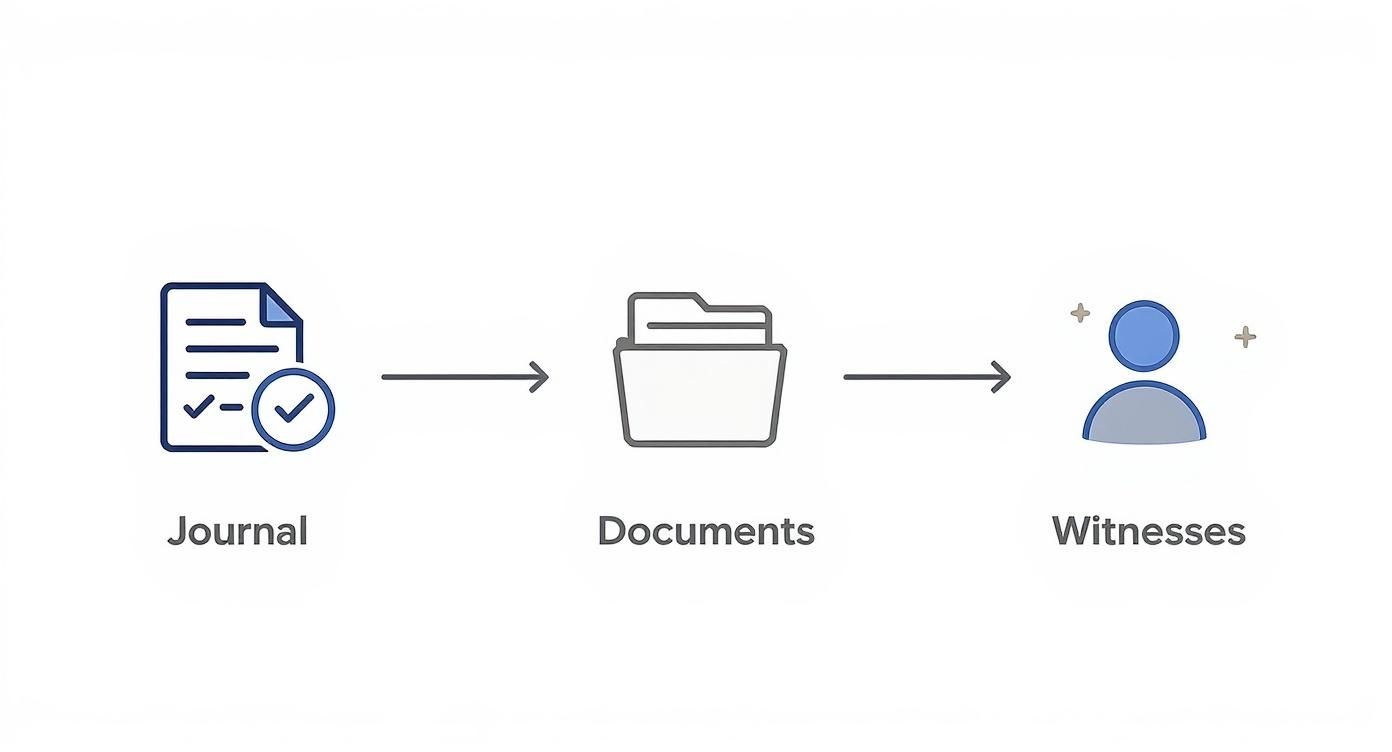
As you can see, the process flows naturally from documenting your personal experiences to gathering hard evidence and lining up people who can back your story.
Step 1: Filing the Petition to Final Decree
The legal journey officially kicks off when you or the child's other parent files an Original Petition in Suit Affecting the Parent-Child Relationship (SAPCR). This is the document that tells the court what you’re asking for—in this situation, to be named the Sole Managing Conservator.
Soon after, the court will set a date for a Temporary Orders Hearing. This is your first major checkpoint. A judge will hear some initial evidence and make temporary rulings on where the child will live, who pays child support for now, and what the visitation schedule will be while the case moves forward. Don't underestimate this hearing. While these orders aren’t final, they often set the stage for the rest of the case and can heavily influence the final outcome.
Before you ever get to a final trial, a Texas judge will almost always order you and the other parent to attend mediation. This is a confidential meeting where a neutral third-party mediator helps you try to hash out an agreement on your own terms. If you reach a full agreement, your case is essentially over. If not, your case continues down the path to a final trial, where a judge will issue a binding Final Decree.
Special Roles in a Custody Case
In high-conflict custody cases, especially those with serious allegations like abuse, neglect, or parental alienation, the judge may bring in outside experts. Their job is to help the court figure out what’s truly in the child’s best interest. You should know who these players are.
- Amicus Attorney: This lawyer is appointed by the court specifically to represent the child’s best interests. They don’t work for you or the other parent. Instead, they act as the court’s investigator—interviewing parents, teachers, and the child—before making a recommendation to the judge.
- Ad Litem Attorney: Very similar to an amicus, an ad litem represents the child's wishes and interests. This role is more common when the child is old enough to clearly state what they want.
- Custody Evaluator: This is a mental health professional who performs a deep-dive investigation into your family. It’s an intense process involving interviews, home visits, and psychological testing, which all culminates in a detailed report and recommendation for the court.
Preparing for the Final Trial
If mediation doesn't lead to a full agreement, your case will be scheduled for a final trial. This is your day in court. You and your attorney will present every piece of evidence you’ve gathered to the judge. Witnesses will testify, documents will be entered as exhibits, and both sides will make their final arguments. For a father fighting for full custody, this is the moment to lay out your entire case, piece by piece, backed by solid proof.
Getting ready for trial is a massive undertaking. You'll spend a lot of time with your attorney organizing evidence, practicing your testimony, and planning for the other side's arguments. Our guide on how to prepare for a custody hearing breaks down the practical steps you can take to make sure you're ready.
Once all the evidence has been presented, the judge will issue a Final Order. This is the legally binding document that details the final conservatorship, visitation, and child support arrangements. It’s the finish line of the entire process and will dictate your parental rights and duties from that day forward.
Overcoming Common Arguments Against Fathers
When you walk into a custody battle, it can feel like you're fighting outdated stereotypes before you even open your mouth. But knowing the arguments the other parent might use against you is a huge advantage. It lets you prepare proactive, evidence-based responses that keep the focus exactly where it belongs: on your child's best interests.
Let's break down some of the most common arguments fathers face and talk about how to shut them down effectively.
The "Work Schedule" Argument
One of the oldest tricks in the book is claiming your work schedule makes you an unsuitable primary caregiver. The other parent might argue you work too many hours or that your job is too demanding to give your child the stability and attention they need.
This argument is designed to paint you as an absent provider, not a hands-on dad. Don’t let it stick. Your response needs to be built on concrete solutions and solid preparation, not just getting defensive. Here’s how you counter it:
- Show Up With a Detailed Childcare Plan: Don't just say you have it figured out—present a written plan that shows the judge you've thought through every detail. Who will watch the child before and after school? What’s the plan for school holidays? Do you have reliable backup care from family members or trusted sitters?
- Highlight Your Flexibility: If your job offers any flexibility—like working from home, adjusting your hours for school events, or taking time off for appointments—make sure this is clearly documented and presented to the court.
- Prove Your Past Involvement: This is where your parenting journal and calendar become your best friends. Use them to prove your work schedule has never stopped you from being an engaged father. Point to every parent-teacher conference you attended, doctor's visit you handled, and school play you never missed.
The "Less Nurturing Parent" Argument
It’s an unfair stereotype, but fathers often have to fight the insinuation that they are somehow less nurturing or emotionally connected than mothers. This argument leans on old-fashioned gender roles and has no place in a modern Texas courtroom, but you still need to be ready for it.
The best way to fight this is with actions and evidence that speak louder than words.
Your goal is to show, not just tell, the court that you provide for your child's emotional well-being just as capably as their physical needs. Witness testimony is incredibly powerful here.
Having teachers, counselors, coaches, or even family friends testify about your strong, loving bond with your child can completely neutralize this argument. Your parenting journal, filled with entries about comforting your child after a nightmare or celebrating a small success, provides a tangible record of your nurturing role.
Confronting Allegations of Unfitness
In high-conflict cases, you might face direct attacks on your character. These are serious allegations that you absolutely must handle calmly and methodically. If the other parent makes false claims about you, it is critical to refute them with evidence, not angry denials.
For example, if you are falsely accused of substance abuse, you can voluntarily submit to drug testing to prove the claim is baseless. If you are accused of being aggressive, your calm and respectful communication records—texts, emails, co-parenting app messages—become your best defense.
The key is to remain the reasonable, child-focused parent, even when things get ugly. Let the evidence do the talking. By anticipating these common arguments and preparing fact-based rebuttals, you can protect your reputation and steer the court’s attention back to the single most important factor: what is truly best for your child.
What to Do Next
The journey to secure sole custody feels like a marathon, and it will test your patience and resolve at every turn. But every bit of documentation, preparation, and strategy has been building toward one thing: creating the safest, most stable future for your child. Your entire case hinges on proving to a judge that naming you the Sole Managing Conservator is undeniably in your child’s best interest. This isn't about "winning" against the other parent; it's about winning for your child.
Feeling overwhelmed is normal, but you can take back control by focusing on these immediate, practical steps:
- Start a Parenting Journal Today: If you haven’t already, open a notebook or a digital file and start logging everything. Note daily routines, appointments, positive interactions, and any concerning incidents involving the other parent. Be factual and detailed.
- Organize Your Evidence: Create a specific folder (physical or digital) for every piece of proof. This means report cards, medical records, receipts for child-related expenses, and saved communications like texts and emails.
- Go Dark on Social Media: Stop posting anything about your case, the other parent, or your personal life. Opposing counsel will absolutely dig for anything that can be twisted to make you look irresponsible or vindictive.
- Keep Communications Calm and Brief: Make sure every text and email with the other parent is polite, brief, and focused only on the children. This creates a record showing you are the reasonable, child-focused co-parent.
- Identify Your Witnesses: Make a list of neutral, credible people who have seen your parenting firsthand—teachers, coaches, doctors, or neighbors. Their objective testimony can be incredibly powerful in court.
Protecting your child is the most important job you will ever have, and you don’t have to do it alone. The right legal strategy can be the difference between feeling lost and feeling empowered. If you're ready to build the strongest possible case and protect your child's future, the experienced attorneys at The Law Office of Bryan Fagan, PLLC are here to help. We understand what's at stake for fathers in Texas. Schedule a free, confidential consultation today to discuss your specific situation and create a winning strategy.