Skip to content
Going through a divorce can feel like you're trying to find your way in the dark, especially when you have no idea what your spouse is really doing with your money. That uncertainty is a huge source of anxiety, but thankfully, the legal process has a built-in flashlight to bring critical facts into view. It's called discovery, and it’s the formal, court-supervised process where you and your spouse exchange all information and documents relevant to your case. This ensures a fair division of property and helps you make informed decisions about your children and your future.
Turning Fear Into Facts Through The Discovery Process

The single biggest source of stress in a divorce often comes from not knowing. Questions can keep you up at night: Are there hidden bank accounts? Is my spouse being honest about their income? What is our family business really worth? Discovery is the legal system's answer to these gut-wrenching questions.
Think of it as the tool that illuminates the entire financial landscape of your marriage. Its whole purpose is to make sure every decision is based on cold, hard facts—not guesswork. Under the Texas Rules of Civil Procedure, both you and your spouse are required to provide a full and honest accounting of your financial lives.
Why Discovery Is Essential For A Fair Outcome
The discovery phase is your chance to gather the evidence you need to build a strong case. Without it, you’d be negotiating blind, potentially agreeing to a settlement that is nowhere near fair. This process is absolutely critical for several reasons:
- Uncovering Hidden Assets: It gives you legal methods to track down bank accounts, investments, or property your spouse may not have volunteered to disclose.
- Verifying Income and Debts: You can get official confirmation of salary, bonuses, business revenue, and the true amount of marital debt.
- Establishing a Complete Marital Estate: It ensures every single asset and liability is identified and valued correctly before a single thing is divided.
By forcing a transparent exchange of information, discovery levels the playing field. It empowers you to negotiate from a position of strength, armed with the exact same facts as your spouse.
Ultimately, this phase of your divorce is designed to replace fear with facts. At The Law Office of Bryan Fagan, PLLC, we use the discovery process strategically to protect your rights and work toward a just and fair resolution for your family’s future.
Defining The Discovery Process In A Texas Divorce
So, what exactly is "discovery" in a Texas divorce? Let's start with an analogy. Imagine you're trying to put together a 1,000-piece puzzle, but your spouse is holding half the pieces. You’d have no way of seeing the complete picture, right? The same is true when you’re trying to divide a lifetime of shared assets and responsibilities.
Discovery is the formal legal process for getting all those missing pieces on the table—bank statements, property deeds, business records, retirement account information, you name it. It is a structured, mandatory exchange of information between you and your spouse, governed by the Texas Rules of Civil Procedure, to make sure everyone is working from the same set of facts.
The Purpose Of Discovery Is Transparency
At its core, the goal of discovery is to force complete transparency. Its entire purpose is to prevent one person from hiding assets, downplaying their income, or concealing debts. By requiring both sides to lay their cards on the table, the Texas legal system ensures the final division of your marital estate is based on a complete and honest accounting.
This is the phase where your attorney gathers the hard evidence needed to protect your financial future. Without it, you'd be stuck negotiating based on assumptions and guesswork, leaving you incredibly vulnerable to an unfair settlement.
Discovery is so fundamental that over 90% of divorce cases in the U.S. involve some form of it. It’s also incredibly effective at getting to the truth—so much so that over 70% of divorce settlements are reached only after discovery is completed, because it gives both sides a realistic, no-nonsense view of the marital estate. You can find more insights on the role of discovery from the American Bar Association.
Leveling The Playing Field In Your Divorce
Think of discovery as the great equalizer. It doesn't matter if one spouse exclusively handled the finances throughout the marriage. During discovery, both you and your attorney get the right to access every single relevant financial document.
This process ensures that no one is left in the dark. It empowers you to negotiate from a position of knowledge and strength, ensuring that the final outcome is just and equitable.
By compelling a full exchange of information, discovery dismantles any power imbalance that might exist when one person has more financial know-how than the other. It confirms that all assets are identified, valued correctly, and accounted for before any final decisions are made about property division, child support, or spousal maintenance. Ultimately, it’s about making sure your divorce decree is built on a foundation of truth.
The Six Essential Tools Of Divorce Discovery
Knowing a process exists to get answers is one thing, but understanding exactly how your attorney will uncover the facts is what truly builds confidence. Discovery isn't a single action; it's more like a legal toolkit with six powerful instruments designed to gather very specific types of information. Each tool serves a distinct purpose, and when used together, they allow us to assemble a complete and accurate picture of your marital estate.
This entire process is designed to gather information, verify its accuracy, and pave the way for a fair and just division of your assets and debts.
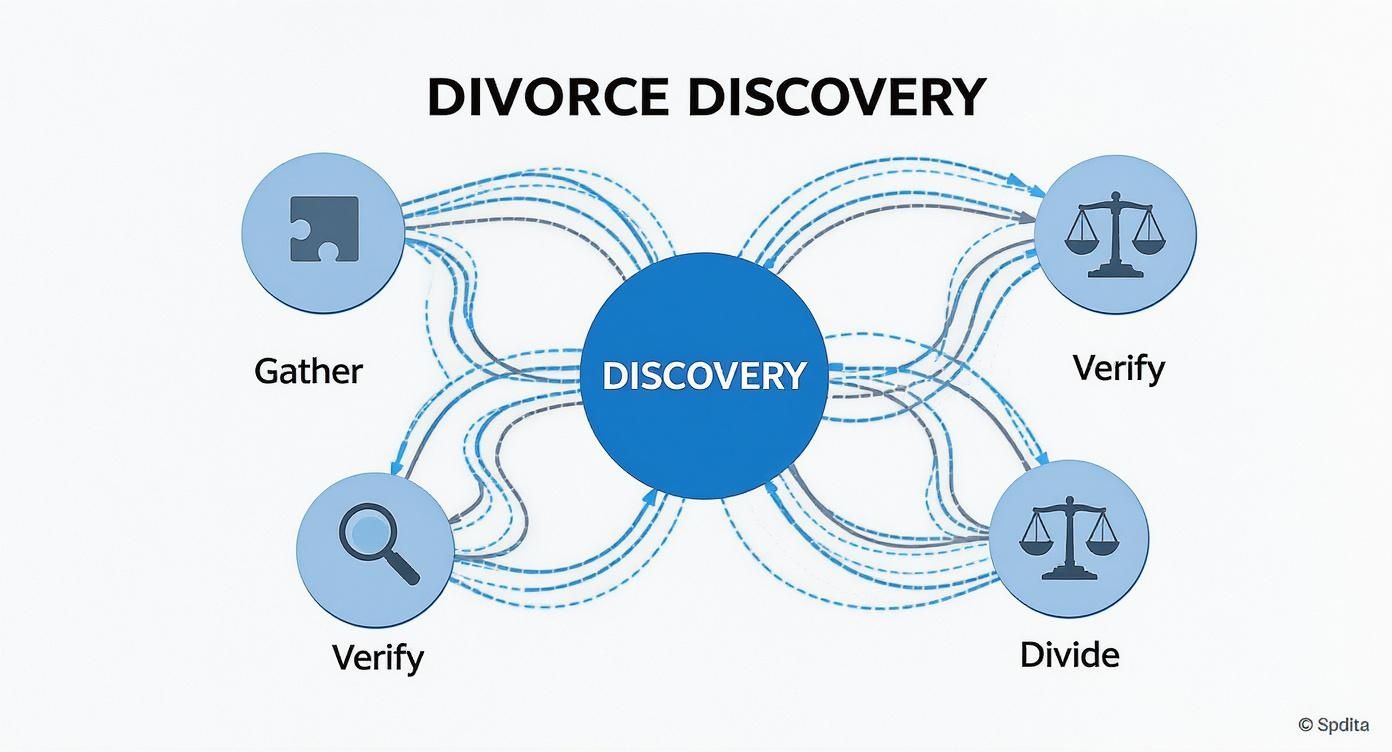
As you can see, discovery is the central hub connecting all the critical goals of your case. Let's break down the specific tools your legal team at The Law Office of Bryan Fagan, PLLC will use to accomplish these goals for you.
Your Guide to the Tools of Divorce Discovery in Texas
To give you a quick overview, this table summarizes the primary tools we'll discuss. Think of it as a cheat sheet for understanding how we gather the information needed to protect your interests.
| Discovery Tool | What It Is | Commonly Used To Obtain |
|---|---|---|
| Requests for Disclosure | Standard, required questions to get basic case information. | Names of witnesses, legal arguments, existence of key documents. |
| Interrogatories | Written questions that must be answered under oath. | Specific facts about finances, property, employment, and debts. |
| Requests for Production | Formal demands for copies of physical documents and records. | Bank statements, tax returns, deeds, business financial records. |
| Requests for Admission | Written statements the other side must admit or deny. | Confirmation of undisputed facts, like property status or account balances. |
| Oral Depositions | In-person, under-oath interviews recorded by a court reporter. | Detailed testimony, clarification of written answers, locking in a story. |
| Subpoenas | Court orders compelling information from third parties. | Bank records, employer payroll information, business partner testimony. |
Now, let's take a closer look at how each of these tools works in a real Texas divorce case.
1. Requests For Disclosure
Think of this as the starting line for discovery. Governed by Rule 194 of the Texas Rules of Civil Procedure, Requests for Disclosure are a standardized set of basic questions that both sides are required to answer. It's the "ground rules" exchange.
This isn't optional; once requested, each spouse must provide fundamental information without making objections. We're talking about details like potential witnesses, the legal theories behind their claims, and a list of the documents they plan to use. It's a foundational step that sets the stage for a much deeper investigation.
2. Interrogatories
Interrogatories are where we start digging into the details. These are written questions sent to your spouse that they are legally obligated to answer in writing and under oath. This isn't just an informal email—their responses carry the same weight as testimony given in a courtroom.
Under Texas law, each side is generally limited to 25 written interrogatories, so we have to make them count. Your attorney will strategically craft these questions to get specific facts about finances, property, employment, and other relevant issues. For instance, we might ask: "Please list every financial account, including bank, investment, and retirement accounts, you have had an interest in during the last five years."
3. Requests For Production Of Documents
This is where the paper trail comes in, and it's perhaps the most crucial tool for getting to the financial truth. A Request for Production is a formal, written demand for your spouse to provide copies of specific documents or other physical evidence. This is how we get the hard proof needed to verify every asset and debt.
Commonly requested documents include:
- Financial Statements: We'll ask for bank statements, credit card bills, and investment account summaries, usually going back three to five years.
- Tax Returns: Personal and business tax returns give us a detailed overview of income and financial activities.
- Property Deeds and Titles: These are the official documents proving ownership of real estate, vehicles, and other major assets.
- Business Records: If a business is part of the marital estate, we will request its profit and loss statements, balance sheets, and any shareholder agreements.
To make sense of all this data, tools like bank statement converter software can be incredibly helpful, turning mountains of raw financial data into clear, usable information for your case.
4. Requests For Admission
This tool is all about efficiency. Requests for Admission are used to narrow down the issues that are actually in dispute by asking your spouse to either admit or deny a series of written statements. If they admit something, it's considered a proven fact for your case.
For example, your attorney could send a request that says: "Admit that the funds in the savings account ending in -1234 are community property." If your spouse admits it, we no longer need to spend time or money proving that fact in court. This helps us focus our efforts—and your resources—only on what is truly being contested.
5. Oral Depositions
An oral deposition is a formal, in-person interview where your attorney questions your spouse (or another witness) under oath. Everything said is recorded by a court reporter, creating an official transcript. This is an incredibly powerful tool for a few key reasons.
First, it gives your attorney the chance to ask follow-up questions in real-time, digging deeper into vague or inconsistent answers from written discovery. Second, it locks the person into their story. If they try to change their testimony later on, we can use the deposition transcript to challenge their credibility. To better prepare, it helps to understand the common mistakes to avoid during your divorce deposition.
6. Subpoenas
So, what happens when crucial information is held by a third party, like a bank, an employer, or maybe your spouse's business partner? That’s where a subpoena comes in. A subpoena is a court order that legally compels a person or company who isn't part of your divorce to provide documents or testify.
A subpoena ensures that no stone is left unturned. It allows us to get information directly from the source, which is critical if you suspect your spouse is not being fully transparent.
For example, we can subpoena your spouse’s employer for payroll records to verify their true income, or we can subpoena a bank for five years of statements if we suspect a hidden account exists. It's a vital tool for getting independent verification of the facts.
Navigating The Texas Divorce Discovery Timeline
Waiting for answers during a divorce can feel like an eternity. The uncertainty stretches your patience and adds another layer of stress to an already difficult time. But knowing the general timeline of the discovery process can give you a much-needed sense of control and a realistic picture of the road ahead.
The timing of discovery isn’t random; it follows a predictable sequence guided by Texas law.
Typically, the discovery process kicks off in earnest after your spouse has been served with the divorce petition and has filed a formal Answer with the court. Think of the Answer as their official response to your lawsuit. Once it’s filed, the gates for formal information exchange swing wide open, and your attorney can start sending out the tools we've discussed, like Interrogatories and Requests for Production.
Understanding Key Deadlines
Once a discovery request goes out the door, a new clock starts ticking. The Texas Rules of Civil Procedure are very clear about the deadlines for responding. In almost every case, your spouse will have 30 days from the day they receive the request to provide their sworn answers and hand over the requested documents.
This 30-day window is the standard, but it’s important to know that extensions can be requested. In fact, it's quite common for attorneys to agree to a short extension. This is just one of many reasons why patience is so crucial during this phase of your divorce.
The discovery timeline is a marathon, not a sprint. Each step is methodical and designed to ensure a thorough and fair process, even if it feels agonizingly slow at times.
Keep in mind, this exchange of information doesn't just happen once. Discovery is often an ongoing process. As new information comes to light, it can lead to more questions and another round of requests. This back-and-forth can extend the overall timeline quite a bit.
So, How Long Does Discovery Take in Total?
What does this all mean for the big picture? The entire discovery process can last anywhere from a few months in a relatively straightforward case to well over a year if your divorce involves complex issues. Think of things like a family-owned business, high-value assets, or a contentious custody battle.
Several factors will influence how long this phase takes:
- The complexity of your marital estate: Valuing businesses, tracing separate property, or untangling complicated investments takes time and expertise.
- The level of cooperation: An uncooperative spouse can intentionally drag out the process, forcing your attorney to file motions with the court just to get compliance.
- Local court rules: Different counties in Texas have their own local rules and scheduling orders that can impact the discovery control plan. For example, courts in Harris County may have slightly different timelines than those in Travis County.
This emphasis on thorough and timely disclosure is a cornerstone of family law everywhere. For instance, in Canada, the discovery process—known there as 'disclosure'—is a strict requirement that can also take several months to complete. Failure to comply can lead to serious penalties, which shows that courts, including those in Texas, take this obligation very seriously. You can learn more about international disclosure standards from the Department of Justice Canada.
Your attorney at The Law Office of Bryan Fagan, PLLC, will manage these timelines for you, ensuring every deadline is met and strategically pushing the case forward to gather the facts needed to protect your future.
Handling Common Challenges During Discovery
Knowing your rights during discovery is empowering, but what happens when the other person simply refuses to play by the rules? It is one of the most frustrating and emotionally draining parts of a divorce, but you are not without recourse when your spouse tries to stonewall the process.
The Texas legal system has powerful tools to enforce the rules of discovery and ensure transparency. When you have an experienced attorney on your side, you can counter these frustrating tactics and keep your case moving forward toward a fair resolution.
When Your Spouse Won't Cooperate
In an ideal world, both sides would provide complete and honest information within the required 30-day deadline. Unfortunately, that doesn't always happen. Your spouse might ignore requests, provide incomplete documents, or object to every question without a valid reason. This isn't just frustrating; it's a direct violation of the Texas Rules of Civil Procedure.
When this happens, your first line of defense is a Motion to Compel. This is a formal request your attorney files with the court, outlining exactly what information your spouse has failed to provide. A judge will then review the motion and, if they agree the requests are valid, will issue a court order forcing your spouse to produce the information by a specific date.
A Motion to Compel is the legal system's way of saying, "The time for games is over." It transforms a simple request into a direct judicial command that carries serious consequences for non-compliance.
This single action often gets the process back on track. The prospect of facing a judge is usually enough to encourage cooperation.
The Consequences Of Hiding Information
If your spouse ignores a court order from a Motion to Compel or is caught intentionally hiding information, the court can impose penalties known as sanctions. These are not just a slap on the wrist; they are designed to punish misconduct and compensate you for the time and money wasted.
Sanctions in Texas can include several powerful remedies:
- Attorney's Fees: The judge can order the uncooperative spouse to pay for the attorney's fees you incurred while having to file the Motion to Compel.
- Fines: The court can impose financial penalties payable directly to the court.
- Adverse Rulings: In more extreme cases, a judge might rule that certain facts are automatically considered true in your favor or prevent your spouse from presenting evidence on specific issues.
Uncovering Hidden Assets
One of the most serious challenges is dealing with a spouse you suspect is actively trying to hide money or property. Delays and evasive answers are often red flags for concealed finances. If you find yourself in this situation, it is critical to act decisively. Our team has extensive experience in these complex situations and can provide guidance on how to handle suspected hidden assets in your divorce. We utilize forensic accountants and other experts to trace financial records and uncover the truth.
No matter the challenge, you have legal options. The discovery process is built to ensure fairness, and the courts have little patience for those who try to obstruct it.
We Answer Your Top Questions About Divorce Discovery
When you're facing a divorce, the discovery process can feel like a maze of legal rules and procedures. It’s natural to have questions, and you deserve clear, practical answers. Below, we’ve tackled some of the most common concerns we hear from clients every day.
How Much Does Discovery Cost In A Texas Divorce?
This is a critical question, and the honest answer is: it depends entirely on your situation. If you and your spouse are on decent terms and willing to exchange information openly, the costs can be minimal. The real financial drain happens when a case becomes high-conflict or involves complex assets.
For instance, if we need to schedule multiple depositions, bring in a forensic accountant to track down hidden money, or hire an expert to value a family business, those costs will add up. A huge part of our job at The Law Office of Bryan Fagan, PLLC is to sit down with you and have a frank discussion about the costs versus the potential benefits of each discovery tool. We treat every expense as a strategic investment in protecting your financial future, not just another box to check.
What Happens If I Hide Assets During Discovery?
Let us be direct: trying to hide assets or being dishonest during discovery is one of the worst mistakes you can possibly make in a Texas divorce. Every response you give is under oath, which means lying is the same as committing perjury in a courtroom. The consequences are serious and can follow you for years.
If a judge discovers you've intentionally concealed information, they have a lot of power to set things right. This isn't just a slap on the wrist. A judge can:
- Force you to pay every penny of your spouse's attorney's fees for the time they spent digging up the assets you hid.
- Award a disproportionate share of the marital estate to your spouse as a direct punishment for your deception.
- Find you in contempt of court, which could lead to hefty fines or even jail time.
In Texas family law, total honesty isn’t just good advice—it’s a legal mandate. The risk of getting caught hiding assets is far greater than any temporary advantage you think you might gain.
Can My Spouse Ask For Absolutely Anything In Discovery?
No, discovery isn't a free-for-all designed to let your spouse dig into every corner of your life. While the scope is broad, every single request must be relevant to the issues at hand in your divorce. That means the information has to relate to community or separate property, debts, income, or matters involving your children.
It's our job as your attorneys to shield you from improper requests. We will immediately object to any questions or demands for documents that are clearly meant to harass you, are excessively burdensome, or try to access privileged information (like the confidential advice we give you). You don't have to put up with a fishing expedition, and we'll make sure the process stays fair and focused.
Is Formal Discovery Necessary If Our Divorce Is Amicable?
Even in the friendliest of divorces, a complete and transparent exchange of financial information is non-negotiable. You might not need to go through formal depositions or interrogatories, but you absolutely need a full financial picture to ensure your settlement agreement is fair to both of you.
In these situations, we often rely on a slightly less formal but equally powerful tool: the Sworn Inventory and Appraisement. This is a document where both parties list all marital assets and debts under oath. Skipping this step is a huge gamble. You could unknowingly agree to an unfair division of property that becomes nearly impossible to fix later on. It’s a simple step that protects everyone by ensuring all decisions are based on the complete truth.
What to Do Next

It's completely normal to feel buried by all this information, but the path to clarity starts with a few concrete actions. Taking these proactive steps can save you significant time, money, and stress, empowering your legal team to build the strongest possible case for you from day one.
Here’s what you can start doing today:
- Start Gathering Financial Documents Now: Don't wait for formal requests. Begin pulling together key financial records from at least the last three to five years. This means tax returns, bank statements, pay stubs, credit card bills, and retirement account summaries.
- Be Completely Honest With Your Attorney: Your legal team is your most trusted advocate. Be upfront about everything—the good, the bad, and the messy. Full transparency allows us to anticipate challenges and craft the most effective strategy for your unique situation.
- Stay Meticulously Organized: Set up a system, whether it’s a physical binder or a secure folder on your computer, to keep all your documents sorted and easy to find. This simple habit will prove invaluable.
Remember, discovery is a marathon, not a sprint. It demands patience and attention to detail, but it is the single most important tool we have to ensure your settlement is based on all the facts. If you’re worried your spouse may have spent marital funds improperly, it’s critical to raise those concerns early. Learning how to prove dissipation of assets in a Texas divorce case can give you a better idea of how we tackle these complex financial issues.
You have a right to a fair and just outcome. The discovery process is how we enforce that right, turning uncertainty into undeniable facts that protect your future.
You don’t have to go through this complex process alone. Our team at The Law Office of Bryan Fagan, PLLC, is here to guide you with empathy and expertise every step of the way. Take control of your future by scheduling a free, confidential consultation with one of our experienced Texas divorce attorneys today. Visit us at https://texasdivorcelawyer.us to get started.