Skip to content
Facing a divorce can feel like navigating a storm, but divorce mediation in Texas offers a much calmer, more constructive path forward. It’s a confidential process where you and your spouse sit down with a neutral third-party expert—the mediator—to negotiate a fair settlement completely outside of a courtroom. Instead of letting a judge make life-altering decisions for your family, mediation puts you in control of your future.
What Is Divorce Mediation and Is It Right for Your Family?
The end of a marriage brings a wave of uncertainty about your finances, your home, and most importantly, your children. You’re probably picturing heated arguments in a courtroom, with lawyers battling over every last detail. While that’s one way to resolve a divorce, Texas law strongly encourages a more peaceful, private alternative that puts you and your spouse back in control of the outcome.
A Different Approach to Divorce
Divorce mediation is fundamentally different from a traditional court battle. Instead of an adversarial process where one side “wins” and the other “loses,” mediation is built on cooperation. The goal isn’t to fight, but to find common ground and create a mutually acceptable agreement that addresses every aspect of your divorce.
The mediator’s job isn't to take sides or make decisions for you. Their role is to facilitate productive conversations, help you both see the key issues clearly, and guide you toward creative solutions. This process allows you to keep control over the decisions that matter most, such as:
- Property Division: How you’ll divide your home, bank accounts, retirement funds, and debts according to Texas community property laws.
- Child Custody: Where your children will live and how you will co-parent effectively moving forward.
- Support: Working out child support and any potential spousal support based on your family’s specific needs.
By shifting the focus from conflict to problem-solving, mediation empowers you to design a future that actually works for your unique family situation.
Why Texas Courts Favor Mediation
In Texas, the vast majority of family law judges will order you and your spouse to attend mediation before they will consider letting your case go to a final trial. This isn't just a casual suggestion; it's a standard part of the divorce process for very good reasons.
Courts recognize that agreements you make yourselves are almost always more detailed, creative, and durable than orders handed down by a judge who only knows the surface-level facts of your life. For a deeper look at the contrasts, you can explore the key differences between divorce vs mediation.
The core principle of mediation is self-determination. The Texas Family Code supports this process because it allows you and your spouse—the two people who know your family best—to craft your own solutions with dignity and privacy.
The entire process is confidential. That means what you discuss in mediation cannot be used against you later in court if you don’t reach a full agreement. This creates a safe space to negotiate openly and honestly, fostering a more amicable resolution that can help preserve a working co-parenting relationship for years to come.
Mediation vs. Litigation At a Glance
It can be tough to visualize the difference between sitting down with a mediator and heading into a courtroom battle. This table breaks down the key distinctions between these two very different paths.
| Feature | Divorce Mediation | Traditional Litigation |
|---|---|---|
| Control | You and your spouse make the final decisions. | A judge makes the final, binding decisions for you. |
| Cost | Significantly less expensive. | Often very costly due to attorney fees and court costs. |
| Timeline | Much faster; can be resolved in weeks or a few months. | Can drag on for many months, or even years. |
| Privacy | Completely confidential and private. | Public record; hearings are open to the public. |
| Tone | Collaborative and cooperative. | Adversarial; one side "wins," the other "loses." |
| Outcome | A customized agreement tailored to your family's needs. | A standardized court order based on legal precedent. |
| Future Relationship | Fosters communication and preserves co-parenting. | Often damages relationships, making co-parenting harder. |
As you can see, mediation offers a path that prioritizes your control, your privacy, and your family's future well-being. It’s designed to find solutions, not create more conflict.
The Texas Divorce Mediation Process Step by Step
Watching your life change during a divorce can feel overwhelming, but understanding the process ahead can bring back a powerful sense of control. The path through divorce mediation in Texas isn't a mystery; it's a structured journey designed to help you and your spouse reach a fair agreement without the stress and expense of a courtroom battle.
Knowing what to expect at each stage will help you walk in feeling prepared, not intimidated.
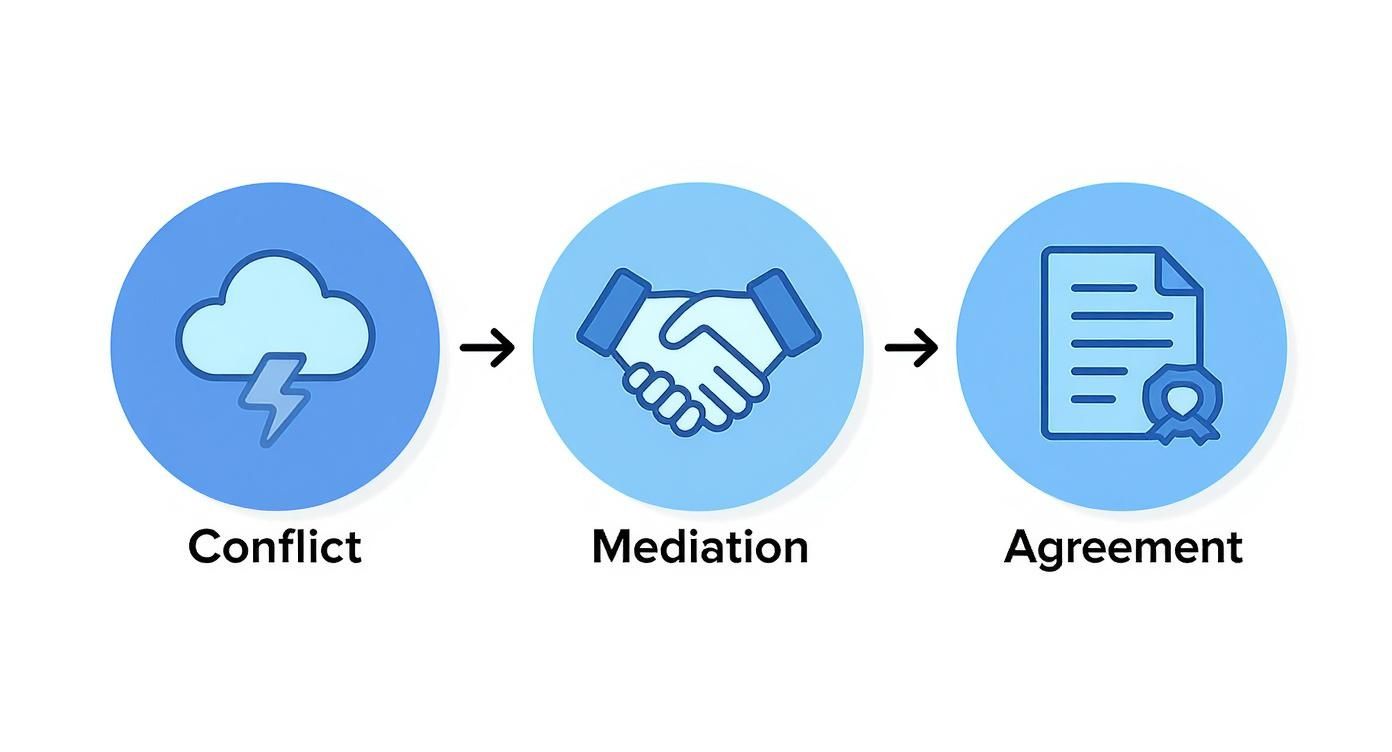
This visual captures how mediation works—it transforms a messy dispute into a structured, legally sound resolution that you and your spouse agree on. Let's break down the individual steps you'll take.
Step 1: Selecting the Right Mediator
Your journey begins by choosing a qualified, neutral mediator. This person is typically a seasoned family law attorney or a retired judge with specialized training in conflict resolution. It’s crucial that both you and your spouse agree on who to hire. If you can't, the court can appoint one for you.
Your attorney is your best resource here. We can provide a list of respected mediators whose style and experience fit the unique issues in your case, whether you're dealing with complex property division or sensitive child custody matters. Making a smart choice here sets the stage for a productive day.
Step 2: The Opening Session
A mediation session typically lasts for a half-day (4 hours) or a full day (8 hours). It kicks off with an opening session where everyone gathers—you, your spouse, both attorneys, and the mediator. The mediator will explain their role, lay out the ground rules for the day, and, most importantly, stress the confidentiality of the process.
Under the Texas Family Code, anything said during mediation is protected. This is a critical feature. It creates a safe space where you can freely propose solutions without worrying that your words will be used against you if your case ends up in court. After the mediator's introduction, each attorney might make a brief opening statement outlining the key issues.
Step 3: Private Caucuses and Negotiation
After the opening, the real work begins in private sessions called "caucuses." You and your attorney will go into one room, and your spouse and their attorney will go into another. The mediator then shuttles back and forth between the two rooms, acting as a messenger, a reality-checker, and a guide.
In these confidential meetings, you can speak bluntly with the mediator and your lawyer. The mediator's job is to:
- Listen to your side of every issue.
- Help you see the strengths and weaknesses of your position from a legal standpoint.
- Explore different areas where compromise might be possible.
- Carry offers and counter-offers between you and your spouse.
This "shuttle diplomacy" is incredibly effective. It lowers tension and helps everyone stay focused on finding a workable solution. If you're curious about how this fits into the bigger picture, you can learn more about how family mediation and court overlap in Texas.
Step 4: Reaching and Finalizing the Agreement
As you and your spouse get closer to an agreement on the big issues—who gets the house, what the co-parenting schedule will look like, how finances are split—the mediator helps put all the terms on paper. Once every issue is resolved, the mediator will formalize it into a document called a Mediated Settlement Agreement (MSA).
This is the most critical part of the entire day. You, your spouse, and your attorneys will review every single word of the MSA. Once everyone is satisfied and signs it, that agreement becomes legally binding and irrevocable under Texas law. This powerful document is what your attorney will use to draft your Final Decree of Divorce, officially ending your marriage on the exact terms you decided on for yourselves.
Understanding the Mediated Settlement Agreement
After a long day of negotiations, the most important thing you'll walk away with is the document that puts all that hard work onto paper. This document is called the Mediated Settlement Agreement (MSA), and it is the entire point of your mediation and the legal bedrock of your Texas divorce. Think of the MSA as the official blueprint for your life after divorce, spelling out every term you've agreed upon.
The Power and Finality of a Signed MSA
Under Section 6.602 of the Texas Family Code, a properly signed MSA is binding and irrevocable. This is a point that cannot be overstated. The second you, your spouse, and your attorneys put your signatures on that document, its terms are locked in for good.
This finality is intentional. The law is written this way to encourage people to stick to the deals they've negotiated fairly and to prevent "buyer's remorse." It gives you the certainty you need to move on, knowing the issues are truly settled.
Once an MSA meets the requirements of the Texas Family Code, you are entitled to a judgment based on what it says. A judge cannot simply refuse to sign a divorce decree that mirrors the agreement because they personally don't like a term you and your spouse decided on.
Because of this finality, you should never feel pressured to sign an MSA. Your attorney's most critical job during mediation is to scrutinize every clause, making sure your rights are protected and that the language perfectly matches the agreements you made.
Can a Mediated Settlement Agreement Be Challenged?
The bar for overturning a signed MSA in Texas is incredibly high. The law offers very few ways to challenge one, and success is extremely rare. To even have a chance, you would have to prove you were forced to sign the agreement through illegal means, such as:
- Fraud: One party deliberately lied about or hid a crucial fact (like a secret bank account) that you relied on when agreeing to the deal.
- Duress: You were threatened or coerced into signing against your will.
- Undue Influence: One party used such intense pressure that it completely overpowered your ability to make your own decision.
Proving any of these claims is an uphill battle, which is why the preparation you do before mediation and the careful review you do before signing are so important. Texas offers various private mediation styles to fit different needs, allowing you to choose experts who can guide the process and ensure the MSA is the result of clear, good-faith negotiation. You can learn more about the different divorce mediation options available in Texas.
How to Prepare for a Successful Mediation
Walking into mediation unprepared is like trying to build a house without a blueprint—it’s bound to be chaotic, and you probably won't like the result. Your success in a divorce mediation in Texas comes down to thoughtful preparation. This isn't about gearing up for a fight; it's about walking in with clarity, confidence, and a clear vision for your future. When you're properly prepared, you can negotiate from a position of strength, making the process more efficient and less stressful.

Gathering Your Financial Foundation
First, you must gather every piece of financial information that tells the story of your marriage. You can't have a fair conversation about dividing assets and debts without a complete and accurate picture. This step is absolutely non-negotiable.
Working with your attorney, you’ll need to pull together and organize the following documents:
- Income Information: Recent pay stubs for both you and your spouse, plus W-2s and tax returns for the last 3-5 years.
- Bank Statements: Statements for all checking, savings, and money market accounts going back at least a year.
- Property Records: Deeds for your home and any other real estate, along with recent property tax appraisals to help establish their value.
- Debt Statements: Paperwork for all liabilities—mortgages, car loans, credit card balances, and student loans.
- Retirement and Investment Accounts: The most recent statements for any 401(k)s, IRAs, pensions, and brokerage accounts.
Having these documents ready prevents delays and allows the mediator to work with facts instead of guesswork.
Creating a Realistic Post-Divorce Budget
Next, you need to paint a realistic picture of what your life will cost after the divorce is final. Create a detailed monthly budget that accounts for all your anticipated expenses—housing, utilities, groceries, transportation, insurance, and childcare.
This budget does two incredibly important things:
- It informs your negotiations: It helps you understand what you genuinely need, whether that's specific assets or potential spousal support.
- It grounds your expectations: It gives you a data-driven look at your new financial reality, helping you make practical, sustainable decisions.
A clear budget removes emotion from financial discussions and focuses the conversation on real numbers. It’s a powerful tool for advocating for a settlement that lets you start your next chapter on stable ground.
Developing Your Parenting and Emotional Game Plan
If you have children, your most important prep work is creating a proposed parenting plan. This is your vision for how you and your ex-spouse will co-parent effectively. Before you enter the mediation room, you should thoughtfully consider:
- Conservatorship: Do you want to be joint managing conservators, which is the standard in Texas?
- Possession Schedule: A detailed calendar showing when the children will be with each parent, including holidays and summer vacation.
- Decision-Making: How will you handle big decisions about education, healthcare, and religious upbringing?
- Child Support: What is a fair and appropriate amount based on the Texas child support guidelines?
Equally crucial is your emotional preparation. Divorce is draining, but mediation demands a solution-focused mindset. Work with your attorney to define your goals.
Identify your "must-haves"—the non-negotiable items essential for your future. Just as importantly, figure out the areas where you have some flexibility. Knowing the difference is the key to a successful negotiation.
Bringing a cooperative, forward-looking attitude to the table can completely transform the dynamic of the day.
Handling Complex Issues in Texas Mediation
There's no such thing as a one-size-fits-all divorce. Every family is different, and your divorce process should be, too. Divorce mediation in Texas is a flexible tool designed to help you untangle even the most complicated issues, from emotional child custody decisions to the nuts and bolts of dividing a business. The process adapts to you, not the other way around.

Crafting Child Custody Agreements That Work
When you have children, the focus of mediation shifts to your family’s future. Instead of letting a judge who doesn’t know you impose a standard possession order, mediation gives you the power to build a custom parenting plan that truly works for your children.
In mediation, you can get specific on topics like:
- Detailed Possession Schedules: You can move beyond the standard Texas schedule to create a plan that fits work travel, holiday traditions, or your kids' sports calendars.
- Decision-Making Authority: You can clearly define who has the final say on big decisions like schooling, non-emergency medical care, and religious upbringing.
- Communication Protocols: Set ground rules for how you and your ex will communicate about the kids. This simple step can prevent countless arguments down the road.
The goal is to create a comprehensive plan that brings stability and predictability to your children’s lives when they need it most.
Dividing High-Value and Complex Assets
If you are a business owner, a medical professional, or a couple with significant investments, dividing property is more complex than splitting a checking account. This is where mediation really shines. High-net-worth divorces need the time and focused expertise that a courtroom can't provide. In mediation, your attorney can bring in financial experts, like forensic accountants or business valuators, to ensure every asset is identified and valued correctly.
The family home is often the most significant asset, so it's vital to explore different strategies for splitting home equity in a divorce during these discussions.
In mediation, you have the flexibility to explore creative solutions that a court might not consider, such as buyouts, structured payouts for a business interest, or unique ways to divide complicated retirement accounts.
This approach ensures a thorough and fair division of everything from stock options and rental properties to the family business you built from the ground up. For a deeper dive, read our guide on Texas divorce property division.
Addressing Family Violence and Safety Concerns
It’s a common misconception that mediation is only for couples who get along. That’s not true. Texas law has specific protocols to make the process safe and fair, even with a history of family violence. If you have safety concerns, the mediator can put strict measures in place to protect you.
These safety measures often include:
- Shuttle Mediation: You and your spouse stay in separate rooms for the entire day. The mediator shuttles back and forth, so you never have to see or speak to the other person.
- Staggered Arrival/Departure Times: The mediator will ensure you arrive and leave at different times so you don't cross paths in the building.
- Virtual Mediation: The entire session can be done via video conference, allowing you to participate from the safety of your own home.
Your attorney will inform the mediator of any protective orders or safety issues long before mediation begins, ensuring the right protections are in place from the start.
Your Next Steps Toward a New Beginning
You’ve now seen how divorce mediation in Texas offers a confidential and constructive path forward. It’s a process that puts you in the driver’s seat, empowering you and your spouse to shape your family’s future through a legally binding agreement you create—not one a judge imposes on you.
Take Action with Confidence
The next step is to take action. You don't have to walk this road alone. Divorce mediation in Texas is also a smart financial move. Mediator rates typically range from $100 to $300 per hour per party, and since that cost is split, it’s far more manageable than litigation. When you compare that to the average Texas divorce, which can easily cost between $15,000 to $30,000, the savings become clear. You can learn more by reading our cost-benefit analysis of Texas divorce mediation.
The compassionate attorneys at The Law Office of Bryan Fagan, PLLC, are here to protect your rights, guide you through every stage, and help you build a stable foundation for your new beginning.
What to Do Next
We invite you to schedule a free, no-obligation consultation to talk about your specific situation and see how we can help you navigate this process with confidence. Let our experience and empathy work for you.
Call The Law Office of Bryan Fagan, PLLC, today to take that first step toward a peaceful resolution and a brighter future.
Frequently Asked Questions About Divorce Mediation
Even after understanding the mediation process, it's normal to have more questions. When you're facing a journey like this, a lot of "what ifs" can pop into your head. Here are answers to some of the most common questions we hear from clients.
Do I Still Need a Lawyer if We Use a Mediator?
Yes, absolutely. A mediator is a neutral third party. Their job is to guide the negotiation, but they legally cannot give legal advice to you or your spouse. Your attorney is your personal advocate, exclusively dedicated to protecting your rights and best interests.
Your lawyer’s role during mediation is to:
- Prepare you for the session and help you define your negotiation strategy.
- Advise you on your legal rights under Texas law regarding property, custody, and support.
- Review every word of the final Mediated Settlement Agreement (MSA) to ensure it’s fair, accurate, and legally sound before you sign it.
The mediator is the referee, but your attorney is in your corner, ensuring you get a fair outcome.
What Happens if We Cannot Reach an Agreement?
Mediation isn't an all-or-nothing deal. If you and your spouse can’t agree on every issue, the process is not a failure. You can still create a partial settlement agreement that resolves all the topics you did agree on. This is still a huge win. By settling some issues, you dramatically narrow the scope of what a judge needs to decide, saving you time, money, and stress as your case proceeds to court on only the few remaining unresolved items.
How Long Does Divorce Mediation Typically Take?
It depends on the complexity of your case and the willingness of both parties to negotiate. Many Texas divorces are successfully settled in a single session. A typical session is either a half-day (4 hours) or a full day (8 hours). Cases with complex assets or highly contested custody battles might need more time, but the goal is always to find a resolution as efficiently as possible.
Is Mediation Confidential in Texas?
Yes, and this is one of the most powerful features of mediation in Texas. Under the Texas Civil Practice and Remedies Code, everything said or proposed during a mediation session is legally protected and cannot be used as evidence in court.
This legal shield creates a safe space for negotiation. It encourages everyone to be open and honest, allowing you to explore settlement ideas without fear that a proposal could be used against you later if you don't reach a final deal.
This confidentiality is what makes mediation such an effective tool for resolving sensitive family matters with privacy and dignity.
Navigating the details of mediation can feel overwhelming, but you don't have to figure it out alone. The experienced and compassionate attorneys at The Law Office of Bryan Fagan, PLLC are here to answer all your questions and guide you every step of the way. Schedule your free consultation today to learn how we can help you achieve a peaceful and fair resolution. Visit us at https://texasdivorcelawyer.us to get started.