Skip to content
Facing a divorce is overwhelming, and it’s completely natural to worry about your financial future. In Texas, what most people call alimony is legally known as spousal maintenance, and understanding how it works is your first step toward building a stable new life. Think of it as a temporary financial bridge, designed to help a lower-earning spouse get back on their feet and become self-sufficient after the marriage ends. The laws in Texas are strict, so let's walk through what you need to know.
Navigating Your Financial Future During a Texas Divorce

Worrying about how you'll make ends meet after a divorce is one of the most common and valid concerns we hear from Texas families. You’re not just ending a relationship; you're completely restructuring your financial life. Getting a handle on how spousal maintenance works is a crucial first step toward building that new, stable future for yourself with confidence.
The rules around spousal support have changed a lot over the years. With more dual-income households and more equal earning potential between spouses, courts look at these requests differently than they did a generation ago. The good news is that the legal framework is more standardized now, which makes the process more predictable—if you know what you’re doing.
Taking Control of Your Post-Divorce Life
Securing your financial footing takes a proactive approach. It’s about more than just understanding maintenance; you need a comprehensive game plan for your new life. Our guide on planning your finances for a divorce in Texas is a great place to start building that foundation.
As you navigate this transition, remember that financial planning is only one piece of the puzzle. You'll also be dealing with new family dynamics, and preparing for those is just as important. For instance, if you have children, learning how to manage co-parenting can be as vital as sorting out your finances. Resources on co-parent counselling for separated couples can offer valuable strategies for keeping things healthy and stable for your kids.
Ultimately, the goal is to build a life where you feel secure and confident. Knowing your rights when it comes to spousal maintenance is a powerful tool to help you get there. We're here to help you understand every option available under Texas law.
Understanding Spousal Maintenance vs. Contractual Alimony
When you're facing a divorce, figuring out the finances can feel overwhelming, especially when you hear the word "alimony." While most people use that term, it's critical to know that Texas law officially calls court-ordered support "spousal maintenance." Getting the language right is the first step, but understanding your actual options is what will help you build a secure financial future.
It's helpful to think of spousal support not as a punishment but as a temporary financial bridge. The goal is to give a lower-earning spouse a fair shot at getting back on their feet and becoming self-sufficient. In Texas, there are two completely different ways this can happen, and each has its own set of rules.
Court-Ordered Spousal Maintenance
This is the one governed by the Texas Family Code. To get a judge to order spousal maintenance, you can't just ask for it—you have to prove you meet very specific legal requirements. A judge will look at the evidence and decide if you qualify.
Because it comes directly from a court order, it's legally enforceable. If your ex-spouse stops paying, you can take them back to court for enforcement actions like wage garnishment. But this path also comes with strict limits on how much a judge can order and for how long. We’ll dive into those exact numbers and qualifications in the next sections.
It's a common mistake to think that only men pay spousal support these days. While that was once the norm, the percentage of women paying has been on the rise, reflecting how family dynamics and incomes have changed. Texas family courts are gender-neutral; they focus on a spouse's earning capacity and financial need, not their gender. You can explore more divorce statistics to see how these trends are shaping outcomes across the country.
Contractual Alimony
This option gives you and your spouse much more control. As the name suggests, contractual alimony is a voluntary agreement that you negotiate as part of your overall divorce settlement, usually with the help of lawyers or a mediator. You and your spouse get to decide everything: the amount, how long payments will last, and any other specific terms that work for your family.
This flexibility can be a huge advantage. You could agree to payments that are higher than the legal caps for court-ordered maintenance, or you could set up a payment schedule that aligns with both of your financial realities. The key difference here is that this is a private contract. If the payments stop, you can't go to the family court for enforcement; you have to sue for breach of contract in civil court, just like with any other broken agreement.
So, how do you decide which path makes sense? It helps to see them side-by-side.
Spousal Maintenance vs. Contractual Alimony in Texas
This table breaks down the key differences between a judge's order and a private agreement.
| Feature | Court-Ordered Spousal Maintenance | Contractual Alimony |
|---|---|---|
| Origin | Ordered by a judge after a hearing or trial. | Agreed upon voluntarily by both spouses. |
| Eligibility | You must meet strict legal criteria in the Texas Family Code. | No legal requirements; it's based entirely on what you both agree to. |
| Flexibility | Very rigid; the payment amounts and duration are capped by law. | Highly flexible; the terms are whatever you negotiate. |
| Enforcement | Enforced by the family court through wage withholding or contempt. | Enforced as a breach of contract in civil court. |
| Can it Be Changed? | A court can modify it later if there's a major change in circumstances. | Generally cannot be modified unless your original contract says it can be. |
Deciding whether to fight for court-ordered maintenance, negotiate contractual alimony, or even use a mix of both is a critical strategic decision. It really comes down to your unique circumstances, the kind of relationship you have with your soon-to-be-ex, and what you want your financial future to look like.
Qualifying for Spousal Maintenance Under Texas Law
Figuring out if you can even ask for financial support is often one of the most stressful parts of a divorce. Unlike some states where spousal support is more common, Texas law sets a very high bar for court-ordered maintenance. It's not automatic, and you have to prove to a judge that you meet specific, strict criteria.
The whole system is designed to make sure spousal maintenance is a last resort. It’s reserved for spouses who genuinely can’t support themselves after the marriage ends. Think of it as a two-step qualification process—you have to pass the first test before you can even move on to the second.
The First Hurdle: Your Minimum Reasonable Needs
Before a judge will even look at anything else, you must first prove that you will lack sufficient property to provide for your minimum reasonable needs after the divorce is finalized. This is the bedrock requirement, straight out of Texas Family Code Section 8.051.
In plain English, this means a court will look at the assets you're getting in the property division—your share of bank accounts, retirement funds, real estate, and other community property. If that property is enough for you to live on and cover your basic needs, your request for maintenance will likely be denied right then and there.
For instance, if you're awarded a hefty investment portfolio or the family home with substantial equity, a judge might decide you have enough assets to sell or tap into to support yourself. The court is focused on ensuring you can cover essentials like housing, food, and healthcare, not maintaining a lavish lifestyle.
The Second Hurdle: Proving Your Specific Circumstance
If you manage to clear that first hurdle and show you don’t have enough assets, you’re not done yet. You then have to prove that at least one of several specific situations applies to you. Simply having a lower income than your spouse isn’t enough.
This decision tree infographic breaks down the paths you must follow to be eligible for spousal maintenance in Texas.
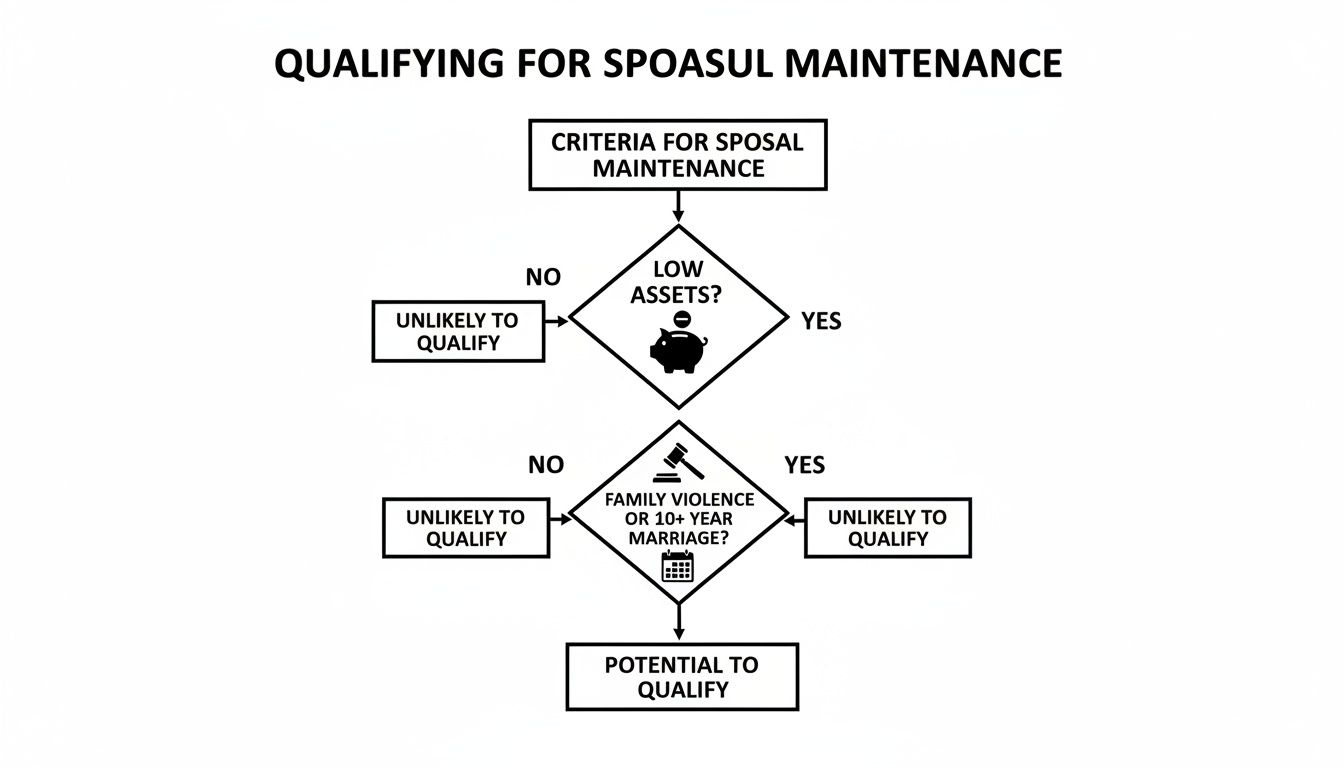
As the visual shows, after proving you have insufficient assets, you must then meet either the family violence or the 10+ year marriage requirement, or qualify based on a disability.
You must meet one of these conditions:
- Family Violence Conviction: The spouse you’re seeking maintenance from was convicted of (or received deferred adjudication for) a criminal offense that also counts as family violence. This act must have happened during the marriage, been against you or your child, and occurred within two years before you filed for divorce or while the case was pending.
- Marriage of 10+ Years: Your marriage lasted for 10 years or longer, and you can show you can't earn enough to provide for your minimum reasonable needs. You also have to prove you’ve made diligent efforts to earn income or develop skills to become self-sufficient during the separation.
- Disability: You are unable to earn enough to support yourself because of an incapacitating physical or mental disability. This can apply no matter how long the marriage lasted.
- Caring for a Child with a Disability: You are the primary caregiver for a child of the marriage (any age) who has a physical or mental disability that keeps you from being able to earn enough to meet your own needs. This also applies regardless of marriage length.
Texas Family Code Section 8.052 explicitly says a court has to consider the "diligence" a spouse has shown in trying to find a job or get training. This means you have to be actively trying to become self-supporting. A judge will want to see proof—job applications, enrollment in training programs, or other concrete steps you've taken.
Navigating these strict requirements demands a clear strategy and solid evidence. You need to build a compelling case that shows not only your financial need but also how your situation fits squarely into one of these legal boxes. Understanding these rules is the first step toward protecting your financial future.
How Courts Calculate Alimony Payments and Duration

Once you know you might qualify for spousal maintenance, two big questions immediately jump to mind: "How much can I get?" and "How long will it last?" You need real numbers to plan your life, and thankfully, Texas law doesn't leave you guessing.
The court's goal isn't to punish one spouse or create a lifelong dependency. Instead, it aims to provide a reasonable, temporary bridge to help the lower-earning spouse get back on their feet financially. To keep things predictable, the law sets clear limits on both the amount and the duration of payments.
Calculating the Maximum Payment Amount
Texas puts a firm cap on court-ordered spousal maintenance. A judge's hands are tied by a straightforward formula designed to prevent excessive awards.
Under Texas Family Code Section 8.055, a court cannot order maintenance payments that are more than $5,000 per month or 20% of the paying spouse's average monthly gross income—whichever is less. This is a hard-and-fast rule.
Let's walk through a quick example to see how this plays out in the real world.
Example Calculation
Imagine the higher-earning spouse brings in an average gross income of $15,000 per month. Here’s how the judge would find the maximum possible payment:
- Calculate 20% of Gross Income: $15,000 x 0.20 = $3,000
- Compare to the $5,000 Cap: The calculated $3,000 is less than the statutory maximum of $5,000.
- Determine the Maximum Award: In this case, the absolute most a judge could order is $3,000 per month.
It’s critical to remember this is the ceiling, not the guaranteed amount. The final payment could be lower, because the judge will then consider a whole host of other factors to land on a number that's fair and necessary.
Factors That Influence the Final Amount and Duration
Just hitting the threshold doesn't mean you automatically get the maximum payment for the maximum time. After figuring out the cap, the court zooms out to look at the bigger picture. The law requires judges to order payments for the shortest reasonable period that allows you to become self-sufficient.
To decide what's fair for both the monthly payment and the duration, a judge will weigh several factors, including:
- Financial Resources: What property and assets will each of you walk away with after the divorce?
- Education and Skills: What is each spouse's educational background and work history? How long would it take the receiving spouse to get the training needed for a decent job?
- Marriage Duration: Simply put, how long were you married?
- Age and Health: The court considers the age, earning ability, and physical and emotional condition of the spouse asking for support.
- Homemaker Contributions: Did you contribute as a homemaker or support your spouse's career or education, sacrificing your own earning potential?
- Misconduct: The judge can consider bad behavior by either spouse, like adultery or wasting community funds.
This detailed review ensures the final order is custom-fit to your family's unique situation, balancing one person's needs with the other's ability to pay.
How Long Can Spousal Maintenance Last?
Just like payment amounts, Texas law also sets strict time limits on how long spousal maintenance can last. The timeline is tied directly to how long you were married. In short, the longer the marriage, the longer the potential support period.
The court's order must be for the shortest duration that allows you to meet your minimum reasonable needs by becoming self-sufficient. This "shortest reasonable period" principle is a guiding force in every judge's decision.
The table below breaks down the absolute maximum timeframes a judge can order under Texas law.
Texas Spousal Maintenance Duration Limits
This table summarizes the longest a Texas court can order spousal maintenance, which is based on the length of the marriage.
| Length of Marriage | Maximum Duration of Maintenance |
|---|---|
| 10 to 20 years | Up to 5 years |
| 20 to 30 years | Up to 7 years |
| 30 years or more | Up to 10 years |
| Family Violence Conviction (any marriage length) | Up to 5 years |
| Disability (any marriage length) | For as long as the eligibility criteria persist |
Keep in mind, these timeframes aren't automatic—they are the legal maximums. A judge is free to order maintenance for a shorter period if they believe you can get back on your feet sooner. Knowing these caps is key to setting realistic expectations as you start planning for your financial future.
Securing Financial Stability During Your Divorce
Watching the bills pile up while your divorce is still ongoing can be terrifying. The entire legal process, from filing the initial petition to finalizing the decree, can take months—sometimes longer. That leaves a lot of time for financial uncertainty, especially if you’ve relied on your spouse’s income to get by.
The good news is, you don't have to wait until the very end of your case to get help. Texas law provides a crucial tool to maintain the financial status quo while your divorce is pending: temporary spousal support.

This isn’t the same as the post-divorce spousal maintenance we’ve been discussing. Think of it as a short-term solution, a financial lifeline designed to make sure you can cover necessary living expenses—like the mortgage, utilities, and groceries—until your divorce is finalized and your property has been divided. It keeps your household afloat during a period of intense uncertainty.
How to Request Temporary Orders
You can ask for temporary spousal support right at the beginning of your divorce by filing a motion for what are called temporary orders. The court will then schedule a hearing where you and your spouse will each present your financial situations. A judge listens to both sides, weighs the evidence, and decides if temporary support is necessary and, if so, how much is appropriate.
These orders aren't just suggestions; they are legally binding and stay in place until your final divorce decree is signed. If your spouse is ordered to pay, they absolutely must comply.
A temporary support order does more than just provide immediate relief. It can also set a precedent for future negotiations. The amount a judge orders for temporary support often serves as a powerful starting point when discussing long-term contractual alimony or the final division of assets.
Building a Strong Case for Temporary Support
To convince a judge that you need temporary support, you have to do more than just say you need money. You need to show them. Clear and detailed evidence of your financial reality is essential to making your case.
Successfully arguing for temporary support requires careful preparation and documentation. This usually includes:
- A Detailed Budget: You’ll need a comprehensive list of all your monthly expenses, from housing and transportation to food and insurance. Be thorough.
- An Inventory and Appraisement: This is a sworn document that lists all your assets and debts, giving the court a complete and honest picture of your financial standing.
- Recent Financial Statements: Pay stubs, bank statements, and credit card bills are crucial for backing up the numbers you present in your budget.
Presenting this information clearly and professionally is vital. Working with an experienced legal team is key to protecting your financial future during this critical phase. We can help you gather the right documents and build a compelling argument that demonstrates your need for support while your divorce moves forward.
Changing or Enforcing Your Alimony Order
It’s a common myth that your divorce decree is the final word on your finances. The truth is, life is unpredictable. A court order signed today might not make sense two, five, or ten years down the road. Financial situations can shift dramatically for you or your ex-spouse long after the ink on the divorce papers has dried.
Thankfully, Texas law gets that life doesn't stand still. If you or your former spouse experiences a major life event—like an involuntary job loss, a big promotion, or a serious illness—you can ask the court to modify the spousal maintenance order. This is the legal system’s way of ensuring the support arrangement stays fair and realistic over time.
When Can You Modify Spousal Maintenance?
You can't just go back to court because you feel like changing the alimony order. The legal bar is set high: you must prove there has been a "material and substantial change in circumstances" since the original order was made. This isn't just a minor dip or bump in income; it has to be something truly significant.
So, what counts as a material and substantial change? While every case is different, some common examples include:
- Significant Income Changes: This could be a major, involuntary job loss for the paying spouse or, on the flip side, a substantial promotion or new high-paying job for either party.
- Remarriage or Cohabitation: If the person receiving maintenance remarries or starts living permanently with a new romantic partner, the obligation to pay almost always ends.
- Disability or Illness: A new, long-term health problem that impacts either spouse's ability to work and earn a living can be grounds for a change.
- Changes in the Receiving Spouse's Needs: For example, the receiving spouse finishes a degree or training program and is now fully capable of supporting themselves.
Filing a Petition to Modify is a formal legal process. It’s not enough to just say things have changed; you have to present clear evidence to the court showing how circumstances have fundamentally shifted, making the original order unfair or impossible to follow.
What to Do When Alimony Payments Stop
It’s incredibly stressful when court-ordered alimony payments suddenly stop coming. You were counting on that support to make ends meet, and now you’re left in a financial bind. The most important thing to know is that you have powerful legal tools at your disposal to make your ex-spouse pay what they owe.
A court order is not a suggestion; it is a legally binding mandate. Willfully disobeying a judge's order to pay spousal maintenance has serious consequences under the Texas Family Code.
If your ex-spouse isn't paying, you can file a Motion for Enforcement. This legal action asks the court to step in and force them to comply. A judge has several potent options, including ordering wage withholding, where the payments are taken directly out of your ex's paycheck before they even see it. You can learn more about this process in our detailed guide on how a Motion to Enforce works.
In more extreme cases, a judge can hold the non-paying spouse in contempt of court. This can lead to hefty fines or even jail time until the past-due amount is paid in full. You do not have to just let missed payments slide. Taking quick legal action is the best way to protect your financial stability and hold your former spouse accountable.
Key Takeaway and What to Do Next
Getting through the maze of Texas spousal maintenance can feel like a heavy lift, but you now have a solid understanding to work from. Knowing how alimony works is the first real step toward taking back control of your financial life and moving forward with certainty.
Remember, Texas law has very specific, strict rules about who can get a judge to order spousal maintenance. There's also a world of difference between what a court can force and what you and your spouse can agree to on your own through contractual alimony. Finally, the law puts hard caps on how much can be paid and for how long, providing predictability for everyone involved.
With this knowledge in your back pocket, your next move is to get advice that fits your life. No two divorces are the same, and what works for one family might be completely wrong for yours. The best tool you have right now is a clear picture of your legal rights and options—it's what will protect your financial stability.
Here are a few practical steps you can take right away:
- Gather Your Financials: Start pulling together recent pay stubs, bank statements, tax returns, and a list of your monthly bills. Having this information ready makes your first consultation with an attorney far more productive.
- Avoid Assumptions: It’s easy to think you won't qualify for support or that you’ll automatically have to pay the maximum. The law has many nuances, and only a professional can give you a real assessment based on your specific situation.
- Focus on a Solution: Whether you end up in mediation or a courtroom, the goal is to find a fair outcome that lets both you and your former spouse move forward. A problem-solving mindset will be your greatest asset.
You don't have to figure this all out by yourself. The time after a separation is draining, emotionally and financially. Trying to navigate the Texas legal system on top of all that just adds stress you don't need. Getting professional guidance isn't just a legal expense; it's an investment in your own peace of mind.
Think of this guide as the map. A conversation with an experienced attorney provides the turn-by-turn directions for your specific journey. You are not alone in this. At The Law Office of Bryan Fagan, PLLC, our attorneys are here to listen, explain your options in plain English, and build a strategy to protect what you've worked for. We invite you to schedule a free, no-obligation consultation to talk about your case. Let us help you find the clarity and confidence to move forward.