Skip to content
Watching your 401(k), a symbol of your hard work and future security, become another item on a list of assets to be divided can feel incredibly discouraging.
But when it comes to splitting a 401(k) in a Texas divorce, it’s not about losing everything. It’s about fairly dividing what you and your spouse built together. The key is understanding that only the portion of your 401(k) that grew during the marriage is considered community property and subject to division. This guide will walk you through exactly how that works and what you need to do to protect yourself.
How Your 401k Is Handled in a Texas Divorce
As you start the divorce process, you’ll hear the term "community property" a lot. This legal concept is the foundation of how assets are handled in our state, and your retirement accounts are a critical part of that conversation.
The Texas Family Code presumes that any property acquired by either you or your spouse during the marriage belongs to the "community estate."
But what does that really mean for the 401(k) you started years before you even met your spouse? It means we have to draw a clear line between what’s yours alone (your separate property) and what belongs to the marriage (community property).
Separate vs. Community Property in Your 401k
Your 401(k) account isn't just one big pot of money to be split down the middle. Texas law requires a detailed look to distinguish what's rightfully yours from what's shared.
Here’s the breakdown:
- Separate Property: This includes the full balance of your 401(k) on the day you got married, plus any growth—like interest or market gains—on that specific pre-marital amount. This portion is yours and is not subject to division, but you must be able to prove it.
- Community Property: This is everything else. It’s all the value added to the account from the date of marriage until the date of divorce. This includes your contributions, your employer's matching funds, and all the investment growth on those marital contributions.
This distinction is often where people feel a wave of relief. You aren't losing half of your entire life's savings—only the part that was built during your marital partnership.
To make this clearer, let's break down which components of your 401(k) fall into each category.
Table: Separate vs. Community Property in Your 401k
| Asset Component | Separate Property (Yours Alone) | Community Property (Subject to Division) |
|---|---|---|
| Pre-Marriage Balance | The total value of the account on your wedding date. | N/A |
| Growth on Pre-Marriage Balance | All interest, dividends, and market gains earned only on the pre-marriage balance. | N/A |
| Your Contributions During Marriage | N/A | All contributions you made from your paycheck between the date of marriage and divorce. |
| Employer Contributions During Marriage | N/A | All matching funds or profit sharing your employer contributed during the marriage. |
| Growth on Marital Contributions | N/A | All investment gains earned on both your and your employer's contributions made during the marriage. |
Understanding this table is the first step in protecting your assets. Without clear proof, a court will presume everything in the account is community property.
The "Just and Right" Division Standard
Once the community property portion is identified, a Texas court will divide it in a way that is “just and right.” While this often means a 50/50 split, it’s not an automatic guarantee.
A judge can consider other factors, like fault in the breakup of the marriage, differences in earning capacity between spouses, or who will have primary custody of the children when deciding the final percentage.
For instance, if the community portion of your 401(k) is determined to be $400,000, the starting point for division will be $200,000 for each spouse. The court then adjusts from there based on the unique circumstances of your case.
The Critical Importance of Tracing
This brings us to the most important action you can take: tracing. To protect your separate property, you must provide "clear and convincing evidence" of the 401(k)'s value on your wedding day. This means digging up old account statements, sometimes from years or even decades ago.
Failing to trace your separate property effectively can have devastating consequences.
If you can't prove which portion was yours before the marriage, a judge may be forced to treat the entire account as community property, making all of it divisible.
Protecting your financial future starts with protecting your past records. For a deeper dive into the specific laws and strategies around this, you can learn more about how Texas laws impact retirement during divorce in our detailed guide.
Calculating the Community Share of Your Retirement Account
Figuring out how much of your 401(k) is actually on the table in a divorce can feel overwhelming. You understand the basic idea—only the portion built during the marriage is divisible—but turning that legal concept into a hard dollar amount takes the right documents and precise math. This is where the theory gets real.
The first move is to gather your paperwork. You'll need the 401(k) account statement from as close to your wedding date as possible, plus the most recent statement showing the account's value. These two documents are the foundation for everything that follows.
The Math Behind the Split
With your statements in hand, the goal is to isolate the community property portion of the account. Many people make the mistake of just subtracting the pre-marriage balance from today's balance. That approach is dangerously wrong because it ignores all the market growth on your separate, pre-marital money—and that growth is also considered your separate property.
Texas courts use a much more accurate method that accounts for this growth. While the exact formula can get complicated, the core idea is to trace how your pre-marital balance performed throughout the marriage.
Here’s a simplified, real-world example to show you how it works:
- Balance on Date of Marriage: Let's say your 401(k) was worth $50,000 on the day you got married.
- Balance on Date of Divorce: Today, the account has grown to $300,000.
- Tracing the Growth: A financial expert would analyze the account's history and find that your original $50,000 grew to $80,000 over the years, thanks to market gains and interest. That extra $30,000 is also your separate property.
- Calculating the Community Share:
- Total Separate Property = $50,000 (initial balance) + $30,000 (growth) = $80,000
- Total Community Property = $300,000 (current value) – $80,000 (total separate property) = $220,000
In this scenario, the part of the 401(k) that’s up for division is $220,000. If the court orders a standard 50/50 split, you and your spouse would each be entitled to $110,000 from that community share.
When to Bring in a Financial Expert
The example above is clean, but real life is almost always messier. The math gets incredibly tricky with long-term marriages, multiple retirement accounts, or complex compensation like stock options.
This is especially true for business owners and individuals with high-value estates. Accurately tracing those funds is a specialized skill that goes beyond basic arithmetic.
A forensic accountant can be one of the best investments you make in your divorce. They have the expertise to perform a detailed tracing analysis, making sure every dollar of your separate property is properly identified and protected. Their report gives the court the clear, convincing evidence it needs to rule fairly.
Hiring a professional not only protects your assets but gives you confidence that the numbers are accurate and can stand up in court. For a complete breakdown of how assets are classified, take a look at our in-depth guide on what is community property in Texas.
Navigating the QDRO Process in Texas
Your divorce decree might feel like the final step, but when it comes to splitting a 401(k), it's just the beginning. The decree outlines the agreement, but the Qualified Domestic Relations Order (QDRO) is the legal tool that actually makes the division happen. This isn’t just a paragraph in your final papers—it’s a completely separate, highly detailed court order that must be drafted perfectly.
A QDRO (pronounced "kwah-dro") is a special order required by federal law that instructs a retirement plan administrator on exactly how to divide a 401(k) or pension between you and your ex-spouse. Without a signed and approved QDRO, trying to withdraw money from a retirement account can trigger massive tax bills and the dreaded 10% early withdrawal penalty.
Think of the QDRO as the only key that legally unlocks the account for a penalty-free division during a divorce.
The QDRO Process from Start to Finish
Finalizing a QDRO is not a quick task. It involves several precise steps and requires approval from multiple parties. We’ve seen people try to rush this or use a generic online template—it's always a recipe for financial disaster. Every 401(k) plan has its own unique rules, and the QDRO must comply with them down to the letter.
Here is a step-by-step breakdown of how the process unfolds:
- Drafting the Order: Once you and your spouse agree on how the 401(k) will be split, an attorney or a QDRO specialist drafts the order. This document must be specific, spelling out the exact dollar amount or percentage going to the non-employee spouse (the "alternate payee") and how it will be paid out.
- Submitting for Pre-Approval: This is a crucial strategic move. Before sending the QDRO to the judge, your attorney should send the draft to the 401(k) plan administrator. They'll review it and flag any language that doesn't meet their plan's rules, letting you fix it upfront and avoid a rejection later.
- Approval by the Court: After the plan administrator gives the draft a thumbs-up, both you and your ex-spouse (or your lawyers) will sign it. It's then submitted to the judge, who signs it and makes it an official court order.
- Final Submission to the Plan: The signed, court-approved QDRO goes back to the plan administrator for one last review. They’ll double-check everything before officially accepting it and processing the division of the funds.
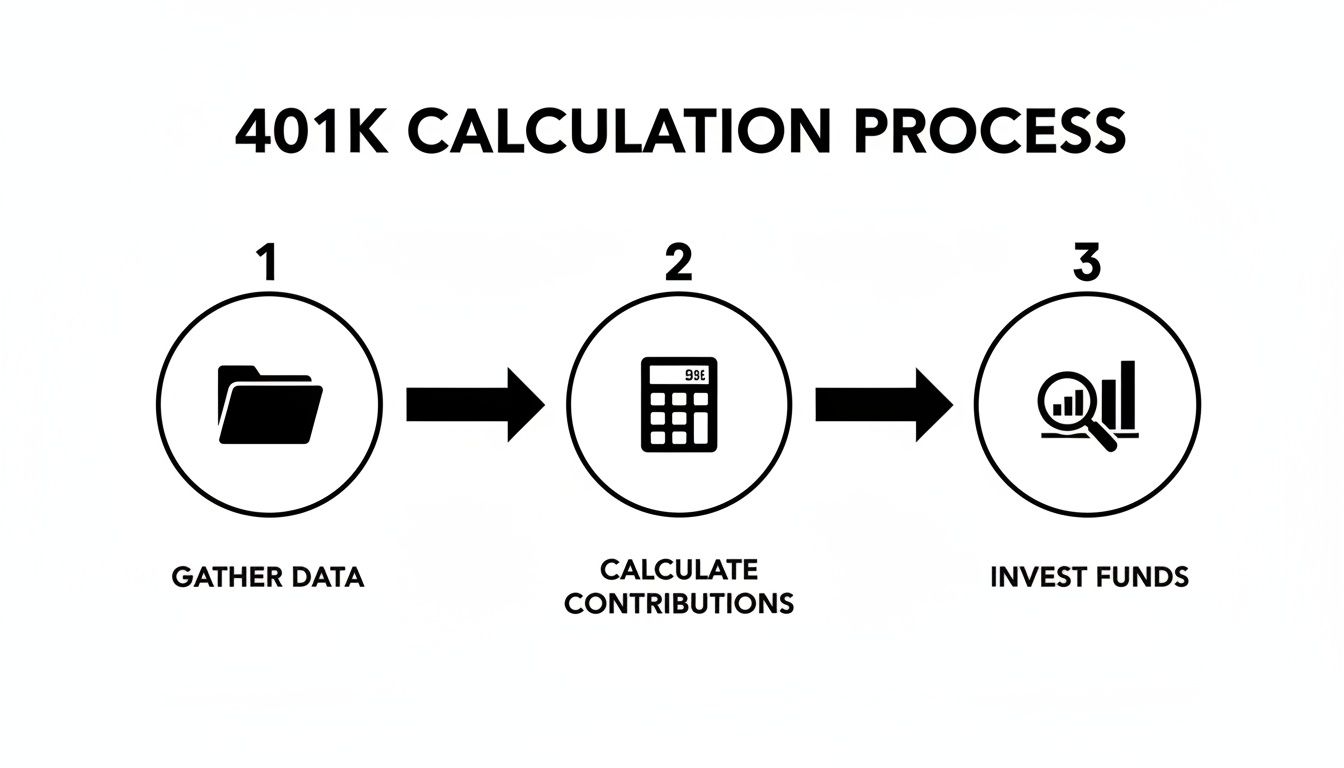
As you can see, a methodical approach is everything. Gathering accurate information from the start is the foundation for a fair calculation and, ultimately, a secure financial future.
Why Timing Matters in Texas
Starting the QDRO process early is a major strategic advantage. In Texas, it's always wise to begin drafting the QDRO while the divorce is still pending instead of putting it off until after the final decree is signed.
Delays can be incredibly costly. If the stock market takes a nosedive while you're waiting, the value of the share being transferred could plummet. Worse yet, if the employee spouse retires, dies, or takes out a loan against their 401(k) before the QDRO is finalized, it can become exponentially harder—or even impossible—for the other spouse to get their rightful portion. Don't let this be an afterthought.
A QDRO isn’t just administrative paperwork; it is the legal shield that protects your share of the retirement assets. Treating it with the urgency it deserves can safeguard tens or even hundreds of thousands of dollars for your future.
Avoiding Penalties and Taxes
A huge piece of the puzzle is understanding the federal tax rules. Normally, pulling money out of a 401(k) before age 59½ comes with steep penalties, but a QDRO is one of the key early withdrawal penalty exceptions.
This court-approved order lets you divide the funds without triggering that 10% early withdrawal penalty. The person receiving the money (the alternate payee) has a choice to make. They can roll their share directly into their own IRA, which keeps it growing tax-deferred for their own retirement.
Or, they can opt to take a cash distribution. If they take the cash, they will have to pay ordinary income tax on that amount, but—thanks to the QDRO—they'll completely avoid that extra 10% penalty. It's a critical protection that saves thousands.
Creative Strategies for Dividing Retirement Assets
Watching the balance of your 401(k) get cut in half can feel like a devastating blow, especially if you're close to retirement. But a strict 50/50 split of the account itself isn't your only option. Texas law encourages creative settlements, and you have the power to negotiate a solution that better protects your long-term financial stability.
Instead of liquidating hard-earned investments or starting over from scratch, you can propose a more strategic approach known as an "asset offset" or a "buyout."
Understanding the Asset Offset Strategy
The idea is simple: you keep your 401(k) completely intact. In exchange, your spouse receives other community assets of equal value. This is a powerful move for anyone who wants to avoid derailing their investment momentum or losing years of carefully planned growth.
Let's look at a practical example. Imagine the community property portion of your 401(k) is calculated to be $200,000. In a standard division, your spouse would get $100,000 through a QDRO. With an asset offset, you might instead offer them $100,000 in equity from the family home, a brokerage account, or another valuable marital asset.
This strategy can be a true win-win:
- You Keep Your Retirement Intact: Your investments keep growing without interruption, which is critical if you are nearing your target retirement date.
- Your Spouse Gets Immediate Value: They receive a tangible asset, like cash from a home sale or a brokerage account, without having to wait for a QDRO to be processed and finalized.
Weighing the Pros and Cons of a Buyout
While an asset offset sounds great on the surface, it demands a very careful financial analysis. The biggest hurdle is making sure the trade is truly equal. Here’s the catch: a dollar in a 401(k) is not the same as a dollar in cash because of one huge factor—taxes.
The money in your 401(k) is pre-tax. When you eventually withdraw it in retirement, you will pay income tax on every dollar. The equity in your home, on the other hand, is post-tax money. You can’t just trade $100,000 in pre-tax retirement funds for $100,000 in post-tax home equity and call it an even deal.
To make the trade fair, you have to account for the future tax liability. This often means the person keeping the 401(k) might need to offer a slightly discounted value from other assets. Why? To make up for the built-in tax bill their spouse is helping them avoid paying today.
Getting this calculation wrong can easily cost you tens of thousands of dollars. It's a key area where having a strong legal team is essential for protecting your finances. To see more ways to secure what's yours, explore our guide on how to protect assets during divorce.
The Power of Mediation in Finding Solutions
Negotiating these kinds of complex trade-offs is exactly what mediation was designed for. Instead of leaving the decision to a judge who might just order a simple split down the middle, mediation gives you and your spouse a confidential forum to work through the numbers.
In mediation, you can sit down with a neutral third party and explore different scenarios. What if you keep the entire 401(k) and your spouse keeps the house? What if you split the retirement 60/40 and adjust the division of another asset to make it equitable?
This collaborative process empowers you to find a custom-fit solution that aligns with both of your financial goals. It puts you in control, allowing you to craft a settlement that feels right for your unique situation instead of having a one-size-fits-all solution imposed on you by the court.
Common 401(k) Mistakes to Avoid in a Texas Divorce

It’s tempting to want the fastest, simplest solution just to close this chapter of your life. But when you're splitting a 401(k), a single misstep can have devastating financial consequences. Based on our years of helping Texas families, we’ve seen the same costly mistakes happen over and over again. Here’s how you can avoid them.
Mistake #1: Cashing Out Instead of Using a QDRO
When emotions are high and you need funds to start your new life, the idea of getting a lump-sum cash payout from your ex-spouse's 401(k) can seem appealing. Please don't do it. This is almost always a catastrophic financial error.
Withdrawing your share without a QDRO means you're not just taking a distribution; you're triggering a major taxable event. You will owe ordinary income tax on the full amount, plus a crippling 10% early withdrawal penalty if you're under age 59½. This can instantly erase 30% or more of your retirement share.
A QDRO is the only federally approved method for splitting a 401(k) penalty-free in a divorce. It allows you to roll the funds directly into your own IRA, keeping your money invested and growing for your future without losing a dime to unnecessary taxes and penalties.
The financial stress of divorce makes this mistake all too common. Research shows that divorced households are 9.5% more likely to raid their 401(k) for quick cash, a move that seriously undermines long-term security. You can learn more about this 'divorce penalty' and its impact on retirement savings here.
Mistake #2: Forgetting to Update Your Beneficiaries
This is a quiet mistake that can cause unimaginable heartache and legal chaos years down the road. After your divorce is final, your ex-spouse is likely still listed as the primary beneficiary on your 401(k), life insurance policies, and other accounts.
If you were to pass away without updating this, the plan administrator is legally obligated to pay the entire account balance to the person named on that form—your ex-spouse. It doesn't matter what your will says. Your new spouse or your children could be left with nothing.
Actionable Tip: The moment your divorce decree is signed, make a list of every single account you own that has a beneficiary designation. Contact each administrator, get the proper forms, and update them to reflect your new reality. Do not put this off.
Mistake #3: Underestimating Future Tax Liabilities
When you're negotiating a buyout—say, you keep the 401(k) and your spouse gets the house—it's easy to overlook the built-in tax bill. A 401(k) is funded with pre-tax dollars. The equity in a house is post-tax money.
Trading $200,000 in your 401(k) for $200,000 in home equity is not an equal trade. That retirement money has a future tax liability attached to it. Failing to account for this difference means you could be giving your spouse a significantly better deal at your own expense. A fair buyout requires calculating the after-tax value of the 401(k) to ensure the division is truly "just and right."
Mistake #4: Failing to Get Plan Administrator Pre-Approval
You’ve drafted the QDRO, the judge has signed it, and you think you’re done. But then you submit it to the 401(k) plan administrator, and they reject it. This frustrating delay happens all the time when you don't get their input first.
Every retirement plan has its own specific rules and required language for QDROs. A tiny error can get your order kicked back, forcing you to go back to court for an amendment. That costs both time and money.
The smart move is to send a draft QDRO to the plan administrator for pre-approval before you submit it to the judge. This allows them to flag any issues, which can be corrected easily, ensuring the final, signed order will be accepted without a hitch.
What to Do Next
We know this is a lot to take in. It's completely normal to feel overwhelmed when you're facing the complexities of dividing retirement accounts. But the most empowering thing you can do right now is move from learning to acting. This isn't just about splitting a 401(k); it's about laying a solid foundation for the next chapter of your life. You don't have to figure all this out on your own.
Key Takeaway
Protecting your hard-earned retirement assets is one of the most critical parts of your divorce. The decisions made here will impact your financial well-being for decades to come. Don't leave it to chance. Your immediate priorities should be to gather all your financial statements, consult with a Texas family law attorney who has deep experience with QDROs, and begin mapping out your financial goals for the future. If you need help structuring your financial recovery, it might be worth understanding what financial coaching entails.
This guide has given you the background knowledge to ask the right questions and understand the process. Now, it's time to get advice that is specifically tailored to your situation. We invite you to schedule a free, confidential consultation with The Law Office of Bryan Fagan, PLLC. Let our experienced attorneys review your case, answer your specific questions, and build a strategy to protect what you've worked so hard to save and secure your financial future.
Frequently Asked Questions About 401k Division in Texas
As you dig into the details of splitting a 401(k) in a Texas divorce, practical questions will come up. Here are straightforward answers to the most common concerns we hear from clients.
Can my spouse get my 401(k) if our marriage was short?
Yes, but only the portion that’s considered community property. The length of your marriage is key, as it directly impacts how much community value was created. In a very short marriage, the divisible portion—the contributions and growth that happened during the marriage—will be much smaller than in a long-term marriage. Your pre-marital balance remains your separate property, but you must be able to trace it and prove it.
What happens to the 401(k) loan I took out during the marriage?
A 401(k) loan taken out during the marriage is almost always treated as a community debt. This means the outstanding loan balance is subtracted from the total community value of the 401(k) before it gets divided. For example, if the community portion of the account is worth $100,000 but there’s a $20,000 loan against it, the net value for division would be $80,000. The debt is shared, just like the asset.
How long does the QDRO process take in Texas?
The timeline can vary, but a realistic estimate is anywhere from three to six months after the divorce is finalized. This window accounts for drafting the order, getting it pre-approved by the plan administrator (a crucial step), securing the judge’s signature, and the plan’s final processing. A smart move is to start the QDRO drafting process while your divorce is still pending to avoid frustrating delays later on.
Do I have to sell stocks to divide my 401(k)?
Not necessarily, and in many cases, you shouldn't. Most QDROs allow for an "in-kind" transfer of assets. So, if your 401(k) holds 100 shares of a particular stock, your ex-spouse can receive 50 of those exact shares directly into their own retirement account. This is a huge benefit because it prevents you from having to sell assets at a bad time and allows both of you to benefit from any future growth.
Understanding these nuances is key to protecting your financial future. At The Law Office of Bryan Fagan, PLLC, we help Texas families navigate complex property division with clarity and confidence. If you have questions about your specific situation, schedule a free, no-obligation consultation with our experienced attorneys today by visiting us at https://texasdivorcelawyer.us.