Skip to content
Texas Family Code § 6.601 allows married couples to use arbitration to resolve divorce issues through a private arbitrator instead of a judge, provided both parties agree in writing. That written agreement must also state whether the arbitration will be binding or nonbinding.
You may be facing a divorce with years of shared property, difficult financial decisions, or serious concerns about your children's future. The thought of presenting every disagreement in open court can feel exhausting. Texas divorce law gives you another possible path, but arbitration isn't automatic, and it isn't right for every family.
Why Texas Divorces Can Go to Arbitration Instead of Court
You and your spouse may agree on some parts of the divorce but remain stuck on property division, debt, support, or other issues. Rather than asking a judge to decide every disputed question, you may choose a private arbitrator who reviews the evidence and makes a decision within the authority granted by your written agreement.
That option can provide a more focused setting. You and your spouse can select someone with family-law experience, organize the disputed issues, and present the information that matters most. Arbitration is still a legal process, not an informal conversation, but it may feel more manageable than a fully litigated courtroom case.

A private decision-making process
Consider a couple who wants a final answer about dividing a closely held business and several financial accounts. They don't want to negotiate indefinitely, but they also don't want every detail discussed in a public courtroom. If both spouses freely agree in writing, arbitration may give them a private decision-maker while preserving the court's role in the divorce process.
The critical point is consent. One spouse generally can't decide alone that the other must arbitrate. The agreement must come from both parties, and the written document must identify the type of arbitration they've selected.
Practical rule: Arbitration can replace a judge's fact-finding role for agreed divorce issues, but it doesn't eliminate the need for a valid court case and a final court order.
Texas Family Code § 6.601 appears in Chapter 6, the part of the Family Code governing suits for dissolution of marriage. The provision has been part of Texas family-law practice for decades. By 2010, the First Court of Appeals was already citing § 6.601 as a basis for arbitration in divorce proceedings, showing that the framework had become established well before the 2020s. The statutory text is available through the Texas Family Code provisions on dissolution of marriage.
Arbitration is only one route. You can also learn about filing for divorce without going to court when your circumstances may support an agreed or alternative process. The right choice depends on whether you and your spouse can cooperate, whether you need a decision-maker, and whether safety or fairness concerns require closer judicial involvement.
What Texas Family Code 6.601 Actually Says
The statute creates a straightforward framework, but the choices inside that framework have major consequences. Under § 6.601, a Texas court may refer a divorce case to arbitration when the parties make a written agreement requesting it.
The written agreement comes first
Your agreement should clearly identify the divorce issues that will go to arbitration. Depending on your case, that may include:
- Property division: Questions about the marital home, investments, retirement interests, business assets, or personal property.
- Debt allocation: Disputes over credit accounts, loans, tax obligations, or debts connected to a business.
- Spousal maintenance: Eligibility or the terms of support, if that issue is included within the parties' agreement.
- Other divorce issues: Any additional matters the agreement properly places before the arbitrator.
The agreement also must say whether the arbitration is binding or nonbinding. Don't treat that phrase as routine wording. It determines whether the arbitrator's decision is intended to provide a final answer or serve as a recommendation that can be followed by further court proceedings.
Binding and nonbinding arbitration
With binding arbitration, the arbitrator issues an award, and § 6.601 provides that the court shall render an order reflecting that award. The arbitrator's decision therefore has legal significance in the divorce process. The court's later order is essential because it incorporates the award into the divorce judgment.
With nonbinding arbitration, the arbitrator's decision doesn't end the dispute in the same way. If the parties don't accept the result, the case may continue toward a trial or another resolution.
The statute works alongside Family Code § 6.6015, which addresses when the court must decide enforceability issues before compelling arbitration. That structure reflects a balance: Texas law permits private decision-making, but it doesn't allow the process to bypass the court's responsibility to determine whether the agreement can be enforced.
Your divorce also remains subject to Texas procedural requirements. For example, The Texas 60-Day Divorce Waiting Period explains why no Texas divorce can finalize in under 60 days. Arbitration may affect how disputed issues are decided, but it doesn't automatically remove other requirements for obtaining a final divorce decree.
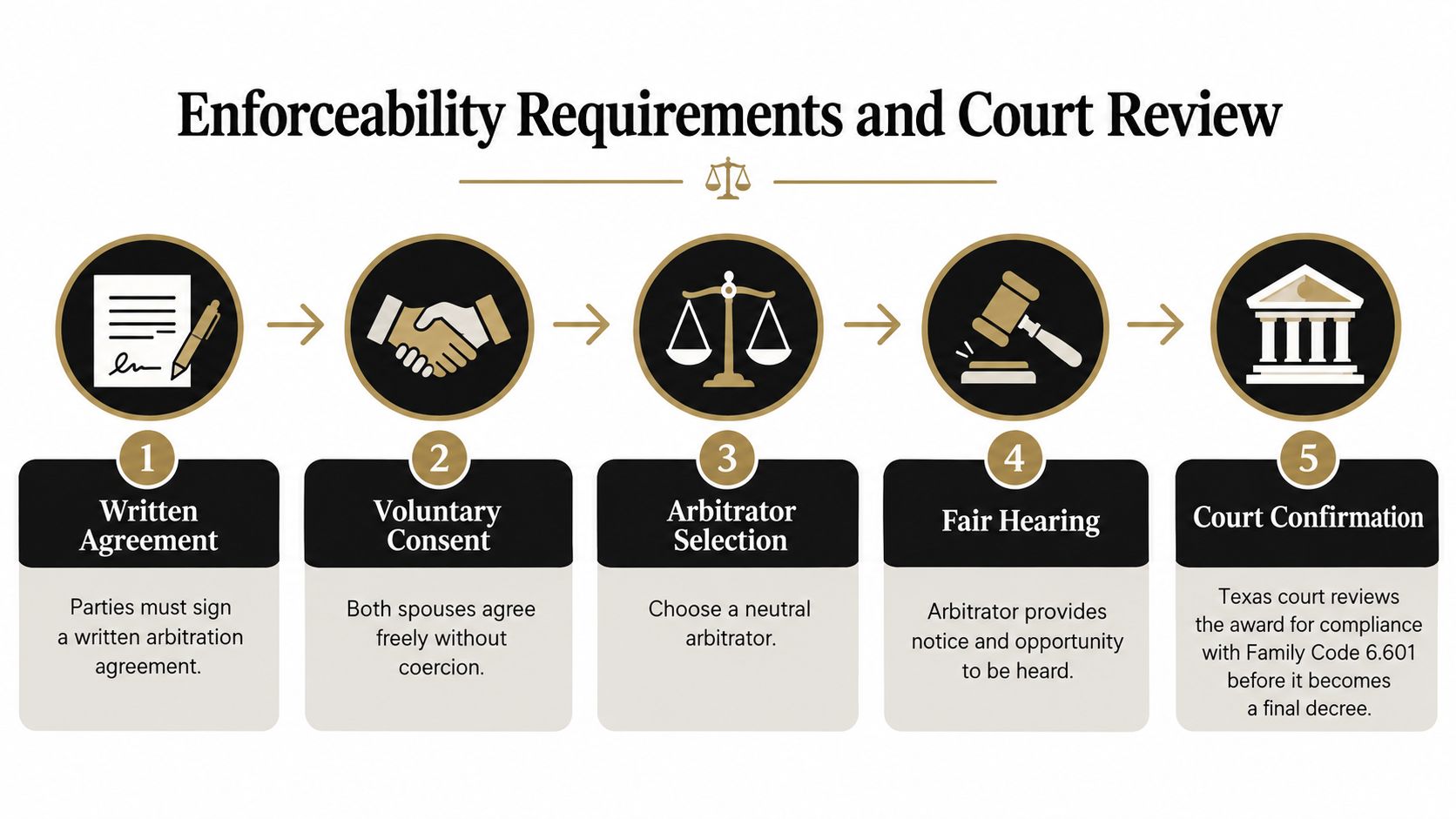
Enforceability Requirements and Court Review
A signed paper isn't automatically enough. If one spouse challenges the validity or enforceability of the arbitration agreement, the trial court must address that challenge before ordering binding arbitration.
The Texas Supreme Court has made this threshold requirement clear. The trial judge must first determine whether the agreement is valid and enforceable against the spouse who objects. The court can't just send the case to arbitration and postpone that question until later.
What the court examines
The court's review may involve the circumstances surrounding the agreement and the reasons for the challenge. Your lawyer may need to address whether you understood the agreement, whether you consented to it, whether the document covers the disputed issues, and whether any legal defect prevents enforcement.
The court's role doesn't mean the judge decides the underlying property or support dispute at that stage. The immediate question is whether the parties made a binding and enforceable agreement to use arbitration.
The judge decides whether the arbitration agreement can be enforced. The arbitrator decides the assigned dispute only after that legal gate is cleared.
Once the arbitration concludes, the court remains involved. For divorce issues covered by § 6.601(b), the court must render an order reflecting the arbitrator's award. That means arbitration doesn't replace the divorce decree. Instead, it supplies the decision that the court incorporates into the final legal order.
The Texas Supreme Court's explanation is important because family-law arbitration isn't identical to commercial arbitration. Divorce affects legal rights, property, and family relationships, so judicial oversight remains part of the statutory design.
You should also understand the practical importance of enforcement after the final order. If a former spouse doesn't follow the decree, information about filing a motion to enforce in a Texas divorce case can help you identify the type of court relief that may be available.
Arbitration versus Mediation and Traditional Litigation
The simplest distinction is this: mediation helps you reach your own agreement, arbitration gives a neutral person authority to decide, and litigation places the decision with a judge.
In mediation, a neutral mediator helps you and your spouse identify options and negotiate. The mediator doesn't impose a result. You remain free to accept or reject proposed terms until you sign an enforceable settlement.
Arbitration is different. After the parties create a valid agreement, the arbitrator hears the assigned dispute and issues an award. That can help when you need a final decision but want more control over the decision-maker and setting than a traditional courtroom may provide.
Traditional litigation gives the judge authority to decide disputed matters after the parties present pleadings, evidence, testimony, and legal arguments. Court litigation may be necessary when one spouse won't agree to arbitration, when the agreement is challenged successfully, or when the case requires judicial powers that arbitration doesn't provide.
| Method | Who Decides | Binding? | Privacy Level | Typical Timeline |
|---|---|---|---|---|
| Mediation | You and your spouse | Only after you agree and sign | Generally more private than a courtroom | Depends on cooperation and preparation |
| Arbitration | A private arbitrator | Depends on the written agreement | Generally private | Depends on the issues and hearing process |
| Traditional litigation | A judge | Court orders control | Court proceedings may be public | Depends on court schedules and case complexity |
Choosing the right path
Mediation may fit when you and your spouse can exchange information openly and make compromises. Arbitration may fit when you want a decision-maker but prefer a private process. Litigation may be the safer route when cooperation is absent, important facts remain disputed, or one party needs the court's direct authority.
For a closer look at an agreement-based process, review Family Code 6.602 mediated settlement agreements in a Texas divorce. Your attorney can also help you decide whether mediation should happen before arbitration or whether the facts call for litigation from the beginning.
Step by Step Guide to Initiating Arbitration
Arbitration should begin with careful planning, not a rushed signature. The first question is what you want the arbitrator to decide and what authority the arbitrator should have.
1. Define the scope in writing
You and your spouse sign a written arbitration agreement. It should state whether the process is binding or nonbinding and identify the issues included. A vague agreement can create another dispute before the arbitration even begins.
2. Ask the court for referral
Your attorney can file the appropriate request with the divorce court and attach the signed agreement. The judge reviews whether the agreement is valid and enforceable before compelling arbitration.
3. Select the arbitrator
The parties typically need a neutral professional with experience that matches the case. A property-heavy divorce may require someone comfortable with business interests, retirement assets, valuation questions, and complex financial records. A custody-focused matter requires careful attention to the limits that apply to child-related issues.
4. Prepare and present the evidence
You'll gather financial records, proposed property divisions, parenting information, and other documents relevant to the assigned issues. Your lawyer should help you present a clear theory of the case rather than overwhelming the arbitrator with disconnected paperwork.
5. Receive the award and return to court
The arbitrator issues an award after reviewing the submissions and hearing the parties' positions. For binding divorce arbitration under § 6.601, the court then renders an order reflecting the award as part of the divorce process.
Preparation matters more than drama. A well-organized financial summary or parenting proposal can make your position easier to understand and defend.
Administrative work can also affect the process. Some legal teams use virtual legal assistants companies as a resource for document organization and support tasks, while your attorney remains responsible for legal advice, strategy, and advocacy. You should ask who will handle confidential records and how your information will be protected.
When Arbitration Works Best for Your Specific Situation
Arbitration can be useful when you and your spouse want a final decision but don't want a judge unfamiliar with your family to resolve every detail. It may also help when you want the decision-maker's professional background to match the problem.
Complex property and financial interests
Business owners often face valuation, ownership, reimbursement, and income questions that require organized financial evidence. High-value estates may involve several categories of property and competing claims about separate and community interests. An arbitrator with appropriate family-law and financial experience may be able to focus closely on those disputes.
That doesn't mean arbitration guarantees a favorable result. You still need complete records, credible valuations, and a legally sound position. Your attorney should also identify which issues belong in arbitration and which require court action.
Parents need a different analysis
Texas law permits arbitration in parent-child disputes under Family Code § 153.0071, but custody arbitration has an important safeguard. The Texas Supreme Court has explained that even when arbitration is binding, a court may reject an award involving the parent-child relationship if, after a non-jury hearing, the court determines that the award isn't in the child's best interest. The court's best-interest review protects the child even when the parents selected arbitration.
That rule makes custody arbitration different from a purely financial dispute. You may use arbitration to obtain a parenting decision, but the child's welfare remains central, and the court retains authority to reject an award that fails the best-interest standard. The Texas Supreme Court's explanation of this protection is available in its decision concerning child-related arbitration.
Situations requiring caution
Arbitration may be a poor fit when one spouse refuses to participate, alleges coercion, or raises domestic-violence concerns. It may also be less suitable when the case needs extensive discovery or when you need the broad tools and direct authority available through litigation.
The Texas 60-Day Divorce Waiting Period still controls the minimum time before a divorce can finalize. Arbitration can change the decision-making route, but it doesn't erase that requirement.
Common Questions About Texas Divorce Arbitration
Can one spouse force the other to arbitrate? Generally, no. Section 6.601 depends on a written agreement between the parties. If you challenge the agreement, the trial court must decide enforceability before ordering binding arbitration.
Does binding mean the judge has no role? No. The arbitrator decides the assigned issues, but the court must render an order reflecting the award in a binding divorce arbitration. The judge also handles the threshold question of whether the agreement is valid and enforceable.
Is custody arbitration the same as property arbitration? No. In parent-child disputes, the court may reject a binding award after a non-jury hearing if the award isn't in the child's best interest. That safeguard reflects the court's continuing responsibility to protect children.
Is mediation better than arbitration? Neither process is automatically better. Mediation may fit when you and your spouse can reach a voluntary agreement. Arbitration may fit when you need a neutral decision-maker. Litigation may be necessary when consent, safety, discovery, or judicial authority is a central concern.
What should you do first? Gather your financial records, identify the issues you can't resolve, and speak with a Texas family-law attorney before signing an arbitration agreement. The Law Office of Bryan Fagan, PLLC can help you evaluate arbitration, mediation, custody concerns, support issues, property division, and enforcement options based on your circumstances.
The Law Office of Bryan Fagan, PLLC offers guidance on Texas divorce arbitration, mediation, custody, support, property division, and enforcement, including cases involving businesses or substantial estates. Visit Law Office of Bryan Fagan, PLLC to schedule a free consultation and discuss a practical strategy for protecting your rights and moving forward.