Skip to content
You may be sitting at the kitchen table in Katy, trying to decide whether one more conversation can repair your marriage or whether you need to learn what filing for divorce would involve. If children, a home, retirement accounts, a business, or safety concerns are part of the picture, uncertainty can feel overwhelming. A thoughtful divorce lawyer in Katy can help you understand your choices before a rushed decision turns into a legal problem.
Starting Your Katy Divorce With Clarity
Consider a couple living near Cinco Ranch. They have children, a mortgage, and separate ideas about what should happen next. One spouse wants to file immediately. The other wants counseling first. Neither understands how quickly decisions about the home, parenting time, bank accounts, or bills can become part of a court record.
Texas law doesn't force every family into the same path. You may be able to negotiate a complete agreement, use mediation, pursue a collaborative process, or ask a judge to decide disputed issues. The right approach depends on your safety, finances, children, communication, and willingness to exchange complete information.
The decisions to make before filing
Start by gathering records, not by deleting messages or moving money. Useful documents may include:
- Financial records: Bank statements, tax returns, pay records, retirement statements, loan documents, and business records can help identify the marital estate.
- Parenting information: School schedules, medical details, childcare arrangements, and your normal caregiving responsibilities can help you discuss a workable parenting plan.
- Safety concerns: If you fear violence, stalking, intimidation, or financial control, tell your attorney early. Safety may affect service, temporary orders, possession, and communication.
- Timing concerns: Your residency history, county residence, upcoming school events, employment changes, and access to funds can all affect planning.
A consultation isn't a commitment to file or litigate. It gives you a chance to ask what documents matter, whether temporary orders may be needed, and whether negotiation is realistic. You can also review this step-by-step plan for what to do before filing for divorce in Texas before meeting counsel.
Practical rule: Don't make major financial or parenting changes simply because you feel pressured. Learn how Texas rules apply to your facts first.
Your first goal isn't to predict every result. It's to replace confusion with an organized plan.
Understanding the Texas Divorce Process
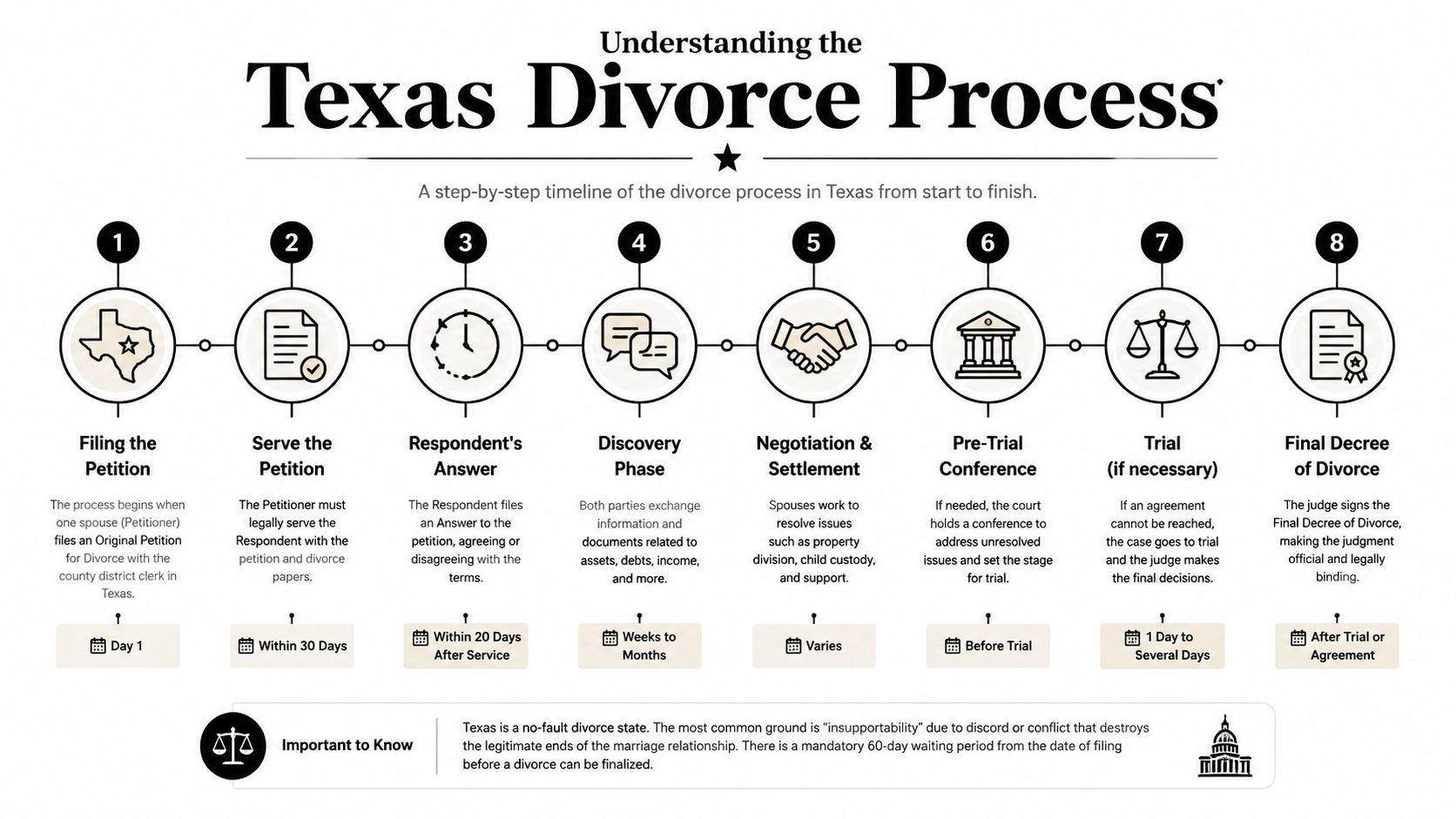
A Texas divorce usually follows a recognizable sequence, but the length and complexity depend on service, disputes, children, property, and court scheduling.
Step one, confirm eligibility and venue
Texas requires at least one spouse to have been domiciled in the state for the preceding six months, and either spouse must have lived in the county where the case is filed for the preceding 90 days. These requirements come from Texas Family Code Section 6.301.
For Katy families, the correct court may be in Harris, Fort Bend, or Waller County, depending on where the county-residency requirement is satisfied. The marriage location doesn't determine venue. Your attorney may verify leases, utility records, school records, employment information, and other evidence of residence.
Step two, file the petition
The spouse who starts the case files an Original Petition for Divorce. The petition identifies the marriage, residency, children, property issues, and requested relief. The Original Petition for Divorce in Texas provides a plain-language look at what this initiating document must contain.
After filing, the other spouse generally must receive legal notice through service or an accepted waiver. A response helps prevent the case from moving forward without that spouse's participation.
Step three, address immediate needs
The court may consider temporary orders while the case remains pending. These orders can address who stays in the family home, who pays bills, how parents exchange children, possession schedules, child support, and access to property.
Temporary orders don't necessarily decide the final outcome. They create structure while the spouses exchange information and negotiate.
Step four, observe the waiting period
Texas imposes a minimum 60-day waiting period after the petition is filed before the divorce can be finalized. The waiting period generally applies even when the spouses agree. A domestic-violence case may qualify for a waiver, but an exception isn't automatic. See this Texas divorce timeline explanation for the statutory timing and possible exception.
Step five, exchange information and negotiate
You and your spouse may exchange financial documents, written questions, property information, and proposed parenting terms. Mediation gives both sides a private setting to negotiate with a neutral mediator. Many courts require mediation or another settlement effort before trial.
If you reach agreement, the terms can be placed in a mediated settlement agreement or another enforceable settlement document, followed by preparation of the final decree.
Step six, obtain the final decree
The final decree addresses divorce, property and debt, conservatorship, possession, support, and other agreed or decided issues. The judge reviews the paperwork and, when required, receives testimony before signing it.
A decree is more than a formality. It controls what happens after the case ends, so unclear language can create enforcement disputes later.
Choosing the Right Type of Divorce
No divorce path is automatically better. The useful question is whether the process fits your level of agreement, safety, financial complexity, and need for privacy.
An uncontested divorce may fit when both spouses agree on every material issue, including property, debts, children, support, and the wording of the final decree. It can give you more control and reduce courtroom conflict, but an agreement that overlooks a retirement account, tax issue, or future enforcement problem may be difficult to fix.
A contested divorce becomes necessary when important disputes remain. A judge may decide unresolved issues after hearings or trial. This path provides formal procedures for obtaining information and presenting evidence, but it can increase conflict, expense, and uncertainty.
Mediation can help spouses resolve specific disagreements without asking a judge to decide every issue. Collaborative divorce uses a team-based negotiation model in which both spouses and their lawyers work toward settlement. These options often provide more privacy and control than trial, but they work best when both sides exchange information openly and negotiate safely.
Military families may face additional issues involving service obligations, deployment, notice, and federal protections. The Servicemembers Civil Relief Act can affect how a case proceeds when military duties interfere with participation. A service member or military spouse should raise that issue at the first consultation.
High-asset cases need a different level of preparation. Business interests, executive compensation, retirement plans, intellectual property, real estate, and separate-property tracing can make an apparently simple agreement unsafe.
| Divorce Type | Best Fit | Typical Timeline | Cost Level | Court Involvement |
|---|---|---|---|---|
| Uncontested | Complete agreement and full disclosure | Often more streamlined, but still subject to Texas procedures | Lower relative level | Limited |
| Contested | Disputes over children, property, or support | Usually longer and fact-dependent | Higher relative level | Substantial |
| Mediation-based | Negotiation is possible with neutral assistance | Depends on preparation and unresolved issues | Variable | Usually limited if settled |
| Collaborative | Both spouses commit to structured settlement work | Depends on cooperation and complexity | Variable | Minimal if successful |
| Military | A service member or military spouse needs case-specific planning | Depends on service-related circumstances | Variable | Depends on disputes and federal protections |
| High-asset | Businesses, complex compensation, or substantial estates | Often extended by valuation and tracing | Higher relative level | Depends on settlement success |
A Katy divorce lawyer should help you compare these routes, including privacy, control, likely disputes, and the possibility that negotiation may not succeed.
Protecting Children and Planning Support
Children's needs often make divorce feel less like a single legal event and more like several connected decisions. Texas courts address conservatorship, possession and access, child support, medical support, and sometimes spousal maintenance within the same family situation.

Parenting arrangements focus on the child's interests
Texas commonly presumes that parents will serve as joint managing conservators, but that label doesn't automatically create equal possession or eliminate geographic restrictions. The court focuses on the child's best interests and may consider each parent's caregiving history, stability, safety, communication, and ability to support the child's relationship with the other parent.
A parenting plan may address school-week possession, weekends, holidays, transportation, telephone contact, and where the child may live. Standard and extended possession schedules can differ, including summer adjustments described through 40, 50, 60, 70, 80, or 90-day periods under applicable orders. The correct schedule depends on the order and the child's circumstances.
Support depends on correctly identified income
Texas child support uses a percentage-of-net-resources model. The guideline percentages are 20% for one child, 25% for two, 30% for three, 35% for four, and 40% for five children, with at least the five-child amount for six or more children. For a low-income obligor under the guideline floor, the schedule is 15%, 20%, 25%, 30%, and 35% for one through five children. These rules are summarized by TexasLawHelp's child-support guidance.
The calculation can change with bonuses, commissions, self-employment income, deductions, and other resources. Statutory guidelines applied up to a monthly net-resource cap of $9,200 as of 2024, according to the Texas judiciary's family-law report. Medical support, health coverage, and childcare expenses may require separate analysis.
For a plain-language explanation of the calculation, review how child support is calculated in Texas.
Maintenance requires evidence, not assumptions
Spousal maintenance is fact-specific. Texas Family Code Section 8.052 allows the court to consider each spouse's ability to meet minimum reasonable needs, education and employment skills, marriage length, age and health, child-support duties, waste or concealment of property, homemaker contributions, contributions to a spouse's education, and misconduct such as adultery or cruel treatment. The statutory factors appear in Texas Family Code Section 8.052.
Your attorney may collect pay records, job history, medical information, household budgets, childcare evidence, and financial-misconduct records. A material and substantial change may support a later modification of certain orders, but you generally need the proper court filing and evidence rather than an informal arrangement.
Dividing Property and Complex Assets
Suppose a Katy couple owns a family home, retirement accounts, a local business interest, and funds received by inheritance. The key question isn't who paid a bill or whose name appears on an account. You first need to classify each asset, trace its history, value it, and then consider a fair division of the community estate.
Texas property acquired during marriage is presumed to be community property. Property owned before marriage, or received by gift or inheritance, is generally separate property if you can prove that classification with clear and convincing evidence. TexasLawHelp's explanation of dividing property and debt describes these community and separate-property principles.
Classification comes before division
The equity built in a Cinco Ranch home during the marriage may be part of the community estate even if one spouse made more of the mortgage payments. A retirement account may contain both premarital and marital portions, requiring statements from before marriage through the valuation date. A qualified domestic relations order may be needed to divide certain retirement benefits.
A small business creates additional questions. The business itself, retained earnings, compensation, goodwill, and debt may require financial analysis. A business valuator can help determine what portion is marital and what value should be assigned. A forensic accountant may trace deposits, withdrawals, reimbursements, and compensation.
Inherited funds can become disputed when they move through joint accounts or pay for marital expenses. Commingling doesn't automatically answer every legal question, but missing records can make tracing harder. Keep statements, closing documents, inheritance records, loan documents, and business ledgers organized.
Documentation matters: A separate-property claim is only as strong as the records that trace the asset from its original source through the divorce.
Texas uses a fair-division standard
Texas Family Code Section 7.001 requires the court to divide the spouses' estate in a manner that is “just and right,” considering the parties' rights and the children of the marriage. Texas isn't an automatic 50/50 state. A court may weigh circumstances such as caregiving, earning capacity, fault-related conduct, health, and the needs of children, depending on the evidence and applicable law. See Texas Family Code Section 7.001.
You may also need practical guidance about handling the house in a divorce, including whether to sell, refinance, buy out an interest, or address the home through a negotiated settlement. The decree should identify property and debts accurately. Texas law provides procedures for property not addressed in the decree later, which is another reason complete disclosure and careful drafting matter before signing.
Finding the Right Katy Divorce Attorney
You don't need an attorney who promises a guaranteed result. You need one who can explain the risks, identify missing information, and build a strategy around your family.
Questions to ask before hiring counsel
Use your consultation to test fit, not just credentials. Ask:
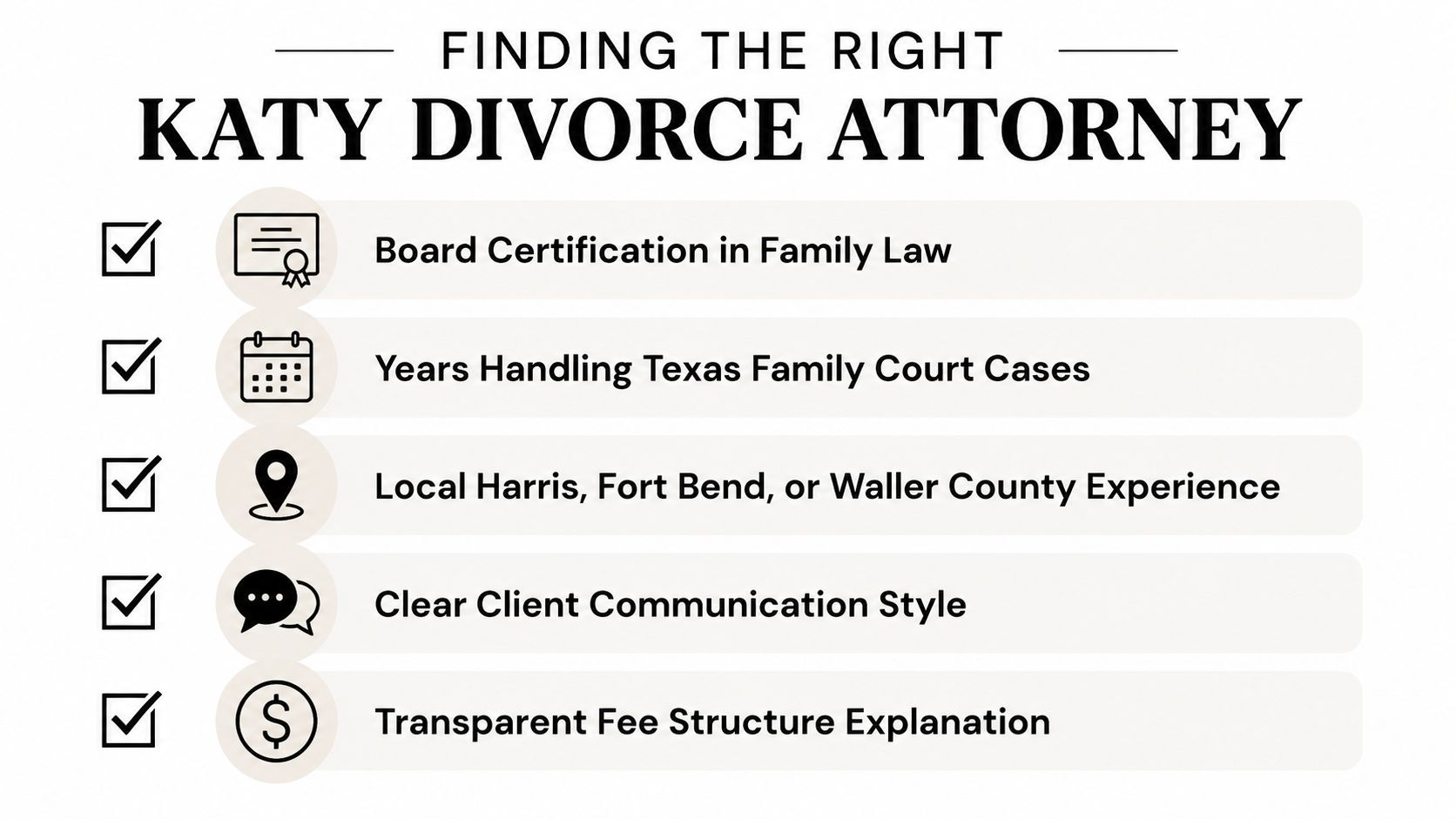
- Family-law experience: Does the attorney regularly handle Texas divorce, custody, support, property, mediation, and enforcement matters?
- Local familiarity: Has the lawyer worked with the Harris, Fort Bend, or Waller County courts relevant to your case?
- Case strategy: Can the attorney explain what may be negotiated, what may require temporary orders, and what could proceed to trial?
- Communication: Will you receive understandable updates, and can working parents use virtual or after-hours meetings when available?
- Fees: Will the firm explain the engagement letter, billing structure, expenses, and what services are included?
Board certification in family law can be one useful credential to investigate, along with years handling Texas family-court matters. You should also be cautious if someone guarantees an outcome, pressures you to settle immediately, or won't provide a written engagement letter.
Legal support often includes organized document collection and case administration. Understanding how paralegals help with divorce can help you ask what work is handled by the attorney and what support staff may assist with, while remembering that legal advice must come from a licensed attorney.
For additional questions to bring to a consultation, use this guide to choosing a divorce lawyer.
The Law Office of Bryan Fagan, PLLC offers Texas family-law representation, free consultations, in-person and virtual consultations, educational resources, and assistance with divorce, custody, support, mediation, high-asset matters, military divorces, temporary restraining orders, and enforcement.
Questions Katy Families Commonly Ask
Can you complete an uncontested divorce without a trial?
Often, yes, if both spouses agree on every material term and the final documents accurately reflect that agreement. You still need to satisfy residency rules, complete required filings, observe the waiting period, and obtain a properly signed final decree. Don't treat a verbal agreement as enough.
Can mediation resolve a dispute before trial?
Mediation can help you negotiate parenting, property, support, and debt issues with a neutral mediator. You should bring organized financial records and a clear list of priorities. If safety concerns or severe power imbalances exist, tell your attorney before agreeing to mediate.
How is a closely held business divided?
The business may require classification, valuation, and tracing. A valuator or forensic accountant may review ownership records, financial statements, compensation, debt, and goodwill. The final solution might involve an offsetting asset, a buyout, continued ownership, or another negotiated structure.
What happens after the decree?
If a former spouse doesn't follow the order, you may need enforcement or contempt proceedings. If circumstances change, a modification may be possible for qualifying issues such as parenting or support. Keep payment records, messages, calendars, and copies of the decree, and obtain legal advice before withholding possession or changing payments.
Key Takeaway and Your Next Step
Your Katy divorce involves more than ending a marriage. Texas rules may affect where you file, how you protect children, how support is calculated, how property is classified, and how the final decree will operate later. Early preparation can reduce avoidable conflict because you understand your records, priorities, and options before deadlines and hearings shape the case.
Gather financial documents, write down your parenting goals, identify immediate safety or housing concerns, and list the questions you want answered. Where communication and safety permit, mediation may help you retain control over important decisions. You can also explore related information about Texas child custody, property division, and divorce mediation as you prepare.
You don't have to understand every statute before asking for help. A consultation can turn a difficult moment into a practical plan designed for your family.
The Law Office of Bryan Fagan, PLLC helps Katy families address divorce, custody, child support, property division, mediation, military matters, and post-decree enforcement with clear guidance and responsive representation. Schedule a free consultation by visiting Law Office of Bryan Fagan, PLLC to discuss your circumstances with a Texas family-law attorney.