 Skip to content
You're sitting at the kitchen table in McKinney, trying to decide whether to tell your spouse, call a lawyer, or wait until the children are asleep. That first decision can shape your finances, parenting schedule, privacy, and position for months.
When the Decision to Divorce Becomes Real in McKinney
A parent in Craig Ranch may spend the first weekend after deciding to divorce staring at an empty side of the closet while wondering how the children will divide their time. A professional commuting along US-75 may be answering work messages while researching a divorce lawyer in McKinney. Both people face the same hard truth: emotion starts the process, but early legal decisions control what happens next.

The first 30 days aren't about filing as quickly as possible. They're about stabilizing your home, protecting access to records, understanding immediate parenting concerns, and choosing a lawyer who knows how your case will move through Collin County. Texas law generally requires at least 60 days after filing before a divorce can be finalized under Texas Family Code § 6.702, so rushing to file without a plan rarely creates the advantage people expect. Texas Family Code § 6.702 establishes the statutory waiting period.
Collin County procedure matters. Local standing orders, including those filed in connection with the 296th District Court, can affect what you may do with property, children, accounts, and insurance while the case is pending. Filing in McKinney instead of Plano isn't merely a preference about convenience. Venue depends on residency facts, county rules, and the court assigned to the case.
Practical rule: Don't make major financial or parenting moves before you understand the court orders and local procedures that may apply to you.
If counseling is part of how you and your spouse are trying to communicate safely, a resource such as couples counselling for Kelowna partners may offer general relationship support, although it isn't a substitute for Texas legal advice. Your lawyer should help you separate emotional decisions from legal decisions without dismissing either one.
The right attorney won't promise an easy divorce. They'll identify the risks early, explain your choices plainly, and build a plan that fits your children, property, and tolerance for conflict.
What to Look for in a McKinney Divorce Lawyer
A lawyer's website can tell you where the office is. It can't tell you whether that lawyer is the right fit for a Collin County custody dispute, business valuation, or military pension issue. You need to ask direct questions and compare the answers.
Test local courtroom experience
Ask, “How often do you appear in Collin County, and how familiar are you with the standing orders and procedures in the 296th, 380th, 416th, and 469th District Courts?” Local familiarity doesn't guarantee an outcome, but it helps your lawyer anticipate filing requirements, scheduling practices, and courtroom expectations.
Ask whether the lawyer has handled temporary orders, contested custody hearings, enforcement cases, and prove-ups in the county. A lawyer who only prepares agreed divorces may not be equipped for a case involving coercive control, hidden income, or emergency parenting concerns.
Confirm family-law focus
Ask, “What percentage of your practice is Texas family law, and are you board certified in family law?” Board certification isn't mandatory, but it gives you a concrete credential to investigate. You should also ask who will handle your file, rather than assuming the attorney in the consultation will personally perform every task.
Communication deserves the same scrutiny. Ask:
- Response expectations: Who answers urgent parenting questions, and how quickly should you expect a response?
- Staff roles: Will a paralegal manage routine filings, discovery, and scheduling?
- Case updates: How often will the firm send status reports?
- Decision authority: Which choices require your approval before the lawyer acts?
Match the fee structure to the case
Ask, “Is this likely to be a flat-fee uncontested matter or an hourly contested case, and what work does the initial retainer cover?” You should also ask about billing increments, replenishment requirements, mediation preparation, expert costs, and trial preparation.
Military divorces require additional screening. If you or your spouse serves at a nearby installation, ask about military retirement, deployment schedules, and the Uniformed Services Former Spouses' Protection Act. Business owners and high-asset spouses should ask who values companies, professional practices, stock options, retirement plans, and real estate.
Use this guide to choosing a Texas divorce lawyer to build your interview list. Don't hire based on confidence alone. Hire the attorney whose experience, communication system, and billing model match the actual pressure points in your case.
Mediation Collaborative Divorce or Litigation
You have three broad paths, and the cheapest-looking option isn't always the safest. Your decision should reflect cooperation, financial transparency, parenting conflict, safety, and the complexity of the estate.
Compare the choices before you commit
Mediation uses a neutral facilitator to help you and your spouse negotiate. Texas practitioner materials commonly place mediation around $3,000 to $4,000 per person on average, with mediator hourly rates around $300 to $600 and full-day mediation often around $800 to $2,500 per side, as summarized by Texas divorce mediation cost guidance. Those figures are planning benchmarks, not a guaranteed quote. Mediation can be substantially less expensive than litigation, but only if both sides prepare complete financial exhibits and workable parenting proposals.
Collaborative divorce gives each spouse a collaboratively trained lawyer and keeps negotiations structured outside ordinary courtroom litigation. It can protect privacy and help spouses solve complex issues creatively. The major risk is procedural. If either spouse withdraws from the collaborative process, both parties generally need new litigation counsel.
Litigation uses the court's authority to obtain orders, compel information, protect children, and decide issues the spouses can't resolve. It may be necessary where there's domestic violence, a serious power imbalance, hidden assets, severe custody conflict, or refusal to disclose financial information.
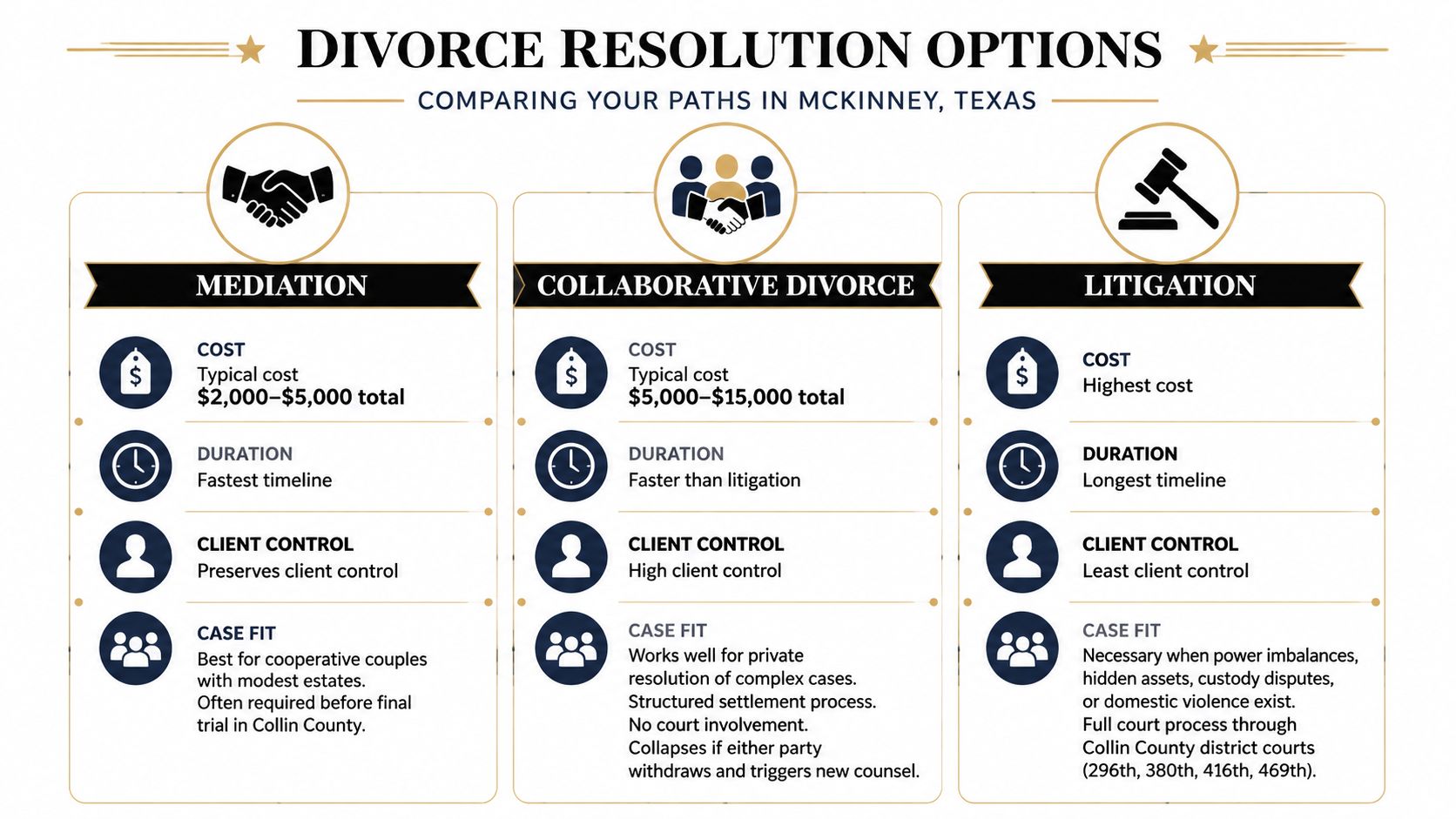
| Factor | Mediation | Collaborative Divorce | Litigation |
|---|---|---|---|
| Cost | Usually lower than litigation, with preparation affecting the total | Structured attorney and professional fees | Usually highest because of hearings, discovery, and trial preparation |
| Duration | Often the fastest route when agreement is realistic | Faster than litigation when both spouses remain committed | Usually longest, especially with disputed custody or complex assets |
| Client control | High, because spouses negotiate the terms | High, with a guided settlement process | Lower, because the judge decides unresolved issues |
| Best fit | Cooperative couples with manageable disputes | Private resolution of complex matters | Safety concerns, hidden assets, major power imbalance, or entrenched conflict |
For a practical overview, Mediation for Divorce in Texas explains how preparation affects the process. You can also review Divorce Mediation in Texas: How It Works for the basic reason most contested Texas divorces settle in mediation.
Don't mediate merely because your spouse demands it. Mediation works when you can participate safely, understand the finances, and receive legal advice before signing an agreement.
How to Prepare for Your First Consultation
Your first consultation should produce a legal map, not just a discussion of whether divorce feels possible. Bring enough information for the lawyer to identify jurisdiction, immediate risks, support concerns, and the likely path to resolution.

Build your document packet
Gather these materials if you can access them lawfully:
- Marriage information: Your marriage certificate and a one-page timeline of the marriage.
- Income records: Recent pay stubs and three years of tax returns.
- Banking and retirement: Bank statements, retirement statements, and investment records.
- Property records: Vehicle titles, mortgage statements, and records for real estate.
- Protection and benefits: Insurance policies and beneficiary information.
- Parenting information: A draft parenting schedule, school details, medical needs, and practical transportation concerns.
Don't secretly access accounts or devices you aren't authorized to use. Tell your lawyer what you have, how you obtained it, and what records you believe are missing.
Ask questions that expose fit
Write these questions down before you arrive:
- How much of your practice involves divorce and custody?
- How often do you appear in Collin County district courts?
- Who will be my primary contact?
- Will a paralegal work on routine filings and discovery?
- What retainer structure applies to my case?
- What billing increment do you use?
- What work is included in the initial retainer?
- Should I pursue mediation, collaborative divorce, or litigation?
- What temporary orders might I need?
- What facts could change your initial assessment?
The lawyer is evaluating more than whether you want a divorce. They'll examine Texas residency and county venue, possible grounds, immediate support needs, parenting risks, and whether the facts support an uncontested, mediated, or litigated track. Texas recognizes insupportability, a no-fault ground added to the Texas Family Code effective January 1, 1970, as part of the state's modern divorce framework. Texas divorce history places that change in the broader history of Texas family law.
If temporary orders are needed, ask the firm how you'll prepare for the Collin County courthouse at 2100 Bloomdale Road. Wear clean, conservative clothing, arrive early enough to park and pass security, bring identification and your case information, and follow the clerk or courtroom coordinator's check-in instructions. Your lawyer should tell you exactly where to go and what to expect.
Property Support and Custody Considerations in Texas
A Craig Ranch business owner may assume the company belongs solely to the spouse who built it. A professional commuting to Plano may assume the house gets sold and the proceeds split. Texas property division is more complicated because the court classifies property first, then divides the community estate in a manner that is just and right, not automatically equal.
Classify and trace the estate
Under Texas Family Code principles, property acquired during the marriage is generally presumed to be community property. The marital estate begins on the marriage date, not when the couple started living together. A spouse claiming separate property must trace it with clear and convincing evidence, which can require account records, purchase documents, inheritance records, and careful transaction histories.
Community funds used to improve or pay down a spouse's separate asset may create a reimbursement claim. Retirement accounts and stock options may also require detailed division. A qualified domestic relations order, commonly called a QDRO, can direct the division of eligible retirement benefits, but the decree and the order must match the plan's requirements.
The homestead deserves special attention. A residence in Collin County may carry constitutional and statutory protections that affect sale, occupancy, and a spouse's ability to transfer an interest. Don't sign a deed, refinance paperwork, or buyout proposal before your attorney reviews the title, mortgage, equity, and homestead issues together.

Support and parenting affect the plan
Texas spousal maintenance is narrow. Under Family Code § 8.051, a spouse generally must show financial need and a qualifying circumstance, such as a marriage lasting 10 or more years, disability, care for a disabled child, or family violence within two years before filing. Public Texas court materials summarize the cap at $5,000 per month or 20% of the paying spouse's gross income, whichever is less. Texas courts' spousal maintenance materials explain the rule-driven framework.
Child support uses the paying parent's monthly net resources. The guideline percentages are:
| Number of Children | Percentage of Net Resources | Cap Applied |
|---|---|---|
| One | 20% | Subject to Texas guideline limits |
| Two | 25% | Subject to Texas guideline limits |
| Three | 30% | Subject to Texas guideline limits |
| Four | 35% | Subject to Texas guideline limits |
| Five | 40% | Subject to Texas guideline limits |
| Six or more | 40% | Subject to Texas guideline limits |
These percentages are summarized in Texas child support guideline information. Courts may also address health insurance and work-related childcare. A standard possession order may work for some families, while a custom schedule may better fit a true 50/50 arrangement, school demands, travel, or a child's medical needs.
Collin County Timelines and Court Process
Your case moves through defined stages, but the pace depends on service, disputes, preparation, and the court's docket. McKinney residents commonly look first to Collin County venue, but your lawyer must confirm that at least one spouse has lived in Texas for six months and in the filing county for 90 days. Texas residency and venue guidance explains why those checks belong at the beginning.
Follow the case sequence
- File the original petition. The petition identifies the marriage, requested relief, property issues, and parenting concerns.
- Complete waiver or service. Your spouse must receive legal notice or sign a valid waiver.
- Request temporary orders when necessary. The court can address temporary possession of the home, parenting time, support, and immediate conduct while the case continues.
- Exchange information. Discovery and disclosures clarify income, debts, property, retirement, business interests, and custody evidence.
- Negotiate or mediate. A complete agreement can resolve the case without a final contested trial.
- Prepare for final resolution. If disputes remain, the case may proceed through pretrial preparation and trial.
- Present the final decree. In an agreed case, the prove-up is often a short hearing where the court confirms the required facts and approves the decree.
The waiting period under § 6.702 is firm. A court generally can't grant the divorce until at least 60 days after filing, even if you and your spouse agree immediately. Use that time for service, document review, temporary orders, settlement drafting, and mediation rather than waiting passively. Texas divorce procedure guidance describes the petition, service, temporary orders, negotiation, mediation, and final decree sequence.
At the 2100 Bloomdale Road courthouse, scheduling depends on the assigned court and the issue's urgency. Contested custody evaluations, hidden assets, business valuations, continuances, and docket congestion can all slow the case.
For a broader procedural reference, review Texas divorce timelines, then ask your lawyer to apply the general roadmap to your assigned Collin County court.
Your Next Steps After Hiring a Divorce Lawyer
Once you sign a retainer, your job is to become organized and predictable. Your lawyer can build the strategy, but you control many of the daily choices that either protect or damage your position.
Your first 30-day checklist
- Complete financial collection: Provide remaining tax, banking, retirement, mortgage, insurance, business, and debt records.
- Create private communication channels: Consider a separate post office box or email account for legal correspondence, while following your lawyer's advice about privacy and lawful access.
- Protect credit carefully: Discuss freezing or limiting joint credit accounts before taking action, and don't remove funds or cancel essential services without legal guidance.
- Review beneficiaries: Check retirement and life insurance beneficiary designations with your lawyer, because some changes may be restricted while the case is pending.
- Follow every order: Treat parenting exchanges, support payments, possession terms, and communication requirements as mandatory.
- Keep a private timeline: Record missed exchanges, payments, important messages, school issues, and significant events objectively.
- Control social media: Don't post accusations, threats, financial details, or emotional commentary about your spouse or the divorce.
After filing, route substantive communication through counsel when your lawyer advises it. Keep your messages short, factual, and focused on the children when direct co-parent communication remains necessary. Early cooperation with disclosure doesn't mean surrendering your rights. It gives your attorney cleaner information and creates a better chance of resolving the issues without unnecessary court conflict.
The next practical challenge is mediation day in Collin County. You should arrive with organized exhibits, a realistic parenting proposal, and a clear list of issues you can solve versus issues requiring a judge.
Key takeaway: This week, gather your records, write your marriage timeline, list your parenting concerns, and schedule a consultation before making major financial or custody decisions. The Law Office of Bryan Fagan, PLLC offers free consultations and Texas family-law guidance for divorce, custody, support, mediation, enforcement, military matters, and complex property disputes. Visit Law Office of Bryan Fagan, PLLC to discuss your McKinney or Collin County case and decide whether settlement, mediation, or litigation fits your situation.


