Skip to content
Worrying about your financial future is one of the most stressful parts of facing a divorce.
If you’re wondering, "Can I get alimony in Texas?" the short answer is yes, but it’s not as straightforward as you might think. What most people call alimony is officially known as spousal maintenance in Texas, and getting a judge to order it is notoriously difficult. This guide will walk you through your options, explain the law in plain English, and give you a clear, solution-focused path forward.
The Two Paths to Financial Support in Texas
When you’re staring down the uncertainty of a divorce, the thought of keeping your head above water financially can feel overwhelming. You’ve built a life, and now you’re worried about how you’ll support yourself moving forward. It’s a common and completely valid fear, but it's crucial to start with realistic expectations about what Texas law actually allows.
Unlike many other states, Texas law is built to encourage financial self-sufficiency after a divorce. The court system doesn’t just hand out ongoing financial support. Instead, it puts a very high burden of proof on the spouse asking for help.
In Texas, there are two distinct ways to get financial support after a divorce. Understanding the difference between them is the first step in building a strategy that protects your future.
- Court-Ordered Spousal Maintenance: This is the official, legally mandated support ordered by a judge. It is rare and comes with strict restrictions. Securing this type of support is an uphill battle because of the tough eligibility rules in the Texas Family Code Chapter 8. Generally, you have to have been married for at least 10 years just to be considered, unless specific circumstances like family violence or a disability are involved.
- Contractual Alimony: This is a much more common and flexible solution. Instead of leaving the decision to a judge, you and your spouse negotiate the terms of support as part of your overall divorce settlement. That agreement is then written into your final divorce decree, making it a legally binding contract.
The key takeaway is this: While a judge is unlikely to force your spouse to pay support, you and your spouse can absolutely agree to it. This puts the power back in your hands through direct negotiation and mediation.
Your legal strategy should be focused on strategically negotiating a fair contractual agreement. This approach gives you far more control over the amount, duration, and terms of your financial support, letting you create a solution that actually fits your family’s unique situation instead of being stuck with a rigid, one-size-fits-all court formula.
Qualifying for Court-Ordered Spousal Maintenance
Asking a judge in Texas for spousal maintenance isn't a simple request. The burden of proof is entirely on your shoulders. First, you have to show that you've genuinely tried to earn an income but still can't cover your minimum reasonable needs with your own property, including your share of the marital estate.
Once you get past that initial barrier, you have to fit into one of four very specific legal pathways laid out in Chapter 8 of the Texas Family Code. These are strict, non-negotiable requirements a judge must see before they can even think about ordering support.
This decision tree gives you a visual of the two main roads to spousal support in Texas: the tough, court-ordered route versus the more flexible, negotiated path of contractual alimony.
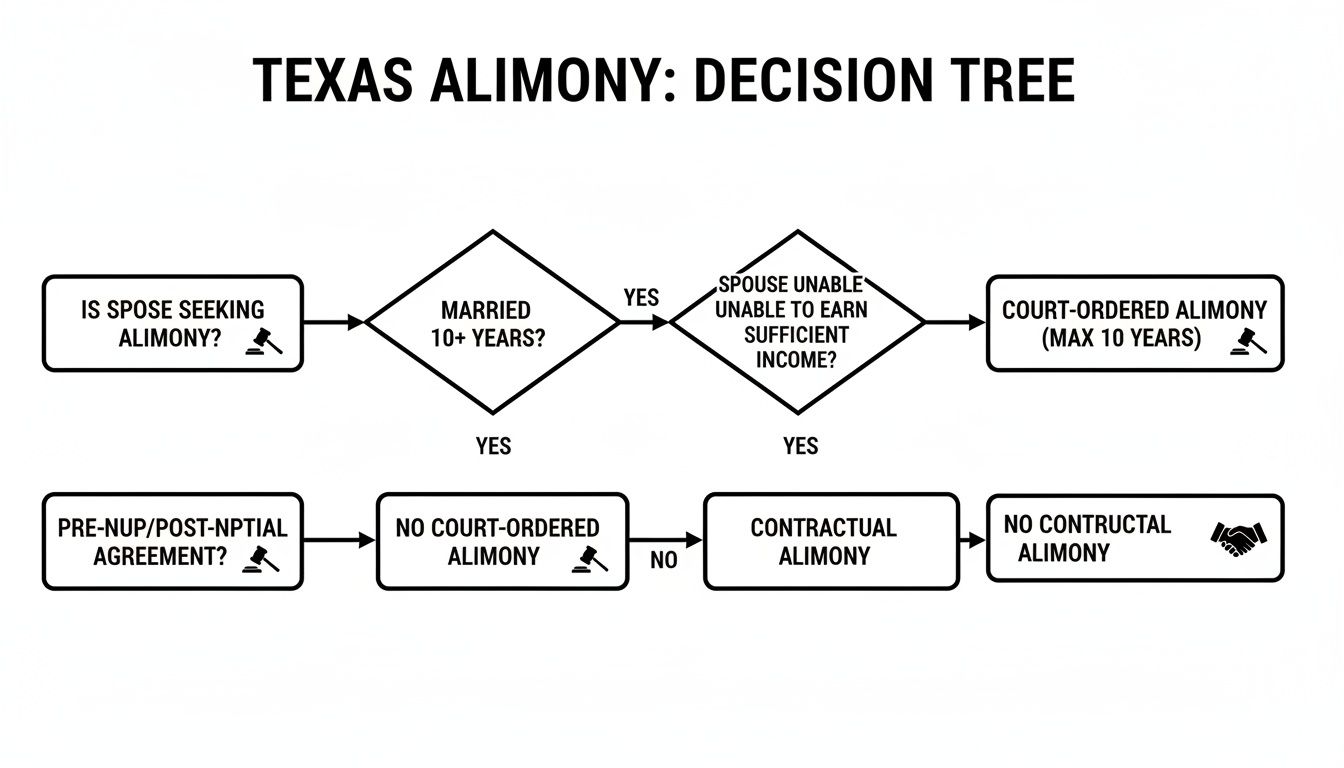
As the chart makes clear, getting a court order means hitting a very narrow target. Contractual alimony, on the other hand, opens up possibilities through mutual agreement.
The 10-Year Marriage Rule
This is the most common path to eligibility, but just being married for over a decade isn’t enough. You have to prove two things:
- Your marriage lasted 10 years or longer.
- You have been working diligently to either earn enough money or develop the skills you need to provide for your own basic needs, but are still unable to do so.
A judge will want to see solid proof of your efforts—things like job applications, enrollment in a training program, or a list of interviews you’ve attended. For instance, a stay-at-home parent ending a 15-year marriage can't just claim they have no income. You need to show the court you've already started taking steps to re-enter the workforce.
The Family Violence Exception
The 10-year marriage rule isn't absolute, especially in situations involving domestic abuse. If your spouse was convicted of (or received deferred adjudication for) a criminal act of family violence, you may be able to bypass the length-of-marriage requirement. This is a critical protection for spouses leaving dangerous situations.
To qualify, the act of violence must have happened within two years of filing for divorce, or while the divorce case is ongoing. This requires concrete evidence, usually a criminal court record, to satisfy the judge. You can learn more about the various factors a court considers by reading our detailed guide on spousal support and alimony in Texas divorce cases.
Disability-Based Qualifications
The Texas Family Code also creates a path to support for those who are unable to work because of a disability. This can apply in two different scenarios.
- Your Disability: You can qualify if an incapacitating physical or mental disability prevents you from earning enough to meet your minimum reasonable needs. Proving this almost always requires medical records and expert testimony to show how your condition directly stops you from being self-sufficient.
- Caring for a Child with a Disability: You might also qualify if you are the primary caretaker of a child from the marriage (of any age) who has a disability. The key here is proving the child's condition requires such "substantial and continuous personal supervision" that it prevents you from being able to earn a sufficient income.
In both of these disability situations, the legal focus isn't just on the disability itself. It’s about how that disability—whether it's yours or your child's—directly impacts your ability to earn a living. Navigating these strict legal hoops requires a sharp legal strategy and powerful evidence.
How Texas Courts Calculate Alimony Payments
If you clear the tough eligibility hurdles for court-ordered spousal maintenance, the next question is: what can you realistically expect to receive? Understanding how Texas judges make their calculations can replace uncertainty with clarity.
The Texas system is designed to provide temporary, targeted support to help a spouse get back on their feet—not to create long-term financial dependency.

Strict Caps on Payment Amounts
Texas law is very clear about the maximum amount of spousal maintenance a judge can order. It's often called the "lesser of" rule because the payment is capped at whichever of two numbers is lower.
A court cannot order payments that exceed either:
- $5,000 per month, or
- 20% of the paying spouse's average monthly gross income.
This means that no matter how much your spouse earns or what your monthly budget looks like, the final award will never go above these legal limits. This rigid structure is one of the most important things to understand from the start.
For example, as outlined in Texas Family Code Sec. 8.055, if the paying spouse earns $30,000 per month, the maximum payment is capped at $5,000. But if that same spouse earns $15,000 per month, the payment is capped at $3,000 (20% of their income), not the $5,000 maximum.
You can see more detailed examples of how much spousal support is in Texas in our related guide.
How Long Can Payments Last?
Just as Texas caps the amount of alimony, it also strictly limits how long you can receive it. The maximum duration is tied directly to the length of your marriage. The logic is simple: the longer the marriage, the longer the potential support period.
This table breaks down the maximum timeframes a judge is allowed to order.
Maximum Duration of Spousal Maintenance in Texas
The table below outlines the absolute longest a Texas court can order spousal maintenance payments, based directly on how many years the marriage lasted. These are the legal maximums as defined by the Texas Family Code.
| Length of Marriage | Maximum Duration of Payments |
|---|---|
| 10 to 20 years | Up to 5 years |
| 20 to 30 years | Up to 7 years |
| 30 years or more | Up to 10 years |
| Marriage of any length with a family violence conviction | Up to 5 years |
It's crucial to remember these are maximums. A judge can, and often will, order payments for a shorter period if they believe it’s appropriate. The court's goal is always to provide support for the shortest possible time that allows you to become self-sufficient.
Other Factors the Court Considers
While the caps on amount and duration are set, a judge still has to decide where within those limits your award should fall. To do that, they look at the complete picture of your family's circumstances.
Some of the key factors they'll weigh include:
- Each spouse’s financial resources, including separate property and their share of the community estate.
- The education and employment skills of both spouses.
- The age, work history, and physical and emotional health of the spouse seeking maintenance.
- Any marital misconduct, like adultery or cruelty, by either spouse during the marriage.
A judge carefully weighs all these elements to land on an amount and duration they believe is "just and right"—while still operating within the strict boundaries of Texas law. This is why presenting a clear, well-documented case is absolutely essential to getting a fair outcome.
Contractual Alimony: The More Flexible Solution
Realizing how tough it is to get a court to order spousal maintenance can be disheartening, but it’s far from the end of the story. While the courthouse doors might seem closed, another, more practical path is wide open: contractual alimony.
Think of it this way: court-ordered maintenance is like being forced to use a rigid, one-size-fits-all government form. Contractual alimony, on the other hand, is like creating a custom agreement that you and your spouse design together to meet your specific needs.

What Is Contractual Alimony?
Contractual alimony is a private financial agreement negotiated between you and your spouse as part of your overall divorce settlement. Instead of asking a judge to make the decision for you, you work together—often through lawyers or in mediation—to decide on the terms of post-divorce financial support.
Once you reach an agreement, the terms are written into your Final Decree of Divorce. This makes it a legally binding contract that a court can enforce, just like any other part of your settlement. It is the main way financial support is handled in Texas divorces.
The truth is, alimony is very attainable in Texas—it's just most often achieved through these negotiated settlements rather than a judge’s order. Contractual alimony, mutually agreed upon in divorce decrees, thrives without the strict legal caps and is used in 70-80% of uncontested divorces because of its flexibility. You can learn more about how frequently Texans choose this route from these divorce and custody statistics.
This statistic highlights a crucial point: you have far more control over your financial future when you negotiate it directly.
The Key Advantages of a Private Agreement
Choosing to create a private agreement gives you significant power and predictability. The biggest benefit is that you and your spouse are not bound by the strict legal limits on the amount or duration of payments.
You’re free to design a plan that actually works for your family. Some of the major advantages include:
- No Financial Caps: You can agree to payments that exceed the $5,000 or 20% income caps that restrict a judge. This is especially vital for individuals in high-asset divorces or those with significant income disparities.
- Customizable Duration: Your agreement can provide support for longer than the 5, 7, or 10-year maximums set by law. You can tie the duration to a specific event, like a child graduating high school or you finishing a degree program.
- Flexible Payment Structures: You aren't limited to simple monthly payments. Your agreement can include creative solutions like a lump-sum payment, "step-down" payments that decrease over time, or payments designed to cover specific costs like a mortgage or tuition.
- Defining Your Own Terms: You can specify exactly when and why payments should end. For example, you can decide whether payments stop upon remarriage or cohabitation—terms a court-ordered plan might not include.
This approach transforms the question from "Can you get alimony in Texas?" to "How can we create a fair alimony agreement in Texas?" It shifts the focus from a courtroom battle to a constructive, solution-oriented negotiation.
Practical Steps to Secure Your Financial Future
Knowing your options is one thing, but taking action is where the real work begins. Whether you’re pursuing court-ordered maintenance or negotiating an agreement, you need a clear, organized approach. This isn't just about winning an argument—it's about building a stable foundation for your new life.
Step 1: File for Divorce
The first formal step is filing an Original Petition for Divorce with the court. This document initiates the legal process and outlines your initial requests, including a potential request for spousal support. This filing kicks off a mandatory 60-day waiting period in Texas before your divorce can be finalized.
Step 2: Build Your Financial Case
To make a compelling case for support—or even just to negotiate from a position of strength—you must back up your claims with evidence. A judge won’t just take your word for it, and your spouse’s attorney won’t either.
Here’s what you’ll need to pull together:
- Income Statements: Pay stubs, W-2s, and recent tax returns for both you and your spouse.
- Monthly Budgets: Create a detailed list of your expenses to establish your "minimum reasonable needs." This includes everything from your mortgage or rent and utilities to groceries and healthcare costs.
- Expense Reports: Find receipts, bank statements, and credit card bills that back up every expense listed in your budget.
- Proof of Job Search: If you're asking a court for support, you must show you're trying to become self-sufficient. Keep records of job applications, interviews, or any training programs you’ve enrolled in.
Getting your documentation in order is also a critical first step in protecting your assets. To learn more, check out our guide on how to protect assets during divorce.
Step 3: Negotiate Through Mediation
While you should always prepare for a potential court battle, the best path forward for most families is mediation. In this process, a neutral third-party mediator helps you and your spouse negotiate a settlement outside the courtroom. It’s far less adversarial, more private, and almost always more cost-effective than letting a judge decide your fate. Mediation puts you in control, allowing you and your spouse to craft a personalized solution.
Step 4: Finalize Your Decree
Once an agreement is reached, whether through mediation or a court order, it is written into your Final Decree of Divorce. This document legally ends your marriage and makes the terms of your spousal support agreement enforceable. If your ex-spouse fails to pay as ordered, you can file an enforcement action to compel payment through wage garnishment, property liens, or even jail time for contempt of court.
Navigating your new financial landscape can be tricky, so you might find a dedicated guide to financial planning after divorce to be a helpful resource.
What to Do Next
Facing the financial upheaval of a divorce can be overwhelming, but you do not have to figure it out alone. Understanding your options is the first, most powerful step toward taking back control of your life.
Your financial future is too critical to be left to chance. The only way to protect it is with a solid understanding of Texas law and a smart, strategic plan that fits your family's unique circumstances.
Key Takeaways:
- Court-Ordered Maintenance is a Long Shot: Texas law makes it incredibly difficult to get a judge to order spousal maintenance. The eligibility rules are strict, and the awards are limited in both amount and duration.
- Contractual Alimony Puts You in Control: The most effective way to secure financial support is by negotiating a private agreement. This approach lets you bypass the court's rigid limitations and create a plan that actually works for you.
- Your Case is Built on Evidence: Whether in a courtroom or at a mediation table, your case hinges on solid proof. Documenting your financial needs, your efforts to find work, and your spouse’s income is non-negotiable.
- You Must Be Proactive: Securing your financial footing demands a forward-thinking legal strategy that prioritizes smart negotiation and fiercely protects your interests every step of the way.
Here at The Law Office of Bryan Fagan, PLLC, we offer the compassionate guidance and assertive representation you need to safeguard your future. We know what's at stake, and our entire team is committed to helping you build a stable, secure foundation for your new life.
Don't wait another day to get the answers and clarity you deserve. Schedule a free, confidential consultation with one of our experienced family law attorneys today. Let’s sit down, talk through your situation, and build a clear, actionable plan to help you move forward with confidence.
Common Questions About Alimony in Texas
Even after you get the basics down, you probably have a few specific questions about how this all applies to your life. Let's walk through some of the most common—and most important—questions we hear from our clients every day.
Can I Still Get Spousal Maintenance If I Was Unfaithful?
In Texas, a judge is allowed to consider marital misconduct—including adultery—when making a decision about spousal maintenance. While infidelity doesn't automatically disqualify you, it can hurt your case. The court might be less likely to award you maintenance, or they might grant a smaller amount for a shorter period. On the flip side, if your spouse's misconduct was the reason the marriage ended, that could strengthen your argument for needing support.
Does Alimony End if My Ex Remarries?
The answer depends on the type of support you have.
- Court-Ordered Spousal Maintenance: Yes. Under the Texas Family Code, these payments automatically stop by law if the person receiving them remarries or moves in permanently with a new romantic partner.
- Contractual Alimony: Not necessarily. Because this is a private contract, the terms are whatever you and your ex-spouse agreed to. If your divorce decree doesn’t specifically say that payments stop upon remarriage, the obligation could continue. This is a perfect example of why the exact wording in your divorce decree is so important.
What Happens if My Financial Situation Changes After the Divorce?
A major financial shift for either you or your ex could be grounds to change your support order, but once again, it depends on which kind of alimony you have.
Court-ordered spousal maintenance can be modified if you can show a “material and substantial change” in circumstances for either person, such as a job loss. However, Texas law only allows for a reduction in court-ordered maintenance, never an increase.
Contractual alimony can usually only be changed if both you and your ex-spouse agree to it. This provides stability but offers little flexibility if your life takes an unexpected turn.
Your financial future is too important to leave to chance. At The Law Office of Bryan Fagan, PLLC, we’re focused on giving you the clear, strategic advice you need to feel secure. If you’re wondering about your eligibility for spousal support or need help building a solid negotiation strategy, we're here for you. Schedule your free, confidential consultation with our experienced Texas divorce attorneys today at https://texasdivorcelawyer.us and take the first step toward protecting what you’ve built.