Skip to content
When your spouse walks out the door and doesn't come back, the emotional toll can be overwhelming. In Texas, that act of leaving can also have serious legal consequences. This is known as abandonment, or desertion, and it's a 'fault' ground for divorce that can change everything from how your property is divided to who gets custody of the children.
At The Law Office of Bryan Fagan, PLLC, we understand the shock and uncertainty you're facing. Our goal is to provide you with clear, authoritative guidance so you can navigate this difficult time with empathy and confidence.
Understanding Abandonment in a Texas Divorce
It’s natural to feel like you’ve been abandoned when your spouse leaves without warning. For the Texas Family Code, however, the word has a very precise meaning. It’s more than just your spouse packing a bag after a heated argument and staying at a friend’s place for a week.
To claim abandonment in a Texas divorce, you have to meet a clear, two-part legal standard. While most divorces in Texas are filed on "no-fault" grounds, proving abandonment can give you a significant advantage in court. The first step is understanding exactly what the law requires so you can protect your rights.
The Legal Definition of Abandonment
Under Texas law, you can’t simply tell a judge your spouse left. You must prove two very specific things happened:
- Intent to Abandon: Your spouse left with the clear intention of ending the marriage for good. This wasn't a temporary "cooling off" period or a short-term separation; they were gone and had no plans to return.
- One-Year Absence: They must have stayed away, without interruption, for at least one full year before you file for divorce on these grounds. If they come back, even for a weekend with the intent to reconcile, that one-year clock can reset.
That one-year rule is a major hurdle, and it’s what legally separates abandonment from other situations where a couple lives apart. If you want to learn more about the different reasons you can file, take a look at our comprehensive guide on the grounds for divorce in Texas.
Texas Family Code § 6.005 lays it out clearly. The law says a court can grant a divorce to one spouse if the other spouse "left the complaining spouse with the intention of abandonment" and "remained away for at least one year."
Actual vs. Constructive Abandonment
The law also recognizes a critical twist on this concept called constructive abandonment. This is where you are the one who physically leaves the marital home, but you did so only because your spouse's behavior was so intolerable it forced you out.
Think about it this way: if a spouse's cruelty, emotional abuse, or refusal to be a partner makes living together impossible, you shouldn't be penalized for seeking safety. If you leave under those conditions, a court might see your spouse as the one who "constructively" abandoned the marriage. In that case, you are legally considered the abandoned party, even though you were the one to pack your bags.
Proving constructive abandonment depends on strong evidence of your spouse’s misconduct. The law acknowledges that sometimes, leaving is the only reasonable choice to protect your physical and emotional health.
Understanding these details is key. Whether you were left behind or forced to leave, knowing your rights gives you the power to make better decisions. An abandonment claim can shift the entire dynamic of your divorce, putting you on stronger footing as you move forward.
Proving Abandonment in a Texas Court
That feeling of being left behind is heavy. But to turn that personal reality into a legal argument for an abandonment divorce Texas, you need to build a solid case. A judge won’t just take your word for it; you have to provide clear evidence that satisfies the strict standards laid out in the Texas Family Code.
For a court to recognize abandonment, your situation must meet two critical legal tests. First, you have to prove your spouse’s intent. Their departure must have been voluntary and with the clear intention of permanently leaving the marriage. A temporary separation to cool off after a fight doesn’t count; this is about a deliberate decision to desert the relationship for good.
Second, you must show the duration. Your spouse must have remained away from you continuously for at least one full year. This is a hard-and-fast rule. If they move back in for a month, or even just for a weekend with the intent to reconcile, that one-year clock could reset, complicating your claim.
The Two Pillars of an Abandonment Claim
To successfully file for an abandonment divorce in Texas, a judge will look for concrete proof of these two core elements. Simply stating that your spouse is gone isn’t enough. You need to present a compelling story backed by verifiable facts that leave no doubt about their actions and intentions.
Here’s what a court needs to see:
- Pillar 1: Intent to Abandon: This is about proving your spouse’s state of mind. Did they communicate their intention to leave for good? Did their actions—like cutting off all contact or starting a new life elsewhere—show they had no plans to return?
- Pillar 2: One-Year Continuous Absence: You must establish a clear timeline. Mark the date they left and show they did not return to live with you for at least 365 consecutive days before you filed your divorce petition on these grounds.
This flowchart breaks down the essential requirements for proving abandonment in a Texas divorce.
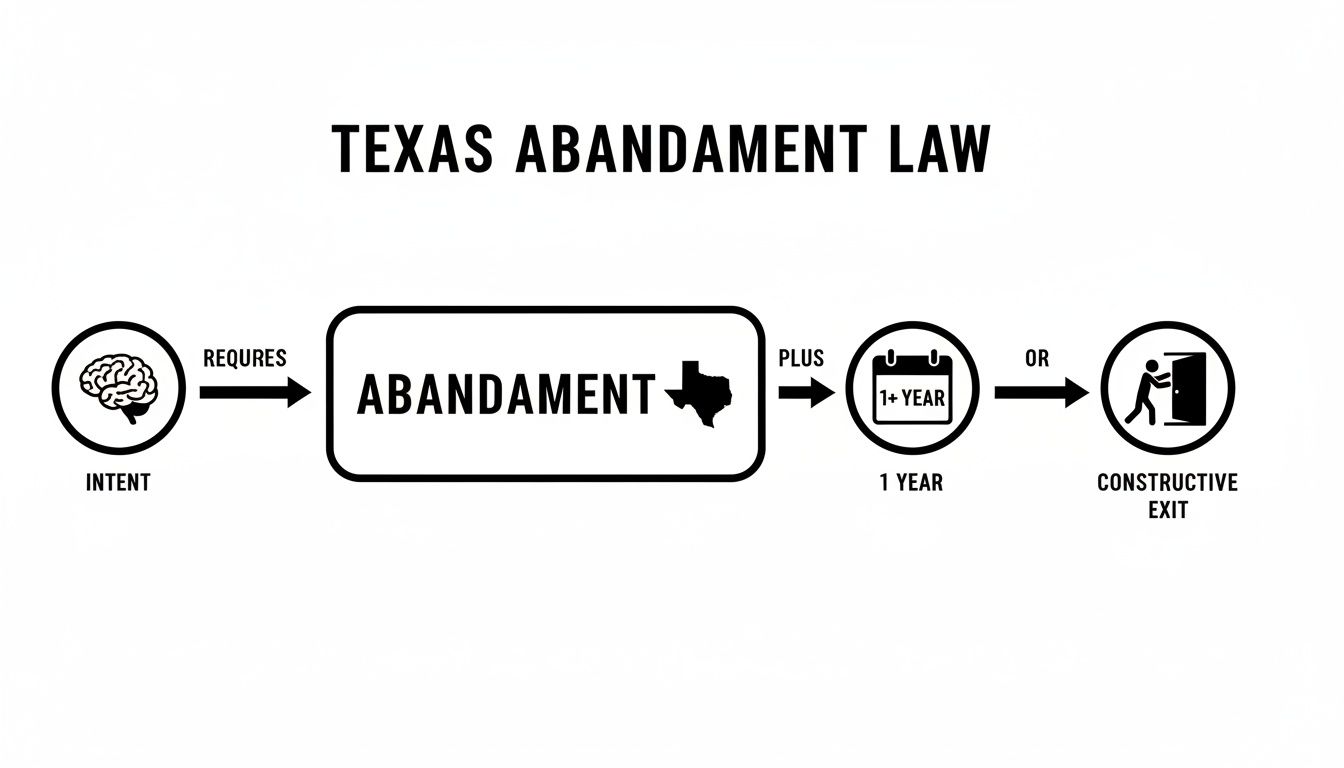
As the visual shows, your claim rests on proving your spouse's intent to leave, their continuous one-year absence, or the presence of behavior that forced you out (constructive abandonment).
What Is Constructive Abandonment?
Texas law also recognizes a vital and often misunderstood concept called constructive abandonment. This is a situation where your spouse's behavior becomes so intolerable that it forces you to be the one to physically leave the home.
In cases of constructive abandonment, the spouse who created the unbearable living situation is legally considered the one who abandoned the marriage, even if they never moved out.
Imagine a situation where your spouse’s cruelty, emotional abuse, or refusal to act as a partner makes staying under the same roof impossible. In these scenarios, the law doesn't penalize you for seeking safety and peace of mind. By leaving, you aren't abandoning your marriage; rather, you are reacting to your spouse’s abandonment of their marital duties. Successfully arguing this can be complex and requires strong evidence of their misconduct.
One of the biggest hurdles in these cases can be simply locating your spouse to serve them with divorce papers. If they have truly disappeared, it can lead to a more complicated process. You may want to read more about how a default divorce works in Texas when a spouse cannot be found or refuses to participate.
Abandonment as a fault-based ground for divorce in Texas carries specific legal requirements that distinguish it from other reasons couples separate. Under Texas law, abandonment occurs when one spouse voluntarily leaves the other with no intention of returning, and critically, they must remain away for at least one continuous year before the divorce can be filed on this ground. This one-year minimum requirement is a substantial threshold that sets abandonment apart from no-fault divorce options, which allow Texans to dissolve their marriage based on 'insupportability' without proving fault. To discover more insights about abandonment divorce in Texas on our blog, you can explore real-life examples and deeper explanations.
How Abandonment Can Affect Your Divorce Outcome
When you've been left behind to manage life, the bills, and the kids all on your own, it’s only natural to want the court to recognize the hardship you've faced. Proving an abandonment divorce Texas claim is about more than just principle; it can give you real, strategic leverage and change the final outcome of your case.
A judge's finding that your spouse was at fault for the marriage ending gives them the legal grounds to make decisions that favor you. This can be a turning point, giving you a stronger position to negotiate for your financial future and your family’s well-being.
The Impact on Property Division
In Texas, community property is divided in a way that is "just and right." This doesn't automatically mean a 50/50 split. When a judge finds that one spouse is at fault for the divorce because of abandonment, they have the authority to award the abandoned spouse a larger share of the community estate.
Think of your marital property as a pie. In a typical no-fault divorce, that pie is usually sliced right down the middle. But when abandonment is proven, the judge can decide you deserve a bigger slice to help make up for the harm and difficulty you endured.
This might mean you receive:
- A greater percentage of financial accounts, like savings or investment portfolios.
- A larger share of retirement assets, such as a 401(k) or pension.
- The right to keep the family home or another major asset.
This is the court's way of acknowledging the damage caused by your spouse's actions and working toward a truly fair result.

Custody and Child Support Implications
When kids are involved, a parent’s long and unexplained absence is a huge red flag for the court. The judge's number one priority is always the best interest of the child. A parent who disappears for a year or more has shown a profound disregard for their parental duties.
This can have a major impact on custody, or conservatorship, as it's called in Texas.
A judge may see the abandoning parent's behavior as proof they can’t provide a stable and loving environment. This could lead to the court restricting their parental rights and possession schedule, or even ordering supervised visitation to protect the child’s well-being.
On top of that, an abandonment claim can put you in a much stronger position for child support. If the parent who left also failed to provide financial support during their absence, the court will take that very seriously when calculating both back-owed and future child support payments.
Spousal Support or Alimony
Proving abandonment can also open the door to securing post-divorce spousal support, which you might know as spousal maintenance or alimony. Texas has very strict rules for who can receive spousal support, but a finding of fault is one of the key factors that can help you qualify.
If you can demonstrate that your spouse’s abandonment left you without the financial ability to meet your basic needs, a judge is more likely to order them to pay support for a period of time after the divorce is final. This can provide a critical financial cushion while you get back on your feet.
Proving abandonment can be a game-changer, potentially affecting every major part of your divorce. Understanding these impacts is the first step toward building a strong case.
Here’s a quick summary of how proving abandonment might influence the different parts of your divorce proceeding.
| Impact of Abandonment on Key Divorce Issues |
| :— | :— |
| Divorce Component | Potential Impact of Proving Abandonment |
| Property Division | The judge can award you a disproportionate share (more than 50%) of the community property. |
| Child Custody (Conservatorship) | Your ex-spouse’s rights could be restricted, and you may be named the sole managing conservator. |
| Child Support | The court can order retroactive child support and ensure future payments are enforced. |
| Spousal Support (Alimony) | A fault finding strengthens your eligibility claim for post-divorce spousal maintenance. |
As you can see, the benefits of pursuing an abandonment claim can be significant, offering a path to a more secure and stable future.
Family law cases are a massive part of the judicial system's workload. Divorce filings alone account for nearly 40% of all new family law cases in the state, with child support matters adding another 28%. These numbers show just how often these issues arise and why having skilled legal help is so important when things like property and custody are on the line. You can learn more from the Texas Judiciary's latest statistical report about these trends.
Gathering Evidence to Build Your Case
A claim of abandonment is only as strong as the evidence you bring to court. To succeed, you can't just tell the judge your spouse left; you have to prove it with clear, organized evidence. Your goal is to construct a detailed timeline that proves both their intention to leave for good and their continuous absence for at least one year.
This might feel like a daunting task, especially when you're already dealing with the emotional fallout. But think of it as methodically putting together the pieces of a puzzle. Each piece you find helps paint a clearer picture for the court, moving you from a place of uncertainty to one of control.

What Evidence Do You Need?
The best evidence creates a pattern of behavior that leaves no doubt about your spouse's decision to desert the marriage. Focus on collecting documents and testimony that confirm their intent and the one-year timeline.
Here are the key types of evidence to start gathering:
- Communication Records: Save every text, email, social media message, or voicemail where your spouse states they are leaving and not coming back. A message as direct as, "I'm done, don't expect me back," is a powerful piece of evidence showing intent.
- Financial Documents: Pull together bank statements, credit card bills, and other financial records. These can show a clear stop in financial support for the household, proving they've abandoned their marital duties.
- Social Media Activity: Screenshots of your spouse's public social media profiles can be incredibly revealing. Posts showing them living in a new city, starting a new relationship, or talking about their "new life" serve as strong circumstantial evidence.
- Proof of a New Residence: Any evidence that your spouse has established a new home is critical. This could be a copy of their new lease agreement, utility bills in their name at a different address, or mail being forwarded to a new location.
When your spouse's whereabouts are unknown, figuring out how to track a spouse's location can feel necessary. However, it's vital to ensure any methods you use are legal and admissible in court, which is why working with an attorney is so important.
The Power of Witness Testimony
Beyond documents and digital breadcrumbs, testimony from other people can be one of the most persuasive forms of evidence. A judge will want to hear from others who can confirm your story.
"A well-prepared witness can make all the difference. Their testimony provides a third-party perspective that validates your claims and adds a human element to the facts, making your case more relatable and credible to the court."
Talk to trusted friends, family members, or neighbors who have firsthand knowledge of what happened. These witnesses can testify about:
- The last date they saw your spouse at the marital home.
- Conversations they had with you or your spouse about the departure.
- Their direct observations of your spouse's absence from holidays and family events over the past year.
- Your efforts to manage the household and care for the children on your own.
Organizing Your Evidence for Court
Once you start collecting these items, keeping everything organized is essential. Create a dedicated folder—either a physical one or a digital one on your computer—for all abandonment-related evidence.
Step-by-Step Breakdown:
- Create a Timeline: Start a document that lists key dates, beginning with the day your spouse left. Add every significant event, communication, or piece of evidence you discover in chronological order.
- Sort by Category: Group your evidence into logical categories like "Financials," "Communications," and "Witness Information." This makes it much easier for you and your attorney to find what you need quickly.
- Preserve Digital Evidence: Don't just leave texts and emails on your phone. Take screenshots and back them up to a secure cloud service or an external hard drive. Digital data can be lost or deleted, so preservation is key.
Building a strong case for abandonment is a detailed process, but it is entirely manageable with a methodical approach. By working closely with your attorney at The Law Office of Bryan Fagan, you can ensure that every piece of evidence is collected legally and presented effectively to protect your rights and secure a just outcome.
Should You Consider a No-Fault Divorce Instead?
While proving abandonment can give you leverage in a Texas divorce, it’s not the only way forward—and it’s definitely not always the right one. The emotional and financial toll of a fault-based divorce can be steep. You have to ask yourself: is the potential reward truly worth the fight?
Thankfully, Texas law doesn’t require you to prove your spouse did something wrong to end your marriage. The most common and direct path is a no-fault divorce, which lets you dissolve the marriage without pointing fingers. This approach is almost always faster, less expensive, and emotionally easier on everyone involved, especially for parents and business owners who need a swift resolution.
Understanding No-Fault Divorce in Texas
The legal reason for a no-fault divorce in Texas is called insupportability. This is a term you'll find throughout the Texas Family Code, and it has a very specific legal meaning.
Texas Family Code § 6.001 defines insupportability as a situation where "the marriage has become insupportable because of discord or conflict of personalities that destroys the legitimate ends of the marital relationship and prevents any reasonable expectation of reconciliation."
In plain English, this just means the marriage has broken down so much that it simply can’t be fixed. You don’t have to prove who was at fault; you only need to state that the relationship is no longer working. It's the most common reason cited in Texas divorce petitions for a reason.
Weighing Your Options: Fault vs. No-Fault
Choosing between an abandonment claim and a no-fault divorce is a strategic decision. While pursuing an abandonment divorce Texas claim might help you secure a larger share of the marital estate, it comes with a high burden of proof and often leads to a drawn-out court process.
Practical advice for deciding your path:
- Consider a no-fault divorce if your evidence is weak: If you can't definitively prove your spouse intended to abandon you, or if they weren't gone for a full, continuous year, a fault claim will almost certainly fail.
- Consider a no-fault divorce if you want a faster resolution: A fault-based divorce can drag on for months, sometimes even years. A no-fault divorce, especially if you and your spouse can agree on the terms through mediation, can be finalized much more quickly, often within the Texas 60-day waiting period.
- Consider a no-fault divorce if you want to minimize conflict: Proving fault means airing your private life in a public courtroom. This can be incredibly draining for you and any children caught in the middle.
The Modern Approach to Divorce
Filing for a no-fault divorce is part of a larger trend in how couples are choosing to end their marriages. Texas has actually seen its divorce rate drop significantly over the last few decades, falling from 5.5 divorces per 1,000 people in 1990 to just 1.4 in recent years. This shift reflects a move toward less contentious ways to separate. You can discover more insights about Texas divorce statistics on Divorcerate.org.
Opting for a no-fault divorce doesn't mean you're letting your spouse "get away" with their actions. It simply means you're choosing a more efficient legal tool to reach your goal: ending the marriage so you can start your next chapter. To better understand this route, you might want to read our guide that explains more about how a no-fault divorce in Texas works.
Ultimately, the best path forward depends entirely on your unique circumstances. Our role at The Law Office of Bryan Fagan is to help you weigh these pros and cons, giving you the compassionate and expert advice you need to make the right choice for your future.
Your Next Steps on the Path Forward
When your spouse walks out, it's easy to feel lost and overwhelmed. But understanding your legal options is the first step toward taking back control and finding your footing again. While the legal side of an abandonment divorce in Texas can feel complicated, you can break it down into small, manageable actions.
What to Do Next
The path forward requires careful planning and a bit of strategy. Here are three immediate things you can do to prepare for what lies ahead.
-
Document Everything: Your most important task is to start a timeline. Write down the exact date your spouse left and keep a daily or weekly log of their absence. This simple record is the bedrock for proving the mandatory one-year period required by law.
-
Gather Your Evidence: Start collecting any proof that shows your spouse intended to leave permanently. This might include text messages, emails, or even social media posts that show them starting a new life elsewhere. Financial records demonstrating a lack of support are also incredibly powerful. Keep everything in a safe, secure place.
-
Evaluate Your Goals: Take some time to think about what you really want. Is pursuing a fault-based divorce for abandonment the best route for you, or would a straightforward no-fault divorce save you time, money, and emotional energy? Be honest with yourself about your budget and how much conflict you’re prepared to handle.
Key Takeaway: You don't have to walk this road alone. The law provides you with rights and options to protect your family and your finances. The right guidance can make all the difference in securing your future.
The choices you make in the coming weeks and months will have a lasting impact. We invite you to schedule a confidential, free consultation with the experienced attorneys at The Law Office of Bryan Fagan, PLLC. Let us help you create a clear strategy to move forward with confidence.
Frequently Asked Questions About Abandonment
When you're dealing with a spouse who has left, a flood of questions and uncertainties is completely normal. The path to an abandonment divorce in Texas can feel confusing. Below, we've answered some of the most common questions our clients ask us when they're navigating this difficult situation.
What If My Spouse Sends Money Occasionally?
It's a common misconception that a few sporadic payments from a spouse who has left will automatically ruin your abandonment claim. That’s not necessarily the case.
A judge will look at the big picture—the entire context of your separation. If your spouse has clearly cut off every other part of the marriage, like companionship, communication, and living together, a few random payments might not be enough to stop your claim. The court is more focused on their overall intent to desert the marriage, not just a handful of financial transactions.
Can I File for Divorce Before the One Year Mark?
Yes, you absolutely can. You don't have to wait an entire year before you can start the divorce process in Texas.
As long as you meet the state's residency requirements, you can file for a no-fault divorce based on insupportability at any time. However, if you want to use abandonment as a specific fault ground for your divorce, you do have to wait until your spouse has been gone continuously for at least one year.
Is Military Deployment Considered Abandonment?
No, a military deployment is never considered abandonment under Texas law. Proving abandonment requires showing that your spouse left voluntarily and without a good reason.
A service member who is deployed is simply following legal orders and doing their duty. Their absence isn't a voluntary choice in the legal sense needed to prove desertion for an abandonment divorce Texas case.
Key Takeaway: The legal system makes a clear distinction between someone who chooses to leave the marriage and someone who is required to be absent due to military service.
What If I Cannot Find My Spouse to Serve Papers?
This is a very common and understandable worry in abandonment cases. If you've done your best to find your spouse but can't locate them, the court has procedures to make sure your case doesn't get stuck.
Your attorney can ask the judge for permission to use an alternative method of service. This could include:
- Substituted Service: Leaving the divorce papers with a relative or another person who is likely to get them to your spouse.
- Service by Posting: Placing a public notice of the divorce filing at the courthouse.
These methods allow your divorce to move forward, even when your spouse is completely unreachable.
Navigating the complexities of an abandonment claim requires strategy and experience. The team at The Law Office of Bryan Fagan, PLLC is here to provide the compassionate, authoritative guidance you need. Don't face this alone—schedule a free, confidential consultation to understand your rights and build a plan to protect your future. Visit us at https://texasdivorcelawyer.us to get started.