Skip to content
Facing divorce can feel like navigating a storm without a compass, leaving you uncertain about where to turn next.
Understanding the rules that govern this journey is the first step toward finding solid ground. Texas divorce laws, while detailed, are designed to create a clear and fair path forward. The process begins with straightforward residency rules and typically proceeds on "no-fault" grounds, meaning you and your spouse don't have to prove who was to blame to end the marriage. This guide will walk you through each step, offering the clarity and confidence you need to protect your family and your future.
Your First Steps: Filing for Divorce in Texas

Taking that first step toward divorce is often the most difficult. It's an emotional and overwhelming decision, but you can regain a sense of control by understanding the legal framework. Texas law is very clear about the requirements you must meet before a court will grant your divorce.
Think of these requirements as the keys to the courthouse door—without them, your case simply cannot move forward.
Meeting the Residency Requirements
Before you can file an Original Petition for Divorce, you must show that Texas has the legal authority, or "jurisdiction," over your marriage. The Texas Family Code sets two simple but strict rules for this:
- State Residency: At the time you file, either you or your spouse must have lived in Texas for the last six months.
- County Residency: Additionally, one of you must have lived in the specific county where you plan to file for at least the last 90 days.
These rules are mandatory. For example, if you've lived in Harris County for five years but your spouse recently moved to another state, you can still file for divorce in Harris County because you meet both criteria.
Key Requirements for Filing for Divorce in Texas
This table summarizes the essential legal requirements you must meet before filing for divorce in Texas.
| Requirement | Explanation in Plain English | Texas Family Code Reference |
|---|---|---|
| State Residency | One spouse must have called Texas home for the six months immediately before filing. | Sec. 6.301(1) |
| County Residency | One spouse must have lived in the county of filing for the 90 days immediately before filing. | Sec. 6.301(2) |
| Waiting Period | A divorce cannot be finalized until at least 60 days have passed since the petition was filed. | Sec. 6.702 |
Meeting these isn't just a suggestion; it's the law. The court will verify this information at the beginning of your case.
Choosing the Grounds for Divorce
Once you've cleared the residency hurdle, you'll state the legal reason, or "grounds," for the divorce. Fortunately, Texas law provides a straightforward path that avoids unnecessary conflict for most couples.
The most common ground for divorce is insupportability. This is simply the Texas term for a "no-fault" divorce.
According to Texas Family Code Sec. 6.001, insupportability means the marriage has become unsupportable due to "discord or conflict of personalities that destroys the legitimate ends of the marital relationship and prevents any reasonable expectation of reconciliation."
In plain English, this means you and your spouse no longer get along, and there is no realistic hope of fixing the marriage. You do not need to prove anyone did anything wrong, which helps keep the process simpler and less contentious.
While less common, Texas does recognize fault-based grounds like cruelty, adultery, or abandonment. These are typically raised only in specific situations where one spouse's conduct might influence how the judge divides your property.
Filing the petition officially starts the process. To get a head start, it’s wise to learn about the essential documents for filing for divorce in Texas to ensure you are fully prepared.
Understanding Community Property in a Texas Divorce

Dividing the life you've built together can feel like the most overwhelming part of a divorce. Texas is a community property state, a legal concept that shapes every financial aspect of your separation. Understanding this rule is fundamental to protecting your financial future.
The core idea is simple: most assets and debts you or your spouse acquired from your wedding day until the day you divorce belong to the marriage itself—the "community estate." Think of your marriage as a shared financial partnership where you both have a claim to what was built during that time.
Defining Community vs. Separate Property
The first step in any property division is sorting everything you own into two categories: community property and separate property. Texas law starts with a powerful assumption: all property owned by either spouse at the time of divorce is presumed to be community property.
The burden of proof is on the person claiming an asset as their own separate property.
So, what qualifies as separate property? The Texas Family Code is very specific. Separate property generally includes:
- Assets you owned before the marriage: This could be a car, a bank account, or real estate titled in your name before the wedding.
- Gifts received during the marriage: If a family member gave you a specific cash gift, that money is yours alone.
- Inheritances received during the marriage: Any property or money you inherited is considered your separate property.
- Personal injury settlements: The portion of a settlement meant to compensate you for pain and suffering (not lost wages) is typically separate.
Anything outside these narrow categories is almost certainly community property. This includes income earned by both of you, the family home purchased during the marriage, retirement accounts funded with marital earnings, and even a business started after you were married.
Getting this right is critical. You can learn more about the specifics of community property vs. separate property in our detailed guide.
The "Just and Right" Division Standard
Here’s a common misconception: people often assume community property means everything gets split exactly 50/50. While a 50/50 division is the starting point, the Texas Family Code gives judges the authority to divide the marital estate in a way that is "just and right."
This "just and right" standard means a judge can award a disproportionate share (for example, 60/40) to one spouse based on several factors. The court will consider the earning capacity of each person, any fault in the breakup (like adultery or cruelty), and the needs of the children.
This flexibility is designed to achieve a fair outcome, not just a mathematically equal one. For instance, a stay-at-home parent who has been out of the workforce for years might be awarded a larger share of the assets to help them transition to financial independence.
Navigating Complex Assets
For many families, especially business owners or those with high-value estates, the financial picture is more complicated.
- Business Valuations: If you or your spouse own a business, determining its value and the portion that is community property is a complex process that often requires financial experts.
- Retirement Accounts: Dividing 401(k)s, pensions, and military retirement benefits requires special court orders called Qualified Domestic Relations Orders (QDROs) to be executed correctly and without tax penalties.
- The Family Home: Deciding the future of the house is often highly emotional. Options range from one spouse buying out the other's share to selling the home and splitting the proceeds.
In these complex situations, applying community property rules demands precision. Having an experienced attorney is essential to protect your financial interests.
Protecting Your Children: Custody and Support in Texas
When your marriage ends, your first thought is almost always, "What about the kids?" In a Texas divorce, your children’s well-being is the court's highest priority. Every decision a judge makes is guided by a single principle: the best interest of the child.
In Texas, we use the legal term conservatorship instead of "custody." This framework outlines the rights and responsibilities each parent holds. The law presumes that it's best for children if their parents are named Joint Managing Conservators. This means you will share in the duty of raising your children, though it doesn't always mean a 50/50 split of time.
Understanding Conservatorship and Possession Schedules
Being Joint Managing Conservators is about sharing parental rights and duties. Usually, one parent is named the "primary" conservator, which gives them the right to determine the children's residence (typically within a certain geographic area).
The other parent has a possession schedule, which is the legal term for a visitation plan. This is the calendar that details when the children will be with each of you.
The default arrangement in Texas is the Standard Possession Order (SPO). This is a detailed schedule that outlines a clear plan for weekends, holidays, and summer breaks. It is designed to provide consistency and stability, which courts believe is in a child's best interest.
While the SPO is common, it's not mandatory. You and your co-parent can create a custom schedule that fits your family's unique needs. As long as you both agree and it serves the children, a judge will almost always approve it. Understanding the factors that define the best interest of the child in Texas will help you build a stronger case for the arrangement that works best for your kids.
How Child Support Is Calculated in Texas
In addition to a time-sharing plan, the court will establish how your children will be supported financially. Child support in Texas is calculated using a specific formula based on the net monthly income of the paying parent (the "obligor").
The calculation follows percentage-based guidelines from the Texas Family Code:
- One Child: 20% of net resources
- Two Children: 25% of net resources
- Three Children: 30% of net resources
- Four Children: 35% of net resources
- Five or more Children: 40% of net resources
These percentages apply to the obligor's net income up to a statutory cap, which is adjusted for inflation. These gender-neutral guidelines are applied fairly to ensure children are financially secure, no matter which parent is the higher earner.
Creating a Cooperative Parenting Plan
While court orders provide the legal foundation, a successful co-parenting relationship is built on a solid parenting plan. This is a detailed rulebook you and your co-parent create together. It goes deeper than the possession schedule and covers important day-to-day decisions.
A strong parenting plan should address:
- Decision-Making: How will you jointly handle choices about your child’s education, non-emergency medical care, or extracurricular activities?
- Communication: What are the ground rules for how you and your co-parent will communicate respectfully?
- Dispute Resolution: If you disagree in the future, how will you resolve it without returning to court?
Creating this plan helps build a stable future for your children. It minimizes future conflict and reassures them that while your marriage is ending, your commitment to them as parents remains stronger than ever.
The Texas Divorce Process From Start to Finish
Knowing what to expect can make the divorce process feel less like a daunting legal maze and more like a series of manageable steps. Understanding the typical timeline in Texas will help you navigate this path with more confidence and less anxiety.
The process begins when one spouse, the Petitioner, files an Original Petition for Divorce. This document officially starts the legal case and outlines what the petitioner is asking the court to do regarding property and children.
Kicking Off The Legal Process
Once the petition is filed, your spouse—the Respondent—must be officially notified. This critical legal step is called service of process. It ensures the Respondent knows about the lawsuit and has a fair opportunity to participate.
After being served, the Respondent has a limited time to file an Answer with the court. Filing an Answer is essential; it prevents the Petitioner from obtaining a default judgment and ensures the Respondent's side of the story will be heard.
The Discovery and Negotiation Phase
With both of you officially part of the case, the next phase is discovery. This is the formal process of exchanging all necessary information. Think of it as putting all your financial cards on the table. You will share documents like bank statements, pay stubs, tax returns, and retirement account information. The goal is full transparency, which is the only way to negotiate a fair property division.
The vast majority of Texas divorces—over 90%—settle out of court. The most common path to settlement is mediation.
Mediation is a confidential meeting where you, your spouse, and your attorneys work with a neutral third-party mediator. The mediator’s job is not to take sides but to guide the conversation and help you find common ground on all issues, from property division to your parenting plan. Most Texas courts require you to try mediation before they will set a final trial date.
The 60-Day Waiting Period and Finalizing The Divorce
A key piece of Texas law is the mandatory 60-day waiting period. The clock starts the day the Original Petition for Divorce is filed. Even if you and your spouse agree on everything on day one, a judge cannot legally sign your final decree until at least 61 days have passed. This "cooling-off" period is part of the Texas Family Code to ensure decisions are not made in haste.
Once you reach a settlement, your attorney will draft the Final Decree of Divorce. This comprehensive legal document contains every term of your agreement. The journey through the divorce process often culminates in signing legal documents securely, and this final decree is the most important one.
Finally, you will have a brief, uncontested court appearance where the judge reviews the decree, asks a few questions, and signs it. At that moment, your divorce is official.
When children are involved, the process focuses on three key areas: who makes decisions (conservatorship), when each parent has the children (schedules), and how they will be financially supported (support).
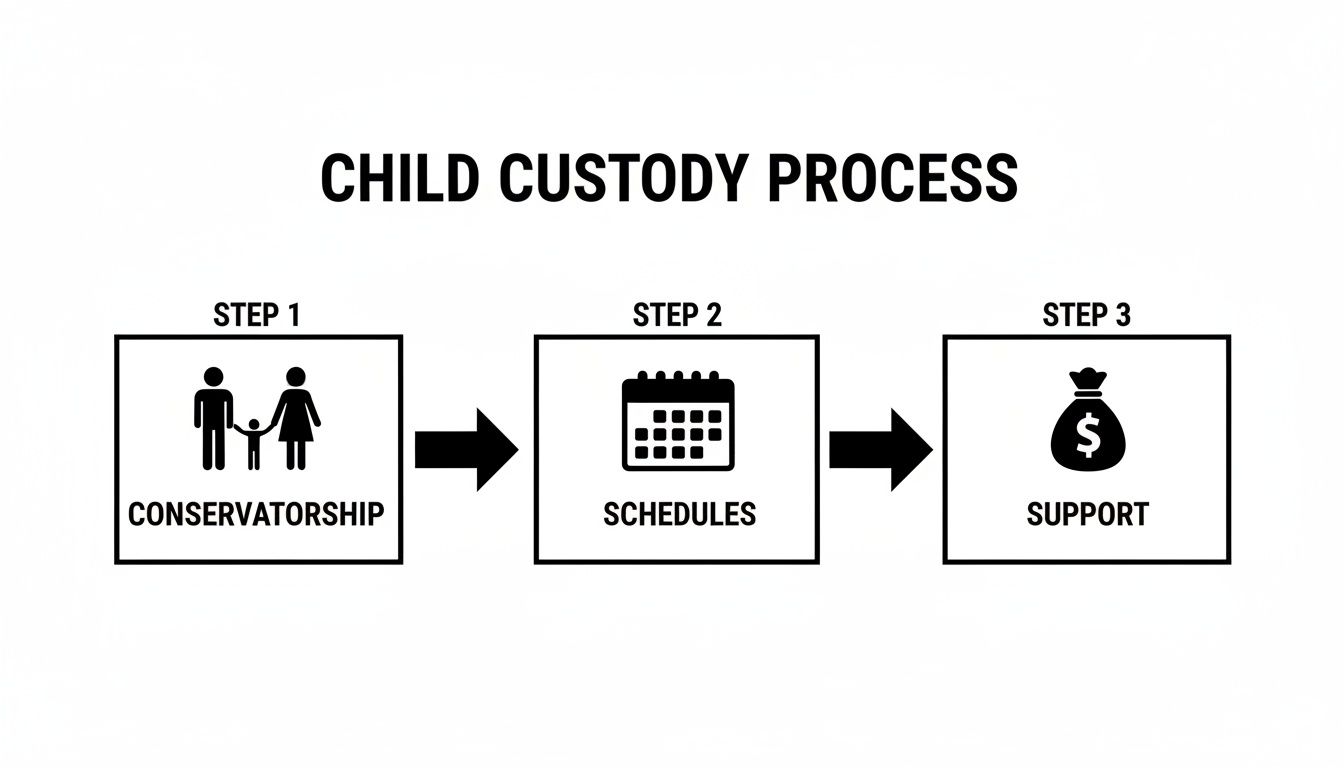
This simple flow shows how Texas law methodically addresses the core pieces of your children's future, ensuring their well-being remains the top priority.
Timeline of a Typical Texas Divorce
This table outlines the major stages and estimated timelines in the Texas divorce process.
| Stage | What Happens During This Stage | Typical Timeframe |
|---|---|---|
| Filing and Service | One spouse (Petitioner) files the Original Petition for Divorce. The other spouse (Respondent) is formally served and files an Answer. | 1-4 weeks |
| Temporary Orders Hearing (If Needed) | A court hearing to establish temporary rules for finances, property, and child arrangements while the divorce is pending. | 2-6 weeks after filing |
| Discovery | Both sides exchange financial and other relevant documents (bank statements, property deeds, etc.) to ensure full transparency. | 1-6 months |
| Mediation | A neutral mediator helps the couple negotiate a settlement on all issues (property, child custody, support). | 1-2 months after discovery |
| Finalization | If an agreement is reached, the Final Decree of Divorce is drafted and signed. A short "prove-up" hearing is held after the 60-day waiting period. | 61 days to 1 year+ from filing |
| Trial (If Uncontested) | If no agreement is reached, the case proceeds to trial where a judge will make the final decisions. | 6 months to 2 years+ from filing |
While every case is unique, this provides a solid framework for the road ahead.
Spousal Maintenance and Mediation in Texas
As your marriage ends, two big questions often arise: how will I manage financially, and can we settle this without a costly court battle? Texas law provides answers through two key tools: spousal maintenance for post-divorce financial support and mediation for resolving disputes collaboratively.
Understanding these concepts is the first step toward planning your financial future and taking control of the divorce process.
How Spousal Maintenance Works in Texas
While many people call it "alimony," the official term in Texas is spousal maintenance. It's important to know that this support is not awarded in every divorce. In fact, Texas has some of the most restrictive eligibility rules in the country.
A judge will only order maintenance if the spouse requesting it can prove they have made a diligent effort to earn a living but still cannot meet their "minimum reasonable needs."
To be eligible for court-ordered maintenance, you generally must meet one of these criteria:
- The marriage lasted for 10 years or longer, and the requesting spouse lacks the ability to earn sufficient income.
- The other spouse was convicted of an act of family violence.
- The requesting spouse has an incapacitating physical or mental disability.
Even if you meet these high standards, the law places strict limits on the amount and duration of payments. For instance, after a marriage of 10 to 20 years, the maximum duration for maintenance is typically five years.
The Power of Mediation in a Texas Divorce
Forget the dramatic courtroom showdowns you see on TV. The reality is that the vast majority of Texas divorces are settled amicably, primarily through mediation. This process, known as Alternative Dispute Resolution (ADR), is so effective that most Texas counties require couples to try it before they can get a final trial date.
Mediation is a guided negotiation where you, your spouse, and your lawyers sit down with a neutral mediator. The mediator’s job is not to pick sides but to facilitate productive conversations and help you find creative, workable solutions.
The entire process is confidential. This allows you to freely explore different settlement options without worrying that your words will be used against you in court. It puts the power back in your hands to craft custom agreements that make sense for your family, rather than leaving life-altering decisions up to a judge.
By resolving your case through mediation, you can save a tremendous amount of time, money, and emotional stress. More importantly, you remain in control of the outcome and can begin your next chapter with a solid, legally binding agreement you helped create.
Key Takeaway: Your Next Steps
Feeling overwhelmed by divorce is normal, but this is also your opportunity to take back control. Understanding the law is the first step, but now it's about turning that knowledge into action to build a secure future for you and your family. You have the strength to get through this, but you don't have to do it alone.
The single most important thing you can do right now is get personalized legal advice from a compassionate attorney who can help you build a strategy tailored to your specific situation.
Your Action Plan for Moving Forward
To prepare for the road ahead, focus on these practical first steps:
- Gather Financial Documents: Start collecting recent tax returns, bank statements, pay stubs, property deeds, and retirement account statements. Full financial transparency is essential for a fair outcome.
- Create a Post-Divorce Budget: Sketch out a realistic picture of your income and expenses after the divorce. This will help you understand your financial needs.
- Outline a Parenting Plan: If you have children, think about what a stable co-parenting schedule would look like from their perspective. Consider holidays, school, and daily routines.
Taking these steps empowers you. When you organize your information and define your priorities, you begin to turn uncertainty into a clear, actionable plan.
What to Do Next
You've learned the fundamentals of Texas divorce law, from property division to child conservatorship. Now is the time to apply that knowledge.
Your next chapter deserves to be built on a foundation of confidence and security. We invite you to schedule a free, no-obligation consultation with the compassionate attorneys at The Law Office of Bryan Fagan, PLLC. We are here to listen, answer your questions, and help you craft a strategy that protects what matters most to you.
Answering Your Questions About Divorce in Texas
Navigating a divorce brings up many questions, and it's completely normal to feel uncertain. Here are straightforward answers to some of the most common questions we hear from our clients.
How Much Does a Divorce Cost in Texas?
The most honest answer is: it depends. The cost of your divorce is almost always tied to the level of conflict between you and your spouse.
An uncontested divorce, where you both agree on all major issues, is the most affordable path. In these cases, your costs are primarily court filing fees and attorney's fees for drafting and finalizing paperwork.
A contested divorce becomes more expensive with each disagreement. Costs can include formal discovery, hiring financial experts, mediation, and preparing for a potential trial. We believe in transparency and will discuss potential costs with you during your free consultation.
Can I Get Divorced in Texas if My Spouse Lives Somewhere Else?
Yes. As long as you meet the state's residency requirements, you can file for divorce in Texas. You must have lived in Texas for the last six months and in the county where you are filing for the last 90 days.
While a Texas court can grant the divorce itself, making orders about property or children involving an out-of-state spouse requires the court to have "personal jurisdiction" over them. This involves specific legal steps, and having an experienced attorney is crucial to ensure any orders are enforceable.
What is the Difference Between a TRO and a Protective Order?
These two court orders sound similar but serve very different purposes.
A Temporary Restraining Order (TRO) is a standard tool in many divorce cases designed to maintain the status quo. Think of it as a "pause button." It is a civil order that prevents either spouse from taking actions that could cause harm, such as:
- Selling marital property
- Draining bank accounts
- Removing a spouse from health insurance
- Removing children from their school
A Protective Order, however, is a much more serious legal action used in situations involving family violence. Its sole purpose is to protect a person from threats, harassment, or abuse. A Protective Order legally requires an abusive person to stay away from the victim, their home, their job, and their children's school.
Do I Have to Go to Court for My Divorce?
It's highly unlikely you will ever have to go through a contested trial. The vast majority of Texas divorces are settled out of court through negotiations or, most commonly, mediation.
Once you and your spouse reach an agreement, your attorney will draft a Final Decree of Divorce. After the mandatory 60-day waiting period is over, you will have a brief, informal court appearance called a "prove-up." This is not a trial but a simple administrative step where the judge reviews your agreement, asks a few questions, and signs the decree to make your divorce final.
Trying to navigate Texas divorce laws on your own can feel overwhelming, but you don’t have to do it alone. The compassionate and experienced attorneys at The Law Office of Bryan Fagan, PLLC are here to provide the clarity and support you need. We invite you to schedule a free, no-obligation consultation to discuss your situation, understand your rights, and start building a strategy that protects your family and your future.