Skip to content
You sign the divorce papers, and suddenly the bills don't stop, the mortgage still comes due, and your spouse may be asking who pays what while the case is still pending. That first week is where a lot of Texans feel the most pressure, because the legal fight and the household cash flow problems hit at the same time.
In Texas, temporary orders are the court's way of putting rules around that chaos. They can decide who pays support, who covers debts, and who has money for legal representation while the divorce is still open, which is why the phrase temporary orders Texas divorce what spouse must pay matters so much to both sides. For many families, these orders are less about final outcomes and more about keeping the lights on until the judge signs the decree.
Navigating Financial Uncertainty During a Pending Divorce
A spouse moves out, a paycheck gets rerouted, or the credit card bill lands with no clear plan for payment. That's when divorce stops feeling abstract and becomes a real financial emergency. The question is no longer who was right in the marriage, it's who is covering the mortgage, the car note, and the grocery run this month.
That's where temporary orders come in. Texas courts can enter these orders before the final divorce decree, and the Texas State Law Library notes that they can require temporary spousal support, temporary payment of debts, and interim attorney's fees while the case is pending, which shifts real responsibility immediately after filing, not months later. Texas Law Help's overview of temporary orders and restraining orders captures the basic function well, these orders are designed to protect cash flow and preserve the community estate while the case moves forward.
A practical way to think about it is this, temporary orders are the court's pause button on financial chaos. They don't decide the whole divorce, but they do decide who carries which burden right now. That matters most when one spouse controls most of the income or when the household was running on a single checking account before filing.
Practical rule: if the bills cannot wait for a final decree, temporary orders are usually the first place to look for relief.
For parents, the pressure often includes childcare, school expenses, and basic household costs. For business owners, it can mean separating personal and business cash flow fast enough to keep the company running without draining the marital estate. For higher-asset couples, temporary orders can help prevent one side from making sudden financial moves that create unnecessary damage before property division is resolved.
What Payments a Texas Judge Can Order

Texas judges have a broad toolbox during a pending divorce. The main question is which payments keep the household stable without leaving either spouse unable to cover day-to-day life. In practice, temporary orders can deal with support, debt payment, and legal fees in one package, because the financial pressure usually hits all three at once.
The law allows a judge to order one spouse to pay temporary spousal support, temporary payment of debts, and interim attorney's fees while the case is pending. Those orders can be entered before the final decree is signed, and Temporary Orders During a Texas Divorce explains how those court orders shape the case while it is still open. If the issue is support alone, that topic usually needs its own analysis, because the cash-flow fight is different from the rest of the temporary relief request.
The three most common payment categories
- Temporary child support: Courts can set temporary support to keep children's day-to-day needs covered while the case is pending. In real life, that usually means housing, food, school-related costs, and other regular expenses that cannot be put on hold.
- Temporary spousal support: Texas treats this as a discretionary order. The judge looks at need and ability to pay, then sets an amount that fits the facts instead of using a fixed formula.
- Attorney's fees and suit money: A court can order one spouse to help pay the other side's legal costs so the process does not become one-sided just because one spouse controls the money.
A temporary orders hearing is often about access to resources as much as it is about legal labels. If one spouse cannot keep up with ordinary expenses or hire counsel, the case can become lopsided fast.
Debts matter too. A judge can assign temporary responsibility for things like mortgage payments, car notes, and other joint obligations while the divorce is pending. That can protect credit and reduce the chance that missed payments spill into the final property case.
The court's temporary orders also set the financial structure for the case while it is pending. The judge is not just deciding who pays, the judge is deciding which bills stay current long enough to get the case to the finish line.
Proving Financial Need and Ability to Pay

Texas temporary spousal support turns on proof. The spouse asking for support has to show financial need, and the other spouse has to have ability to pay. In practice, the hearing becomes a cash-flow review of the household, because the judge is trying to see whether the requesting spouse can cover reasonable expenses and whether the paying spouse can contribute without being pushed into default. As the temporary support guidance from Scroggins Law Group explains, the court looks at both sides of the ledger, not just one spouse's hardship.
What convinces a judge
The strongest cases are built on documents, not emotion. A judge wants to see how much money is coming in, how much is going out, and whether the requested support is needed to cover reasonable expenses.
Bring the paperwork that tells the story before you try to tell it yourself.
That usually means:
- Pay records: recent pay stubs, and if you're self-employed, business income records that show actual cash flow.
- Bank statements: enough to show recurring deposits, withdrawals, and whether savings are already being used to stay afloat.
- A monthly budget: housing, utilities, food, transportation, insurance, medical needs, and other ordinary expenses.
- Debt schedules: credit cards, loans, mortgage obligations, and car notes, especially where both spouses have been relying on shared funds.
- Supporting testimony: why the requesting spouse cannot meet reasonable needs right now, and why the paying spouse can still contribute after essential expenses.
The details matter. If you overstate your budget, the judge may distrust the whole request. If you understate your real expenses, you may leave money on the table and still struggle to make it through the case. The better approach is a clean, organized picture of monthly shortfall, available resources, and the bills that have to stay current while the divorce is pending.
For parents, the proof of need often has to account for child-related costs that keep coming even after one parent moves out. For business owners, the court may look closely at whether the income is personal income or just business revenue passing through the company. For high-value estates, ability to pay can include more than salary, because community resources and liquid funds may matter when the court decides what is fair.
The Bridge Financing Reality of Temporary Orders
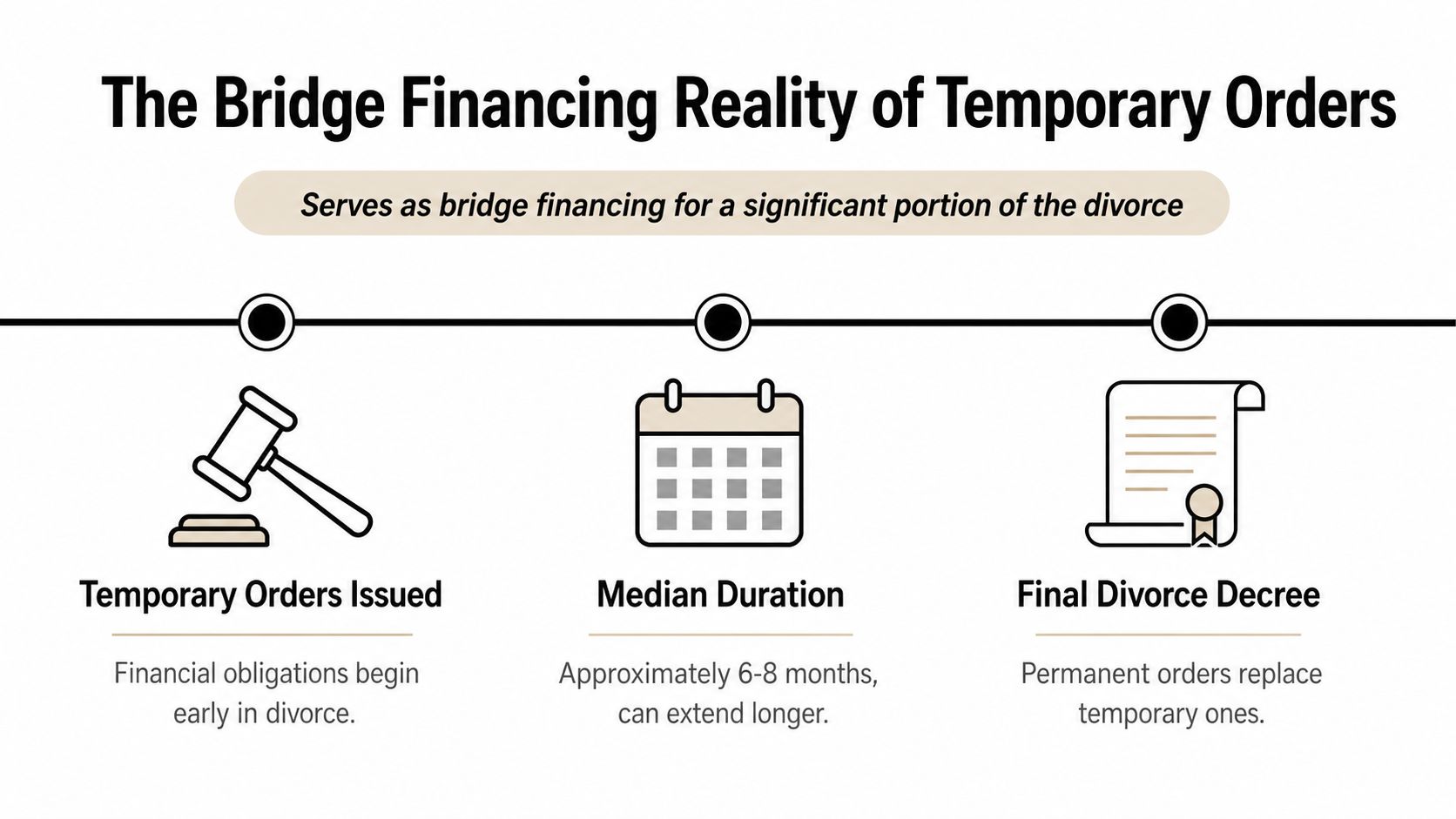
The biggest mistake people make is treating temporary orders like a short administrative phase. In Texas, they often function as bridge financing, because the case cannot end until the 60-day waiting period passes, and contested divorces commonly last longer, sometimes months longer. According to this Texas divorce guide on temporary alimony, temporary orders must operate for at least 60 days in every case.
That timing mismatch changes the whole financial picture. If you're the spouse paying support or debts, you need to budget for an obligation that may continue well beyond the first hearing. If you're the spouse receiving support, you need to treat temporary orders as a bridge, not a permanent solution, because they end when the final decree is signed unless a separate post-divorce maintenance award is made.
A contested divorce can stretch into a longer litigation cycle, and that's where temporary orders do the most work. They keep one spouse from collapsing financially while the court sorts out property, custody, and final support questions. They also give the judge a live snapshot of how the family is operating under pressure, which can affect later negotiation.
Temporary orders are enforceable once entered. That means they are not theoretical, and they are not suggestions. They are active court obligations that shape real spending decisions, month after month, until the final decree replaces them.
The useful mindset is simple, treat temporary orders like a short-term operating budget for the divorce. If you ignore that reality, you can end up with missed payments, credit damage, or a support order that catches you off guard when cash gets tight.
How to Request or Modify Temporary Relief
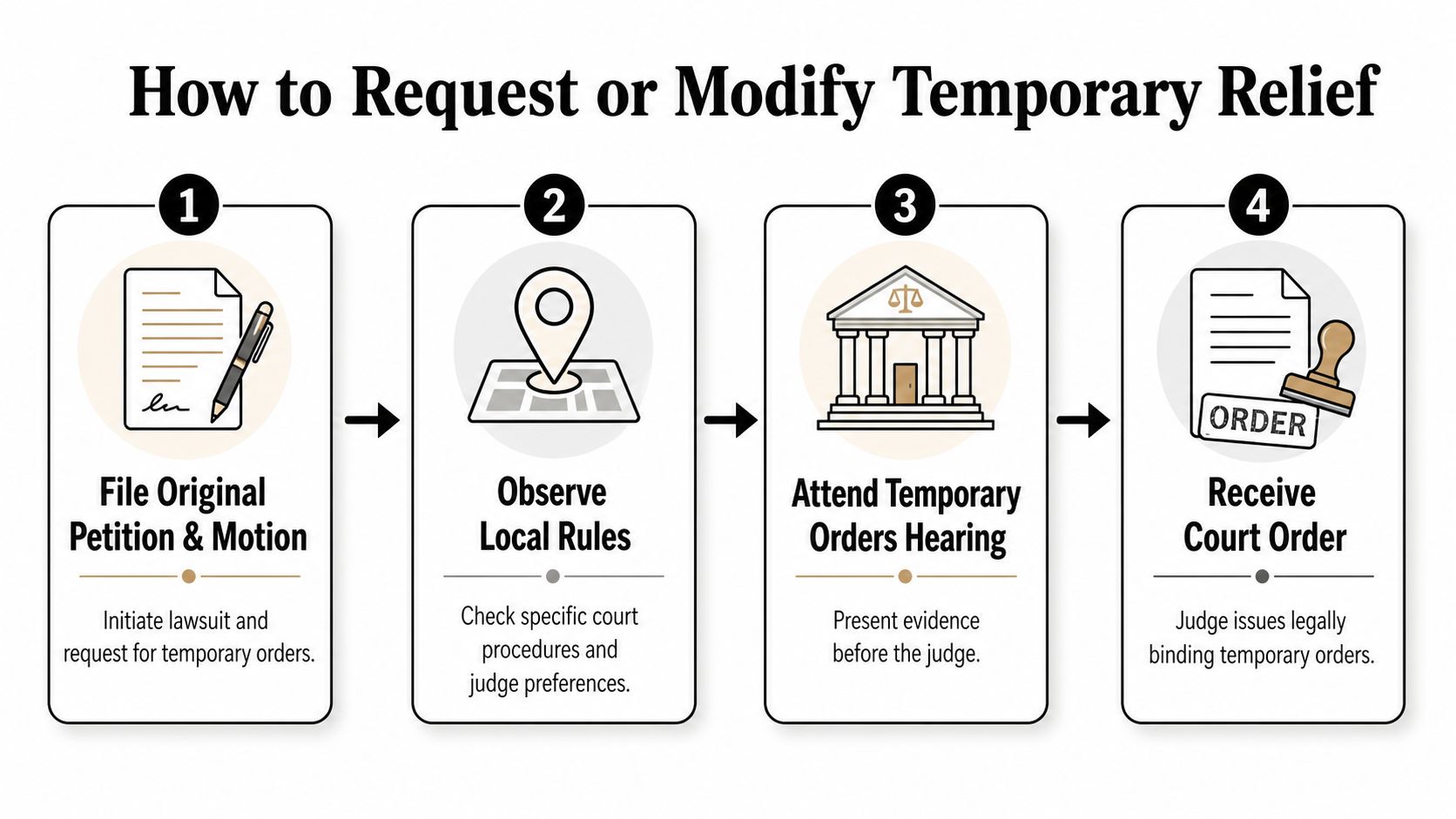
Temporary relief usually starts with a filed request and ends with a signed hearing order. In a Texas divorce, the moving spouse asks the court for relief, the court sets a hearing, the other spouse is served with the motion and hearing order, and both sides gather evidence before the judge decides what should happen. That sequence is laid out in this Texas practice guide on enforcing temporary orders.
The practical steps
- File the request. The motion asks the court for temporary relief tied to the pending divorce.
- Check local procedure. Some courts require mediation before a hearing, and some judges have their own preferences about how temporary issues should be presented.
- Prepare your evidence. Bring financial records, a proposed budget, and anything that supports your request or defense.
- Attend the hearing. The judge hears both sides and signs the order that becomes enforceable immediately. If you need a closer look at the courtroom process, the temporary orders hearing process in a Texas divorce explains what usually happens once the matter is set for hearing.
Local rules matter more than many people expect. Some judges require mediation first, and if the spouses cannot resolve the issues there, the judge decides the dispute in a hearing, as explained by McNamara Lawyers' temporary orders overview. Mediation can give both sides a chance to settle bill payment, support, and other temporary issues without a public fight.
If circumstances change after the order is entered, modification may be necessary. A job loss, a serious medical expense, or a sudden change in child-related costs can make the original order unrealistic. The point is to act quickly and document the change, not to stop paying and hope the problem goes away.
The Original Petition for Divorce in Texas starts the process, but temporary relief often turns on how well the request is framed and how quickly the supporting evidence is assembled. Law Office of Bryan Fagan, PLLC also handles mediation, custody, support, and enforcement issues that often overlap with temporary orders, so the same case strategy can cover several moving parts at once.
Enforcement Risks and Strategic Next Steps
A missed temporary order payment can turn into a contempt problem quickly. Once the judge signs the order, it is a court command, and a spouse who ignores it can face immediate pressure in a case that is already draining time and money. That is why these orders deserve the same care you would give to any other enforceable ruling.
Bottom line: if the order says pay, document, or transfer something, assume the court expects full compliance unless and until the order is changed.
The risk runs in both directions. If you are the spouse supposed to receive support or debt payments, keep a clear record of what the order required and what came in. If you are the spouse making payments, keep proof of every transfer, especially when the obligation involves a mortgage, vehicle loan, or another monthly bill that can affect credit if it is missed.
The best next move is usually documentation paired with a legal plan. Keep the court order, payment confirmations, bank statements, and messages that show a change in income, expenses, or child-related costs. If the financial picture has shifted, ask for a modification instead of letting one missed payment become a contempt issue.
Court procedure can shape how fast enforcement problems move. Some judges want mediation before a hearing, and if the spouses cannot settle the dispute there, the judge decides the issue in court. If you need to understand the consequences of a violation, the guide on what happens if you violate temporary orders in Texas explains the enforcement risk in plain terms.
Act early. Temporary orders are meant to stabilize the case, but they only protect you when both sides treat them as enforceable court orders and not suggestions. If you are dealing with a support request, a missed payment, or a temporary orders hearing, talk with a Texas family law attorney before the problem grows into contempt, credit damage, or a larger property fight.
If you're facing temporary orders in a Texas divorce, the Law Office of Bryan Fagan, PLLC can help you sort out support, debt payment, mediation, and enforcement issues with a plan built around your cash flow and your goals. Visit Law Office of Bryan Fagan, PLLC to schedule a free consultation and get clear guidance before the next hearing changes your financial position.