Skip to content
You're looking at a business, real estate, and years of financial records, while every discovery dispute seems to create another delay. In a complex Texas divorce, the difficult question isn't only how the estate should be divided. It's whether the case is unusual enough for a judge to appoint a special master at all.
When a Texas Divorce Becomes Too Complex for One Judge
Suppose you own an interest in a closely held company, several real estate properties, and investment accounts. Your spouse claims that assets you brought into the marriage became community property through commingling. You believe the records support separate-property treatment, but tracing the money requires bank statements, entity ledgers, tax filings, loan documents, and transaction histories covering years.
At the same time, discovery requests keep expanding. One side wants additional business records. The other objects that the requests are irrelevant or too burdensome. Experts disagree about valuation methods, and temporary disputes keep returning to a court already managing a crowded docket.
That's where a special master in a complex Texas divorce may become worth considering. A special master is a court-appointed neutral who handles limited duties assigned by the judge. The goal isn't to replace the judge or turn your divorce over to a private decision-maker. The goal is to give the court focused help with unusually dense evidence, recurring disputes, or technical case-management problems.
Practical rule: A large marital estate alone usually isn't enough. Your request must connect the complexity to a specific problem ordinary court procedures aren't handling efficiently.
A case involving a substantial estate and straightforward accounts may remain manageable through standard discovery, expert testimony, hearings, and mediation. By contrast, a closely held business with commingled funds, interstate assets, repeated discovery fights, and extensive tracing may present a stronger argument for additional procedural assistance.
Texas no-fault divorce law also helps explain why financial and parenting issues often become the center of the case. Under Texas Family Code Section 6.001, a court may grant a divorce when the marriage has become “insupportable” because of discord or conflict of personalities. Once fault isn't the central ground for ending the marriage, the practical fight often moves to property, support, custody, and evidence.
If intense conflict is affecting your ability to exchange information or make decisions, review this guide to high-conflict divorce in Texas. The key is to separate emotional difficulty from procedural necessity. A special master is designed for the second problem.
What a Special Master Does in Texas Family Court
A complex divorce can leave a judge sorting through discovery disputes, financial records, and competing expert analyses while also managing the rest of the docket. In an exceptional case, the court may appoint a special master for defined procedural work. Under Texas Rule of Civil Procedure 171, the appointment requires an “exceptional case” and “good cause.” The master must also be a Texas citizen, cannot represent either party as an attorney, and cannot be related to either party. These limits support neutrality and keep the appointment separate from either spouse's legal team.
The appointment order sets the boundaries. Depending on its language, the special master may manage selected discovery issues, review financial evidence, conduct limited proceedings, or submit findings and recommendations. The master's authority comes from that order, so parties should read it carefully before assuming what the master can do.
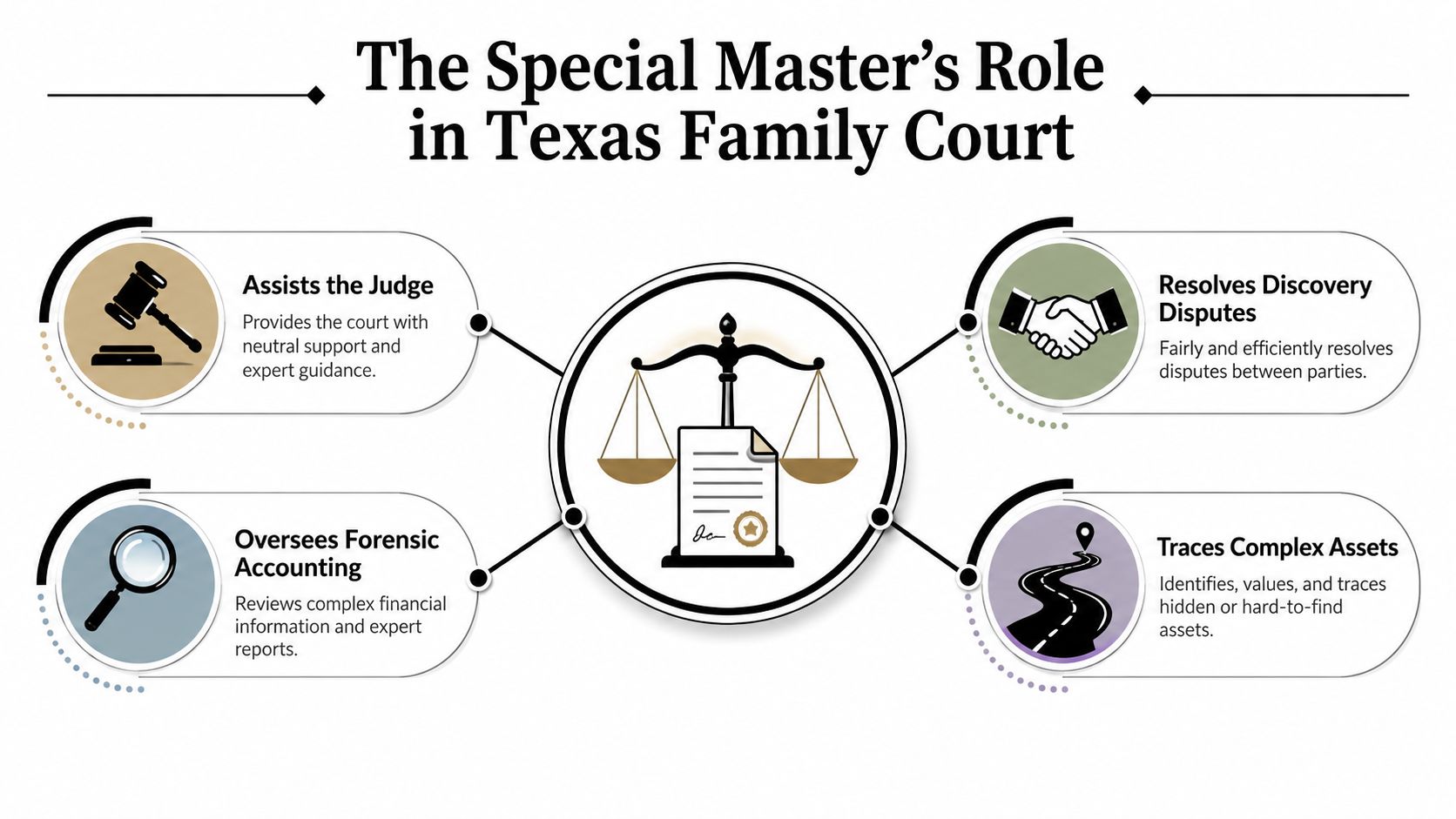
The role is narrower than many people expect
A special master serves a different function from a mediator. A mediator helps spouses negotiate a settlement and generally does not decide disputed issues. Texas courts may refer divorce cases to mediation under Texas Family Code Section 6.602.
An arbitrator has a different role as well. Arbitration may give a private decision-maker authority to resolve disputes under an agreement or court order. A special master remains under the court's authority and must stay within the limits the judge establishes.
The word “referee” can also cause confusion because other states use that title differently. In Texas, the relevant framework is the master in chancery under Rule 171. The appointment order matters more than the label because it identifies the assigned work.
For example, an order might authorize a master to:
- Manage discovery disputes: Address objections involving narrowly defined financial records.
- Review accounting issues: Organize competing analyses and identify unresolved tracing questions.
- Conduct limited hearings: Receive information on assigned issues and report to the court.
- Prepare findings: Narrow the factual disputes that remain for the judge.
The master does not automatically decide the divorce, divide the estate, determine conservatorship, or sign the final decree. Those responsibilities remain with the court unless a lawful order assigns a specifically defined matter otherwise.
Before requesting this form of case management, review how requests, responses, privilege claims, and document production fit together in a discovery guide for a Texas divorce case. For the ordinary sequence from petition through final decree, see How to File for Divorce in Texas: Step by Step.
The Exceptional Case Standard for Appointment
The threshold question is simple to ask and difficult to prove: Why does this divorce require a special master instead of ordinary judicial management?
Rule 171 requires both an exceptional case and good cause. Texas appellate discussion has emphasized that a divorce generally doesn't become exceptional merely because the marital estate is valuable, the spouses disagree, or the litigation is emotionally exhausting. Courts have treated appointment as a narrow procedural tool, not a routine service for high-asset divorces.
What may support the request
A persuasive motion should identify concrete burdens rather than describe the case as “complicated.” A stronger showing may include:
- Repeated interim disputes: The parties return to court over the same discovery or evidence-management problems.
- Technical tracing issues: Transactions move through personal accounts, business entities, loans, and exchanged property.
- A dense business record: The judge must sort through extensive ledgers, tax filings, valuation materials, and competing expert interpretations.
- Persistent discovery obstruction: The ordinary process has failed to resolve focused disputes efficiently.
- Multiple connected proceedings: Parenting, residence, property, or evidence issues create overlapping procedural demands.
The request should explain how the proposed appointment would reduce a specific burden. “The estate is large” is a description. “The parties have recurring disputes over a defined set of business records that require focused review before mediation or trial” is a case-management argument.

What probably won't be enough by itself
A high-value estate with clear account histories may not justify appointment. Neither may ordinary disagreements about property value, routine discovery requests, or the fact that both spouses have experienced attorneys. The court still has to decide whether the appointment is necessary and proportionate.
Texas authority also reflects a structural concern about delegating judicial tasks. Rule 171's historical framework keeps appointment under court control and, in some circumstances, emphasizes party consent. That means your attorney should examine not only whether the facts are complicated, but also whether the proposed structure is legally available and workable.
The persuasive question isn't “How much is at stake?” It's “What specific procedural burden requires this additional neutral?”
Typical Duties a Special Master Handles
A special master's assignment should match the problem. In a property-heavy divorce, the work may focus on financial records. In another case, the assignment may center on repeated discovery disputes. The judge should retain issues that require final judicial judgment.
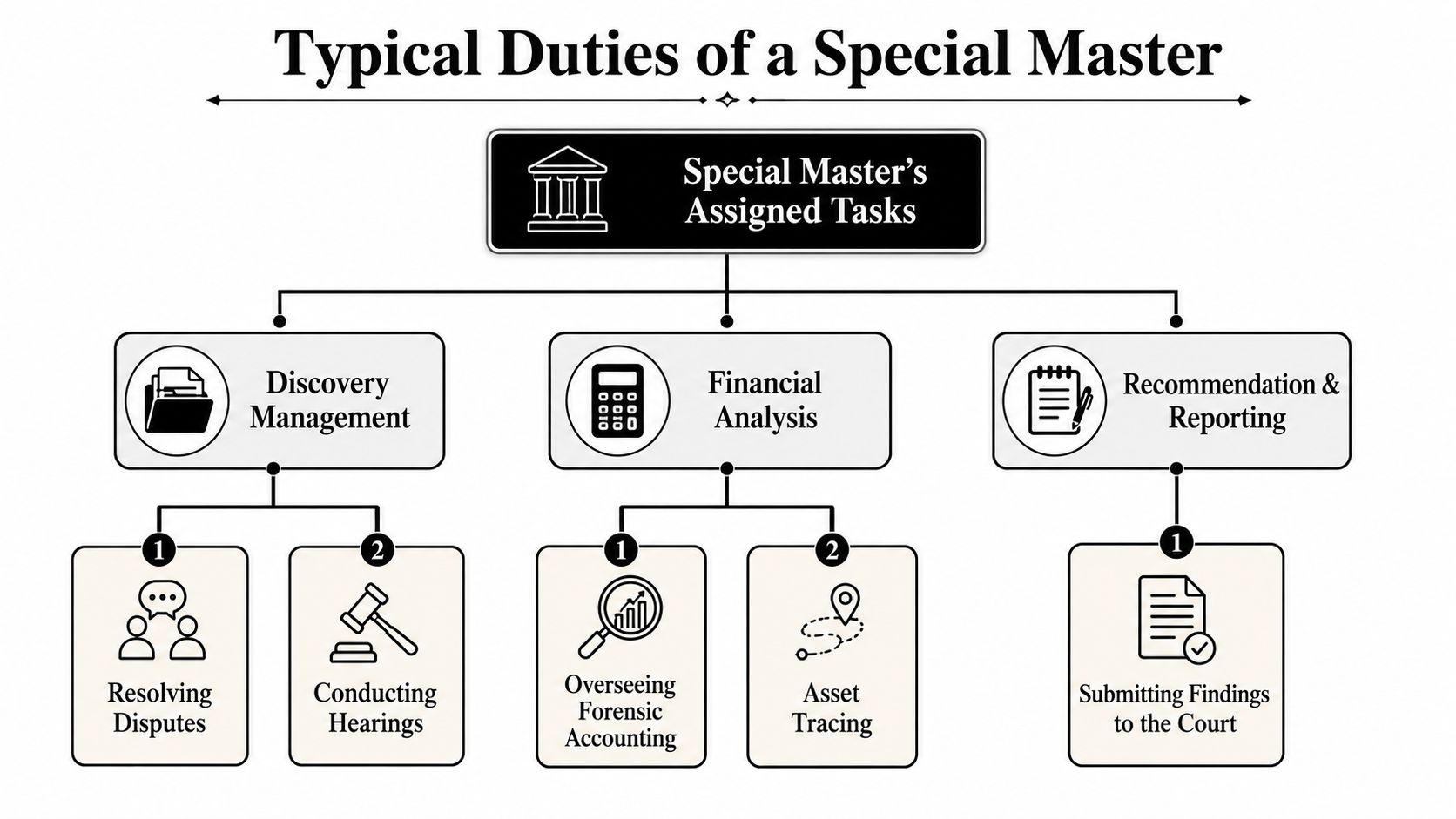
Financial analysis and asset tracing
Texas courts divide the marital estate in a “just and right” manner. When one spouse claims an asset is separate property, that spouse carries the burden of proof. The issue isn't just who held the account or whose name appears on a deed. The evidence may need to show where funds came from, how they moved, and whether community funds were mixed into the asset.
A master may help organize:
- Bank records and transfer histories.
- Entity ledgers and corporate distributions.
- Tax filings and loan documents.
- Real estate purchase and refinance records.
- Transaction chains involving exchanged property.
- Competing business valuation materials.
The master may identify missing evidence, separate agreed facts from disputed facts, and report where the tracing analysis remains incomplete. The judge then uses the properly presented record to make the final ruling.
Discovery management
A special master may address narrowly defined disputes over document requests, privilege, production formats, or the timing of expert materials. This can be useful when routine objections repeatedly interrupt the case.
That role differs from a general case manager. The master doesn't receive unlimited authority to supervise every disagreement. The appointment order should identify the categories of disputes that fall within the assignment.
What remains with the judge
The judge generally retains the final decision on:
- The divorce itself.
- Characterization and division of the marital estate.
- Conservatorship and possession decisions.
- Child support and other final relief.
- Approval of the final decree.
Texas custody law presumes that parents should generally be joint managing conservators after divorce, according to official state guidance. Texas also applies the Uniform Child Custody Jurisdiction and Enforcement Act framework, which can make a child's residence and the proper forum important when families have connections to more than one state. Those issues require careful legal analysis and shouldn't be casually folded into a master's assignment.
How the Appointment Process Works and What It Costs
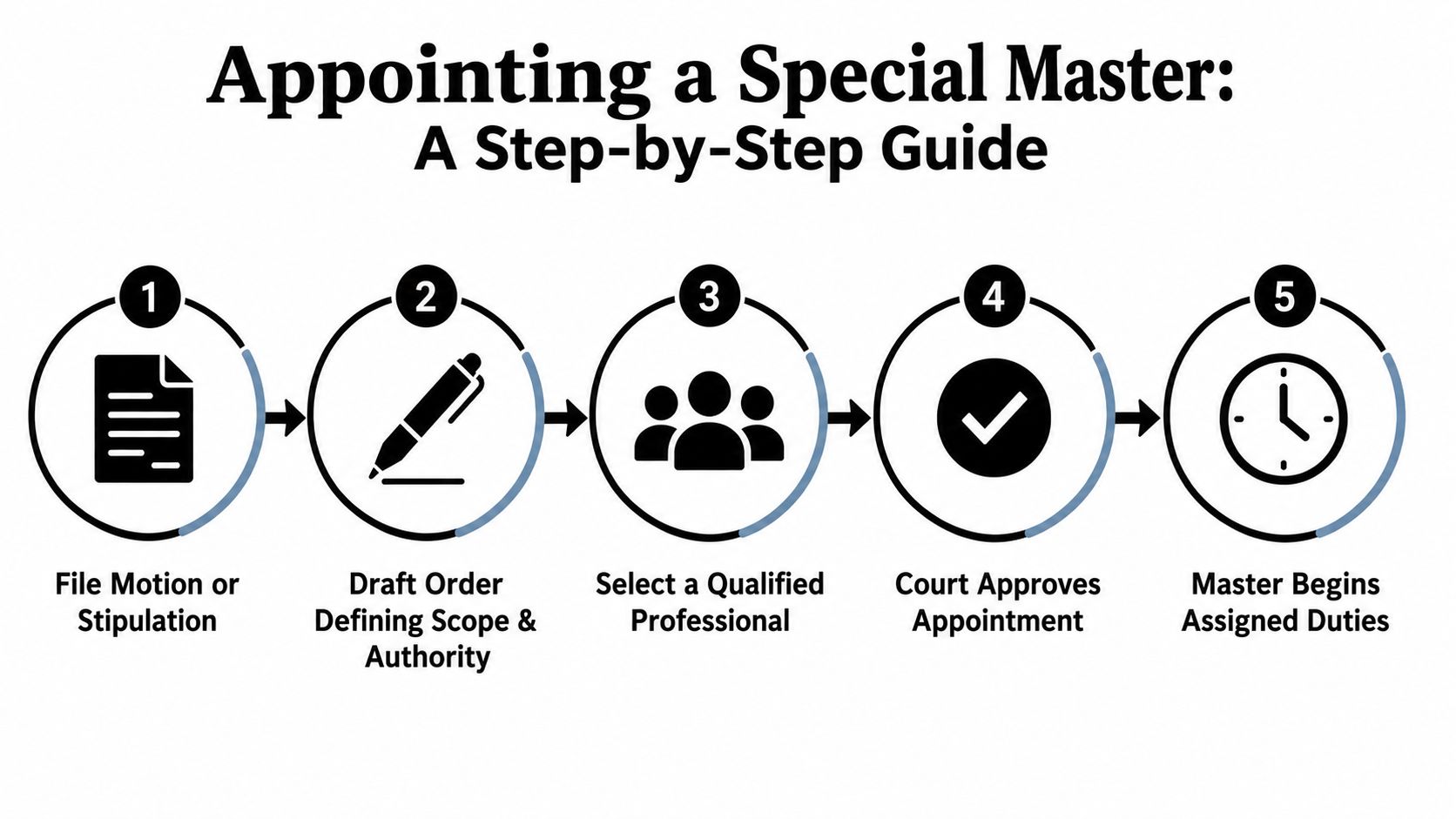
The appointment process begins with a legal and practical assessment. Your attorney should identify the exact burden, collect examples from the record, and determine whether a motion, stipulation, or another procedure fits the case.
A workable sequence
-
Identify the procedural problem. Document repeated discovery disputes, technical tracing questions, or evidence-management burdens. Avoid relying only on the estate's value or the parties' level of disagreement.
-
File a motion or prepare a stipulation. A motion asks the court to act. A stipulation reflects agreement between the spouses. Because consent and court control can matter under the Rule 171 framework, your attorney should evaluate the available route before drafting.
-
Draft a precise order. The order should define the master's subject matter, deadlines, hearing procedures, reporting duties, access to documents, and limits on authority. It should also state whether the master's work is advisory or has binding effect on a specifically identified issue.
-
Choose a qualified neutral. The proposed person must satisfy the applicable neutrality requirements. You should review professional experience, potential conflicts, and familiarity with business records, tracing, valuation, or discovery administration.
-
Address fees before work begins. The order or agreement should explain who pays, how advances are handled, and how the parties divide responsibility. Don't leave fee disputes to develop after the master has started reviewing records.
The cost depends on the person selected, the scope of work, the volume of records, and the number of hearings or reports required. There's no reliable universal budget range in the governing materials, so you should request a written fee structure rather than rely on a general estimate.
You should also compare the expense with the likely benefit. A master may reduce repeated court appearances and narrow the issues. But a broad assignment can create another layer of billing, briefing, and disagreement.
For context on the broader financial planning issues in divorce, review how much a divorce costs in Texas. The special-master decision deserves its own case-specific budget analysis.
Common Objections and How to Challenge Findings
You're allowed to question whether a special master belongs in your case. The strongest objections usually focus on legal authority, necessity, proportionality, scope, or neutrality.
A party opposing appointment may argue that the case isn't exceptional, that ordinary discovery tools are sufficient, or that the proposed assignment improperly transfers decisions reserved for the judge. Another objection may target the selected neutral's relationship, experience, or possible conflict.
Before appointment
Raise objections before the court signs the order whenever possible. Ask your attorney to examine:
- The exceptional-case showing: Does the motion identify unusual procedural burdens, or does it describe a valuable and contested estate?
- The scope: Does the proposed order cover a narrow problem, or does it give the master authority over broad financial or parenting disputes?
- The neutral: Does the candidate satisfy Rule 171's eligibility requirements and appear independent?
- The cost: Does the likely benefit justify another professional's involvement?
- The procedure: Does the court have a clear basis to appoint the master under the circumstances?
You may also propose a narrower alternative, such as a focused discovery hearing, a limited accounting protocol, or mediation after targeted document exchange.
After findings or recommendations
Your objection should be specific. Identify the finding you dispute, the evidence the master overlooked or misunderstood, and the legal reason the judge should reject or modify the recommendation. General dissatisfaction is less useful than a clear record-based challenge.
A special master can reduce a bottleneck only when the parties cooperate with the process. If every procedural decision becomes another fight, the appointment may add expense without producing clarity.
That contrarian point matters. A neutral cannot cure incomplete disclosures, strategic delay, or an order that gives unclear authority. You and your attorney should monitor deadlines, preserve objections, and ensure that the judge receives the final record needed to decide the disputed issues.
How a Special Master Fits Into the Texas Divorce Timeline
Texas Family Code Section 6.702 creates a mandatory 60-day waiting period before a court may grant a divorce, as explained in this Texas divorce timeline resource. That waiting period is a minimum, not a promise that a complex case will finish within that window.
A typical sequence looks like this:
- Filing: One spouse files the original petition and serves or obtains a waiver from the other spouse.
- Early case management: The parties address temporary arrangements, pleadings, preservation of records, and initial disclosures.
- Discovery: The spouses exchange financial and parenting information. In a difficult estate, the parties may raise the special-master issue during this stage.
- Appointment decision: If the court finds exceptional circumstances and good cause, the order defines the master's limited role.
- Mediation: Under Texas Family Code Section 6.602, the court may refer the case to mediation. Mediation is more productive when the parties understand the financial evidence and the disputed issues.
- Agreement or trial: Section 7.006 allows a written agreement addressing property, liabilities, and spousal maintenance. If the parties don't resolve the case, the remaining issues proceed toward trial.
- Final decree: The judge reviews the required documents and signs the final decree.
Texas custody disputes can add another layer because jurisdiction may depend on the child's home-state connection under the UCCJEA. A special master may help organize assigned evidence, but the judge still must resolve final custody and property issues within the law.
What to Do Next If Your Divorce Needs Extra Help
A special master is not a shortcut for every high-asset divorce. It's a narrow tool for a case with unusual factual density, recurring interim disputes, or technical tracing and evidence problems that ordinary court management may not handle efficiently.
Before requesting one, gather the records that show the actual burden. Preserve discovery correspondence, identify unresolved disputes, outline the business or property-tracing problem, and ask whether mediation or a focused hearing could solve the issue at lower cost.
You also need a realistic conversation about cooperation. If you and your spouse can agree on a qualified neutral, a limited assignment, and a clear fee structure, the process may narrow the case. If you can't agree on basic procedures, the appointment may create additional conflict instead.
The Law Office of Bryan Fagan, PLLC handles Texas divorce, custody, property division, mediation, support, and enforcement matters, including cases involving business interests and complex estates. Schedule a free consultation to discuss whether your facts support a special-master request and how to protect your financial and parenting interests while the case moves forward.