Skip to content
You're sitting at the kitchen table with a divorce decree in hand, wondering why the 401(k) or pension still hasn't moved to you. In a Texas divorce, that frustration usually comes from one missing step: the QDRO.
A QDRO, or Qualified Domestic Relations Order, turns a retirement award in your decree into instructions the retirement plan can follow. The right process depends on whether you're dividing a private 401(k), a pension, military retired pay, an IRA, or a Texas public retirement plan. Treating every account alike is how valuable retirement benefits remain undivided long after the divorce ends.
What a QDRO Actually Is in a Texas Divorce
Your divorce decree determines who receives what property. It may award you a percentage of your spouse's 401(k), a portion of a pension, or a defined dollar amount. But for an employer retirement plan, the decree usually isn't enough to make the plan administrator pay you directly. A separate court order, the Qualified Domestic Relations Order, tells the plan how to carry out the award. TexasLawHelp explains why a divorce decree alone doesn't complete retirement division.
The employee who owns the retirement account is the participant. The former spouse receiving part of the benefit is the alternate payee. The QDRO identifies both people, names the exact retirement plan, and states the dollar amount, percentage, or formula the alternate payee should receive.
The decree and QDRO do different jobs
Think of the process as two connected documents:
- The divorce decree divides the marital property under Texas law.
- The QDRO instructs the retirement plan administrator to implement that division.
- The plan administrator reviews the order and distributes benefits according to the plan's rules.
Texas courts decide the property award, but federal retirement law controls how an ERISA-governed plan can distribute benefits. Federal rules also limit what a QDRO can demand. The order generally can't award a benefit the plan doesn't provide, increase the participant's benefits, or require payment earlier than the plan permits. The IRS guidance on QDRO requirements addresses these technical limits.
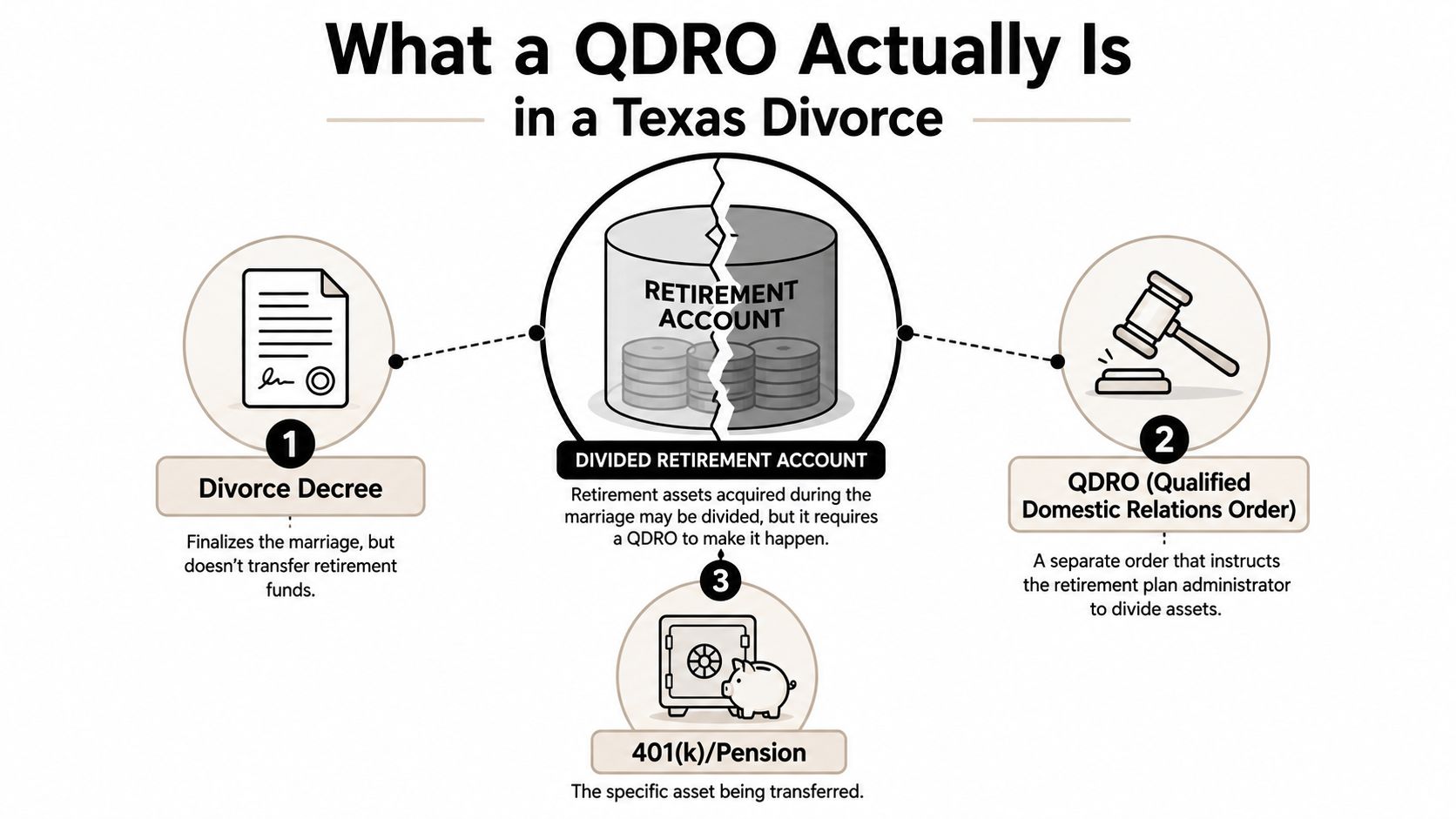
Practical rule: The decree gives you the legal right to a share. The QDRO gives the plan a workable command to transfer that share.
This distinction matters in a high-value divorce. A retirement award may look settled on paper while the participant still controls the account. Until the plan accepts the proper order, you may not have an operational way to receive your portion. If you're dividing an employer-sponsored account, review how to split a 401(k) during a divorce before assuming the decree finished the job.
When Texas Divorce Law Requires a QDRO
Texas generally treats the retirement benefits earned during marriage as community property, even when only one spouse worked or only one spouse's name appears on the account. Texas Family Code section 3.002 defines community property broadly as property acquired during marriage, while section 3.001 addresses separate property, including property owned before marriage or received as a gift or inheritance. The court then divides the community estate in a manner it considers just and right under Texas Family Code section 7.001.
That doesn't always mean an equal split. The court considers the overall estate, and spouses may negotiate a different arrangement through mediation or settlement. For example, one spouse might keep more retirement property while the other receives home equity or another asset. You still need to compare the practical value of each asset, including access rules and tax treatment.
Which retirement assets use which order
| Asset Type | QDRO Required? | Governing Document |
|---|---|---|
| 401(k) or 403(b) | Usually yes | ERISA-based QDRO |
| Employer pension | Usually yes | Plan-specific QDRO |
| IRA | No | Decree and trustee-to-trustee transfer |
| Military retired pay | No | Order under the USFSPA |
| Texas ERS, TRS, or TCDRS benefit | Not necessarily | Plan-specific domestic relations process |
A private employer plan commonly requires a QDRO because the plan administrator needs authority to pay an alternate payee directly. An IRA generally uses a transfer incident to divorce instead. Military retired pay follows a separate federal process, not the ordinary ERISA QDRO process. If you're a federal employee, the TSP divorce rules for federal employees deserve separate review because the Thrift Savings Plan uses specialized court-order procedures.
Texas public plans require special care. The Employees Retirement System of Texas and Teacher Retirement System of Texas apply their own approval rules, and TRS determines whether a domestic relations order is qualified before paying an alternate payee directly, as explained in Texas ERS guidance on qualified domestic relations orders.
A missing order isn't always the end
Texas law allows a party to return to court later to obtain a QDRO when the order wasn't signed with the decree. That makes the omission fixable, but it doesn't make delay harmless. The account may change, the participant may retire, plan rules may change, and records may become harder to obtain.
Your decree should contain clear savings language preserving the court's ability to enter the retirement order later. TexasLawHelp also notes that retirement benefits aren't divided until the plan administrator receives a certified copy of the signed order, so signing the decree alone isn't enough.
Plan-by-Plan Differences You Need to Know
A generic QDRO template is risky because retirement plans don't all calculate or pay benefits the same way. The document must match the asset, the plan administrator's rules, and the award in your decree.
Private 401(k) and 403(b) plans
A defined-contribution plan usually has an account balance. The order may award a percentage of the marital portion, a dollar amount, and investment gains or losses according to the plan's procedures. The plan may allow a shared-payment order, where the alternate payee receives a portion of each payment, or a separate-interest order, where the alternate payee receives a separately calculated benefit.
You should obtain the plan's model language before drafting. The Department of Labor recommends consulting the administrator first because plan-specific requirements control whether the order qualifies. Its QDRO practical guide distinguishes the shared-payment and separate-interest approaches and explains why timing matters.
Defined-benefit pensions
A pension isn't just an account balance. It promises a future payment, so the order must address the benefit formula, the marital portion, payment timing, and available payment forms. Survivor-benefit language is especially important. A QDRO can't create a survivor feature the plan doesn't offer, and the order must work within the pension's rules.
Military retired pay
Military retirement division uses an order under the Uniformed Services Former Spouses' Protection Act, not a standard QDRO. The Defense Finance and Accounting Service processes payments when the order meets federal requirements. Military cases also require careful attention to service dates, retirement elections, disability-related issues, and the exact language accepted by the federal pay system.
Texas public retirement plans
ERS, TRS, and TCDRS aren't interchangeable. Each system follows its own statutes, forms, formulas, and approval process. A court order that works for a private employer's 401(k) may be rejected by a Texas public plan.
| Plan Type | Order Required | Administrator | Key Texas-Specific Note |
|---|---|---|---|
| 401(k) | ERISA QDRO | Employer plan administrator | Use the plan's model language and identify the marital share |
| 403(b) | ERISA QDRO | Employer or third-party administrator | Plan rules determine the permitted payment method |
| Pension | Plan-specific QDRO | Pension administrator | Address payment timing and survivor rights |
| Military retirement | USFSPA order | Defense Finance and Accounting Service | Federal rules govern direct payment |
| ERS or TRS | Plan-specific domestic relations order | Texas retirement system | Approval language and filing steps differ from private plans |
| TCDRS | System-specific order | TCDRS | Confirm the system's method for dividing the benefit |
| IRA | Decree and transfer instruction | IRA trustee or custodian | A QDRO isn't the usual mechanism |
IRAs are divided through a transfer incident to divorce under Internal Revenue Code section 408(d)(6), rather than through a QDRO. The receiving spouse should generally receive a direct transfer into an appropriate account instead of receiving a personal check from the account owner. The IRS rules for QDRO distributions provide special treatment for alternate payees receiving benefits from employer plans, including an exception to the early-distribution penalty that would otherwise apply before age 59½, as reflected in IRS retirement plan guidance.
For a broader review of account division, see dividing retirement accounts in a Texas divorce.
How a Texas QDRO Gets Drafted and Approved
The smoothest QDRO process starts with the plan administrator, not with a form downloaded from the internet. The Department of Labor recommends asking the administrator for the Summary Plan Description, model QDRO, and drafting requirements before anyone submits an order to the court.
Follow the five gates
First, collect plan information. Confirm the full legal name of the plan, administrator contact information, plan number if available, and the participant's current employment status. For a pension, identify the retirement options and the earliest date benefits may begin.
Second, draft the order around the decree. The QDRO must identify the participant and alternate payee, name the exact plan, and state the award as a dollar amount, percentage, or formula. The formula should identify the valuation date and explain how investment gains or losses, contributions, fees, or other plan adjustments affect the alternate payee's share.
Third, choose the correct payment method. A shared-payment order may divide each payment after the participant begins receiving benefits. A separate-interest order may establish an independent benefit for the alternate payee when the plan permits it. Your lawyer should match this election to the pension or account's actual rules.
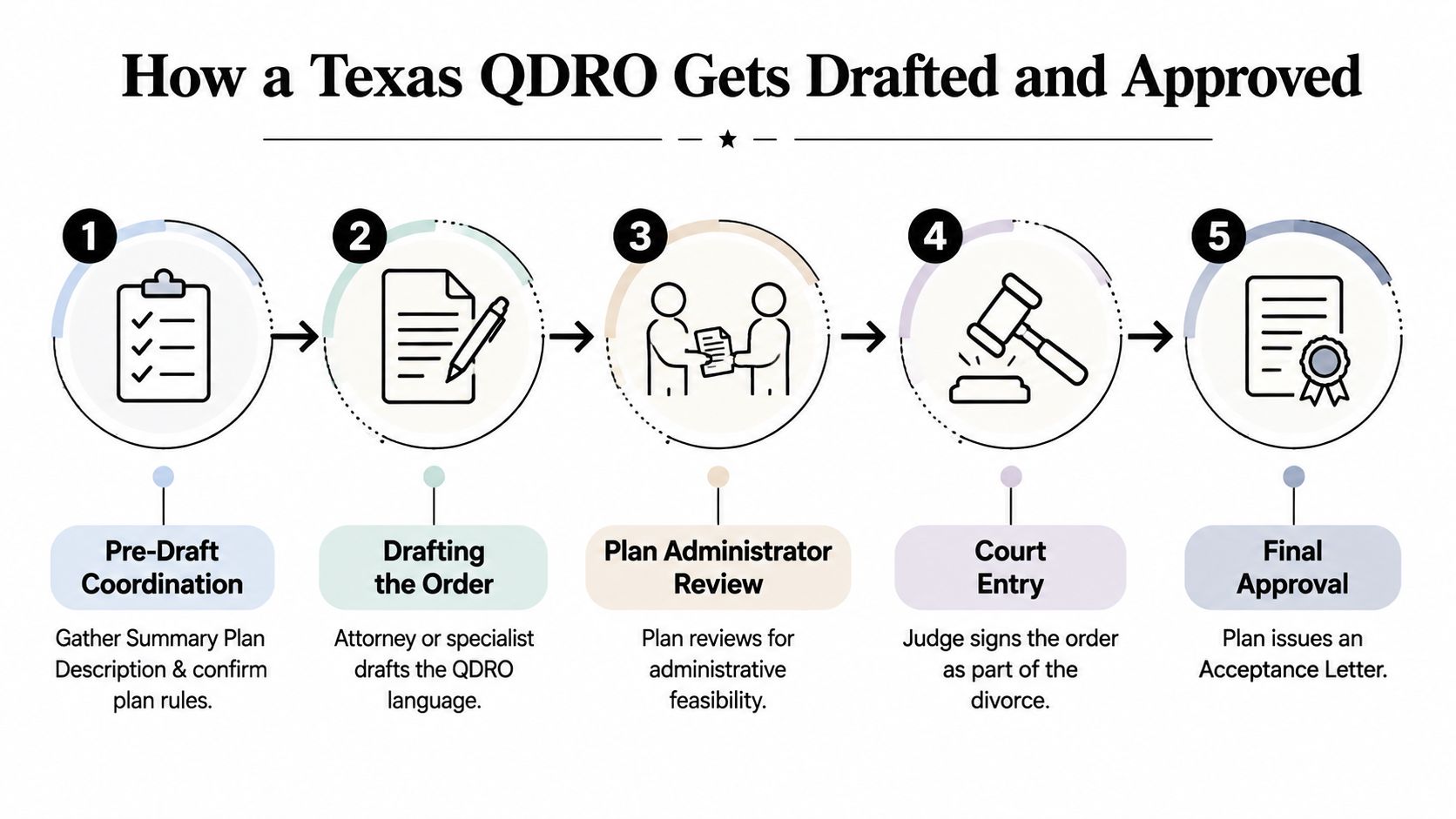
Fourth, obtain court entry. The proposed order must match the decree. The judge signs it, and the clerk prepares a certified copy. If your divorce remains pending, temporary orders can help establish the rules while the case proceeds. Temporary Orders During a Texas Divorce addresses that interim court process.
Fifth, send the certified order to the plan. TexasLawHelp advises sending the certified copy to the administrator after the judge signs it. Keep proof of delivery and request written confirmation that the plan received and accepted the order. A plan rejection usually means the order must be corrected, signed again, and resubmitted.
A certified copy sitting in your lawyer's file doesn't divide the retirement account. The plan administrator must receive and qualify it.
Here's a short video overview of the process:
Common Drafting Pitfalls and How to Fix Them
The most dangerous assumption is that a signed decree automatically gives the former spouse access to the retirement plan. It doesn't. A plan administrator reviews the separate order against federal law and the plan's own document.
Vague drafting creates avoidable rejection. “Fifty percent of the account” may not explain whether the award applies to the marital portion, which valuation date controls, or how gains and losses are allocated. An order also fails when it asks for a payment form, survivor benefit, or retirement date the plan doesn't permit.
| Pitfall | Why Plans Reject It | Fix |
|---|---|---|
| Vague percentage language | The plan can't determine the award or valuation date | State the precise formula and measurement date |
| Wrong plan name | The administrator can't identify the account covered | Use the plan's complete legal name |
| Missing participant information | Federal requirements aren't satisfied | Include required identifying details |
| Unsupported survivor benefit | The order demands a benefit the plan doesn't offer | Confirm available survivor options first |
| Wrong payment method | Shared-payment and separate-interest rules differ | Select the method the plan permits |
| Decree without a separate order | The plan lacks an operational instruction | Prepare and submit the required order |
A QDRO also can't force a plan to increase benefits, create a new benefit form, or pay before the plan allows. Those requests exceed the order's authority and invite rejection.
What happens after rejection
A corrected order may solve the problem. Depending on the circumstances, the court may also enter a nunc pro tunc order to correct a clerical mistake or conduct a post-divorce enforcement proceeding. Texas Family Code section 9.101 provides a mechanism to enforce or clarify property-division obligations when a former spouse refuses to cooperate.
If the participant won't sign, you don't have to accept permanent inaction. Your lawyer can ask the court to enforce the decree, enter the necessary order, or address a failure to comply. Keep every statement, draft, rejection letter, and email. The record may determine whether the issue is a drafting correction or a broader enforcement dispute.
Sample Timeline and Checklist for a Smooth QDRO
Your case may move faster or slower depending on the plan, the court, and whether the administrator requests revisions. Still, a staged plan helps you identify the missing handoff instead of assuming someone else handled it.
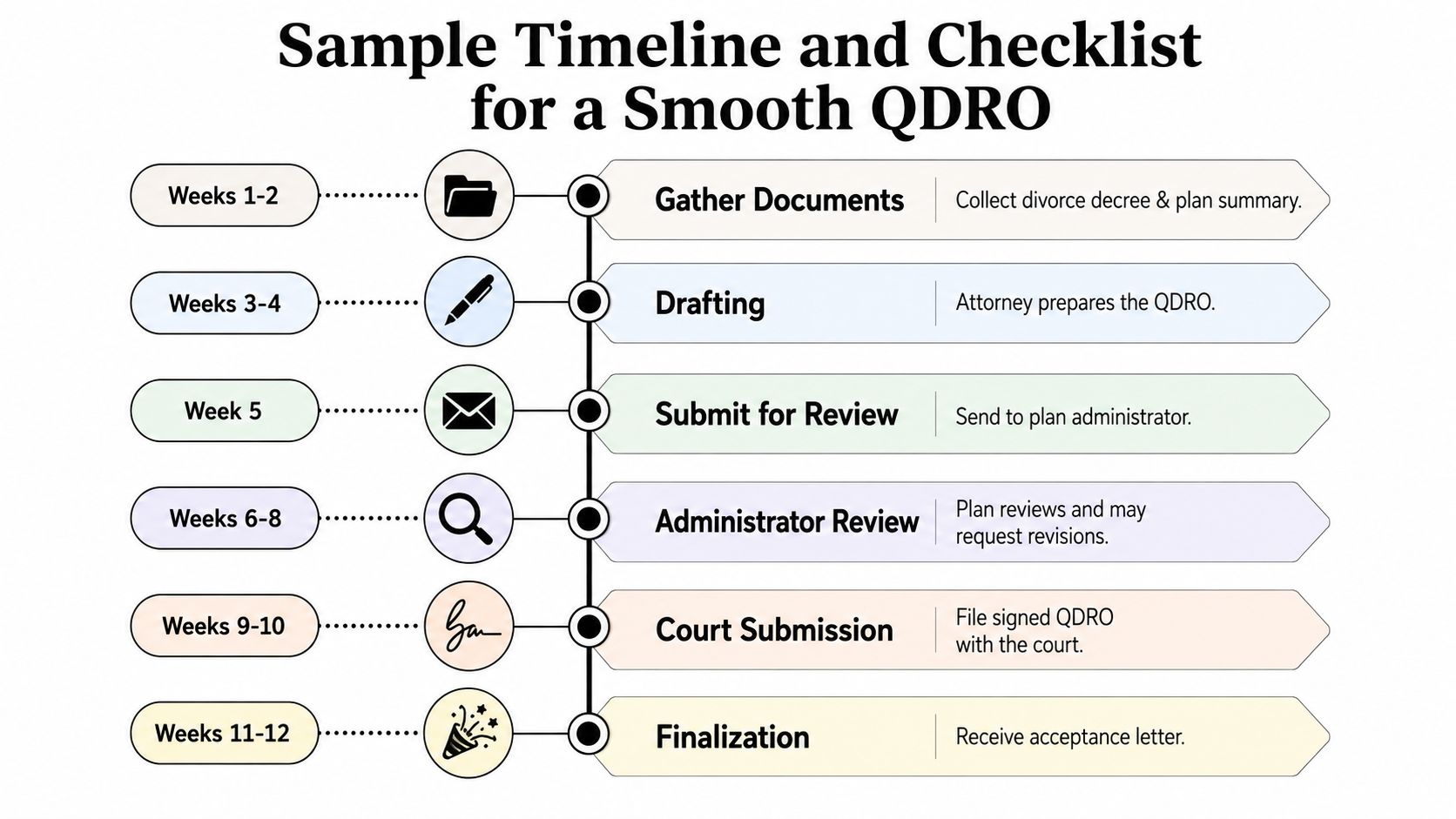
A workable sequence
Weeks 1–2, gather records. Locate the final decree, retirement statements, Summary Plan Description, plan contact information, and any prior domestic relations orders. Determine whether the asset is an ERISA plan, IRA, military benefit, or Texas public retirement benefit.
Weeks 3–6, prepare and pre-submit. The drafter converts the decree into plan-specific language. The alternate payee reviews the proposed formula. Submit the draft to the administrator for pre-approval before asking the judge to sign it when the plan's process allows.
Weeks 7–12, obtain court approval. Address administrator comments, submit the final order to the court, obtain the judge's signature, and request a certified copy. Check that the signed order matches the version the plan reviewed.
Months 4–9, complete administration. Send the certified order to the plan, respond to requests for clarification, establish any receiving account or rollover instructions, and review the administrator's acceptance letter. Confirm how tax withholding will operate before selecting a distribution.
For defined-benefit pensions, the earliest retirement age can control when an alternate payee may begin receiving benefits. Federal guidance generally defines it as the earlier of the date the participant can receive a distribution under the plan or the later of age 50 or the earliest service-separation date the plan permits. That benchmark can matter even when the participant won't retire for many years.
Your printable checklist
- Decree: Confirm the retirement award is stated clearly.
- Plan identity: Obtain the exact plan name and administrator address.
- Separate property: Gather records supporting any premarital portion.
- Model order: Request the plan's QDRO or domestic-relations-order guidelines.
- Draft: Verify names, plan details, formula, valuation date, and payment method.
- Pre-approval: Submit the proposed order when the administrator permits it.
- Court entry: Obtain the judge's signature and a certified copy.
- Delivery: Send the certified order and keep proof of receipt.
- Acceptance: Request written confirmation that the plan qualified the order.
- Follow-up: Complete the rollover or payment instructions and calendar unresolved issues.
Costs, Counsel, and Your Next Steps
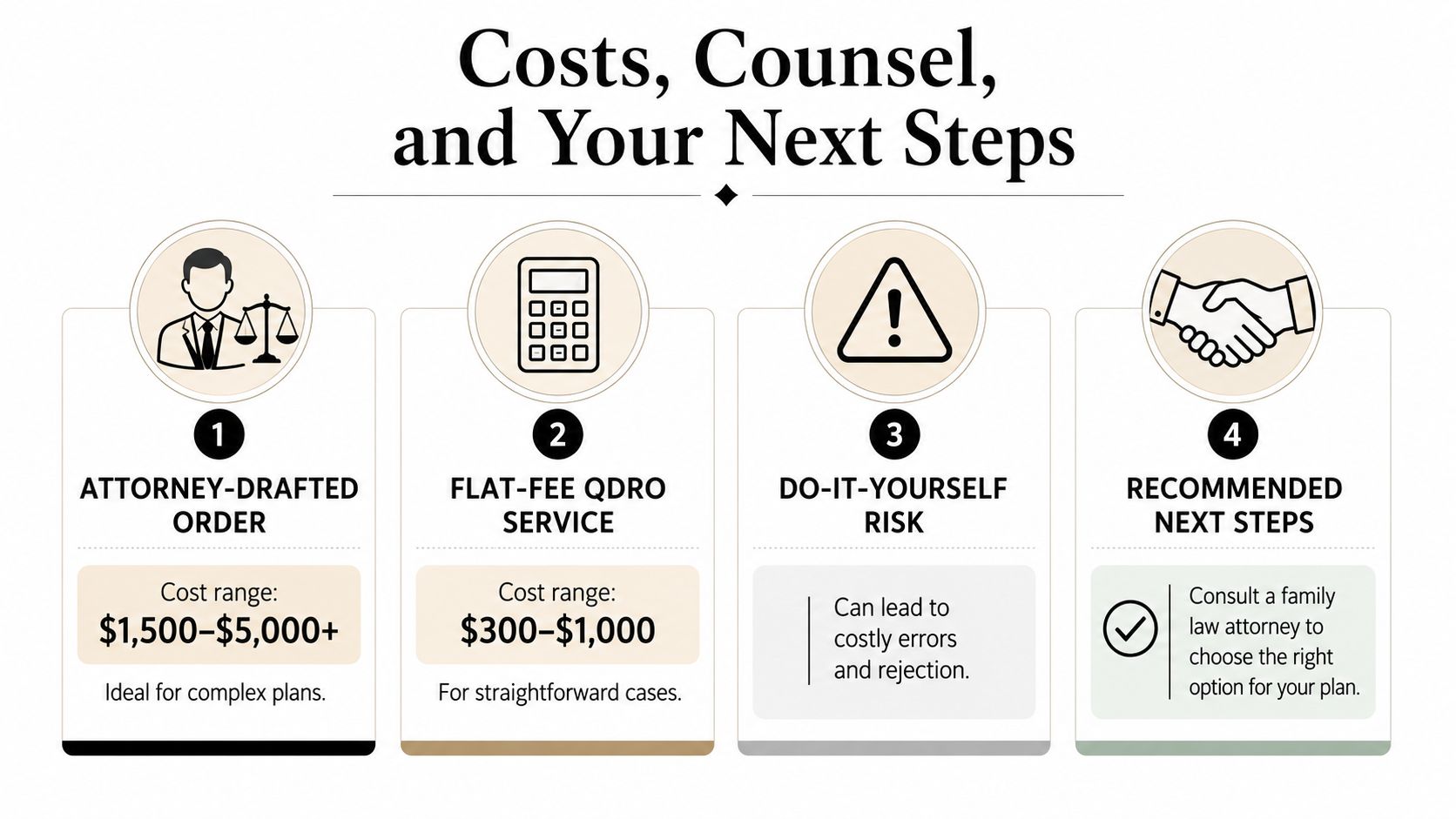
You'll see different pricing models for QDRO work. Attorney-drafted orders often range from $1,500 to $5,000 or more, depending on plan complexity, as described in the supplied Texas retirement guidance. Flat-fee preparation services may cost $500 to $1,500, while the visual reference supplied for this topic identifies a separate flat-fee range of $300 to $1,000. Because these figures vary by provider and plan, ask exactly what the fee includes before you agree.
Plan administrators may also charge processing fees. The supplied guidance identifies administrator fees ranging from $200 to $1,000. Ask whether that fee applies per order, per plan, or per submission, and whether revisions create another charge.
When professional legal help earns its place
A straightforward 401(k) with a clear account balance and uncomplicated percentage award may be suitable for a specialized QDRO preparation service, provided you understand that the service may not represent you in the divorce or resolve a disputed decree.
You should strongly consider a family-law attorney when the case involves:
- A defined-benefit pension: Future monthly benefits require plan-specific choices and timing analysis.
- Military retirement: USFSPA orders involve federal administration and military-specific issues.
- Texas public retirement: ERS, TRS, and TCDRS use their own procedures and terminology.
- A high-value estate: Retirement benefits may interact with businesses, real estate, support, and tax-sensitive settlement terms.
- A disputed decree: Enforcement or clarification may be necessary under Texas Family Code section 9.101.
If you're unsure which professional fits your situation, what type of lawyer you need for family court can help you think through the choice.
What to do next
- Find the decree and every retirement statement.
- Identify the plan type before choosing an order.
- Ask the administrator for its current requirements.
- Confirm whether the decree uses a clear percentage, dollar amount, or formula.
- Submit the draft for plan review when available.
- Obtain the judge's signature and certified copy.
- Send the certified order to the administrator and preserve proof.
- Confirm acceptance and complete any rollover instructions.
- Get legal help promptly if your former spouse refuses to cooperate.
You shouldn't have to guess whether your retirement award will ever reach you. The Law Office of Bryan Fagan, PLLC can review your decree, identify the correct process for your plan, and help coordinate drafting, court entry, and administrator submission. Schedule a free consultation by visiting Law Office of Bryan Fagan, PLLC so you can protect your retirement share before the paperwork becomes a larger problem.