Skip to content
When your life changes after a divorce, your court orders may need to change, too.
Life doesn't stand still just because a judge has signed your divorce decree. A modification of a divorce decree in Texas is the formal legal process for updating your court orders when life changes in a big way. However, you can't change things just because you want to. The key to any modification is proving that a material and substantial change in circumstances has happened since your divorce was finalized.
When Can You Modify Your Texas Divorce Decree?
Facing a situation where your divorce decree no longer fits your life can be stressful, but it’s a reality for many Texans. A sudden job loss, a move for a better opportunity, or a child’s changing needs are all common reasons to revisit your orders. The Texas Family Code provides a legal path for these adjustments, but it's crucial to know which parts of your decree are flexible and which are set in stone.
The entire case will hinge on that legal standard: a material and substantial change in circumstances. This isn't a minor disagreement or a small scheduling conflict. It has to be a significant, provable shift that makes the current orders unworkable or no longer in the child's best interest.
Modifiable vs. Non-Modifiable Orders
When it comes to modifications, not all parts of a divorce decree are treated equally. The law draws a very clear line between orders concerning children and the division of your property. Understanding this distinction from the start is crucial.
| Type of Order | Can It Be Modified? | Key Considerations |
|---|---|---|
| Child Custody (Conservatorship) | Yes | You must prove a material and substantial change and that the modification is in the child's best interest. |
| Child Visitation (Possession) | Yes | Often modified due to relocation, changes in work schedules, or a child's evolving activities and needs. |
| Child Support | Yes | Typically requires a 3-year waiting period and the new amount must differ by 20% or $100, unless a major life event like a job loss occurs. |
| Spousal Maintenance (Alimony) | Yes, but limited | Can be modified (usually downward) if there's a material and substantial change in either ex-spouse's circumstances. |
| Property & Debt Division | No | This is considered final and cannot be changed 30 days after the decree is signed, except in rare cases of fraud. |
As you can see, orders involving children are almost always modifiable if you meet the legal standard. Property division, on the other hand, is locked in. A court won't reopen your case just because you now feel the split was unfair.
What Is a "Material and Substantial Change"?
So, what does this legal phrase actually mean for you? It’s the heart of every modification case. Here are some real-world examples that we see in our practice:
- A major change in income: If the parent paying child support loses their job or takes an involuntary, significant pay cut, that could justify lowering their payments. Conversely, if their income skyrockets, the other parent could seek an increase.
- A parent needs to relocate: If you or the other parent has a great job offer or needs to move to be closer to family support, that will almost always require changing the possession schedule to make it work.
- Your child's needs have evolved: As kids get older, their lives change. A child might develop a medical condition that requires more financial support, or their school and sports schedules might make the old visitation plan impossible.
- A parent's lifestyle becomes a problem: If one parent develops a substance abuse issue or their living situation becomes unstable or dangerous, that could be grounds to modify custody to protect the child.
This flowchart gives you a simple visual guide to see if your situation might qualify for a modification.
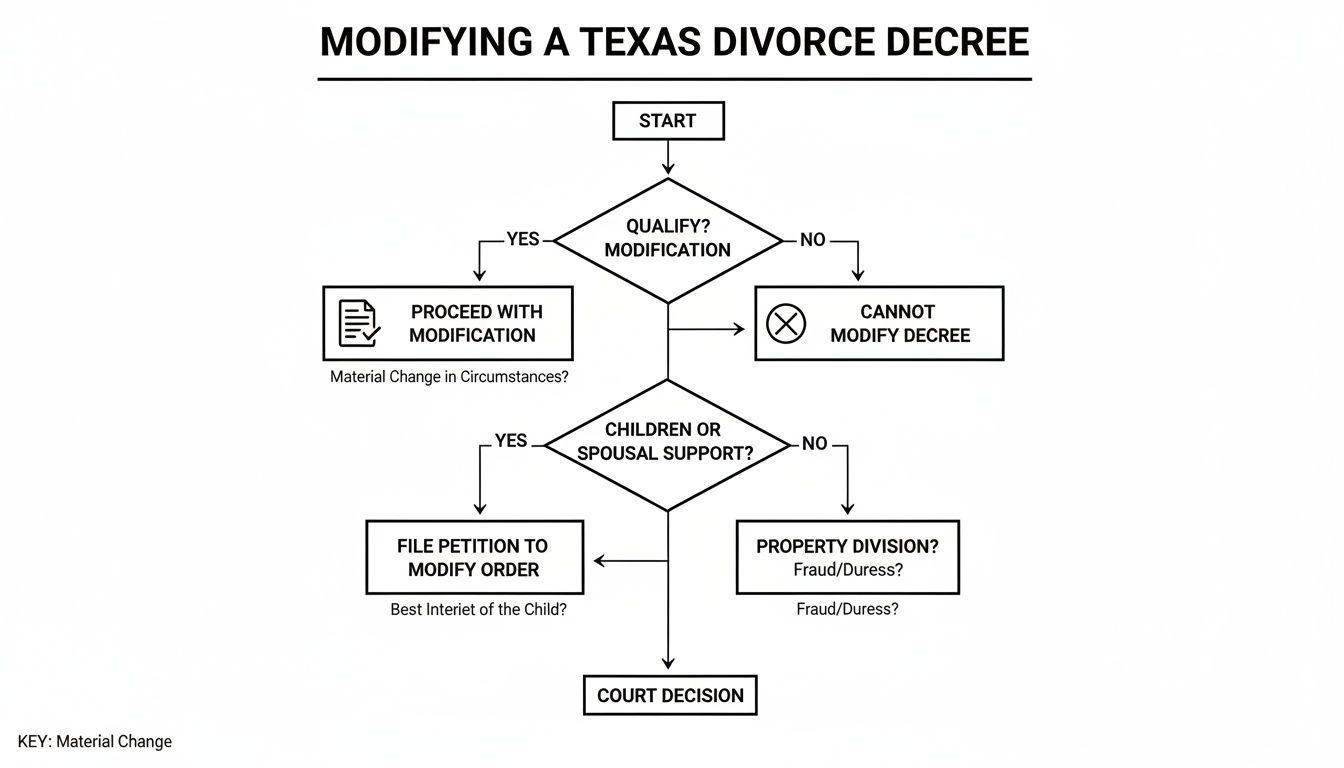
Ultimately, the process always comes back to proving that a "material and substantial change" has happened since your last court order was signed. Before you start the modification process, it's a good idea to refresh your memory on the document itself. For a deeper dive, check out our guide on what is a decree of divorce.
Proving a Material and Substantial Change to the Court

Realizing your divorce decree no longer fits your life is one thing; convincing a Texas judge to change it is another. To get a modification of your divorce decree in Texas, you can't just walk into court and tell your story. You have to show the judge exactly why the change is necessary using concrete evidence. Your goal is to translate your reality into a persuasive legal argument based on a material and substantial change in circumstances.
Gathering Evidence for Child Support Modifications
When it comes to changing child support, it's all about the numbers. A judge won't take your word for it that your income changed. You need to lay out the financial facts in black and white.
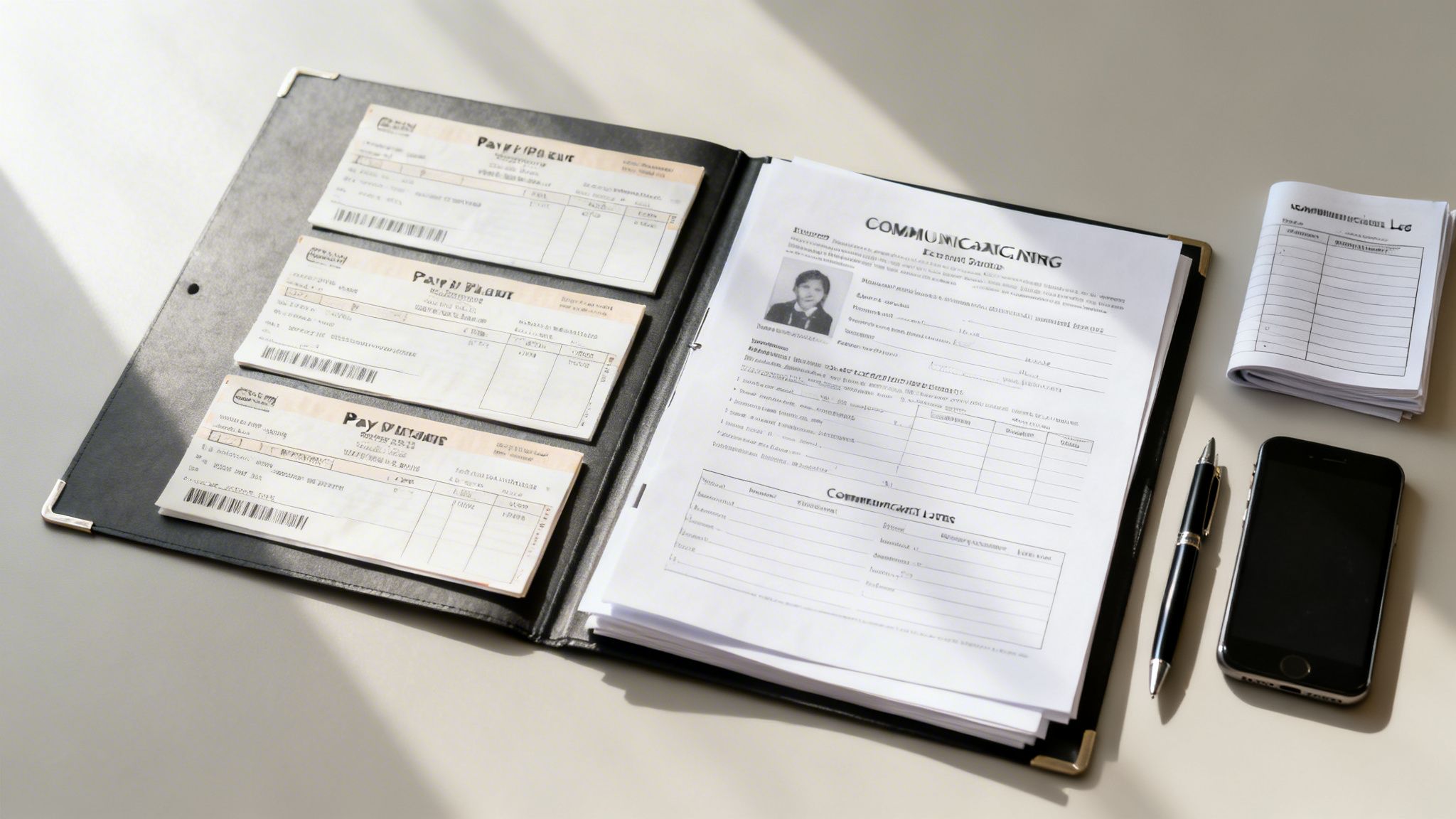
- If your income dropped: Did you lose your job or take a major pay cut? Gather your termination letter, last few pay stubs, and any proof you've applied for unemployment or new jobs. This demonstrates the change was involuntary and that you're trying to fix the situation.
- If your ex's income went up: To ask for more support, you'll need the other parent's recent pay stubs, tax returns, or statements showing bonuses. This information is usually obtained through a formal legal process called "discovery."
- If your child’s needs have changed: Does your child now require expensive medical treatments, therapy, or special tutoring? Present invoices, receipts, and letters from doctors or school professionals that detail these new costs.
The more organized your financial paperwork is, the stronger your case will be. Your goal is to paint a clear picture of the new financial reality, leaving no room for a judge to second-guess the situation.
Building a Case for Custody and Visitation Changes
Modifying custody (what Texas calls conservatorship) or the visitation schedule (possession and access) is often more complex. It’s not just about money; it’s about a child’s emotional and physical well-being. Here, your evidence must prove that your proposed change is in the child’s best interest.
This requires a different kind of proof—one that tells a detailed story about the child's life and each parent's current circumstances. Some of the most compelling evidence includes:
- Communication Logs: A detailed log of texts, emails, and parenting app messages can be incredibly powerful. It can show a pattern of the other parent refusing to follow the court order, being uncooperative, or making poor decisions.
- School and Medical Records: A child's grades suddenly plummeting, an increase in absences, or notes from teachers about behavioral issues can be strong indicators that the current living situation isn't working.
- Witness Testimony: Sometimes, the most powerful evidence comes from a neutral third party. A teacher, coach, or therapist who can speak to the child’s struggles or a parent’s concerning behavior can carry a lot of weight with a judge.
- Proof of a Move: If one parent is relocating, you’ll need to show the new address, information on the quality of the new school district, and a detailed proposal for a long-distance possession schedule.
A judge needs to see how the changed circumstances have tangibly impacted your child. To better understand what specific situations qualify, you might be interested in our guide on understanding material circumstances in Texas family law. Building a solid case is all about showing, not just telling, the court that a real, significant change has happened.
Filing The Modification: How To Start The Legal Process
Knowing you need a change is one thing; getting the legal wheels turning is another. Once you’ve determined that a material and substantial change has happened, it's time to take action. This part can feel daunting, but breaking it down makes the path forward much clearer. The entire process for modifying a divorce decree in Texas kicks off with one key document filed with the same court that handled your original divorce.
Step 1: File a Petition to Modify
Your first official move is to draft and file a Petition to Modify the Parent-Child Relationship. This document is your formal request to the court, and it needs to be filed in the specific court that holds continuing, exclusive jurisdiction over your case—almost always where your divorce was granted. The petition tells the judge and the other parent what you want to change and, most importantly, why.
Step 2: Notify The Other Parent
Just filing the petition isn't enough. The other parent has to be formally notified that you've initiated a legal proceeding. This step, known as service of process, is a non-negotiable requirement under Texas law. Proper service is about fairness, ensuring your ex-spouse has a legal opportunity to respond. It’s typically handled in one of two ways:
- Formal Service: A constable, sheriff's deputy, or private process server will personally deliver the paperwork to the other parent. This is the standard method for a contested case.
- Waiver of Service: If you and the other parent are on the same page, they can sign a Waiver of Service. This document acknowledges they've received the lawsuit and waives the need for formal delivery. It’s a faster, cheaper route for agreed modifications.
Once the other parent is served, they have a specific amount of time to file a formal answer with the court.
Step 3: Navigate the Agreed vs. Contested Paths
From here, your case will follow one of two very different paths, depending entirely on whether the other parent agrees to the changes. The difference in time, cost, and stress between an agreed and a contested modification is enormous. It's also important to know how to file court documents correctly to avoid procedural delays.
- Agreed Modification: If your ex agrees, you're on the fast track. You can both sign an Agreed Order, which your attorney submits to the judge. Often, this can be wrapped up in a matter of weeks without ever stepping into a courtroom.
- Contested Modification: If they disagree, you’re in a contested case. This path involves more legal steps, like exchanging financial documents (called “discovery”), mandatory mediation, and potentially temporary orders hearings. A contested case can easily take several months, or even longer, to resolve.
Having a clear understanding of these paths helps you set realistic expectations from the start.
How Mediation and Court Hearings Work
After you’ve filed to modify your divorce decree, you’re essentially heading down one of two paths: resolving things through negotiation or taking your fight to a judge. In Texas, most judges mandate that you and your ex attempt mediation in Texas divorce before they’ll even give you a court date. It’s an incredibly effective way to resolve disputes without the cost and stress of a courtroom battle.
The Power of Mediation
Mediation puts you in control. It's a confidential process where you, your ex, and your respective attorneys work with a neutral third party (the mediator) to find a solution. The mediator doesn't make decisions; their job is to facilitate a productive conversation and help you both find common ground. This allows for creative solutions a judge simply can't order from the bench.
For mediation to succeed, you need:
- Solid Preparation: Walk into mediation with a clear game plan and the evidence to back it up.
- A Willingness to Compromise: The goal is a fair agreement, not a total victory.
- Patience: These negotiations can take a full day. It's a marathon, not a sprint.
If you find a solution, the mediator drafts a Mediated Settlement Agreement (MSA). Once everyone signs it, the MSA is binding and irrevocable. Your attorney then uses that agreement to draft a Final Order for the judge to sign, which officially completes the modification process.
What to Expect in a Court Hearing
If you can’t reach an agreement in mediation, your case will be scheduled for a hearing in front of a judge. This is where all the evidence you’ve gathered becomes critical. Unlike mediation, a court hearing is formal, follows strict rules, and is adversarial by nature. Your attorney will present your case by calling witnesses, submitting your documents as evidence, and making legal arguments to support your request.
A courtroom is not the place for gut feelings or emotional pleas—it's a place for facts. A judge needs to see documented proof that there has been a material and substantial change in circumstances. Your clear testimony, backed by solid evidence, is what will win your case. After hearing from both sides, the judge will make a ruling. That decision is a final, binding court order that you and your ex must follow from that day forward.
How Recent Texas Laws Impact Your Modification Case

Texas family law isn't static. It evolves, and these legislative updates can directly affect your ability to seek a modification of a divorce decree in Texas. Keeping up with these changes is a crucial part of building a strong case. This is why working with an attorney who stays on top of the latest legal developments is so important for protecting your family’s future.
New Rules for Attorney’s Fees Could Change Your Strategy
One of the most important recent updates comes from House Bill 2524, which went into effect on September 1, 2025. This law brings a new level of consistency to how attorney’s fees are awarded across the Texas Family Code. Under HB 2524, if a judge decides to award attorney's fees, they must order that the fees are "reasonable and necessary." Critically, the law now requires that these fees are paid directly to the attorney.
This single change can give you new leverage in a couple of key ways:
- Stronger Enforcement: It makes collecting attorney’s fees much simpler when your ex-spouse has ignored a court order.
- Negotiation Power: With a clearer standard for awarding fees, the financial risk of going to court becomes more predictable for both sides. This can influence how everyone approaches settlement talks.
Protective Orders and High-Conflict Modifications
For families in high-conflict situations, Senate Bill 1120 extends how long certain protective orders issued in a final divorce decree can last. Now, SB 1120 allows some protective orders to remain in effect for up to two years from the date the divorce is finalized. This is a game-changer for parents who have legitimate safety concerns and are considering a modification based on the other parent's troubling behavior.
The legal landscape is constantly evolving, and Texas continues to see divorce rates between 1.4 and 1.9 per 1,000 people. You can explore more about these new Texas laws and what to expect in court. These shifts all point to one simple truth: what was true during your original divorce might not be the case today.
What to Do Next: Your Action Plan
It's easy to feel buried under legal terms and procedures. Let's cut through the noise and create a clear path forward. Modifying a Texas divorce decree always comes back to one core principle: you must prove a material and substantial change has taken place since the judge signed your last order.
Here's a practical checklist to get you started:
- Build Your Evidence File: Start collecting everything that proves the change. This includes recent pay stubs, text or email logs with your ex, your child's report cards, or medical records—anything that tells a clear story.
- Define Your "Why": Get specific. Do you need the visitation schedule to change on a particular day? Are you asking for a precise dollar amount in child support? A clear objective is the foundation of your case.
- Focus on the Legal Standard: Remember, your feelings don't win a case—evidence does. Every document and piece of testimony must directly prove that a material and substantial change has occurred.
The most critical move you can make is the first one. This process is tough, and you shouldn’t have to guess your way through it. The right legal guidance can be the difference between a frustrating dead end and getting the result your family needs.
We know what's at stake for you and your children. At The Law Office of Bryan Fagan, PLLC, we help Texas families navigate these challenges with empathy and confidence. We invite you to schedule a free, confidential consultation to discuss your situation and learn how we can help you move forward.
Frequently Asked Questions About Modifying a Texas Divorce Decree
Once a divorce decree is finalized, most people hope it’s the last word. But life changes, and sometimes, those orders no longer work for your family. When that happens, a flood of questions usually follows. Here are straight answers to the most common concerns we hear.
How much does it cost to modify a divorce decree in Texas?
The cost can vary dramatically based on one key factor: whether you and your ex-spouse can agree.
- An agreed modification is the most affordable route. If you both agree on the new terms, your costs are mainly limited to attorney’s fees for drafting the new order and court filing fees.
- A contested modification costs more. When you can’t agree, the process involves more legal work, like exchanging information, mandatory mediation, and potentially a court hearing. The final cost depends on the case's complexity and how long it takes to resolve.
What happens if my ex-spouse refuses to agree?
If your ex won't agree, your case becomes "contested." This doesn't mean you're out of options—it just means you’ll need to let the formal legal process play out. You will file your Petition, attend mediation, and if no agreement is reached, present your case to a judge who will make the final decision.
Can I modify custody just because my child wants to live with me?
A child’s wishes are important, but in Texas, they aren't the deciding factor. Under the Texas Family Code, a child aged 12 or older has the right to file a document with the court stating their preference on where they want to live. However, the judge is legally bound to make a final decision based on the "best interest of the child." The judge will consider the child's wishes along with many other factors, such as each parent’s stability and home environment.
Is there a waiting period before I can ask for a modification?
For most issues like custody or visitation, there is no specific waiting period. You can file for a modification as soon as you can demonstrate that a material and substantial change in circumstances has occurred. For child support, you can ask for a review if it's been at least three years since the last order and the new calculation would differ by 20% or $100. However, you don't have to wait three years if a major life event happened, like an involuntary job loss.
Navigating the complexities of a modification can feel overwhelming, but you don’t have to do it alone. The attorneys at The Law Office of Bryan Fagan, PLLC have helped hundreds of families find workable solutions for their new reality. Our whole team is trained to handle your situation with care; we even Hire legal intake specialists who understand the sensitivity of these matters from your very first call.
We invite you to schedule a free, confidential consultation to discuss your situation and learn how we can help protect your family and your future.