Skip to content
Most advice about valuing a professional license in divorce starts with the wrong question. Your medical license, law license, or CPA credential usually isn't an asset your spouse can divide, but the practice built around that credential may contain significant community property. The primary dispute is not what your license could earn in the future. It's whether your practice has transferable enterprise value apart from your personal skill, reputation, and labor.
That distinction can affect mediation, discovery, expert testimony, and the final property division. It also affects how you protect your records, explain your business, and respond when the other side presents an inflated valuation. Texas law gives you a workable framework, but courts need credible evidence, not broad assumptions.
Why Your Professional License Is Not on the Table
Many professionals assume a medical license, law degree, or accounting credential will be treated as a marital asset worth a large sum. That assumption is wrong under Texas law. A professional license has no standalone market value in divorce because you can't sell it, transfer it to your spouse, or separate it from the person who earned it. Texas family-law analysis of professional licenses explains that courts can't value a credential by projecting the income it may help you generate.
Your future earning capacity belongs to you. If you're a physician, lawyer, accountant, or another licensed professional, your spouse generally can't claim a share of the income you'll earn after divorce merely because marital funds or effort helped you complete your education. The license itself isn't divided as community property.
What the court can still divide
The result isn't that your entire professional operation escapes review. The court can examine the practice or business entity surrounding your license, including:
- Tangible assets: Equipment, furniture, technology, and other property owned by the practice.
- Accounts receivable: Amounts owed to the business for services already performed.
- Business systems: Staff, procedures, software, scheduling structures, and administrative operations.
- Enterprise goodwill: Value connected to the practice's brand, client base, location, and operations, if that value exists independently of you.
This is why clean business records matter. A physician-owned clinic with staff, recurring patient relationships, and systems that continue when the physician is absent presents a different valuation question from a solo practice where every client follows the professional. If you're a consultant or independent professional, disciplined records matter too. A practical resource on how to manage invoices as a consultant can help you keep billing activity organized, but invoice management alone doesn't prove enterprise goodwill.
The protection and the risk
The license protects your future earning ability from being treated as a divisible asset. The practice does not receive the same automatic protection. Your spouse may argue that the business has value beyond your personal reputation, while you may argue that the alleged value is really your future labor dressed up as goodwill.
That argument must be tested against records and operating facts. The court isn't supposed to award your spouse a share of your license, personal reputation, or future work. It can, however, include proven business value in the community estate.
The Legal Foundation That Shapes Every Valuation Dispute
The central Texas authority is Nail v. Nail, decided by the Texas Supreme Court in 1972. In that case, the court held that professional goodwill tied to a spouse's personal skill and reputation isn't divisible as community property. Later Texas cases continued the distinction by limiting division to goodwill that exists independently of the professional and has commercial value. A Texas discussion of Nail v. Nail describes why that rule remains foundational in professional-practice valuations.
The rule draws a practical line between two different things. Your professional license and personal goodwill are tied to you. Your practice's enterprise goodwill may be tied to a business that can continue, earn revenue, and retain clients apart from your individual reputation.

The two questions lawyers must separate
First, counsel must classify the underlying business interest. Was the practice created or developed during the marriage? Were community funds used to acquire equipment, hire staff, build the office, or develop the client base? Those questions concern the community estate.
Second, counsel must determine what the business is worth. That value may include tangible property, receivables, and enterprise goodwill. It can't include future income that depends entirely on your personal services or the value of your license itself.
The Texas Family Code requires a court to divide community property in a manner that is “just and right,” not automatically equally. TexasLawHelp's explanation of Texas property division explains that the court can consider circumstances such as earning-power differences, fault, and children's needs. A professional-practice valuation may therefore affect the overall division, but it doesn't mechanically determine the result by itself.
A case involving separate property also requires careful tracing. The Texas guide to separate property in divorce can help you understand why classification and proof matter before the court reaches division.
An agreed case can move efficiently through the statutory waiting period when the spouses resolve valuation and property issues, as described in Uncontested Divorce in Texas: The Faster Path. Agreement doesn't eliminate the need for accurate records. It makes accurate records more valuable because they give both sides a defensible basis for settling.
How Experts Actually Calculate Goodwill Value
A valuation expert doesn't multiply your income and call the result goodwill. The expert selects a method, normalizes the financial information, separates reasonable compensation from excess earnings, and tests whether the resulting value reflects a transferable business.
Texas practice-valuation materials commonly identify three approaches. The appropriate method depends on the practice's records, structure, assets, revenue pattern, and dependence on the professional.
| Method | How It Works | Best Suited For |
|---|---|---|
| Income or excess earnings | Estimates reasonable compensation for a similarly credentialed professional, then values earnings above that amount as goodwill | Practices with reliable historical earnings |
| Market approach | Compares the practice with relevant transactions or market indicators | Practices with meaningful comparable information |
| Asset-based approach | Values identifiable assets and subtracts liabilities, with attention to receivables and other measurable property | Asset-heavy practices or practices with limited goodwill evidence |
You can review the broader framework in this Texas business valuation resource, but your lawyer should apply the method to your specific facts rather than treating a general formula as automatic.
The excess-earnings calculation
Suppose a practice produces $500,000 in annual profit, and the appraiser concludes that a similarly credentialed professional should receive a $250,000 reasonable salary. The excess earnings are $250,000. A published valuation guide explains that appraisers may capitalize those excess earnings at 20% to 33%, which corresponds to roughly a 3x to 5x multiple. That produces an implied goodwill range of about $750,000 to $1.25 million. The math and assumptions are described in Business Valuations in Divorce.
That example doesn't mean your practice has that value. It shows why the reasonable-salary assumption matters so much. A lower salary produces more excess earnings and a higher goodwill figure. A higher salary leaves less earnings available to characterize as goodwill.
The questions you should ask about an expert report
Ask whether the expert used historical earnings rather than speculative future income. Ask how the expert adjusted unusual expenses, owner benefits, related-party transactions, and compensation. Then ask whether the report values revenue that would disappear if you stopped working.
A credible report should explain its assumptions in language a judge can follow. It should also distinguish the value of the practice from the value of your license and personal earning capacity.
Drawing the Line Between Personal and Enterprise Goodwill
The hardest issue is often not calculating a number. It's deciding whether the number belongs to the practice or merely reflects your personal ability to earn money.
Personal goodwill follows you. It may arise from your individual reputation, specialized judgment, personal client relationships, professional skill, and the confidence clients place in you personally. Texas courts exclude this category because it isn't a transferable asset separate from the professional.
Enterprise goodwill stays with the practice. It may arise from a recognizable business name, trained staff, established procedures, a location, a functioning website, recurring contracts, client records, referral systems, and an organization that can continue serving clients without the owner performing every service.

Evidence that supports enterprise value
A court is more likely to take enterprise goodwill seriously when the practice shows operational independence. Useful evidence may include:
- Transferable relationships: Contracts or client arrangements that belong to the entity rather than only to you.
- Independent staff revenue: Employees who serve clients and generate revenue without your direct involvement in every matter.
- Documented systems: Written procedures for intake, billing, scheduling, records, compliance, and service delivery.
- Recognizable branding: A practice name, website, phone number, location, and marketing identity that clients recognize apart from you.
- Recurring revenue: Consistent business income supported by the practice's operations rather than one-time work personally performed by you.
- Evidence of continuity: Records showing that the practice functions during your absence, vacation, illness, or reduced schedule.
The opposing side will look for different facts. If clients hire you by name, contracts prohibit transfer, staff perform only administrative tasks, and the business would collapse when you leave, the alleged goodwill may be personal rather than enterprise-based.
Here is the practical distinction: a buyer must be able to purchase something that has value without purchasing your future labor. If the proposed goodwill disappears when you stop practicing, the valuation likely overstates divisible property.
The same analysis applies when the practice operates through a corporation or other entity. Ownership records, retained earnings, distributions, and business operations need separate review. If your practice is structured as an S corporation, the issues discussed in dividing S-corp stock and retained earnings in a Texas divorce may require coordination with the goodwill analysis.
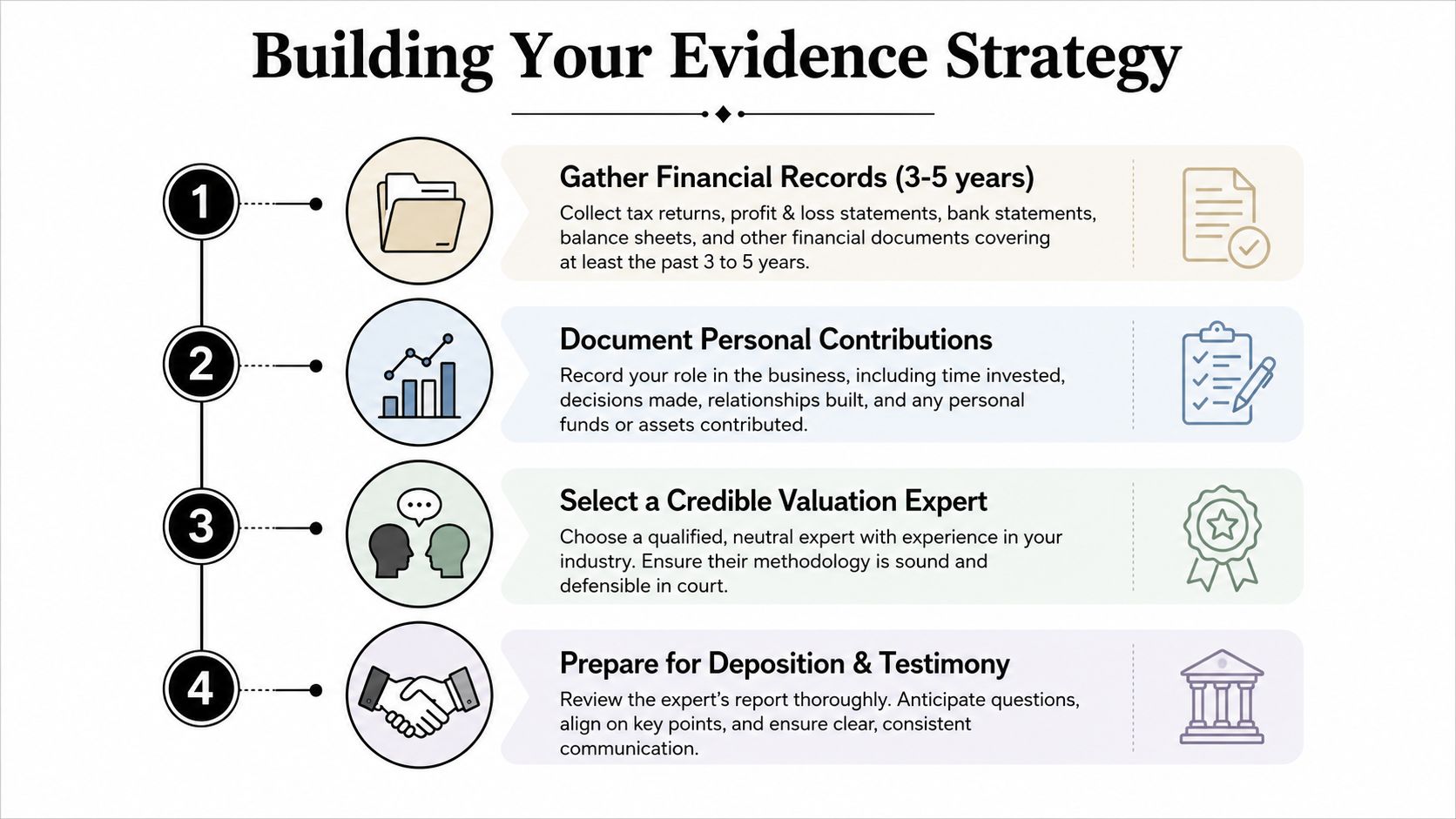
Building Your Evidence Strategy Early
The strongest valuation position usually belongs to the spouse with the clearest records. Don't wait until mediation or trial to begin collecting evidence. Your attorney and valuation professional need time to test the other side's assumptions, identify missing information, and explain your business in a way the court can understand.
Start with the records
Gather business and personal financial records through your lawyer's guidance. The useful categories include:
- Tax information: Individual and business tax returns, schedules, K-1 forms, and supporting workpapers.
- Accounting records: General ledgers, profit-and-loss statements, balance sheets, trial balances, and bank reconciliations.
- Revenue evidence: Invoices, accounts-receivable aging reports, payment histories, payer reports, and client or patient billing records.
- Compensation records: Payroll records, owner draws, distributions, benefits, bonuses, and personal expenses paid by the business.
- Business documents: Formation records, operating agreements, leases, employment agreements, contracts, vendor arrangements, and buy-sell provisions.
- Operational evidence: Staffing charts, procedure manuals, marketing materials, website records, referral information, and scheduling data.
Don't alter, delete, or move records after filing. Preserve them in their ordinary form and give them to counsel so discovery responses remain complete and accurate.
Choose the expert for the actual dispute
You need an appraiser who understands both professional practices and Texas divorce valuation. Ask about experience with your profession, familiarity with personal versus enterprise goodwill, courtroom testimony, and the assumptions the expert expects to test.
Your family lawyer should coordinate with the appraiser or forensic accountant. The appraiser calculates and explains value. Your lawyer addresses classification, admissibility, discovery, negotiation, and the legal limits on what the court may divide.
Use the waiting period wisely
Texas Family Code § 6.702 generally prevents a judge from granting a divorce before the 60th day after the petition is filed. The clock begins when the petition is filed with the court, not when the other spouse is served. Narrow family-violence exceptions can apply, including a qualifying conviction or deferred adjudication for family violence or an active protective order. The statutory rule appears in Texas Family Code § 6.702.
That waiting period isn't a reason to delay. Use it to secure records, identify experts, prepare discovery, and determine whether mediation can resolve the valuation dispute.
Two Scenarios That Show How Valuation Affects Your Outcome
Consider two professionals with similar incomes but very different businesses. The law doesn't value them the same because enterprise goodwill depends on what survives beyond the individual professional.

The physician-owned clinic
A physician owns a clinic with several staff members, a recognized clinic name, established scheduling and billing systems, and patient relationships connected to the organization. Other clinicians provide services, and the clinic continues generating revenue when the owner isn't personally treating every patient.
An appraiser might examine the clinic's historical earnings using an income or excess-earnings approach. The analysis would separate reasonable compensation for the physician's medical labor from earnings attributable to staff, systems, location, patient relationships, and the clinic's operations. Tangible assets and receivables would be evaluated separately.
The physician's license and personal reputation remain outside division. The community estate may nevertheless include measurable enterprise value if the evidence shows that the clinic could continue under different ownership or management. In mediation, the parties might negotiate an offset using other community assets rather than transfer ownership of the clinic itself.
The solo law practice
A solo attorney operates under her own name. Clients hire her for personal judgment and courtroom ability. There are no transferable client contracts, no other lawyers generating meaningful revenue, and no established system that could maintain the practice if she stopped working.
An opposing expert may still assign a goodwill figure by treating earnings above a selected salary as business value. Her attorney should test whether that conclusion reflects transferable enterprise value or capitalizes her future labor and reputation. The records may show valuable receivables, office equipment, and other assets, but those items don't automatically establish goodwill.
The likely negotiation centers on what can be proven. The attorney may retain the license and continue practicing, while the community estate addresses assets that have identifiable value. A court won't divide personal goodwill merely because the professional earns a substantial income.
These scenarios aren't predictions of a result. They show why the same formula can produce a distorted outcome when the expert ignores how the practice operates.
Your Next Steps for Protecting What You Have Built
Start with the legal boundary. Your license, future earning capacity, and personal goodwill aren't divisible property. Your practice's tangible assets, receivables, and independent enterprise goodwill may be included when the evidence supports them.
Then build the record before making a settlement demand. Preserve financial statements, tax filings, billing records, contracts, staffing information, operating procedures, and proof of how the practice performs when you aren't personally handling every task. Retain a qualified valuation expert early enough to challenge unsupported assumptions rather than reacting to the other side's report.
Your spouse may argue that years of financial support helped you obtain your professional credential. That argument usually doesn't convert the license into a divisible asset. The broader property division may still be affected by the just-and-right standard, which gives the court discretion to consider the circumstances of the community estate rather than assigning a value to your license.
If children are involved, protect the valuation process from disrupting parenting decisions. Property discovery, mediation, custody negotiations, child support, and enforcement issues require organized legal strategy, especially when business income and professional compensation overlap.
The Law Office of Bryan Fagan, PLLC can review your practice structure, identify the evidence that matters, coordinate valuation issues, and prepare you for mediation or litigation. You shouldn't have to guess whether a goodwill number reflects your business or your future labor.
The Law Office of Bryan Fagan, PLLC helps Texas professionals and business owners address license, goodwill, practice, and high-asset property issues throughout divorce. Schedule a free consultation to review your records, understand what may be divisible, and build a practical strategy for protecting your practice and financial future.