Facing a custody case can make you feel like your world is spinning out of control. When you're trying to protect what matters most—your relationship with your child—the complex legal terms can feel like a barrier. In Texas, the phrase you'll hear in court isn't "joint custody," but Joint Managing Conservatorship. It's the state's official term for what most people think of as joint custody, and understanding what it truly means is your first step toward regaining control.
This isn't just about splitting time down the middle. It's about sharing the profound responsibility to make the big-picture decisions that will shape your child's future.
What Joint Custody Really Means in Texas
The biggest misconception about texas joint custody is that it automatically guarantees you and the other parent will get the child for an equal amount of time. While a 50/50 schedule is certainly possible, the legal concept in Texas is much more focused on your shared rights and duties than it is on the calendar.
Think of it like being co-CEOs of the most important venture in the world: your child's life. The court entrusts both of you with the authority to make major decisions together, steering the ship as a team.

Conservatorship vs. Possession: A Critical Distinction
To get a handle on how joint custody works in Texas, you need to understand two key terms from the Texas Family Code. This isn't just jargon; it's the foundation of every custody order.
- Conservatorship: This is about your rights and responsibilities as a parent. It’s the legal authority that allows you to make decisions about your child’s education, medical care, and religious upbringing. When you are named Joint Managing Conservators, it means you and the other parent share this authority.
- Possession and Access: This is the nuts and bolts of the schedule—when your child is physically with each of you. It's what most people call the visitation schedule. Even in a joint custody arrangement, one parent is usually designated as the "primary" conservator who has the exclusive right to determine the child's residence.
This distinction is everything. You can have joint decision-making power (conservatorship) without having a perfectly equal parenting time schedule (possession).
The Court's Starting Point: Keeping Both Parents Involved
It’s often reassuring for parents like you to learn that Texas law begins with a strong preference for keeping both parents deeply involved in their child’s life. In fact, Texas courts operate under the presumption that naming parents as Joint Managing Conservators is in the child's best interest.
This legal starting point gives you a solid footing to have an equal say in major life decisions for your child. It's important to separate fact from fiction, and you can learn more about how common custody myths compare to legal realities to better understand this focus on mutual decision-making. This approach reflects the state's ultimate goal: to create stability and ensure your child benefits from the love and guidance of two parents, even after a separation.
Under the Texas Family Code, the single most important factor for a judge is always the "best interest of the child." A joint custody arrangement is often seen as the best way to foster a strong, healthy relationship with both parents.
This framework isn't designed to punish one parent or reward the other. It's built to create a stable, supportive foundation for your child's future. Understanding this helps you focus your energy where it matters most—on demonstrating how you can contribute positively to your child's well-being.
How Texas Courts Decide What Is Best for Your Child
Trying to see a custody case through a judge's eyes can be frustrating. You know you’re a great parent, but proving that in a formal courtroom setting is a completely different challenge.
The good news is that the process isn't a mystery. Texas courts are guided by a single, powerful principle that trumps everything else: the best interest of the child. This standard is the North Star for every decision a judge makes in your custody case. It’s not about what seems fair to you or the other parent; it’s about what will ultimately foster your child's happiness, security, and overall well-being. Understanding how a judge defines this concept is your key to building a strong case.
To give this broad idea real-world structure, Texas courts lean on a set of criteria known as the "Holley Factors." These factors stem from a landmark Texas Supreme Court case and give judges a framework to evaluate a family's situation from every important angle.
Breaking Down the Holley Factors
The Holley Factors aren't a simple checklist where you can score "points" against the other parent. Think of them as a holistic guide the court uses to get the complete picture of your child's life and unique needs. A judge will carefully weigh each of these elements to determine the custody arrangement that truly serves your child.
Key factors a judge will examine include:
- Your child's physical and emotional needs, both now and in the future.
- The parental abilities of you and the other parent.
- The stability of each home you can provide and the plans you each have for your child.
- Any emotional or physical danger the child might face.
- The past actions or failures to act by each parent that might show whether the parent-child relationship is a healthy one.
If your child is 12 years of age or older, the judge may also interview them privately to hear their wishes about which parent they’d prefer to have the right to designate their primary residence. While your child's preference is an important piece of the puzzle, it doesn’t automatically decide the outcome. The judge makes the final call based on all the evidence.
It’s vital to remember that the court's focus is forward-looking. While past behavior is relevant, a judge's main concern is creating a stable, supportive, and predictable environment for your child's future.
How These Factors Apply in Your Case
If you want to show the court that a joint custody arrangement is what’s best for your child, you need to back it up with evidence tied directly to these factors. This means going beyond just saying you're a good parent and actually demonstrating it with concrete examples. To get a deeper understanding of how courts use this standard, you can explore the guiding principles for best interest of the child decisions in Texas and see exactly how these factors come into play.
The table below gives you a practical look at what each Holley Factor really means and what a judge is likely looking for.
Key Factors in Determining the Best Interest of the Child
A breakdown of the 'Holley Factors' Texas courts use to make custody decisions, helping you understand what judges look for.
| Factor | What It Means for Your Case |
|---|---|
| Child's Needs | Does your child have special medical, educational, or emotional needs? Show how you are uniquely equipped and actively involved in meeting them. |
| Parenting Abilities | This looks at your track record of involvement in daily life—helping with homework, getting to doctor's appointments on time, and showing up for school activities. |
| Stability of the Home | The court prizes a safe, consistent, and predictable environment. This includes not just the physical condition of your home but also the stability of your employment. |
| Potential Dangers | This is where serious concerns like a history of domestic violence, substance abuse, or neglect come into play. Hard evidence is absolutely critical here. |
| Child's Wishes | For older children (12+), the judge will consider their preference but will also assess their maturity level and the reasons behind their choice. |
Once you understand these factors, you can start gathering the right information and building a case that clearly shows how your active involvement through a texas joint custody order is truly in your child's best interest.
Crafting Your Parenting Plan and Possession Schedule
Turning a judge's order into a real-life, day-to-day schedule for your family can feel like the hardest part of the process. Think of your parenting plan as the practical roadmap for your co-parenting relationship. It’s where you take the legal framework of texas joint custody and translate it into your daily life, creating the predictability and stability your child needs.
A well-drafted plan is your best defense against future conflict. It gives you clear answers when questions pop up about holidays, school breaks, and everyday routines, making sure you and the other parent are always on the same page.
The Texas Standard Possession Order as a Starting Point
When parents can't agree on a custom schedule, a Texas court will almost always fall back on the Standard Possession Order (SPO). This isn't just some arbitrary schedule; it's the state's default, carefully designed to give children a consistent and predictable routine.
The SPO outlines a clear framework for how time is divided. For the parent who doesn't choose the child's primary residence (the non-primary conservator), it typically includes:
- Possession on the first, third, and fifth weekends of a month.
- Alternating major holidays, like Thanksgiving and Christmas, each year.
- A 30-day stretch of possession during the summer vacation.
This schedule is the legal baseline in Texas. You can dive deeper into the specifics by checking out our guide to the Standard Possession Order in Texas, which breaks down the calendar and its rules.
Exploring the Expanded Standard Possession Order
Many modern families find the traditional SPO a bit too limited. In response, Texas offers an Expanded Standard Possession Order (ESPO), which has become incredibly common for a reason. The ESPO gives the non-primary parent more time, creating a schedule that often feels much closer to a 50/50 split.
The main difference is significant. With the ESPO, the non-primary parent’s weekend starts when school is dismissed on Thursday and ends when school resumes on Monday morning. That one change adds much more weekday and overnight time, which is huge for fostering a stronger daily connection with your child.
Under the Texas Family Code, the Expanded Standard Possession Order is presumed to be in the child's best interest. A judge will order it unless there's good evidence showing it isn't workable or isn't right for your child.
This framework shows the core principles that guide a judge's decision, always putting the child's needs, parental abilities, and overall stability first.
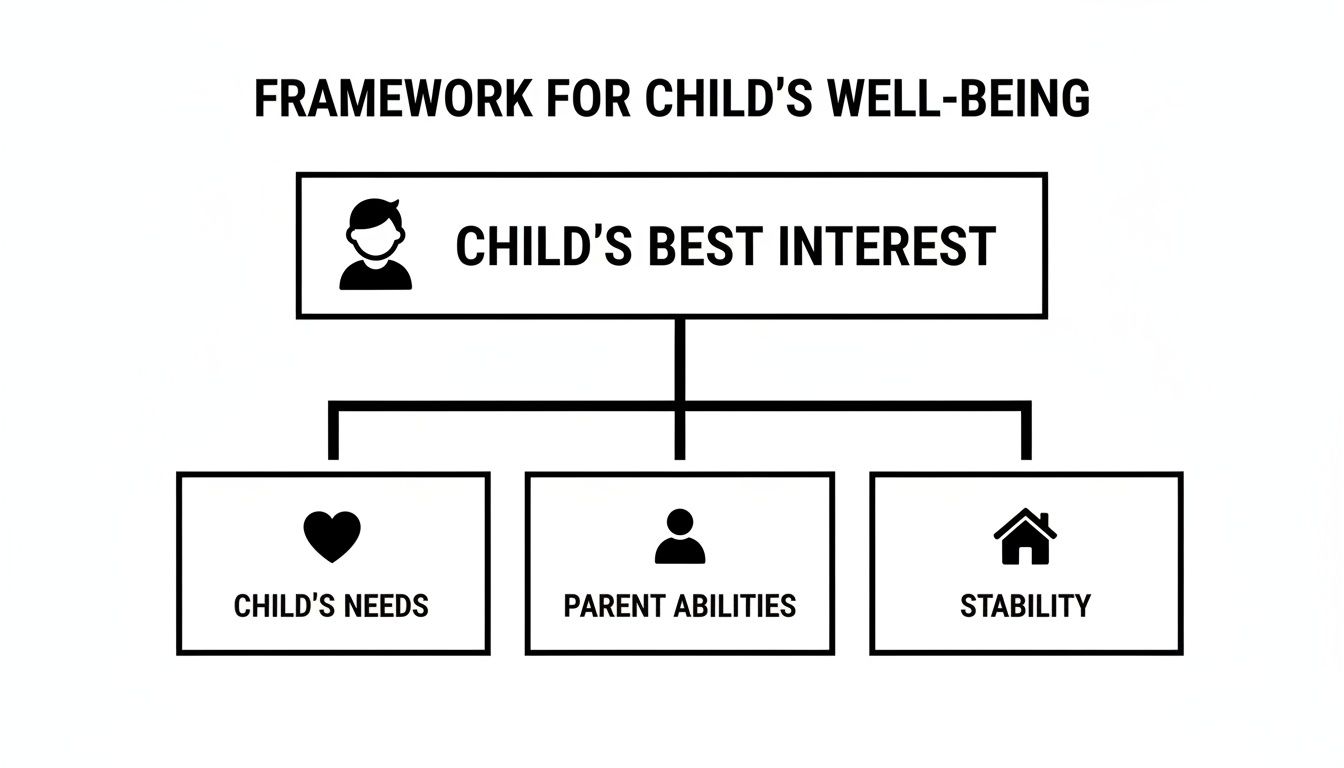
Every decision, including which possession schedule to order, flows from what is truly best for the child's well-being.
Creating a Custom Plan That Fits Your Family
The SPO is just a foundation. You and the other parent have the power to create a completely customized possession schedule that actually works for your family's unique life. Whether you work it out through direct negotiation or with the help of a mediator, you can craft a plan that accounts for your work schedules, your child's activities, and how far apart you live.
A strong custom plan should go beyond just the calendar. To reduce future conflict, you should think about including details on:
- Communication Rules: How will you talk about the kids? A co-parenting app? Weekly phone calls? Set the ground rules now.
- Extracurricular Activities: Who handles transportation, pays for fees, and attends games?
- Medical Decisions: How will you coordinate routine doctor's visits versus handling emergencies?
- Right of First Refusal: If one of you needs a babysitter for a few hours, do you have to offer that time to the other parent first?
For a complete rundown of what to include, it's worth reviewing the common elements found in a joint custody parenting plan. Taking the time now to build a clear, thorough, and practical plan is one of the best investments you can make for your child's stability and your own peace of mind.
How Child Support Works with Joint Custody
When you're facing a custody case, the financial side of things can feel overwhelming. One of the biggest myths we have to bust for clients is the idea that a Texas joint custody order means nobody pays child support. It seems logical—if you share the kids, you share the costs. But that's not how the law sees it.
It's critical to understand that even when you share decision-making and have significant time with your children, a child support obligation almost always exists. This isn't a penalty—it's the court's way of making sure your child’s needs are met consistently, no matter whose home they are in.
In Texas, your possession schedule and your child support obligation are two separate legal duties. The court's number one goal is to ensure your child is financially supported.

Who Pays Child Support in a Joint Custody Case
In nearly every joint managing conservatorship, the judge will name one parent the primary conservator. This is the parent who has the exclusive right to decide where the child lives. Think of them as the child's "home base."
The other parent, sometimes called the non-primary conservator, is almost always ordered to pay child support. In legal terms, the parent paying is the "obligor," and the parent receiving support is the "obligee." These payments are meant to help the primary parent cover the child's everyday expenses—things like their share of the rent or mortgage, food, clothes, and school supplies.
How Texas Calculates Child Support
To keep things fair and consistent across the state, Texas uses a clear formula to calculate child support based on a percentage of the paying parent’s net monthly resources.
Here’s a step-by-step breakdown of the process:
- Determine Gross Income: First, the court adds up all income sources. This isn't just a paycheck; it includes wages, bonuses, commissions, overtime, and self-employment earnings.
- Calculate Net Resources: Next, certain deductions are subtracted from the gross income. These include required taxes, union dues, and the amount paid for the child's health insurance. What's left is the parent’s net monthly resources.
- Apply Percentage Guidelines: Finally, a specific percentage is applied to those net resources, depending on how many children are involved. For one child, the guideline is 20% of net resources. For two children, it's 25%, and so on.
While the approach is structured, figuring out the variables can get complicated. To get a clearer picture of what the numbers might look like in your situation, it helps to dive into the details of how to calculate child support in Texas.
The Impact of the Child Support Cap
For higher-income families, it's important to know that Texas puts a "cap" on the amount of income used in the support calculation. This cap is adjusted every few years to keep up with inflation.
Effective September 1, 2025, the maximum net monthly resources subject to the child support guidelines will increase from $9,200 to $11,700.
If the paying parent earns more than the cap, the percentage will only be applied up to $11,700 per month. However, a judge can still order additional support above the guideline amount if there's proof it's in the child's best interest. This often comes into play for children with special needs, expensive extracurriculars, or unique educational expenses.
Changing or Enforcing Your Custody Order
Life doesn't stand still, and sometimes, a custody order that worked perfectly a year ago no longer fits your family. While a final decree is designed to create stability, Texas law understands that circumstances change. That’s why the law allows for a modification—an official update to your order.
On the flip side, what happens when the other parent doesn't follow the court order? When they fail to follow the schedule or ignore other rules in the decree, you have powerful legal tools to enforce your rights and get your child’s routine back on track.
How to Modify Your Joint Custody Order
You can't just ask a judge to change an order on a whim. To begin the process, you must first prove there’s been a “material and substantial change” in the circumstances of your child or one of the parents. This is the legal key that unlocks a modification.
So, what does that mean in the real world? It's a significant shift that makes the current order unworkable or no longer in your child's best interest.
Common examples that often qualify include:
- A parent gets a new job that requires a relocation outside the geographic restriction in your current order.
- One parent’s work schedule changes dramatically, making the old pickup and drop-off times impossible.
- The child’s own wishes have changed, especially once they reach 12 or older and can tell the judge their preference.
- A parent gets remarried, bringing a new step-family into the picture.
- Serious concerns arise about the child's physical or emotional safety at the other parent's home, like issues with substance abuse or neglect.
Once you prove this change has happened, the court moves to the second, equally important question: Is changing the order in the child’s best interest? You have to prove both points to win a modification.
Enforcing Your Order When a Parent Won't Comply
There's nothing more frustrating than a co-parent who consistently ignores the possession schedule. Maybe they're always late for exchanges, keep the kids an extra day after a holiday, or refuse to return them at the end of their visit. These are violations of a court order, and they carry serious consequences.
To hold the other parent accountable, you can file a Motion for Enforcement with the court. This legal document formally asks a judge to step in, force the other parent to follow the rules, and lays out every single violation that has occurred.
You have to be incredibly specific in an enforcement action. It's not enough to say, "He's always late." You need to list the exact dates, times, and details of each violation. Vague complaints will get you nowhere with a judge.
If the court agrees that the other parent has violated the order, the judge has a whole toolbox of remedies. The consequences can be severe and might include:
- Ordering make-up possession time for you to cover every minute you lost.
- Making the non-compliant parent pay your attorney's fees and all court costs.
- Imposing hefty financial penalties or fines.
- In serious or repeat cases, ordering jail time for contempt of court.
Your best weapon in an enforcement case is a detailed log. Keep a record of every violation—dates, times, and copies of any texts or emails about it. That log is the most powerful evidence you can bring to court.
Common Questions About Texas Joint Custody
When you’re trying to wrap your head around Texas joint custody, it’s natural to have questions. Every family is different, and the standard legal language doesn't always speak to your specific worries. Let's tackle some of the most common questions we hear from parents in your shoes.
Can my child decide which parent to live with in Texas?
This is one of the first things parents ask, especially when their kids are getting older. In Texas, once a child turns 12, the law gives them a voice. They can meet with the judge in private to say which parent they’d prefer to have the right to decide where they live.
But here’s the critical part: your child’s preference is not the final word. A judge will listen respectfully and give their opinion real weight, but it's just one piece of a much larger puzzle. The court’s ultimate decision will always come down to what’s in the child's overall best interest, considering everything from their maturity level to the reasons behind their choice.
What happens if we disagree on a major decision?
As joint managing conservators, you’re going to disagree. What happens when one of you wants public school and the other wants private? A smartly written parenting plan anticipates these roadblocks.
Instead of letting a single disagreement escalate into a court battle, your decree can include a tie-breaking mechanism. Common solutions include:
- Assigning a "tie-breaker" role for specific areas. For example, one parent might have the final say on education, while the other gets the final say on non-emergency medical decisions.
- Requiring mediation for that specific issue before either of you can go back to court.
Defining this process from the start is one of the best ways to keep future conflict—and legal fees—to a minimum.
Do I still pay child support with a 50/50 schedule?
It's a common myth that a 50/50 possession schedule automatically wipes out child support. In Texas, that's almost never the case. Even when you split time right down the middle, a judge can—and frequently does—order one parent to pay child support.
This usually happens when there's a significant gap in income between you and the other parent. The court's primary goal is to make sure your child’s standard of living is consistent and stable in both homes. This is sometimes called an "offset" payment. While the amount might be calculated differently than the standard guidelines, the obligation is there to protect your child's financial well-being.
What to Do Next
Navigating the Texas family court system can feel like trying to find your way through a maze in the dark. But with this knowledge, you now have a roadmap. Understanding the fundamentals of Texas joint custody shifts you from a place of uncertainty to one where you can make informed, confident decisions for your family.
The best way to protect your family's future is by getting expert legal guidance tailored to your unique situation. You don't have to face this alone. The compassionate attorneys at The Law Office of Bryan Fagan, PLLC, are here to provide the clarity and support you need.
We invite you to schedule a free, confidential consultation with our team. Let's sit down, discuss your circumstances, and map out a clear strategy to protect your parental rights and your child's well-being. Contact us today to take the first step toward a stable future for your family.
Navigating the specifics of your case requires more than just general answers—it requires a personalized strategy. The team at The Law Office of Bryan Fagan, PLLC is here to provide the compassionate, expert guidance you need. Schedule a free consultation with us today by visiting https://texasdivorcelawyer.us to get clarity and confidence for your next steps.