Skip to content
Navigating a custody case feels like a heavy weight to carry, but understanding the landscape is the first step toward taking back control. What you might call "shared custody" is legally known in Texas as Joint Managing Conservatorship, and it's what courts assume is best for your child right from the start. This means the default belief is that you and the other parent should share the rights and duties of raising your kids.
You're Not Alone in This Journey
If you're feeling overwhelmed or anxious about a custody dispute, that’s completely normal. The goal here is to cut through the legal noise and give you the knowledge you need to handle shared custody in Texas with confidence. We’ll break down confusing terms like ‘conservatorship’ and ‘possession orders’ into plain English, so you can walk into any conversation feeling prepared.
You’ll see how Texas courts put one thing above all else: the "best interest of the child." This isn't just a catchphrase; it's the legal standard that guides every single decision a judge makes. It’s not about what’s fair to you or the other parent—it’s about creating an environment where your child can thrive emotionally, physically, and mentally.
Understanding Today's Legal Reality
Texas law has come a long way and now presumes that joint managing conservatorship is in your child's best interest. It’s important to know this term refers to shared decision-making authority, not necessarily a 50/50 split of physical time with your child.
This legal shift is a big step toward recognizing the importance of both parents. However, the numbers show there's still a gap between legal theory and courtroom reality. Fathers in Texas, for example, get about 33% of parenting time, which is close to the national average of 35%. This tells us that while the law aims for partnership, achieving a true 50/50 physical custody schedule can still be an uphill battle. You can read more about Texas divorce and custody statistics to get a clearer picture of these trends.
Our mission is to show you that with the right strategy, you can secure a fair arrangement that sets your family up for a positive new chapter. We’ll walk you through the practical steps to build a stable, loving home where you and the other parent can stay deeply involved in your child's life.
Decoding the Language of Texas Custody
To protect your relationship with your child, you first need to understand the specific language the court uses. Here in Texas, you'll rarely hear a judge say the word "custody." Instead, the Texas Family Code talks about conservatorship—a legal bundle of your parental rights and duties.
Think of it like being a board member for the most important company in the world: your child's life. The court’s job is to figure out how the board members—you and the other parent—will share these responsibilities. Getting a handle on these terms is the first, and most critical, step toward building a strong case.
Managing Conservatorship: The Power to Decide
The first key concept you'll encounter is Managing Conservatorship. This is all about the power to make the big, life-shaping decisions for your child. It answers the question: who gets to have a say in the major issues that will define your child's upbringing?
These major decisions typically include the right to:
- Determine where your child lives.
- Make decisions about your child's education.
- Consent to medical, dental, and psychological treatment.
- Decide on the religious and moral training of your child.
Texas law has a very clear starting point: it presumes that a Joint Managing Conservatorship (JMC) is in your child's best interest. In plain English, this means the court wants you and the other parent to share these critical decision-making rights. It's like a business partnership where both partners must collaborate on major company directives.
This visual shows how Texas courts structure these decisions, always starting with your child's best interest as the foundation.
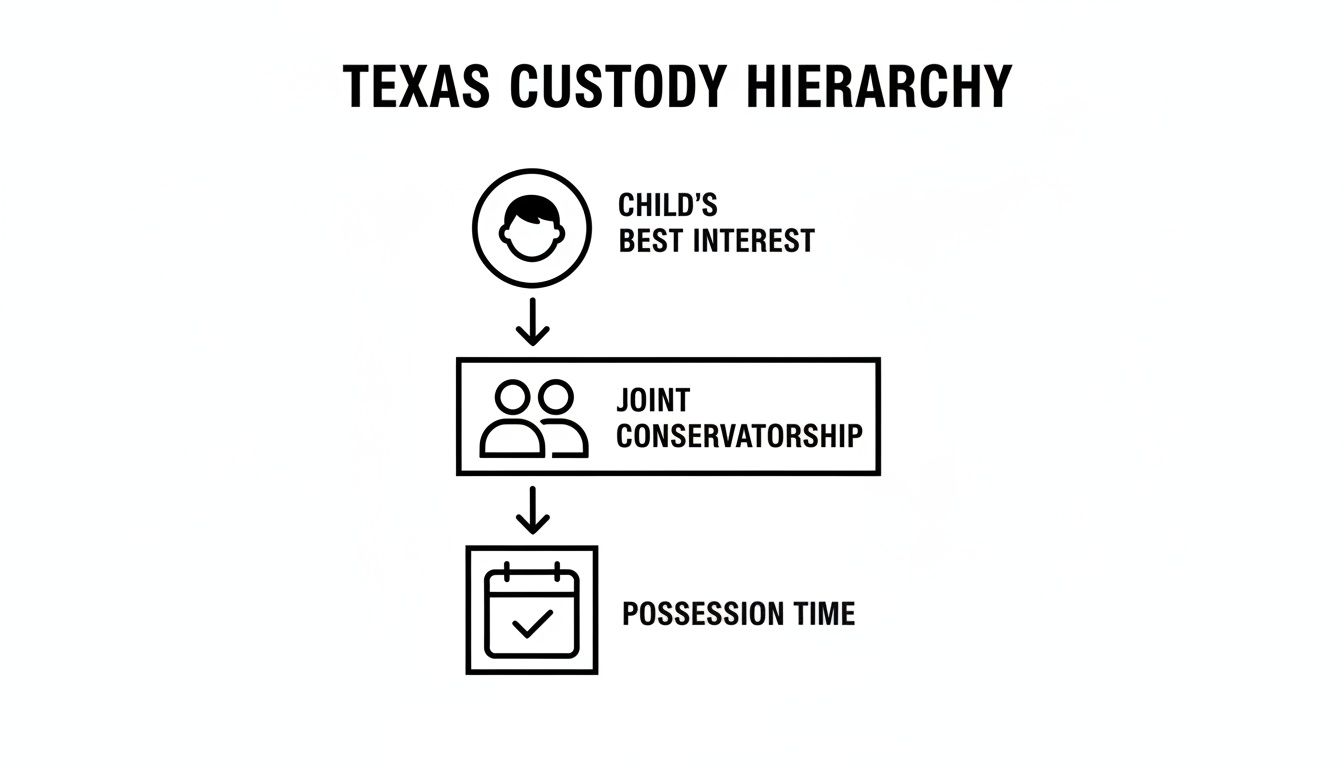
As the diagram shows, everything flows from this single principle, which then shapes how responsibilities and parenting time are split.
Possessory Conservatorship: The Right to Physical Time
While managing conservatorship is about making decisions, Possessory Conservatorship is about something much more personal: the right to have physical possession of your child. This is the legal term for parenting time—the periods when your child is actually with you.
Even when decision-making is shared under a Joint Managing Conservatorship, one parent is usually designated as the primary conservator. This role is critical.
The primary conservator is the parent who has the exclusive right to decide the child’s residence, typically within a specific geographic area. This is also the parent who usually receives child support payments.
The other parent is then named the possessory conservator. You will have a set schedule of time with your child, known as a possession order. This schedule lays out exactly when your child will be with each of you, including weekends, holidays, and summer breaks.
It's vital to understand this distinction. You can share joint decision-making powers (JMC) but still have one parent designated as primary with a standard possession schedule. Your goal should be to work toward an arrangement that maximizes your involvement in both areas. You can learn more about how to structure these schedules in our guide to the Standard Possession Order.
What You Can Do Next
Knowing these terms is your first advantage. It empowers you to communicate effectively with your attorney and the court. When you say you want "shared custody," you can now specify whether you're focused on securing joint decision-making rights, a more balanced possession schedule, or both. This clarity is essential for building a strategy that truly protects your parental rights and your child's future.
Creating Your Parenting Schedule with a Possession Order
Figuring out the day-to-day logistics of shared custody can feel like solving a complex puzzle. That's where a Possession Order comes in. It’s the official roadmap for your parenting schedule, laying out exactly who has the children and when.
A good Possession Order turns confusion into a predictable routine. This isn't just for you and the other parent—it’s for your children, giving them the stability they need to thrive across two homes.
In Texas, the default starting point for this roadmap is the Standard Possession Order (SPO). Think of it as the state’s template for parenting time, designed to keep both parents actively involved. Courts generally presume the SPO is in a child's best interest, especially when you and the other parent live within 100 miles of each other.
What the Standard Possession Order Looks Like
The SPO gives the non-primary parent a regular, predictable schedule with the kids. While it isn’t a perfect 50/50 split, it provides more than enough time for you to maintain a strong, consistent presence in your children's lives.
Here’s a step-by-step breakdown of a typical SPO when parents live fairly close:
- Weekends: The non-primary parent usually has the children on the first, third, and fifth weekends of any given month.
- Holidays: Major holidays like Thanksgiving and Christmas are split and alternated between parents each year, so everyone knows what to expect.
- Summer Vacation: The non-primary parent typically gets 30 days of possession during the summer, which can be taken all at once or broken up.
This structure provides a clear framework, but the details matter. To see exactly how these schedules work, check out our deep dive into the Texas Standard Possession Order. Understanding the default is the first step in deciding if it’s the right fit for your family.
Beyond the Standard: Customizing Your Schedule
Just because the SPO is the default doesn't mean it's your only option. You and the other parent have the power to create a completely custom possession schedule that works for your family’s unique situation. As long as you can work together to create a plan that is in your child’s best interest, a Texas judge will almost always sign off on it.
This flexibility is a huge advantage. It lets you build a schedule around your work shifts, your child's school activities, and your specific co-parenting dynamic. It’s your chance to move beyond a template and focus on what truly helps your child thrive.
A customized possession order allows you to be creative and practical. The goal isn't just to divide time, but to create a stable, nurturing environment for your child across two homes. The court supports agreements that reflect thoughtful co-parenting.
Many families today are moving toward schedules that offer a more equal, 50/50 division of time. This approach reflects a modern reality where both parents are deeply involved in the day-to-day routines of their children’s lives.
Exploring 50/50 Shared Custody Schedules
The trend toward more balanced parenting time is growing. These schedules aren't just hypotheticals; they are becoming more common in Texas courtrooms as judges recognize the benefits of keeping both parents equally engaged.
Two popular 50/50 schedules are the 2-2-5-5 rotation and the week-on, week-off schedule. The 2-2-5-5 schedule (where you have Mondays/Tuesdays, the other parent has Wednesdays/Thursdays, and you alternate weekends) is great for younger kids. For older kids and teens, a simple week-on, week-off plan often works beautifully.
To help you visualize the options, let’s compare some of the most common schedules.
Comparing Common Texas Possession Schedules
This table breaks down the SPO and two popular 50/50 alternatives to help you see what might work best for your family.
| Schedule Type | Parenting Time Split | Best For | Key Feature |
|---|---|---|---|
| Standard Possession Order (SPO) | Approx. 45/55 | Parents who need a court-ordered, predictable structure. | Alternating holidays and a 30-day summer possession for the non-primary parent. |
| Week-On / Week-Off | 50/50 | Older children and teens who can handle longer periods away from one parent. | Minimizes exchanges, giving children a full week to settle into each home. |
| 2-2-5-5 Schedule | 50/50 | Younger, school-aged children who benefit from seeing both parents frequently. | A child is never away from a parent for more than a few days at a time. |
Choosing the right schedule is a deeply personal decision that depends entirely on your kids. A week-on/week-off plan might be a game-changer for a self-sufficient teenager, but it could be tough for a first-grader who needs more frequent contact with both parents.
Likewise, the 2-2-5-5 schedule provides that frequent contact but requires more handoffs and coordination between homes. There's no single "best" answer—only what's best for your child.
How Shared Custody Affects Child Support Calculations
Let's talk about the financial side of your parenting plan. We get this question all the time: "If we split time with our kids 50/50, does that mean no one has to pay child support?" It's a logical question, but in Texas, the answer is almost always no.
Child support and possession time are two separate issues in the eyes of the court. Even with a perfectly balanced schedule, the court will still designate one parent to receive support payments. The law sees child support as a right that belongs to the child, not the parent, to ensure their needs are met consistently no matter which home they're in.

How Texas Calculates Guideline Child Support
Texas has a specific formula it uses to calculate "guideline" child support. The calculation starts with the non-primary parent's "net monthly resources." This is essentially your take-home pay after certain deductions, but it often includes more than just your salary.
Your net resources can include income from a whole host of sources:
- Wages, salaries, tips, and bonuses
- Self-employment income
- Rental income from properties you own
- Retirement benefits, pensions, and social security
- Dividends, interest, and royalties
From this total gross income, the state allows deductions for things like federal income taxes, Social Security taxes, and what you pay for your child's health insurance. The final number is your net monthly resources, and that's the figure the court plugs into its formula. For a deeper dive into this math, check out our guide on how to calculate child support in Texas.
The Percentage-Based Formula in Action
Once the court determines your net monthly resources, it applies a set percentage based on how many children you have. It's a straightforward starting point for the conversation.
Here is the standard breakdown:
- One Child: 20% of net resources
- Two Children: 25% of net resources
- Three Children: 30% of net resources
- Four Children: 35% of net resources
- Five or More Children: 40% of net resources
For example, if the parent paying support has $6,000 in net monthly resources and two kids, the guideline child support payment would be $1,500 per month (25% of $6,000). While this formula is the starting point, judges have the discretion to deviate from it if they believe it's in the child's best interest.
It's a common myth that 50/50 possession automatically cancels child support. A judge can consider equal possession time as a reason to lower the guideline amount, but they are not required to. The primary factor almost always comes back to the financial resources of each parent.
Important Updates to Texas Child Support Laws
The financial world is always changing, and Texas law has had to adapt. Significant legal reforms took effect on September 1, 2023, that directly impact how child support is calculated for many Texas families.
One of the biggest changes was raising the income cap for guideline support calculations from $9,200 per month. This was a long-overdue adjustment that acknowledges today's economic realities—especially when you consider that the average annual cost of toddler care in Texas is a staggering $8,718. This change means that higher-earning parents may now have their support obligations calculated based on a larger portion of their income, ensuring the support amount more accurately reflects their ability to provide for their children.
Achieving Your Custody Goals Through Mediation or Court
Knowing what a shared custody order should look like is one thing, but how do you actually get one? In Texas, you have two primary paths to a final, court-approved agreement: working together through mediation or having a judge decide for you in court.
Your journey toward a stable co-parenting future will almost certainly start with mediation. In fact, most Texas courts require parents to try mediation before they will schedule a final trial. This process is a confidential, structured negotiation where you and the other parent sit down with a neutral third-party mediator.
The mediator’s job isn’t to take sides or make decisions for you. Think of them as a facilitator—someone trained to guide a productive conversation, helping you find common ground and build your own customized parenting plan, piece by piece.
The Power of Mediation
Mediation puts you in the driver’s seat. Instead of handing over control of your family’s future to a judge who only knows you from paperwork and brief courtroom appearances, you and the other parent craft an agreement that truly works for your unique situation. This collaborative approach has huge benefits.
Agreements reached in mediation are often:
- Faster: A successful mediation can resolve your entire custody case in a single day, while a court battle can drag on for months or even over a year.
- Less Expensive: Litigation racks up extensive legal fees, court costs, and expert witness expenses. Mediation is a fraction of that cost.
- More Durable: Because you both had a hand in creating the plan, you are both more likely to follow it long-term. This simple fact reduces future conflict and keeps you out of court.
Mediation also creates a space for creative solutions that a judge might not be able to order. To learn more about this powerful alternative, you can read about the differences between family mediation and court proceedings and see how it empowers parents.
When Court Becomes Necessary
What happens if you just can’t reach an agreement? If mediation fails or isn't appropriate—for instance, in cases involving family violence—your case will move toward litigation. This is the traditional court process where each side presents their case to a judge, who then makes a final, binding decision.
A contested custody case is an adversarial process. It involves formal legal steps, including filing petitions, exchanging evidence through a process called "discovery," and arguing your position in hearings. At a final trial, you and your attorney will present evidence and witness testimony to convince the judge that your proposed plan is in your child’s best interest.
Evidence is everything in a contested custody case. A judge will be looking for concrete proof of your involvement, stability, and parenting skills. This can include school records, communication logs, photos, and testimony from teachers or counselors.
Ultimately, the goal is always to find the most peaceful and effective path forward. Beyond legal strategies, professional support for the family unit through methods like family therapy can significantly aid in achieving long-term custody goals and harmonious co-parenting, whether you are in mediation or litigation.
Your Action Plan for Moving Forward
Navigating a Texas custody case is a marathon, not a sprint. The practical steps you take now will build the foundation for a strong finish. This isn't just theory—it's a checklist to help you take control and move forward with purpose.
Step 1: Get Organized
This one small step—organizing the documents that will become the backbone of your case—can have a massive impact. It ensures you're ready for anything your attorney or the court asks for. Find a secure folder or create a dedicated digital file and begin collecting these key items:
- Financial Records: Grab your last two years of tax returns, your most recent pay stubs, and bank statements.
- Child-Related Documents: You'll need your child's birth certificate, social security card, report cards, and any medical or therapy records.
- Proof of Your Involvement: Start saving photos, emails, or text messages that paint a clear picture of you as an active, engaged parent.
Step 2: Start a Parenting Journal
This might be one of the most powerful tools in your arsenal. Get a simple notebook or a secure app and start documenting your day-to-day involvement with your child. Keep track of every parent-teacher conference you attend, doctor's appointments you handle, and every evening you spend helping with homework. This detailed record provides concrete, undeniable evidence of your commitment.
A consistent journal tells a much more compelling story than simply saying you're an involved parent. It shows a clear pattern of responsible, hands-on parenting that judges find incredibly persuasive.
What to Do Next
The road to securing a fair shared custody Texas order can be emotionally draining, but you don't have to walk it alone. While these first steps are vital, the most important move you can make is to team up with a legal advocate who will stand up and fight for your parental rights.
We invite you to take that step with confidence. Schedule a free, confidential consultation with The Law Office of Bryan Fagan, PLLC. Let’s sit down, talk about your unique situation, and start building a strategy to protect your relationship with your child and secure your family’s future.
Frequently Asked Questions About Shared Custody
Going through a custody case in Texas always sparks a lot of questions. It's completely natural. Below, you'll find straightforward answers to some of the most common concerns we hear from parents who are right where you are now. Getting informed is the first real step toward feeling more in control.
Can we agree to a 50/50 schedule without going to court?
Yes, you and the other parent can absolutely create your own 50/50 possession schedule. In fact, judges prefer when parents can cooperate and create a plan that serves their child's best interests. This is usually accomplished in mediation, resulting in a powerful document called a Mediated Settlement Agreement (MSA).
But here’s the critical part: your informal agreement isn't legally binding on its own. You must have your agreement written into a formal court order and signed by a judge. Without that signature, the agreement is unenforceable, leaving you with no legal options if the other parent suddenly decides to stop following it.
What if the other parent violates the custody order?
It's incredibly frustrating and destabilizing for your child when a parent ignores the possession order. If this happens, you have the right to take action by filing a Motion for Enforcement with the court. This legal filing asks the judge to step in and force the other parent to comply.
To win an enforcement action, you must prove that the other parent knowingly violated a clear and specific part of the order. The penalties can be severe and may include:
- Ordering the other parent to pay fines and cover your attorney's fees.
- Sentencing them to jail time for contempt of court.
- Requiring them to give you make-up possession time with your child.
Can a Texas custody order be changed later on?
Yes, custody orders can be changed—or "modified," in legal terms—but it's not something the court takes lightly. Life changes, and the law understands that a parenting plan for a toddler won't work for a teenager. To get a modification, you must prove to the court that there has been a "material and substantial change" in the circumstances of the child or one of the parents since the last order was put in place.
What counts as a major change? A parent relocating for a new job, a significant shift in a work schedule, or a child developing new educational or medical needs could all qualify. Even then, the court will only approve the change if it is also in the child’s best interest.
The "material and substantial change" standard exists for a reason: to provide stability for children. Courts are reluctant to constantly change a child's routine unless there is a truly compelling reason to do so.
Does my child get to decide where they live?
This is one of the most common questions we get, especially from parents with teens. Under the Texas Family Code, once a child is 12 years of age or older, they can file a document with the court stating their preference for which parent they want to have the exclusive right to decide where they live.
The judge is required to interview the child, but the child’s preference is not the final word. It’s just one piece of the puzzle. The judge will consider your child’s wishes alongside all the other evidence, but the final decision will always come down to the child's best interest. Your child’s maturity level and their reasons for their choice will heavily influence how much weight the judge gives their opinion.
Navigating the complexities of enforcing or modifying a shared custody order in Texas requires skill and experience. You don't have to face these challenges alone. At The Law Office of Bryan Fagan, PLLC, our team is dedicated to protecting your parental rights and securing your child's future. Schedule a free, confidential consultation with us today to discuss your options and build a clear path forward.