Skip to content
You can be sitting at the kitchen table, looking at divorce papers, and suddenly find out your spouse's compensation includes stock options you can't see, can't touch, and can't easily value. That is exactly the kind of asset that makes a Texas divorce feel unfair before anyone even signs a decree.
The good news is that Texas courts have a framework for this. The hard truth is that unexercised stock options are often divided like any other marital asset, even when they're not yet exercisable, and that creates real risk if nobody puts the right language in the divorce order.
Why Unexercised Stock Options Complicate Your Texas Divorce
A spouse in a Houston high-rise job or a Dallas tech role can look rich on paper and still leave the other spouse guessing what the options are worth. That's because these awards live in the future, while divorce happens in the present. The result is anxiety, delay, and a lot of bad assumptions.
Texas does not ignore that problem. Under Texas law, the court looks at when the option was earned and when the marital effort happened, not just whether the option can be exercised today. That's why dividing unexercised stock options in a Texas divorce is such a serious issue, especially when the vesting schedule stretches past the separation date and the divorce decree has to decide who bears the risk.
The real problem is not just ownership, it's timing
A stock option can feel intangible because the employee spouse may not be able to cash it out yet. But Texas family courts still treat it as part of the property picture when the service period overlaps the marriage. The key issue is whether some or all of the award belongs to the community estate under the Texas Family Code, even if the employee can't exercise it right away.
That's where many people get blindsided. They think “not vested” means “not divisible.” In Texas, that's not how it works.
Practical rule: If the option was earned during the marriage, the fact that it can't be exercised yet usually does not remove it from division.
The public-facing problem is simple. Most spouses want to know whether they'll share in the upside, the downside, or both. Texas law gives courts a way to split that future value, but the decree has to say how.
If you want a broader explanation of marital property rules, start with How Property Is Divided in a Texas Divorce, which explains the just-and-right framework Texas courts use every day.
How Texas Law Classifies Stock Options as Community or Separate Property
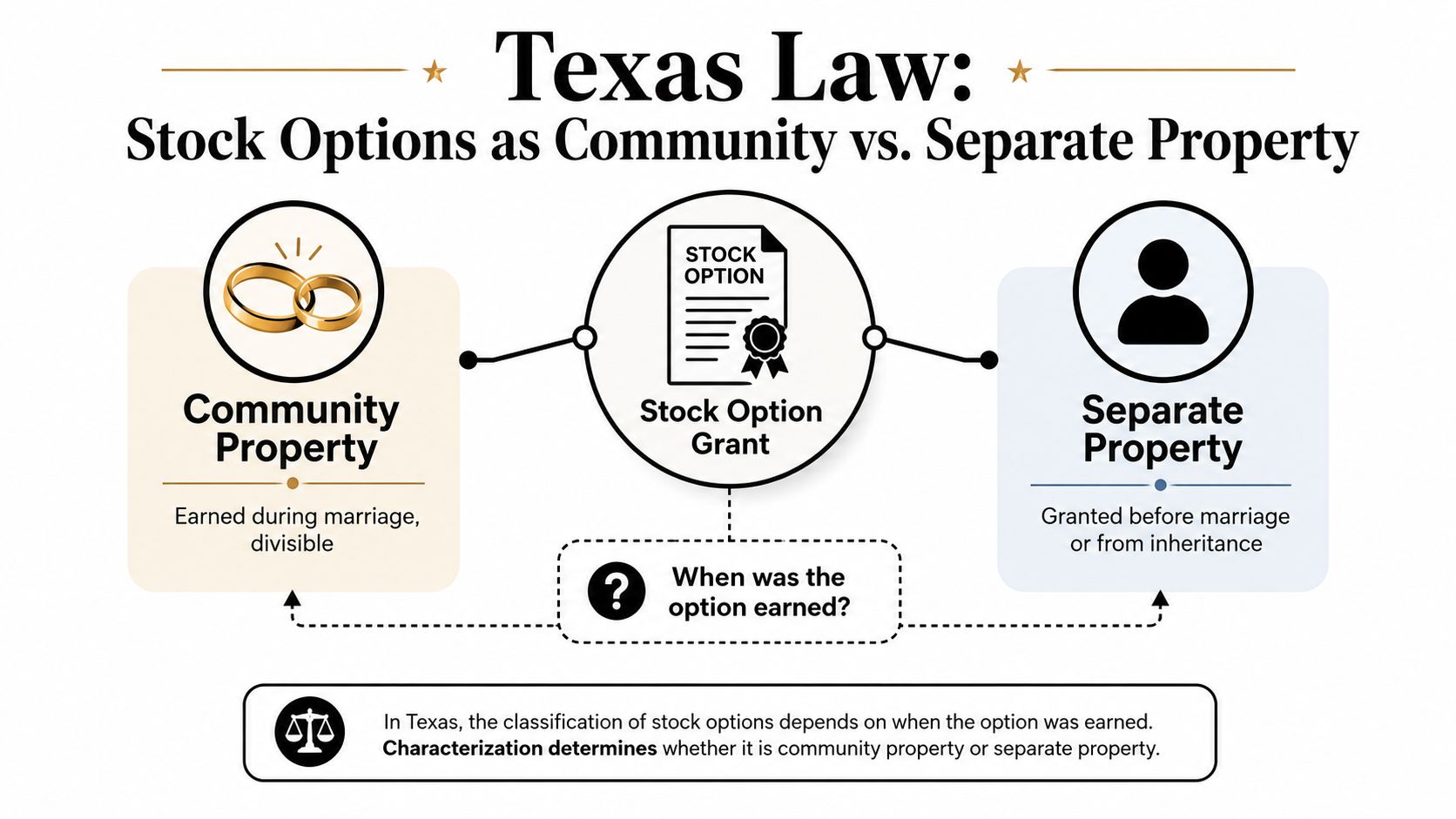
Texas classifies property by asking a basic question, when was it acquired. For stock options, that question gets tricky because the grant date, vesting date, and exercise date may all be different. Think of the option like a paycheck earned over time, not a prize handed over all at once.
Texas Family Code Section 3.007 is the key statute for this analysis, and it ties the classification to the service period behind the award. If the option was granted before marriage but the earning period overlaps the marriage, part of it can still fall into the community estate. If it was granted during marriage but doesn't fully vest until after divorce, the post-divorce portion can be treated as separate property, with the balance divided as community property. The same idea shows up in Texas appellate materials and practitioner guides, which consistently use a time-based approach rather than a simple yes-or-no rule. See the statutory discussion of unvested awards in Texas law on RSUs and stock options in divorce and the months-based historical approach described in Texas appellate materials on stock options, plus the time-rule explanation in a Texas divorce context, here and here.
Why vesting doesn't save the employee spouse
Vesting matters, but it doesn't control everything. Texas looks at the work behind the award. If the employee spouse earned the option through service performed during marriage, the community estate has a claim to that portion even if the award is still locked up.
That is why lawyers fight over grant language, plan documents, and employment terms. A stock option package tied to retention or long-term service can carry a real marital component, even when the employee says, “I can't do anything with it yet.” The court's answer is usually that the asset still exists, so the community share still has to be handled in the decree.
Separate property and mixed-character awards
Some awards are easier. If the option was granted before marriage and no marital effort is involved, that portion may remain separate property. But many grants are mixed. That's where the calculation matters, and where casual assumptions can cost you money.
The safest way to think about it is this, Texas does not ask whether the option feels liquid. Texas asks what part of the earning period belonged to the marriage. If the answer is “some of it,” then the decree has to divide some of it.
The Time-Rule Formula Texas Courts Use to Divide Options
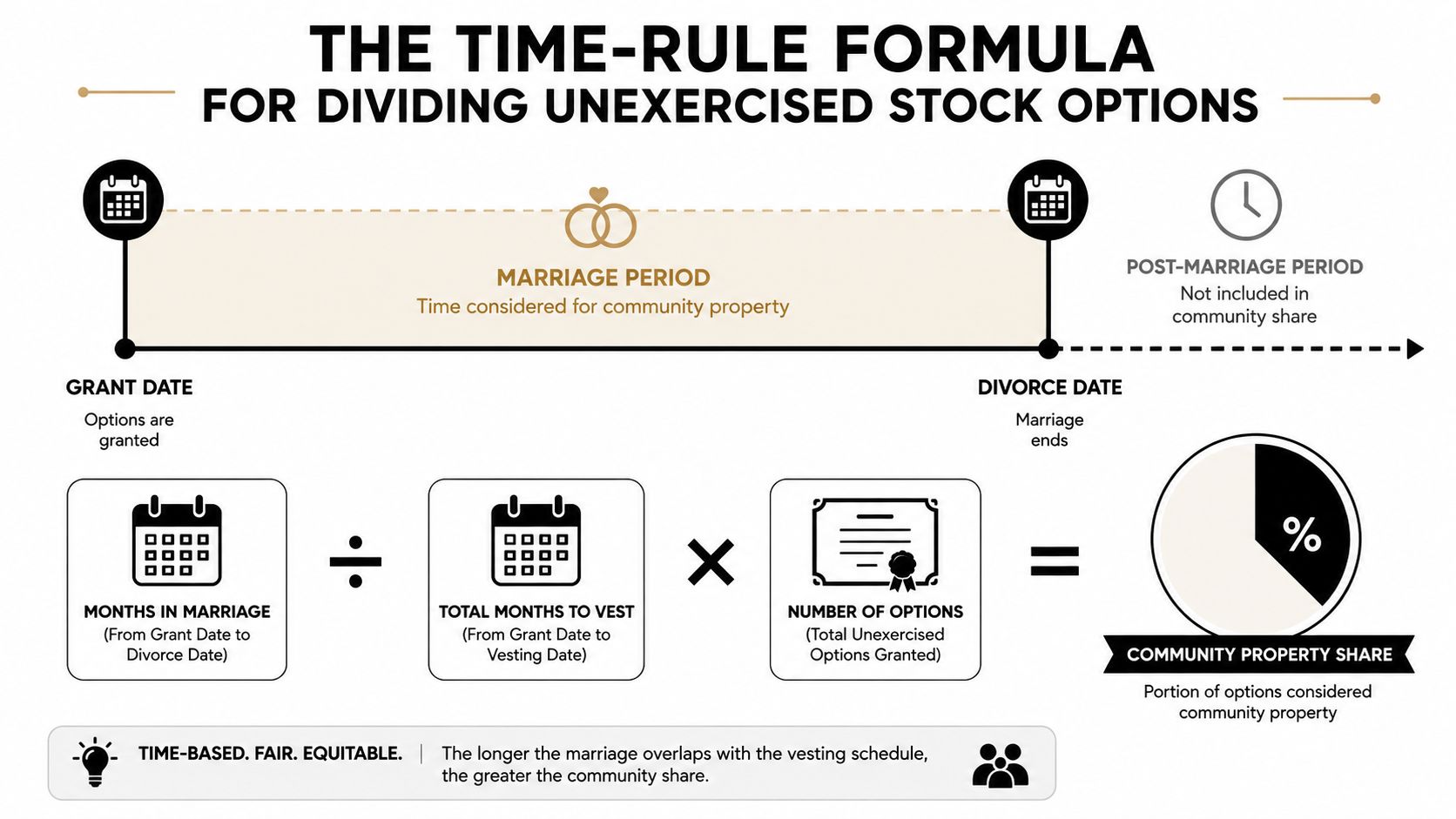
Texas courts have long used a months-based time-rule or coverture fraction to split stock options. The logic is straightforward, the more of the earning period that overlaps the marriage, the larger the community share. That historical approach appears in Texas practitioner and appellate materials, which treat the option as compensation earned over time rather than a lump-sum windfall.
The formula in plain English
The court measures the service time tied to the marriage and divides it by the full grant-to-exercise period. For a grant made during marriage that vests after divorce, the separate-property fraction is the period from divorce to exercisability divided by the total period from grant to exercisability, and the rest is community property. For a grant made before marriage, the analysis shifts, but the same idea stays in place, only the marital portion of the timeline gets divided.
Here's the practical effect. If an option is granted 24 months before divorce and is exercisable 36 months after grant, the court looks at how many months of that timeline were earned during the marriage. The numerator captures the marital service period, and the denominator captures the full option timeline. The community share is whatever remains after the separate-property fraction is calculated.
The point of the time-rule is fairness, not math for its own sake. It ties the division to work done during the marriage.
Why Texas sticks with the months-based approach
This formula protects both spouses. The employee spouse keeps the portion tied to post-divorce labor, and the non-employee spouse shares in the portion earned during marriage. That matters because unvested awards are often part of long compensation cycles, and Texas courts do not treat the absence of current exercisability as a shield from division.
The older appellate materials are important because they show how entrenched this approach is in Texas practice. Texas does not wait for the award to mature before recognizing the marital share. It values the service period, then divides the result.
What this means in a decree
If your decree does not spell out the formula, the parties can end up fighting later about who gets what. Judges and lawyers often use timeline language in the order itself, then connect payment to actual exercise or vesting. That keeps the division tied to the actual event, not a guess made months earlier.
Three Settlement Approaches for Dividing Unexercised Options
There are three practical ways to handle stock options in a divorce, and each one shifts risk differently. The right answer depends on whether you want clean separation now, a later payout tied to actual value, or judicial flexibility if the numbers are too messy to lock down today.
Compare the choices before you sign anything
| Settlement Approach | How It Works | Best For | Key Risk |
|---|---|---|---|
| Immediate offset | One spouse keeps the options, the other gets cash or other property now | Couples who can agree on present value | The valuation can be wrong |
| Deferred distribution | The non-employee spouse gets a set percentage of future proceeds when options are exercised | Awards with uncertain future value | The parties stay tied together |
| Reserved jurisdiction | The court keeps the issue open for later | Cases with incomplete facts or valuation disputes | More litigation later |
An immediate offset sounds clean, but it only works when the option can be valued with enough confidence. That is hard with unexercised awards because nobody knows the future stock price, tax impact, or whether the employee will still be employed. If you accept a buyout too early, you may give away future upside for a number that looked reasonable at the time.
Deferred distribution is usually the safer structure
A deferred distribution, often written as an if, as, and when order, avoids the fight over present value. The non-employee spouse gets a percentage of the future proceeds only when the employee spouse exercises the options. One Texas source describes this as assigning a spouse a defined percentage of the net proceeds from a specific grant, payable only when those options are exercised, which is a common and practical structure for contingent compensation. See the discussion of that deferred distribution method in the context of Texas divorce here.
That structure is especially useful when the options are underwater or too speculative to value fairly today. It also lets the decree account for tax consequences at the moment they matter, when the employee spouse exercises and the tax bill is real.
Reserved jurisdiction should be the exception
Reserved jurisdiction can make sense when the plan documents are incomplete or the grant terms are still changing. But I would not choose it unless you have to. Leaving the issue unresolved means you're betting on future cooperation, and divorce rarely rewards that bet.
If you're also dealing with other equity compensation, the same timing issues often show up in dividing RSUs that vest after divorce in Texas, because the court still has to match future vesting to the marital estate.
What Happens When Options Are Underwater or Expire Worthless
Most Texas divorce content goes quiet here, and that silence hurts people. The fight is not just whether the option is divisible, it's who takes the loss if the option never becomes valuable. If the stock drops below the strike price, the employee is terminated, or the award expires before exercise, the decree needs to answer that now.
Downside risk should not be left to guesswork
Unexercised options can be underwater, blacked out, locked up, or forfeited before either spouse sees a dollar. If you use a deferred distribution structure, that risk is naturally built in, because the non-employee spouse only gets paid if the employee spouse realizes value. If the option never pays off, neither spouse gets a payout from that award.
That is a major advantage over an immediate offset. If one spouse gets bought out based on a present valuation and the option later dies, the employee spouse may feel stuck paying for value that never materialized. If the stock takes off instead, the non-employee spouse may feel shortchanged. Either way, the wrong structure can create resentment and post-divorce litigation.
Practical rule: If the award is speculative, your decree should say who bears forfeiture risk, tax risk, and exercise timing risk.
The language that protects you
Your settlement agreement should address what happens if the employee spouse leaves the company, misses a blackout window, or cannot exercise because the plan changes. It should also say whether a forfeited or worthless option means no payment at all, or whether the parties are using some other adjustment formula. Without that language, the lawyer on the other side may try to argue for the most favorable reading after the fact.
You should also look hard at post-termination exercise windows, transfer restrictions, and any company rules that affect when the option can be used. A decree that ignores those terms is incomplete.
Taxes matter when the payout is real
The tax burden usually falls on the employee spouse at exercise, which means the decree needs to say whether the non-employee spouse gets a share of gross proceeds or net after-tax proceeds. If you skip that detail, the number on paper can be very different from the money that gets distributed.
That is why I prefer orders that are specific, not vague. Stock options are not the place for assumptions.
Steps to Protect Your Interests Before and During Divorce
Start with the documents. If stock options are part of the marriage, you need the grant agreements, vesting schedule, plan documents, exercise history, and any emails about blackout periods or changes in the plan. If you don't have them, ask for them in formal disclosure and discovery right away.
Your first move should be document control
Get the full compensation picture, not just the option statement your spouse wants to show you. That means asking for every equity award, every amendment, and every notice from the employer. If your spouse owns a business or has layered compensation, the analysis often overlaps with valuation issues in Dividing a Business in a Texas Divorce.
Then look at the plan terms. Transfer restrictions, change-of-control rights, and post-termination exercise windows can change everything. A grant that looks valuable on paper may be nearly unusable after a divorce if the plan language is tight.
Use the right professionals early
If the options are significant or the company is privately held, bring in a valuation expert or forensic accountant. You do not want to negotiate blind when the asset depends on future stock price movement and employment status. The right expert can help you understand whether a buyout makes sense or whether a deferred distribution order is safer.
If you're in the first stages of divorce, the Texas process also matters. You file, serve, exchange disclosures, work through temporary orders if needed, and then move toward mediation and a final decree. Texas also has a waiting period before the court can finalize most divorces, so option vesting dates that fall during the case can affect settlement negotiations.
Protect the record and the timing
Keep copies of financial records somewhere your spouse cannot alter them. If the award may vest soon, timing matters, because a few weeks can change how much of the grant falls into the marital window.
For a practical checklist of what to collect before filing, review what documents you should gather before filing for divorce. If you need legal help, the Law Office of Bryan Fagan, PLLC is one option for Texas divorce representation, and the firm regularly handles complex property issues alongside custody, support, mediation, and enforcement matters.

Key Takeaways and Your Next Steps
Texas does not let an unvested or unexercised option hide from property division. If the award was earned during marriage, the court can divide the marital portion under the time-rule approach, and the decree should say exactly how the payout works.
The smartest settlement depends on risk. If you want a clean break, an offset may work, but only with a realistic valuation. If the award is speculative, deferred distribution is usually the better structure because it follows the actual proceeds, including the downside if the option never becomes valuable. Underwater awards, forfeiture risk, and tax treatment all need to be written into the decree, not left to memory or goodwill.
What to Do Next
- Gather the plan documents now. You need the grant agreement, vesting schedule, and employer notices before you can negotiate intelligently.
- Talk to a Texas family law attorney who handles complex property division. Stock options are not a DIY issue when the marital estate, taxes, and future vesting all overlap.
- Do not exercise, transfer, or waive anything without legal advice. A rushed move can change the value and your position in mediation or court.
If you're dealing with a spouse's stock options and the numbers feel impossible, you're not overreacting. You're dealing with a contingent asset that can swing hard in either direction, and it deserves careful handling. For a related planning example, the guide for next-of-kin planning is a useful reminder that complex assets only stay manageable when the documents are clear and current.
The Law Office of Bryan Fagan, PLLC helps Texas families handle divorce, property division, custody, support, mediation, and enforcement with a practical, client-focused approach. If unexercised stock options are part of your case, visit Law Office of Bryan Fagan, PLLC to schedule your free consultation and get a plan that protects your financial future.