Skip to content
If the card is only in your spouse's name, you are not automatically personally liable in Texas just because you're married. But that debt can still affect divorce, and certain assets can still be exposed depending on how the account was used and how the court treats it.
You're usually staring at this problem after a gut punch, a statement you never saw, a balance transfer from years ago, or charges that did nothing for the household. A secret card is more than a money issue. It's a trust issue, a divorce issue, and sometimes a credit issue all at once.
The good news is that Texas law gives you a real roadmap. The bad news is that many people only hear the lazy version, “Texas is a community property state,” and stop there. That's not enough, because Texas also separates personal liability to the creditor from how a divorce court allocates the debt between spouses.
If you're trying to sort out a hidden balance, start by pulling the account history and getting your own records in order. Tools for exporting financial data can help you organize statements and spot patterns fast, especially when you're trying to match charges to dates, vendors, and household spending.
The rest comes down to statute, account structure, and timing. Once you understand those pieces, you can stop panicking and start protecting yourself.
Discovering a Secret Credit Card in Texas
The first reaction is usually disbelief, then anger, then the same question on a loop. In Texas, the answer is straightforward, marriage alone does not make you personally liable for a spouse's secret credit card, but the account can still affect divorce and can still reach certain property issues.
That difference matters because hidden debt usually comes to light late. It may show up in a stack of mail, in discovery during a divorce case, or when one spouse sees transfers, cash advances, or charges that never helped the household and knows something is wrong.
Practical rule: Do not argue about blame before you find the paper trail. Get the statements, the account opening documents, and every payment history you can reach.
If you are overwhelmed, do not guess. Look at the account name, the authorized users, the opening date, and what the charges were for. If you need a clean record for your attorney or financial adviser, keep the account data organized and use a trusted tool for exporting financial data so you can track what happened when.
Texas divorce cases move through filing, temporary orders, discovery, mediation, and then a final decree. Hidden debt can affect every stage, especially if one spouse is trying to move money around before the case is finished. Get the facts early, before the hearing forces you to react.
For general divorce debt questions, What Happens to Debt in a Texas Divorce gives a useful explanation. For property division, How Property Is Divided in a Texas Divorce explains the just and right standard in plain English.
How Texas Community Property Treats One Spouse's Debt
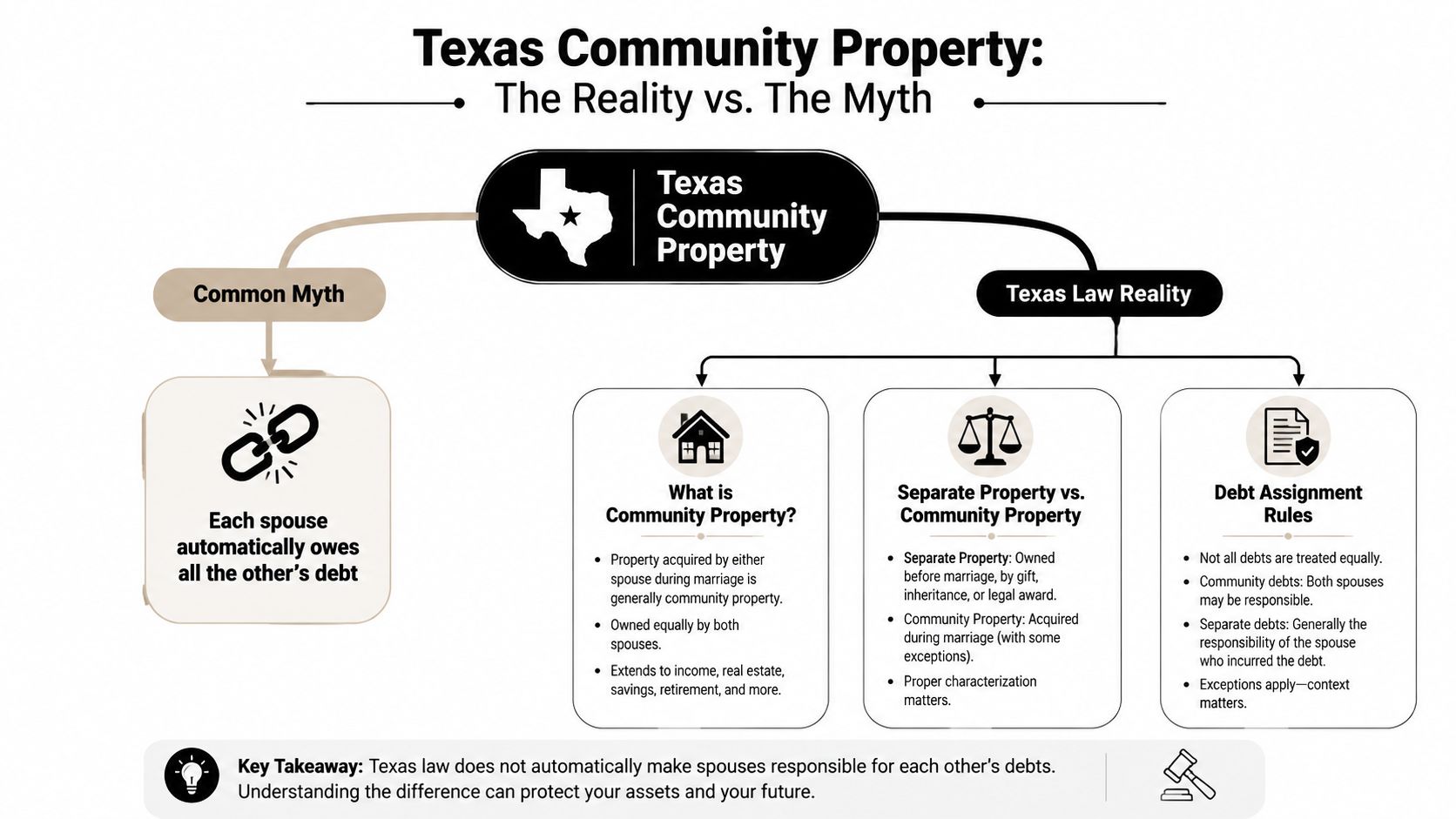
Texas is a community property state, but that does not mean every debt gets split in half just because there is a marriage. The State Law Library explains that Texas no longer uses a broad “community debt” label, and Texas Family Code section 3.201 focuses on when the debt was incurred, whose debt it is, and what type of debt it is. That is the framework that matters when a secret credit card shows up. Texas community property and debt rules
Texas Family Code § 3.201 is clear once you get past the legal wording. You are not personally liable for your spouse's credit-card debt just because you are married. Personal liability exists only if your spouse acted as your agent or the charge was for necessaries. Texas law also says marriage alone does not create agency. Texas Family Code § 3.201
Personal liability and asset exposure are not the same thing
People mix these up all the time. A spouse can avoid personal liability to the creditor and still face questions about whether certain marital assets are reachable. Texas materials make clear that collection analysis turns on the debt's type and the property involved, not just on whether you had a marriage certificate on the wall.
The point is simple. A creditor does not automatically get to collect from every asset in the marriage because one spouse hid a card. Texas law asks whose obligation it is first, then looks at what property is available to satisfy it.
Say your spouse secretly runs up a luxury boutique card. If the card was opened only in your spouse's name, the issuer usually looks first to the debtor spouse's property. Your separate property is generally shielded unless another legal basis exists. That does not make the debt disappear. It means the creditor's reach is narrower than the panic in your head is telling you.
A spouse's hidden card can be ugly, but Texas law still asks, “Whose obligation is this?” before it asks, “What property is available?”
For a broader divorce and debt roadmap, What Happens to Debt in a Texas Divorce explains how liability and collection issues fit into the divorce process.
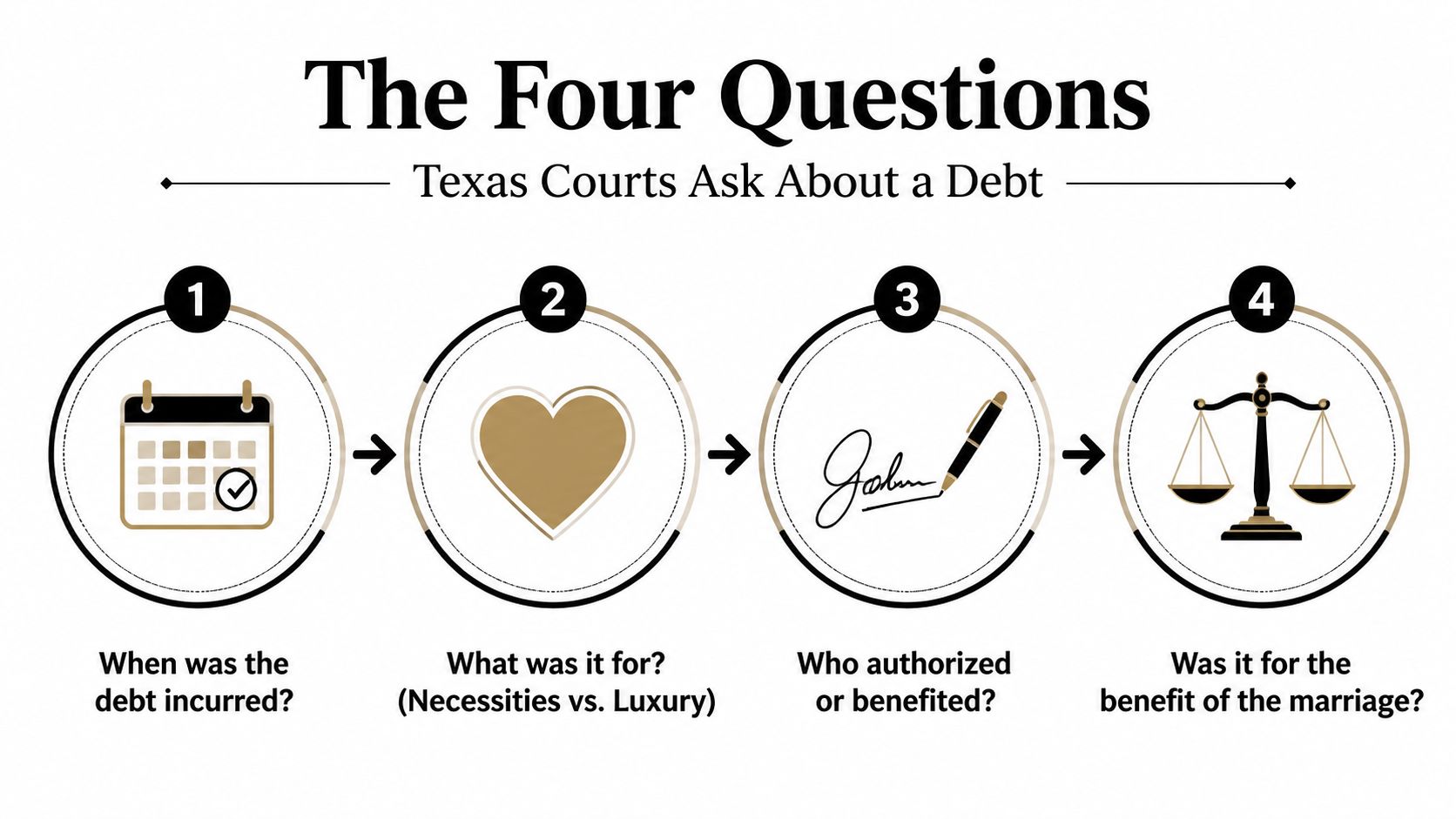
The Four Questions Texas Courts Ask About a Debt
Texas courts don't start with a slogan. They start with four questions. Baylor Law's materials describe that modern analysis as asking when the debt was incurred, what kind of debt it is, whose debt it is, and whether another rule makes a spouse personally liable. That is the test, not the oversimplified “community property means we both owe it” line people hear online. Baylor Law debt liability framework
1. When was the debt incurred
A card opened before marriage usually stays tied to the spouse who incurred it. If the balance appeared during the marriage, the court still has to ask the next three questions before deciding what that means. Timing matters because Texas looks at the debt's origin, not just the date of discovery.
2. What type of debt is it
Contract debt and tort debt are not treated the same way. A credit card is usually a contract debt, which means the account language and who signed it matter. If the debt came from ordinary household needs, the analysis looks different from a hidden spending spree or a side venture.
3. Whose debt is it
The account structure matters. A card in one spouse's name is not the same thing as a joint account. A card in one spouse's name can still be a marriage-related issue for division purposes, but that does not automatically make the other spouse personally liable.
4. Does another rule make the other spouse liable
Agency and necessaries come back in here. Groceries, shelter, medical care, and family clothing can support a necessaries argument. A secret side business usually does not. A hidden spending habit at a luxury store usually does not either.
For evidence strategy in a divorce case, What Evidence Matters Most in a Texas Divorce Case is worth reading because the account records, texts, and spending trail often decide the fight. If you are trying to preserve a clean record, start collecting statements before the other side does.
Common Scenarios With Hidden Credit Card Debt
The question is whether the card was used for the marriage or for the spouse who hid it. A card used for groceries, utilities, and kids' basics can fit a necessaries argument because those charges kept the household going. That kind of spending may lead a judge to assign the debt in a way that reflects who benefited from it.
An authorized user setup is different. If your spouse added you as an authorized user, that does not automatically make you a joint debtor. Your credit file may still show the account, but the card issuer's contract is what decides who owes the debt.
Joint accounts are the clearest risk
A jointly opened card puts both spouses in the direct line of fire. If both signed the account agreement, the creditor can pursue either spouse for the full balance. It does not matter which spouse used the card more often. It does not matter which spouse intended to pay it later.
Secret spending for an affair, gambling, or a side business usually cuts against shared liability
A card used for an affair, gambling, or a hidden side venture usually points the debt back to the spouse who ran it up. Texas courts focus on whether the debt benefited the marriage. An affair charge usually does not help the family, and a hidden business purchase can leave its own paper trail that ties the spending to one spouse.
Fraud is a different fight. If someone used your identity without permission, you may be dealing with a credit dispute or a criminal complaint, not just a divorce issue. Keep those issues separate from the start.
Practical rule: If the card was hidden, the first question is not whether the marriage was strong. It is who opened the account, who used it, and what the charges were for.
For a broader look at how Texas courts separate debt allocation from creditor rights, dividing debt in a Texas divorce explains why a divorce court order and a card issuer's collection rights are not the same thing. If the spending tied into a company, the stakes rise fast, and Dividing a Business in a Texas Divorce becomes part of the analysis in higher-asset cases. For the decree side of that problem, what a final divorce decree does in Texas explains the court's role, and LifeBack Law Firm on divorce bankruptcy is useful if the debt pressure is pushing one spouse toward bankruptcy.
What the Divorce Decree Can and Cannot Do About the Debt
A Texas divorce decree can assign a credit card debt to one spouse, but that order does not automatically stop the creditor from pursuing the other spouse if that person is still liable on the account. Texas law separates court allocation from creditor collection rights, and that split is where people get burned. Texas Law Help on dividing property and debt in divorce
The judge is not required to split debt down the middle. Texas courts use a just and right standard, which lets the court divide debts based on fairness, the facts, and the full property picture. Fairness between spouses, however, does not release either spouse from the card issuer's contract.
What the decree can do
The decree can assign payment responsibility between you and your spouse. It can say who should bear the debt in the divorce. It can also create an enforcement path if one spouse ignores the order. That is the point of the decree, and what a final divorce decree does in Texas explains why the language has to be precise.
What the decree cannot do
The decree cannot erase your name from a joint account. It cannot stop a creditor from collecting from an account holder or co-signer. It cannot rewrite the card company's contract by itself.
That means a decree saying “your spouse pays Chase” still leaves you exposed if your name remains on the account. The issuer can still pursue you until the account is paid, closed, or you are formally released. If your spouse promised to refinance or transfer the balance and never did it, you are still on the hook with the creditor.
Bankruptcy can overlap with divorce when the debt load is too heavy for one decree to fix. If that is part of the picture, read LifeBack Law Firm on divorce bankruptcy before you sign anything. The decree controls the spouses, not the creditor.
Your Step-by-Step Plan to Protect Yourself in Texas
Start with your credit. Pull your reports from all three bureaus and mark any card you did not open, any balance you do not recognize, and any authorized user listing you never approved. If something looks wrong, freeze your credit and treat it like a real risk, because it is.
Next, gather documents. You want statements, account agreements, texts, emails, and any record showing who paid household bills and from what funds. If a card is being used against you, the paper trail matters more than your memory.
Keep your own finances clean
Stop using any card you do not want tied to you. Keep separate spending separate. Don't pay off hidden debt just to make the conflict go away, because that can muddy the divorce record and complicate later disputes.
If you think the collector is calling about an account that is not yours, a debt validation letter can be a useful tool. The basics of debt collection validation explained are worth understanding if collection calls start before the divorce is finished.
Bring in the divorce strategy early
Talk to a Texas family law attorney before mediation or filing. That way the decree language, the property division, and any refinance or balance transfer plan all work together instead of fighting each other. If you're a parent, a business owner, or someone with a high-value estate, this matters even more because debt can affect support, cash flow, and the assets you need to keep stable.
The Law Office of Bryan Fagan, PLLC offers free consultations and works with clients in Houston, Dallas-Fort Worth, Austin, San Antonio, and surrounding counties. If your spouse hid debt, you need a plan, not a lecture.
Key Takeaways and What to Do Next
Texas does not make you automatically liable for a spouse's secret credit card just because you're married. The questions are agency, necessaries, account ownership, and when the debt was incurred. The divorce decree can divide the debt between spouses, but it does not stop the card company from collecting from an account holder whose name is still on the account.
Hidden credit card debt is common in Texas divorces, and it does not have to wreck your case. Document everything, protect your credit, stay current on your own obligations, and get legal advice before you sign a decree or a settlement. The law gives you tools, but only if you use them early.
If this sounds like your situation, schedule a free consultation with a Texas family law attorney who can look at your facts, your county, and your timeline together and help you make the right move.
The Law Office of Bryan Fagan, PLLC helps Texans handle hidden debt, divorce strategy, property division, and the credit fallout that comes with a spouse's secret card. If you need clear guidance on your rights and your next step, visit Law Office of Bryan Fagan, PLLC and schedule a free consultation to talk through your situation.