Skip to content
You're staring at the same problem a lot of Texas spouses miss until the paperwork is already on the table, a timeshare that looked like a family memory and now looks like a monthly bill with your name on it. If you don't handle it cleanly in the divorce, the resort, the lender, and your ex can keep coming back at you long after the decree is signed.
When the Family Vacation Home Is Also a Divorce Asset
The phone call usually goes like this. One spouse wants to keep the beach week because the kids love it, the other wants out because the maintenance fees keep arriving, and both of them assume the timeshare will just sort itself out in the divorce. It won't.
In Texas, that timeshare usually lands in one of three realistic outcomes. One spouse keeps it and gives the other an offset in cash or another asset, both spouses stay on as co-owners, or the interest is sold and whatever net value remains is divided. If you want a plain-English overview of the vacation product side of the issue, a guide to vacation club memberships can help you understand why these arrangements often feel more like long-term obligations than true vacation ownership.
Practical rule: Don't treat a timeshare like a sentimental keepsake. Treat it like an asset with a bill attached, because that's what the court and the resort will see.
The biggest mistake is hoping the decree will make the problem disappear without naming who owns what, who pays what, and what happens if nobody wants it. A timeshare can keep producing maintenance bills, transfer friction, and resale headaches for years. If you're negotiating a divorce in Texas, you need a decision, not a vague promise that “we'll figure it out later.”
The right answer depends on who can use it, who can afford it, and who is willing to carry the continuing costs. Texas courts don't default to a neat 50/50 split on a timeshare, and that's a good thing for you if the numbers or the family situation point in a different direction.
How Texas Family Code Treats a Timeshare Bought During Marriage
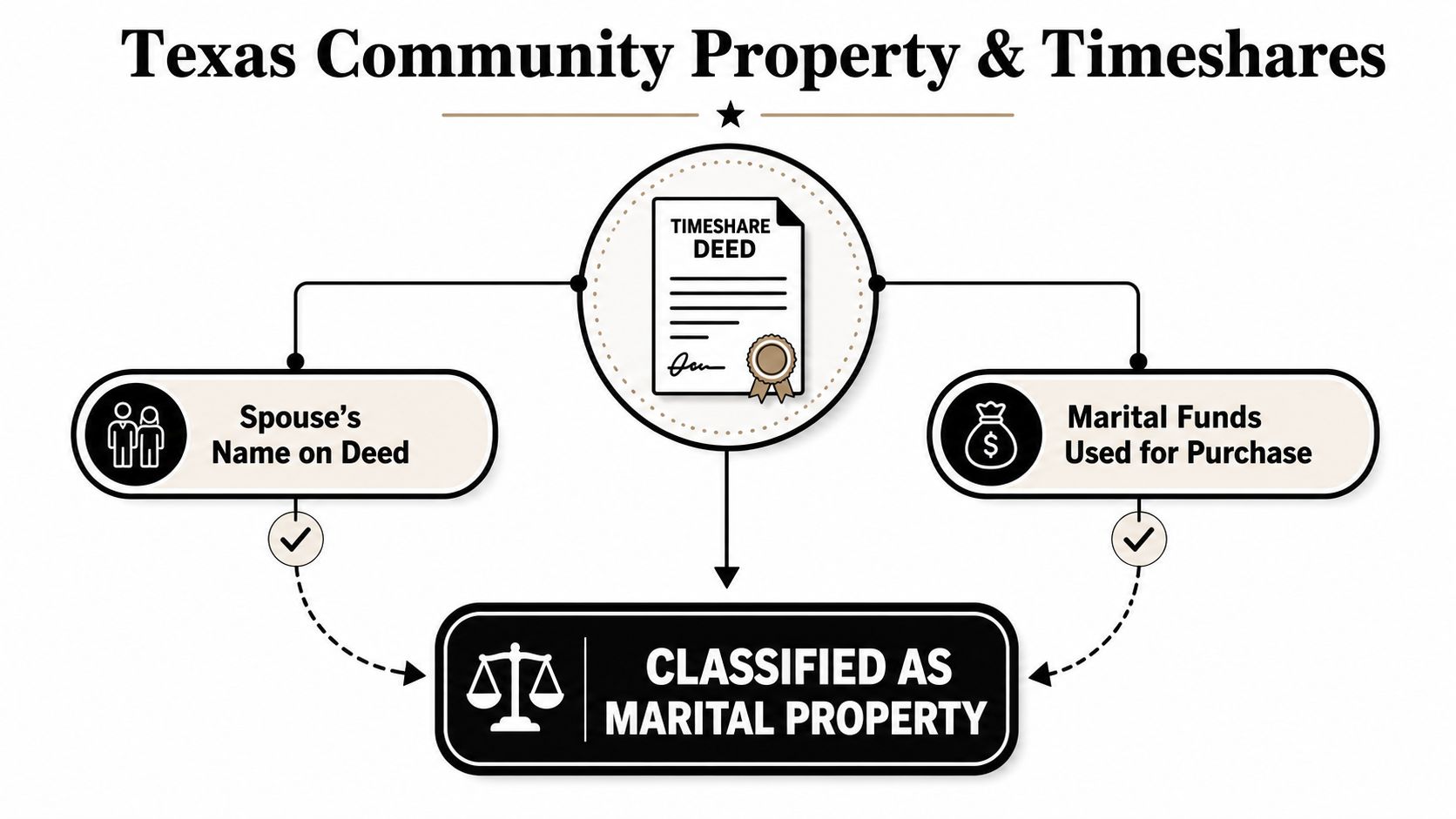
Texas starts with a strong presumption, if property was acquired during marriage, it's community property. That matters even when the timeshare contract or deed is in only one spouse's name, because title alone doesn't control the character of the asset when marital funds paid for it. Texas Family Code Chapter 3 provides the community-property framework, and Chapter 7 governs the award of marital property in divorce, including the court's division power under the “just and right” standard in § 7.001. Texas Family Code Chapter 7
What the court looks at
A judge does not have to split a timeshare 50/50. The court can divide the estate in a way that is fair under the circumstances, which means the timeshare may go to one spouse, both spouses may keep it together, or the court may order a sale and divide the net proceeds. That flexibility matters because a timeshare with continuing annual obligations is not the same as a checking account that can be divided on paper in one line.
A deed in one name is not the same thing as separate ownership if marital money bought the interest.
You should also keep ownership and debt in the same conversation. Texas law treats the community estate as including not just the timeshare interest, but the liabilities tied to it as well. In practice, if the court awards the timeshare to one spouse, that spouse is usually the one assigned the related debt and ongoing obligations too.
There are exceptions. If the timeshare was acquired before marriage, or if it was a true gift to one spouse, it may be characterized as separate property. That is why tracing matters, and why a spouse who says “it's in your name, so it's yours” is usually skipping the legal analysis.
If you need help proving whether a timeshare is separate or community, the tracing rules matter. The separate-property tracing guide is the kind of issue your attorney should be looking at before mediation starts, not after the decree is signed.
Four Common Ways a Texas Divorce Can Divide a Timeshare
Texas couples usually end up with one of four results. The right move depends on whether the timeshare still has real use value, whether the debt and fees are manageable, and whether either spouse wants to stay tied to the property after the divorce. Bad outcomes usually start when people pick the option that feels easiest in the moment, not the one that cuts off future liability.
Compare the trade-offs
| Option | Who Pays Mortgage | Who Pays Maintenance Fees | Typical Speed | Best Fit When |
|---|---|---|---|---|
| One spouse keeps it with an offset | Usually the spouse awarded the asset, unless the decree says otherwise | Usually the spouse who keeps it | Moderate | One spouse uses it and can carry the costs |
| Sale and split | Usually paid from sale proceeds before division | Usually paid before closing or from proceeds | Slower if resale is weak | Neither spouse wants the obligation |
| Continued co-ownership | Both, unless the decree reallocates the bill | Both, unless the decree reallocates the bill | Fast on paper, messy later | Rare, only when both spouses want to keep using it |
| Deed transfer to a third party or family member | Depends on the transfer terms | Depends on the transfer terms | Can be fast if the recipient cooperates | A willing transferee exists and the resort allows it |
A buyout makes sense when one spouse values the vacation use enough to take on the burden. A sale makes sense when neither spouse wants ongoing exposure, even if the resale market is weak. Continued co-ownership sounds cooperative, but it keeps both people financially linked, which is usually a poor fit after divorce unless there is a specific reason to keep the arrangement alive.
A deed transfer can solve the relationship problem, but it does not solve everything by itself. If the resort, lender, or transfer rules require paperwork and fees, the decree needs to say who handles them. That is also where the broader property-division rules matter, so use How Property Is Divided in a Texas Divorce as the framework and then tailor the timeshare language to the actual obligation. If the decree also has to deal with the house, use the same clean, practical approach you would use in Texas real estate division in divorce, because a timeshare with fees hanging over both spouses should not be treated like a simple line item.
If your case also includes a house, investment account, or business, the timeshare should not be negotiated in isolation. In a broader estate, it may be smarter to trade the timeshare away in exchange for a cleaner asset. The goal is not emotional symmetry. It is financial finality.
How Courts and Couples Value a Timeshare in Divorce
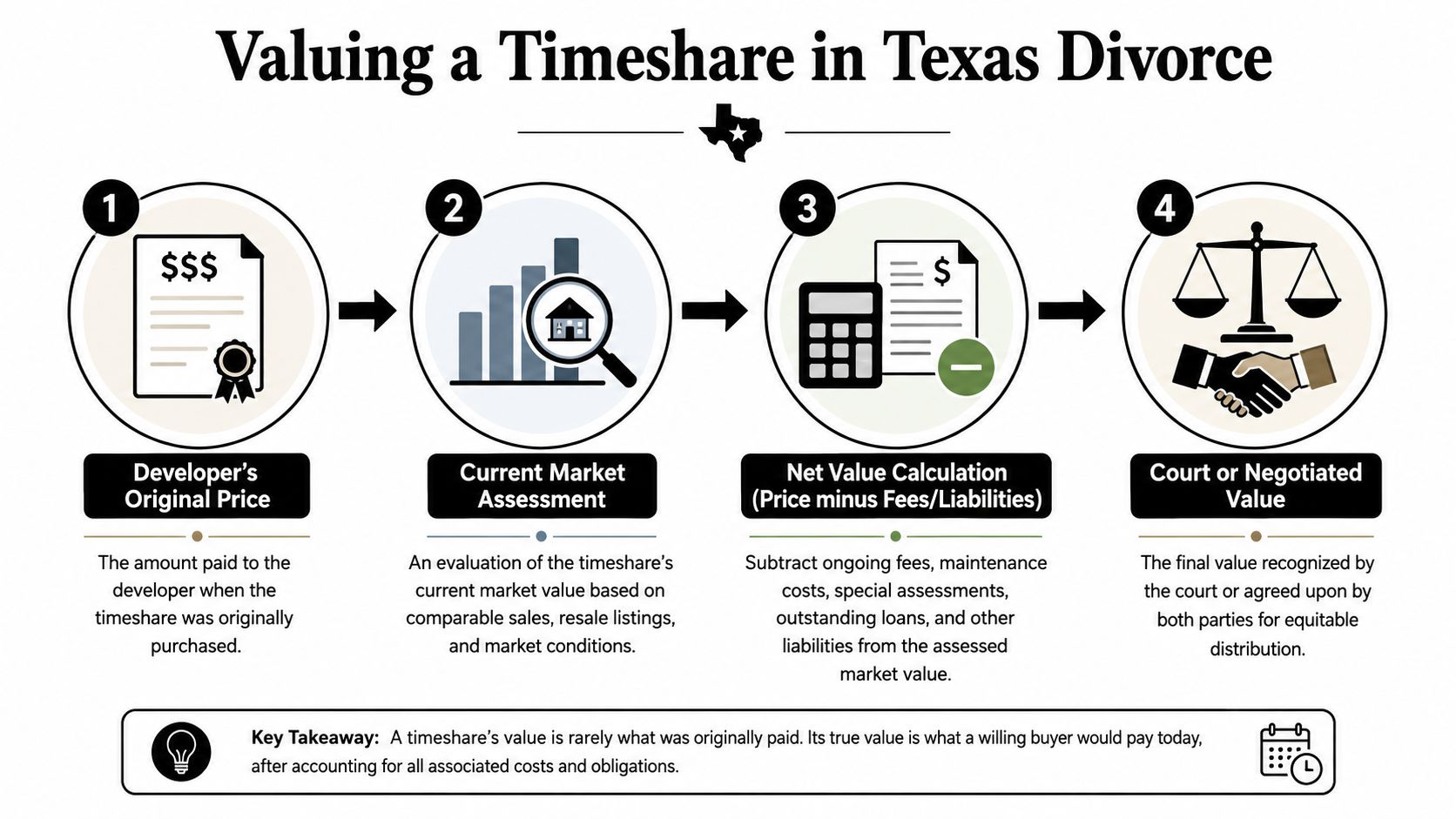
Timeshare valuation goes sideways when people confuse the original purchase price with real-world value. The number that matters in divorce is what the interest would realistically bring today after fees, debt, and transfer costs are subtracted. Anything else is wishful thinking.
Start with net value, not sticker price
A practical way to think about it is simple. Take the current resale reality, subtract the mortgage balance if there is one, subtract unpaid maintenance fees, subtract transfer charges, and account for any special assessments. What's left is the number that should drive settlement talks.
A representative $25,000 example helps show the problem. If the timeshare is underwater after you factor in debt and transfer costs, then a sale may not produce meaningful cash at all, and the couple may be better off negotiating a buyout or even a surrender if that's available. The point is not what the developer once charged. The point is what another buyer would pay, and what it costs to escape the obligation.
Bottom line: If the number after fees and liabilities is close to zero, stop arguing about fantasy value and negotiate the cleanest exit.
Independent resale brokers who know the resort often give more useful numbers than a generic real-estate appraisal. That's because timeshares are not ordinary homes, and a standard residential valuation can miss the special rules, weak resale demand, and transfer friction that make these assets so different. You should also bring maintenance fees and taxes into the conversation early, because those ongoing costs affect what a buyout is really worth to each spouse.
When the value is disputed, your divorce lawyer should insist on numbers that reflect actual market conditions, not nostalgia. The spouse who wants to keep the timeshare should either absorb the carrying cost or give up enough other property to make the deal fair under the just and right standard.
Sample Decree Language for Your Timeshare
A decree should leave no guesswork. It should say who gets the timeshare, who signs the transfer papers, who pays the fees, and what happens if the transfer stalls. If the language is vague, you are setting up the next fight before the ink is dry.
What the decree should spell out
The order should name the spouse who receives title, set a deadline for any deed or transfer paperwork, and assign responsibility for fees that came due before and after the decree date. It should also say who pays the mortgage, who refinances if refinancing is required, and what happens if the refinance never closes. If special assessments or resale proceeds are left out, you are leaving money and risk on the table.
Here is the kind of language that belongs in a buyout case:
“Husband is awarded all right, title, and interest in the timeshare located at [resort description], and Wife shall execute all documents reasonably necessary to transfer title within [set deadline]. Husband shall assume and pay all maintenance fees, assessments, taxes, and loan obligations associated with the timeshare beginning on the decree date.”
Here is a sale scenario:
“The parties shall list the timeshare for sale through a mutually agreed broker within [set deadline], cooperate in signing all transfer documents, and divide the net sale proceeds after payment of sale costs, unpaid fees, and lien obligations in the proportions stated in this decree.”
Those are not magic words. They are direct instructions that prevent a later fight over money and responsibility. If the decree does not say who keeps a future refund, who absorbs a special assessment, or what happens if the buyer does not close on time, the dispute can return later with interest.
If the timeshare carries a loan, the decree also needs to match the property terms to the debt terms. A clear order should say whether one spouse refinances, assumes the mortgage, or keeps paying until the loan is gone. For a plain-English walkthrough of those transfer problems, see assuming a mortgage after divorce.
Maintenance Fees, Mortgages, and the Tax Side
People often encounter challenges here. A timeshare can appear “awarded” in the decree and still generate bills that affect both spouses if the paperwork is sloppy. Maintenance fees, special assessments, taxes, and any mortgage tied to the interest must be assigned with precision.
Don't leave the carrying costs ambiguous
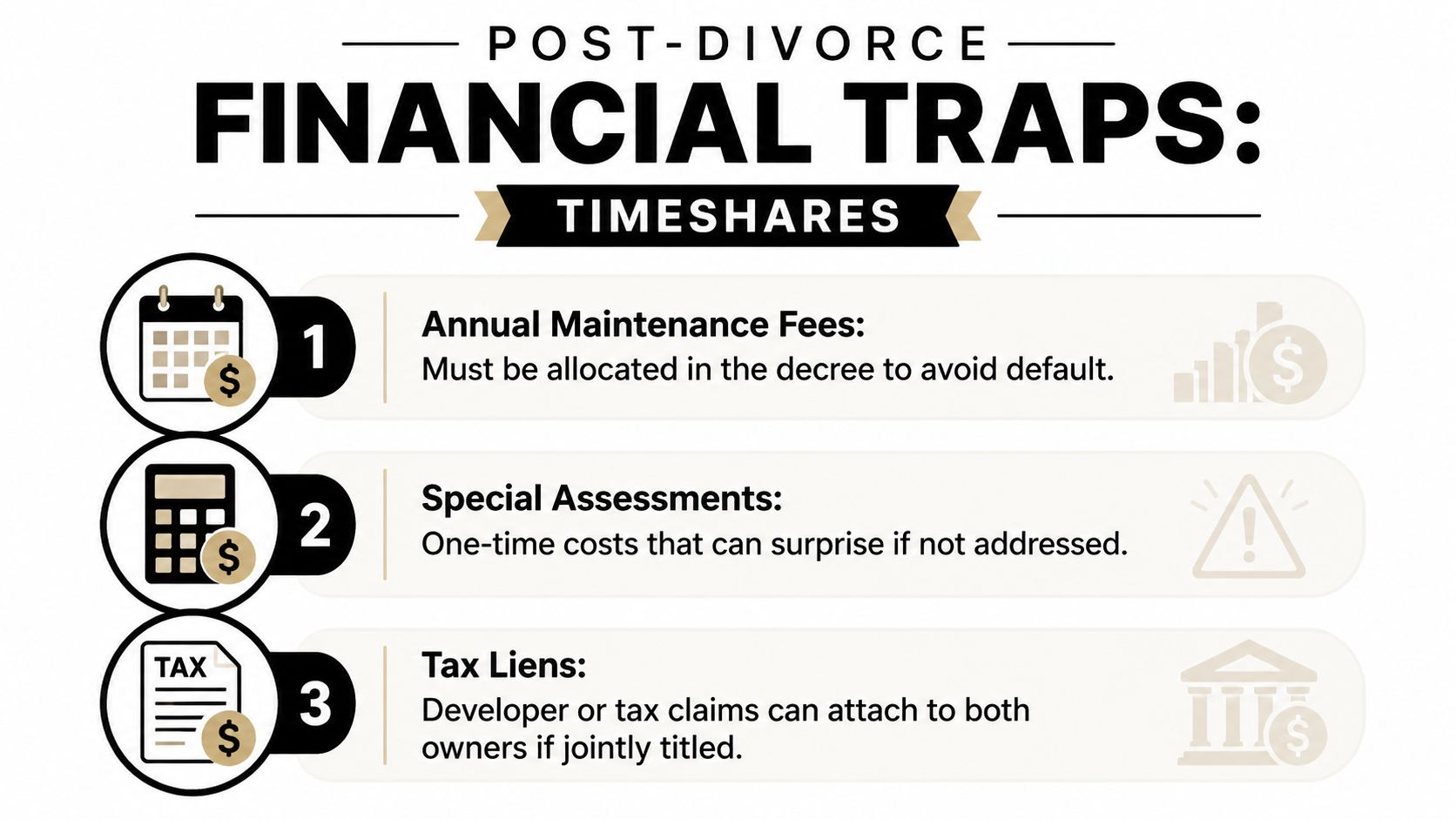
Annual maintenance fees are usually the most annoying surprise because they arrive every year and they don't care that the marriage is over. If the decree doesn't assign them clearly, the spouse who thinks the other should pay may find out the hard way that the resort wants payment from the person still on the account. Special assessments are worse because they show up as one-time charges and can blindside someone who thought the divorce solved everything.
If there is an underlying mortgage, the decree should say whether one spouse refinances, assumes the debt, or keeps paying until the loan is gone. The practical mechanics matter because a lender is not bound by your emotional agreement with your ex, and missed payments can create credit damage or foreclosure risk. For a plain-English walkthrough of mortgage transfer issues, assuming a mortgage after divorce is a useful related topic.
Practical rule: If the timeshare is still jointly titled, treat creditor exposure as active until the transfer is finished.
The tax side should be discussed too. Whoever keeps the timeshare may have the practical burden of any related mortgage interest or property-tax questions, depending on the facts and how the decree is written. If spousal maintenance is part of your case, Spousal Maintenance in a Texas Divorce is relevant because the court's financial picture includes support, property, and debt together, not in separate boxes.
Bankruptcy usually isn't a clean escape hatch for timeshare trouble, so don't assume debt relief will solve it later. The safer move is to allocate the obligation correctly in the decree and close out the title cleanly now.
Post-Divorce Traps and How to Avoid Them
A couple can walk out of mediation feeling relieved and still end up fighting over the timeshare two years later. The most common mistake is leaving the interest jointly titled and assuming no one will care. The developer, a collection agency, or a tax lien holder usually cares.
Here's the pattern I see. One spouse stops using the unit, stops paying attention to the notices, and then gets hit with a bill or lien notice months later. The other spouse assumes the divorce ended the obligation, but the account keeps moving because the title never changed. That is how simple paper problems become enforcement problems.
The post-divorce fix is real, but timing matters. Texas Family Code § 9.201 allows a Suit for Postdissolution Partition when a marital asset like a timeshare was left out of the decree. TexasLawHelp explains that if the divorce was handled in a Texas court, the suit must be filed in the same court that signed the decree, and § 9.202 gives a two-year deadline measured from the denial of rights. Texas law also describes a 4-year window under the Civil Practice and Remedies Code in some circumstances, which is why you should not sit on the issue. TexasLawHelp on post-divorce community property division
You should also know the filing process of the divorce itself so you can time these issues correctly. How to File for Divorce in Texas: Step by Step is the broader roadmap, but the timeshare has to be handled before the final decree whenever possible.
By the first 90 days after the decree, you should have the deed status confirmed, payment obligations updated, any lender or resort transfer steps underway, and a written plan for missed bills or transfer delays. If the timeshare still sits in both names, assume the problem is still alive and act like it.
Your Next Steps and How We Can Help
If a timeshare is in your divorce, stop treating it like a side issue. Pull the deed, the original contract, the last two years of maintenance statements, the current mortgage payoff, and any resale broker opinions you can get before you sit down for mediation. Those documents tell you whether a buyout, sale, or transfer makes sense, and they keep the conversation grounded in facts instead of emotion.
If you and your spouse can still talk reasonably, mediation may save time and protect value. If the asset is tied up in debt, disputed use, or a messy title history, you may need a contested hearing so the court can make a clean just-and-right allocation. Business owners, parents, and people with larger estates should be especially careful here, because one bad property decision can distort the rest of the divorce settlement.
A timeshare should not keep you financially tied to an ex after the marriage ends. The goal is simple, get the title, debt, fees, and future exposure assigned correctly so you can move on without surprise bills or a second lawsuit.
If you want a lawyer who will look at the timeshare as part of the whole divorce picture, the Law Office of Bryan Fagan, PLLC handles Texas divorce, property division, custody, support, mediation, and enforcement matters with both in-person and virtual consultations across Houston, Dallas–Fort Worth, Austin, and San Antonio. Bring the paperwork, bring your questions, and get a real plan before the decree is signed.
The Law Office of Bryan Fagan, PLLC helps Texans handle divorce property division, including timeshares that keep generating fees after the marriage ends. If you're trying to decide between a buyout, a sale, or a transfer, visit Law Office of Bryan Fagan, PLLC to schedule a free consultation and get practical guidance for your next step.