 Skip to content
You're standing at the kitchen counter, sorting through mail after the separation conversation, when a 401(k) statement catches your eye. The balance represents years of work, and now you're wondering whether divorce will carve it up, tax it, or trigger an early-withdrawal penalty.
You and Your 401(k) During a Texas Divorce
A 401(k) division is not completed when the spouses agree on a dollar amount. The result depends on a sequence that works like a relay: the divorce decree sets the award, the QDRO carries that award to the plan, the plan administrator approves it, and only then can the receiving spouse choose a distribution or rollover.
Start by identifying the marital portion. Contributions and investment growth accumulated during the marriage may be part of the community estate, while amounts earned before marriage may remain separate. Account statements and other records help establish that distinction.
The decree should clearly describe the retirement benefit and the division ordered by the court. A separate Qualified Domestic Relations Order (QDRO) then gives the 401(k) plan administrator authority to pay the former spouse as an alternate payee. Court approval alone does not make the plan divide the account. The plan must review and approve the order under its own rules.
After approval, the receiving spouse may have several choices: leave the funds in the plan, roll them into an eligible account, or request a direct distribution. An in-plan division under a properly approved QDRO can allow the recipient to receive or transfer the assigned share without the 10% federal early-distribution penalty that commonly applies to an early cash-out. A defective order or premature withdrawal can produce a very different after-tax result.
For a distribution taken outside the QDRO process before age 59½, ordinary income tax and that 10% penalty typically apply, as explained in the IRS divorce and retirement guidance.
Practical rule: Do not cash out your 401(k) to cover immediate divorce expenses until you know whether a properly approved QDRO can transfer the funds.
If children are involved, financial planning is only part of the work. Guidance on how to protect your teen during divorce can help you recognize stress signals and support a steadier home while the legal process continues.
How Texas Law Treats a 401(k) in Divorce
Texas follows community-property principles. Under Texas Family Code § 3.002, property acquired during marriage is generally community property, while § 3.001 addresses separate property. Applied to a 401(k), contributions made from wages earned during marriage are generally part of the community estate, even when the account is held in only one spouse's name.
That can include employee contributions, employer contributions, and investment changes connected to the marital portion. Contributions and balances earned before marriage may remain separate property, but you'll need records to support that position. Premarital statements, employment records, and documents tracing transfers can become important when an account contains both separate and community funds.
Texas courts use characterization rules before deciding how property should be divided. The inception-of-title doctrine focuses on when the property interest began. For retirement accounts, lawyers and courts may also use a time-based approach to identify the marital share, comparing the period the account or benefit accumulated during marriage with its full accumulation period. The exact method depends on the plan and the evidence available.
A 401(k) loan taken during the marriage also requires attention. The loan can affect the account's value and may be treated as a community obligation, so ignoring it can distort the division.
| Account Element | Default Classification | Key Texas Authority |
|---|---|---|
| Contributions from wages earned during marriage | Community property | Texas Family Code § 3.002 |
| Employer contributions connected to marital employment | Generally community property | Texas Family Code § 3.002 |
| Balance accumulated before marriage | Separate property, if proven | Texas Family Code § 3.001 |
| Growth tied to separate funds | Generally follows the underlying characterization, subject to proof | Texas Family Code §§ 3.001 and 3.002 |
| 401(k) loan incurred during marriage | Typically considered in the community-property analysis | Texas property-division principles |
The characterization analysis determines what is available for division. A QDRO can't protect a separate-property claim that was never documented, and it can't fix a decree that fails to describe the retirement benefit clearly. For a broader discussion of retirement accounts, review dividing retirement accounts in a Texas divorce.
Why records matter
You should gather statements from around the marriage date, current statements, and records showing contributions, rollovers, and loans. If the account has moved between employers, each plan may require separate review. Business owners and high-asset spouses should also examine deferred compensation, pensions, stock plans, and other accounts so the 401(k) isn't evaluated in isolation.
Texas courts divide community property in a manner that is just and right, rather than automatically splitting every asset down the middle. The court may consider the broader estate, each spouse's financial circumstances, and other relevant facts.
Taxes and the 10% Early Withdrawal Penalty Explained
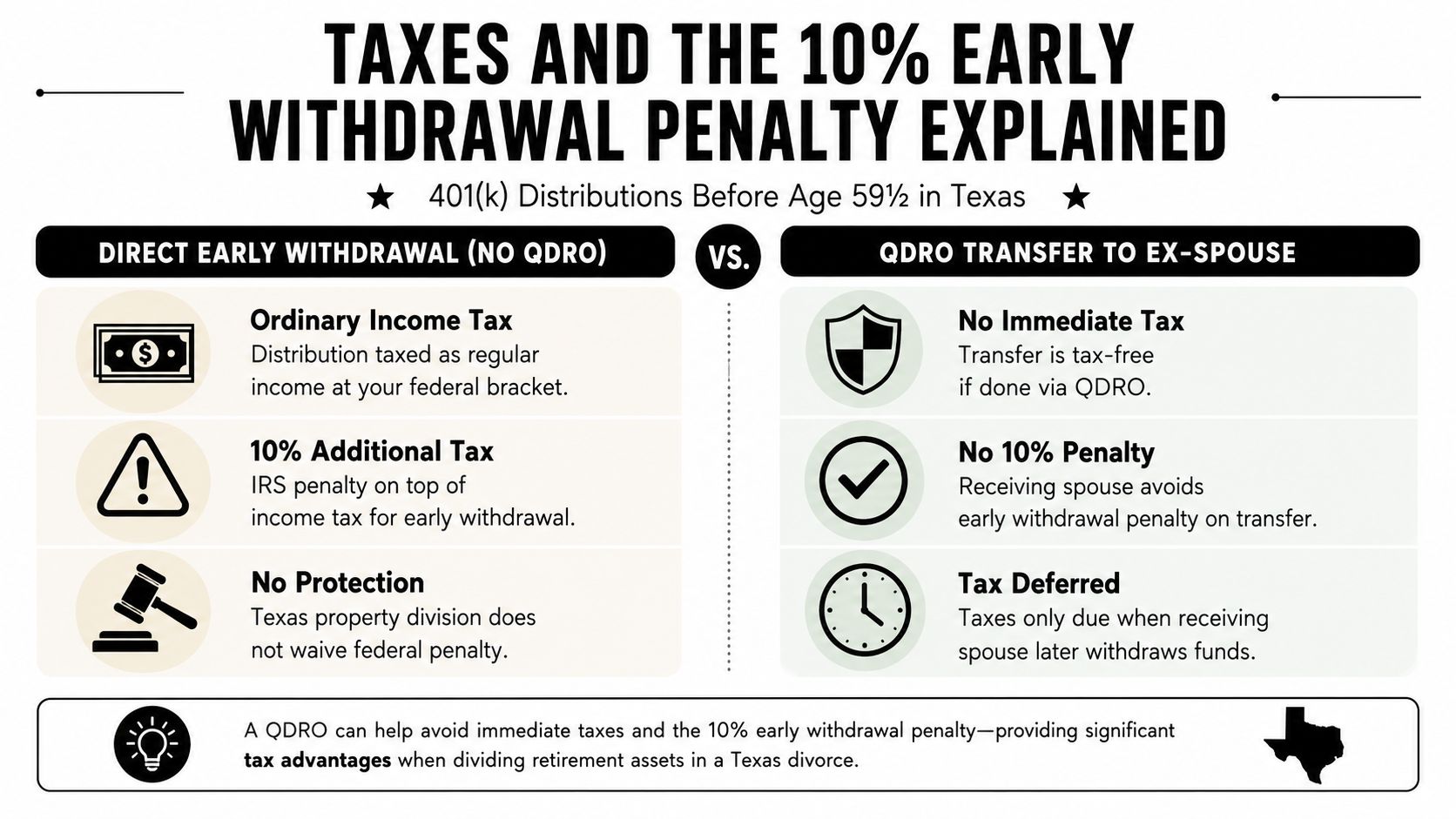
A divorce decree may award you part of a 401(k), yet that award alone does not make a cash withdrawal tax-free. Texas law determines the property division. Federal rules determine how a plan distribution is taxed. Keeping those two systems separate helps explain why the decree, QDRO, plan approval, and distribution must work in the right order.
A typical 401(k) distribution before age 59½ may be subject to ordinary income tax and the federal 10% additional tax. A cash payment may also have mandatory federal withholding under the plan's rules. Withholding is only money held back now, not necessarily the final tax bill, so the amount you receive immediately may be smaller than the amount shown in the account.
A properly qualified QDRO changes the penalty analysis. If the plan pays an alternate payee directly under a valid QDRO, the federal rules generally exempt that payment from the usual 10% early-withdrawal penalty, even when the alternate payee is younger than 59½. Ordinary income tax can still apply unless the eligible funds are rolled into another qualifying retirement plan. The comparison chart on 401(k) early withdrawals and QDRO transfers in a Texas divorce shows the difference between these paths.
The rollover trap
After the plan approves the QDRO and pays the alternate payee, that spouse usually faces a choice. Taking the money can create ordinary income tax, while rolling eligible funds into another retirement account can preserve tax deferral and avoid immediate taxation. A later withdrawal from an IRA before age 59½ generally follows IRA rules, including a possible early-distribution penalty.
The exception attaches to the qualified-plan QDRO distribution, not to every later use of the funds. Someone who needs cash today may make a different choice from someone protecting long-term retirement growth. A tax professional, such as tax attorney Stephen A Weisberg, can help identify the tax questions raised by a planned withdrawal.
An in-plan division may offer another route if the employer's plan permits it. The awarded share can move into an account for the alternate payee within the plan, avoiding an immediate cash distribution and maintaining tax-deferred treatment. That option can avoid the penalty that a premature cash-out may trigger, but it depends on the plan's rules and correct implementation.
Divorce timing matters too. The Texas 60-Day Divorce Waiting Period explains why a Texas divorce cannot be finalized in fewer than 60 days. Use that period to gather records, review plan procedures, and prepare the decree and QDRO rather than withdrawing retirement funds early. For practical guidance on protecting retirement during the process, read surviving the financial storm of divorce and understanding Texas retirement laws.
How a QDRO Protects Your Retirement Savings
A Qualified Domestic Relations Order, or QDRO, is a separate court order used to direct an employer retirement plan to pay benefits to an alternate payee. For a 401(k), it serves as the bridge between the Texas divorce judgment and the federal rules governing the plan.
The decree establishes the property division. The QDRO tells the plan administrator how to carry it out. A decree that says one spouse receives a share of the 401(k) may create a legal obligation between the spouses, but the plan administrator generally needs a qualifying order before transferring or distributing the benefit.
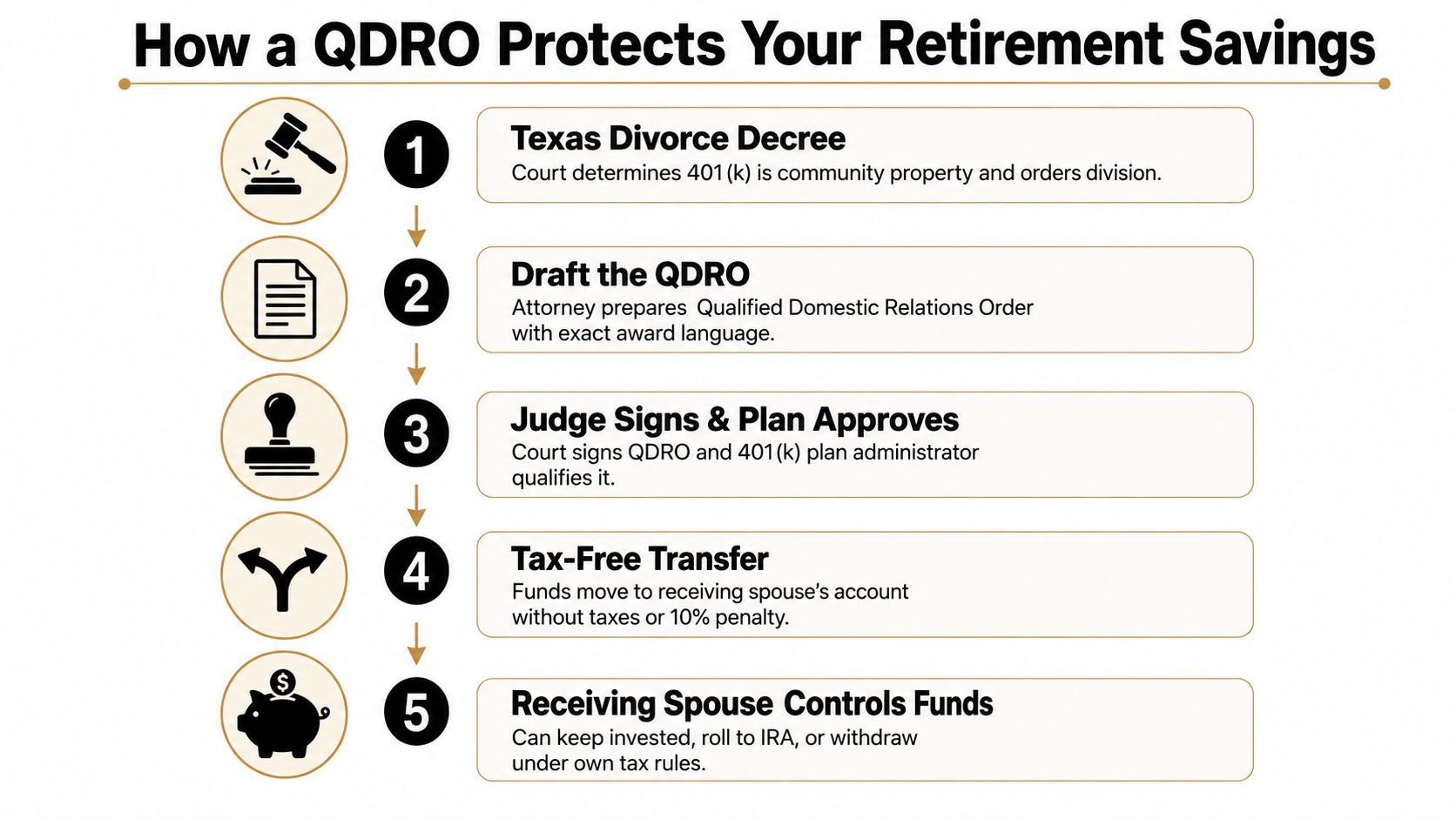
The sequence you should follow
First, identify the plan and its requirements. Obtain the Summary Plan Description and the plan's QDRO procedures. Different plans can require different language, forms, and submission methods.
Next, draft the order. The QDRO should identify the participant, alternate payee, retirement plan, award method, valuation date, treatment of gains and losses, and other terms required by the plan. It must match the property division in the decree.
Then, seek plan review. Your lawyer may submit a draft to the administrator for review before the final hearing, if the plan permits. This can identify technical problems before the judge signs the order.
After that, obtain the judge's signature. The signed QDRO becomes the separate court order that directs the administrator. Texas legal guidance explains that the decree and QDRO are distinct documents, and the signed order must reach the plan administrator before the benefit can be divided.
Finally, wait for qualification before moving funds. The administrator reviews the order under the plan's rules. Only after qualification should you select an eligible rollover or distribution option.
You can learn more about the QDRO process in a Texas divorce, including how the order fits into the larger property division. Information about Dividing Retirement Accounts in a Texas Divorce also addresses how 401(k)s, pensions, and IRAs are split, including QDROs.
Before the hearing: Ask whether the QDRO has been drafted, checked against the plan's procedures, and made consistent with the proposed decree.
A rejected order doesn't necessarily erase your rights, but correcting it can require additional drafting, court action, and delay. If the participant retires, changes employers, takes a loan, or withdraws money before the order is processed, the practical problem can become harder to resolve. Careful preparation protects the settlement you negotiated.
Choosing the Right Option for Your Share
Once the plan qualifies the QDRO, the receiving spouse usually needs to choose how to handle the awarded funds. There isn't one answer for every family. Your age, cash needs, investment experience, creditor concerns, and retirement objectives all matter.
| Option | Tax & Penalty Impact | Creditor Protection | Investment Flexibility | Best For |
|---|---|---|---|---|
| Keep funds in the original 401(k), if permitted | Usually remains tax-deferred; later withdrawals follow plan rules | May preserve protections available under the employer plan | Limited to the plan's investment menu | Someone who wants retirement-focused management without an immediate distribution |
| Direct rollover to an IRA | Generally preserves tax deferral; later early withdrawals may be subject to IRA rules | May differ from the employer plan and depends on applicable law | Often broader investment choices | Someone who wants more control over investments and account management |
| Direct QDRO cash distribution | Generally avoids the 10% penalty for the qualifying distribution, but ordinary income tax can apply | Cash is no longer protected as retirement-plan money | Complete control of cash | Someone with a pressing need for funds who understands the tax cost |
Keeping the money in the original plan may be sensible if the plan accepts the alternate payee and offers useful investment choices. It can also help preserve the account's retirement structure. You should ask whether the plan permits the alternate payee to maintain a separate account and what fees or restrictions apply.
A direct rollover to an IRA can provide broader investment flexibility and simpler control. However, the receiving spouse must understand that a later IRA withdrawal can bring back the ordinary early-distribution rules. Creditor protection may also differ between an employer plan and an IRA.
A direct cash distribution can solve an immediate problem, but it converts retirement savings into taxable income. The QDRO penalty exception doesn't make the distribution tax-free. If you're a business owner, professional, or high-asset spouse, compare this choice with other property offsets before using retirement funds to pay debts, legal expenses, or housing costs.
Parents should also consider the household budget after divorce. Child support, spousal maintenance, insurance, housing, and education expenses may affect whether immediate cash is necessary, but those needs should be modeled before you make an irreversible retirement decision.
Common Mistakes That Cost Texans Money
The most damaging mistakes usually happen when someone treats a 401(k) like an ordinary bank account. Retirement-plan rules don't work that way, and a quick solution can create a lasting tax problem.
Taking money out before the divorce is complete
A spouse may withdraw funds to pay bills, move expenses, or attorney fees. Unless the distribution fits a recognized exception, a withdrawal before age 59½ can create ordinary income tax and the 10% federal early-distribution penalty, as described in the IRS QDRO guidance. A later property settlement doesn't retroactively turn an earlier withdrawal into a QDRO distribution.
The QDRO exception depends on the order and the plan's payment. It doesn't apply merely because the spouses are divorcing.
Treating an IRA like a 401(k)
A 401(k) division generally uses a QDRO. An IRA follows a different transfer process incident to divorce. Rolling money into an IRA before the QDRO is properly handled can also change the rules that apply to a later withdrawal. Keep the account type, order, and distribution path aligned.
Signing the decree and forgetting the order
The divorce decree and QDRO are separate steps. Texas guidance explains that the final decree should describe the retirement benefit, the QDRO should be prepared for the court, and a certified signed copy must be sent to the plan administrator. Without administrator action, the plan may not divide the account.
A missing retirement asset may require post-dissolution litigation. Under Texas Family Code Chapter 9, a former spouse may pursue a post-dissolution partition when community property was omitted, and courts can allow post-decree QDRO proceedings to carry out the original property division. Fixing the omission is possible, but it can consume time, money, and emotional energy.
What to Gather and What to Ask Your Attorney
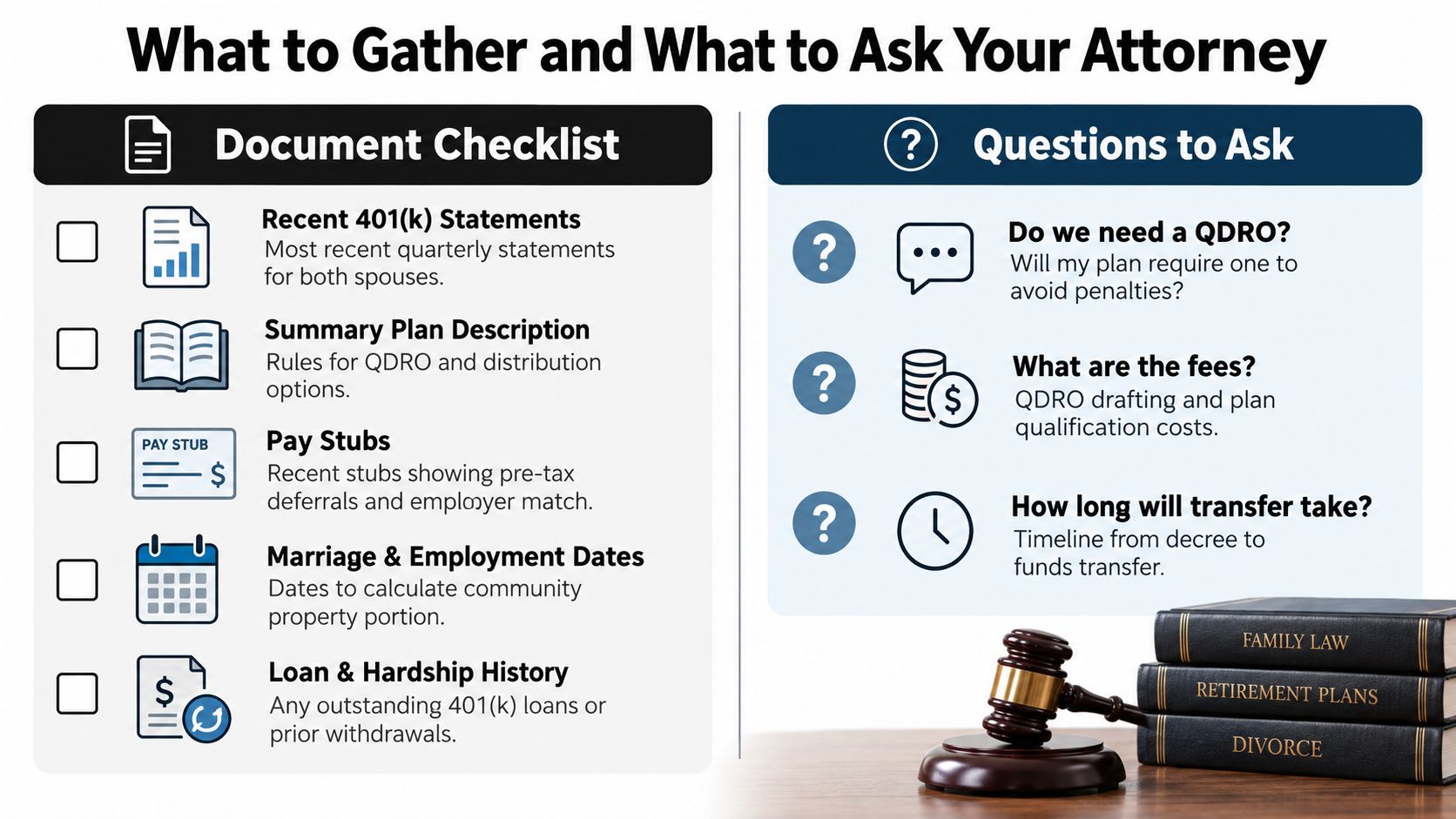
A clear paper trail helps your attorney determine what belongs in the marital estate and prevents a settlement from stopping halfway. Bring:
- 401(k) statements: Get recent statements for both spouses and statements from around the marriage date.
- Plan documents: Include the Summary Plan Description and the administrator's QDRO procedures.
- Employment records: Bring pay stubs showing deferrals and employer contributions.
- Key dates: List the marriage date, employment dates, separation details, and any prior divorce filings.
- Loan information: Include current 401(k) loans, hardship withdrawals, rollovers, and account transfers.
- Court papers: Provide the proposed decree, settlement drafts, and any prepared QDRO.
Ask how the community and separate portions will be calculated. Ask whether an in-plan Roth rollover changes the tax analysis, what the administrator requires to approve the QDRO, and how a current loan affects each spouse's share. Also ask what happens if the participant changes jobs or retires before approval.
The sequence matters: the decree sets the agreement, the QDRO gives the plan instructions, and the plan administrator must approve those instructions before distribution or rollover. Ask whether the plan permits an in-plan division that keeps funds in the 401(k). That option may help the receiving spouse avoid the 10% early-withdrawal penalty that often applies to a cash-out, while a direct QDRO distribution may serve a different need.
A financial advisor or tax professional can review investment choices and future tax consequences. Your family lawyer can coordinate the decree and QDRO terms, but you should understand how each choice affects your post-divorce budget.
The Law Office of Bryan Fagan, PLLC offers free consultations about Texas retirement-asset division and QDRO planning. Bring your records so the attorney can identify gaps before you sign a final agreement.
Key Takeaways and Your Next Steps
Your 401(k) may contain both separate and community property, so the first job is identifying the marital portion. A properly drafted and approved QDRO is the formal path for dividing a 401(k) while generally avoiding the receiving spouse's 10% early-withdrawal penalty. The decree, QDRO, plan approval, and distribution choice must work together.
Choose between keeping funds in the plan, rolling them to an IRA, or taking a direct QDRO distribution only after you understand the tax and investment consequences. For a broader view of settlement and mediation issues, you can review this 2026 divorce walkthrough from Mediation & Negotiation Services. Before you sign anything final, schedule a free consultation with the Law Office of Bryan Fagan so you can protect your retirement savings with a plan customized to your Texas divorce.
The Law Office of Bryan Fagan, PLLC can help you evaluate community and separate retirement assets, prepare for mediation or court, and coordinate the decree and QDRO process with your plan administrator. Visit Law Office of Bryan Fagan, PLLC to schedule a free consultation before you withdraw funds or sign a final settlement.


