Skip to content
Taking that first step toward divorce can feel like you're about to navigate a huge, unfamiliar landscape all on your own. The document that starts this journey is the Texas Original Petition for Divorce, the formal legal paper you file with the court to begin the process.
Think of it as the official announcement to both the court and your spouse that you are seeking to end your marriage. Understanding this document gives you a clear, confident starting point.
Your First Step in a Texas Divorce

Facing a divorce can be overwhelming, but the legal process itself begins with this single, structured document. When you understand what the Original Petition for Divorce does, it demystifies the process and gives you a roadmap. This petition isn't just another form; it's a legal action that sets everything else in motion.
The Purpose of the Petition
At its core, the petition's main job is to provide formal notice. It tells the court system that you are filing a lawsuit to end your marriage. Just as importantly, it legally notifies your spouse (who becomes the "Respondent") of what you're doing. This document doesn't need to air every personal disagreement, but it must include specific, essential information to be legally valid.
The petition lays the groundwork for your entire case by outlining the basic facts and what you're asking the court to do. It covers the critical issues that will need to be resolved, including:
- Identifying the Parties: It clearly states your name (the "Petitioner") and your spouse's name (the "Respondent").
- Stating Jurisdiction: This confirms that you meet Texas's residency rules to file for divorce here.
- Declaring Legal Grounds: It specifies the reason for the divorce. Most people in Texas file under "insupportability," which is our state's version of no-fault divorce, meaning no one has to be blamed.
- Addressing Children and Property: If you have minor children together, the petition must say so. It also needs to mention the existence of community property that will need to be divided.
Why This Document Matters
Getting the petition right from the very beginning is crucial. An accurately prepared document helps you avoid needless delays and complications down the road. It also sets a serious, professional tone for your case, showing the court and your spouse that you are handling this process with care and confidence.
Ultimately, this petition is the foundation on which all other orders, agreements, and even your final decree will be built.
As you prepare for your Texas divorce, you’ll start accumulating a lot of sensitive paperwork. It's a good idea to figure out how you'll securely store important legal documents from the start. By understanding the purpose and structure of this initial filing, you can tackle this first milestone with more confidence, knowing exactly what to expect.
Confirming Texas Residency Before You File

Before a judge will even look at your Texas original petition for divorce, you have to prove you have the right to file here. This isn't a suggestion—it's a strict legal requirement known as jurisdiction.
Getting this wrong is a critical mistake that can get your case thrown out, forcing you to start all over and costing you precious time and money. The court needs to be certain your case belongs in Texas, and that's determined by specific residency rules in the Texas Family Code.
The Two Critical Timelines
To file for divorce in Texas, you have to meet two separate timelines. Think of them as two boxes you absolutely must check before moving forward.
- The 6-Month State Rule: When you file your petition, you (or your spouse) must have lived in the state of Texas for the last six continuous months.
- The 90-Day County Rule: You must also have lived in the specific county where you plan to file for at least the last 90 continuous days.
You must meet both of these rules. For instance, if you've lived in Harris County for ten years but moved to Montgomery County last week, you don't yet meet the 90-day county rule for Montgomery. Your options would be to wait until you hit the 90-day mark or file back in Harris County.
Filing in the correct county is a foundational step. If a court doesn't have proper jurisdiction, any orders it makes could be invalid. Taking a moment to confirm this now prevents major legal headaches down the road.
Applying Residency Rules to Real-Life Scenarios
These rules can feel a bit abstract, so let's walk through how they work in real life. Nailing down the details of Texas divorce residency requirements is the key to a smooth start.
Scenario 1: The Recent Move
Imagine you've lived in Dallas your whole life. You and your spouse separated, and you moved into a new apartment in Plano (Collin County) two months ago.
- You easily meet the 6-month state rule—you've been in Texas for years.
- But you don't meet the 90-day county rule for Collin County yet.
Here, you have a choice: wait another month to file in Collin County, or file immediately back in Dallas County, where you have already established residency.
Scenario 2: The Military Family
What if you or your spouse is in the military? Texas law has specific protections for service members. If you are a Texas resident stationed somewhere else—even overseas—on military duty, you can still file for divorce in the Texas county you consider your permanent home.
The time you spend deployed or stationed elsewhere still counts toward your Texas residency for divorce purposes. This ensures serving your country doesn't strip you of your right to use Texas courts to handle your family law matter.
Confirming your residency is the very first checkpoint. It puts your Texas original petition for divorce on solid legal ground and gives you the confidence that your case is in the right place from day one. If you have any doubt about where to file, it's a critical question to discuss with an attorney right away.
What to Include in Your Divorce Petition
Figuring out what details to put into your Texas Original Petition for Divorce can feel like trying to assemble a puzzle with a thousand tiny pieces. But getting this right is non-negotiable. Accuracy and completeness aren't just suggestions here—they are the foundation of your entire case. This document is your first official communication with the court, telling the judge exactly what you’re asking for. Nailing it from the start is the best way to prevent frustrating delays down the road.
The good news is that the petition doesn't have to be a novel detailing every disagreement from your marriage. It does, however, need to contain specific information required by the Texas Family Code. Each piece serves a distinct legal purpose, from establishing the court's authority to outlining the key issues that need to be resolved.
Identifying the Parties and Stating the Grounds
The first part of the petition is the most straightforward: identifying everyone involved. You will be listed as the Petitioner (the person filing), and your spouse will be the Respondent. You must include the full legal names and current addresses for both of you.
Next, you have to state the legal reason, or grounds, for the divorce. While Texas law does allow for fault-based grounds like adultery or cruelty, the overwhelming majority of divorces are filed on the no-fault ground of insupportability. This simply means that "a discord or conflict of personalities…destroys the legitimate ends of the marital relationship and prevents any reasonable expectation of reconciliation." It’s a neutral, blame-free way to inform the court that the marriage is broken beyond repair.
Children and Property Declarations
If you and your spouse have minor children together, the petition must state this clearly. You'll need to list each child's name, date of birth, and current address. The petition must also include a special statement required by the Uniform Child Custody Jurisdiction and Enforcement Act (UCCJEA), which confirms where the children have lived for the past five years. This is how the court establishes its authority to make decisions about custody.
Similarly, you must state that there is community property to be divided. At this early stage, you don’t need a full, itemized list of every asset and debt. Instead, the petition makes a general request for a "just and right" division of the community estate, which is the legal standard courts use under Texas Family Code § 7.001. You’ll gather that detailed inventory later, and our firm offers a helpful guide on the essential documents for filing for divorce in Texas to get you started.
Filing the petition is a major step, and you’re not alone in taking it. In fiscal year 2023 alone, 108,486 new divorce cases were filed across Texas—47,731 involving children and 60,755 without. These numbers, detailed in the Texas Office of Court Administration's annual report, show just how central this document is to the Texas family court system.
Drafting the petition correctly from the start prevents unnecessary amendments and delays. Below is a quick checklist of the essential components you'll need to include.
Essential Components of a Texas Divorce Petition
| Section of Petition | What to Include | Why It's Important |
|---|---|---|
| Parties & Jurisdiction | Full legal names and addresses for both spouses (Petitioner and Respondent). A statement that Texas residency requirements have been met. | Establishes the court's legal authority to hear your case. Incorrect information can lead to dismissal. |
| Grounds for Divorce | The legal reason for the divorce. Most commonly, this is insupportability (no-fault). | Fulfills a mandatory requirement under the Texas Family Code and sets the legal basis for dissolving the marriage. |
| Information on Children | Names, birth dates, and addresses of all minor children of the marriage. Must include the required UCCJEA statement. | Gives the court jurisdiction to make orders regarding child custody, visitation, and support. |
| Community Property | A statement that community property exists and a request for a "just and right" division. | Puts the division of assets and debts on the court's radar. A detailed inventory is not needed at this stage. |
| Request for Orders | Any specific requests, such as for temporary orders, a name change for a spouse, or a Temporary Restraining Order (TRO). | Formally asks the court to take specific actions to protect assets and establish stability while the divorce is pending. |
| Prayer for Relief | The concluding section where you formally ask the court to grant the divorce and any other relief requested in the petition. | This is the formal "ask" that summarizes what you want the final outcome of the case to be. |
Having this checklist handy ensures you don’t miss any critical information that could hold up your case.
Requesting Temporary Orders and Restraining Orders
Perhaps one of the most powerful and protective parts of your petition is the request for temporary orders. These are crucial for creating stability and setting ground rules while the divorce is ongoing.
You can ask the court to issue orders that:
- Establish a temporary custody and visitation schedule for the kids.
- Order temporary child support and medical support payments.
- Grant one spouse exclusive use of the marital home.
- Decide who will be responsible for paying certain bills during the divorce.
Your petition can also include a request for a Temporary Restraining Order (TRO). A TRO is an immediate court order that prohibits both you and your spouse from taking certain harmful actions, like draining bank accounts, selling property, or harassing each other. It's a vital tool for protecting your assets and keeping the peace from the moment you file.
For example, if you're worried your spouse might empty a joint savings account or pull the kids out of their school as soon as they're served with divorce papers, a TRO can stop that from happening. It essentially freezes the status quo, ensuring assets are preserved and things remain stable until a temporary orders hearing can be held—usually within 14 days. Including this request in your initial petition is a proactive move that can save you from huge financial and emotional headaches. It sets clear boundaries from day one, which is invaluable in a high-conflict situation.
Filing the Petition and Serving Your Spouse
Once your petition is drafted and every detail is correct, the next move is making it legally official. This can feel like a huge step, but knowing what comes next takes the uncertainty out of it. You'll file the document with the district clerk's office and then formally notify your spouse—a critical step known as service of process.
This isn't just about dropping papers in the mail. It's a formal legal procedure designed to protect everyone's rights. The court needs solid proof that your spouse received the lawsuit papers and has a fair chance to respond. Getting this step right is essential to keep your case moving forward without procedural hiccups that could cause major delays.
The infographic below breaks down the core components of the divorce process that your petition sets in motion: dealing with the people involved, dividing the assets, and protecting any children.
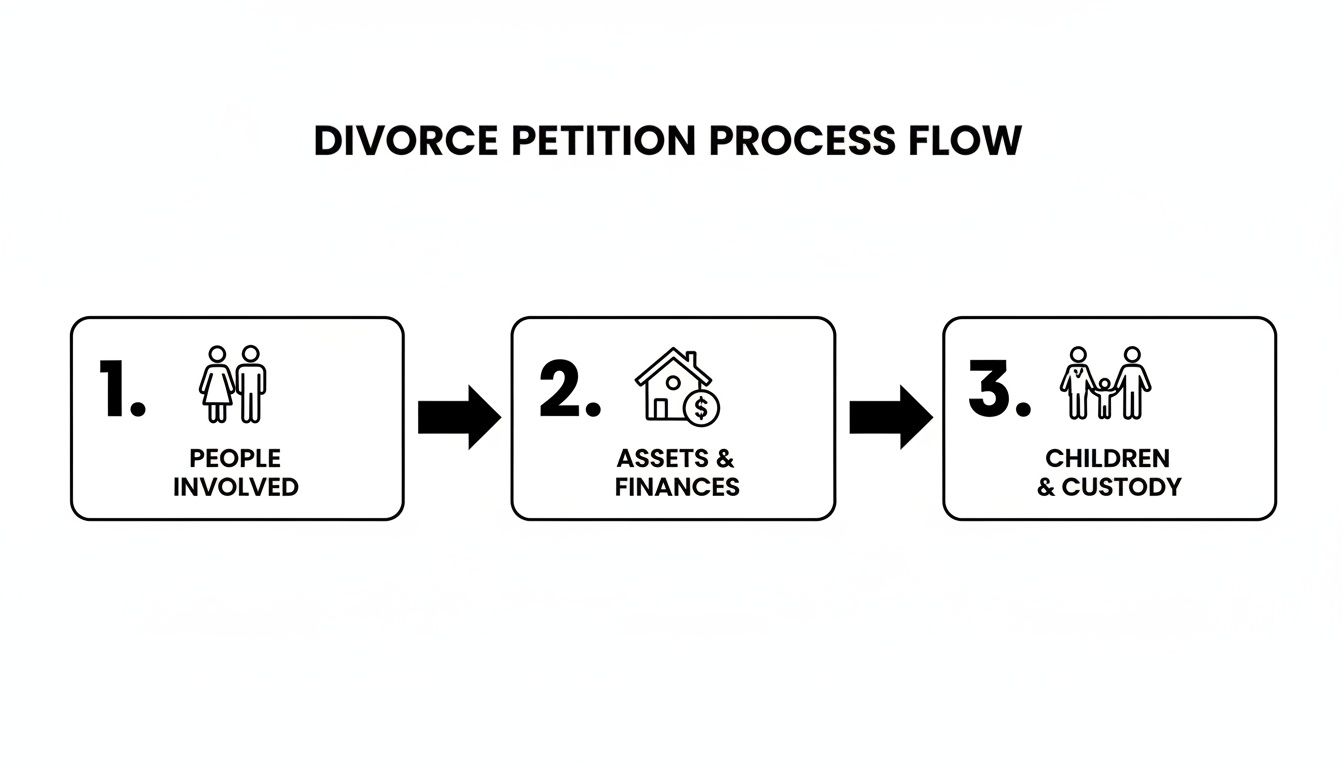
As this visual shows, a Texas divorce is about resolving these three intertwined areas. Filing and serving the petition is what officially kicks off that resolution.
How to File Your Petition with the Court
Filing your Texas original petition for divorce is simply the act of submitting it to the district clerk in the county where you live. Today, most Texas counties use an electronic filing system, often called "e-filing," which makes the process more streamlined.
When you file, you'll also have to pay a filing fee. This fee varies by county but usually lands somewhere between $250 and $350. If paying this would be a financial hardship, you can file a "Statement of Inability to Afford Payment of Court Costs." A judge will review it and may waive the fee for you.
Once the clerk accepts your petition, it's assigned a case number and a specific court. That's the moment your divorce officially becomes a pending legal case.
Understanding Service of Process
After filing, you are legally required to notify your spouse. This ensures they know about the lawsuit and have the opportunity to participate. Texas law offers a few different ways to get this done.
The most common method is personal service. This involves hiring a neutral third party—like a sheriff, constable, or private process server—to hand-deliver a copy of the filed petition and a document called a citation directly to your spouse. The process server then files a "Return of Service" with the court, which serves as official proof that your spouse got the papers.
This method is formal and leaves no room for doubt, making it the best choice if you think your spouse might try to ignore the divorce or be uncooperative.
The Amicable Alternative: A Waiver of Service
If your divorce is on friendly terms and you and your spouse are still communicating, there’s a much simpler, less confrontational option called a Waiver of Service.
Instead of having a stranger show up at your spouse's home or work, you can just send them a copy of the petition along with a Waiver of Service form. By signing this form in front of a notary and filing it with the court, your spouse formally acknowledges they've received the lawsuit and waives the need for formal personal service.
Signing a Waiver of Service does not mean your spouse agrees with everything in your petition. It simply confirms they received the documents, saving you the time and expense of hiring a process server. It’s a cooperative first step that can set a positive tone for an uncontested or collaborative divorce.
Many people find this route far less stressful. If you're considering it, you can learn more about what a Waiver of Service entails and decide if it’s the right fit for your situation.
What Happens If Your Spouse Avoids Service?
It happens. Sometimes, a spouse will actively try to avoid being served with divorce papers. They might refuse to answer the door, hide from the process server, or just make themselves scarce. If this is your reality, don't worry—the law has solutions.
If multiple attempts at personal service fail, your attorney can file a motion for substituted service. This is a request asking the judge for permission to serve your spouse in another way that is reasonably likely to give them notice. Common methods a judge might approve include:
- Leaving the papers with anyone over 16 at a specific location.
- Posting the documents on the courthouse door.
- Service via email or even social media, if the situation warrants it.
Ultimately, a spouse cannot stop a divorce just by avoiding service. The court will make sure the case moves forward once proper notice has been given, one way or another.
What to Expect After You File
You’ve filed the petition. The papers are with the court, and the legal gears have officially started turning. This moment can feel a bit strange—like you've taken a huge step, only to land in a quiet waiting room. Knowing what happens next, and when, is the key to feeling in control during what can be a very uncertain time. The moves you and your spouse make in the coming weeks will set the tone for your entire divorce.
The moment your Texas original petition for divorce is officially on file, two critical clocks start ticking. Getting a handle on these timelines will help you manage your expectations and prepare for what’s ahead.
The Mandatory 60-Day Waiting Period
First things first: Texas law imposes a mandatory 60-day waiting period before a judge can finalize any divorce. This is laid out in the Texas Family Code § 6.702 and is often called a "cooling-off" period.
This rule is non-negotiable and applies to every single divorce in the state, no matter how friendly or straightforward. The clock starts the day after your petition is filed. Even if you and your spouse have everything figured out from day one, you simply cannot get that Final Decree of Divorce signed until at least 60 days have passed.
Your Spouse’s Deadline to Respond
Once your spouse is formally served with the divorce papers, they have a specific deadline to file a response with the court. Their official response is called an "Answer."
The legal deadline is "by 10:00 a.m. on the Monday next after the expiration of twenty days after the date of service." In plain English, this usually gives your spouse about three weeks to file their Answer.
What happens next depends on their action (or inaction):
- If They File an Answer: The case is now considered "contested," at least on paper. This doesn't automatically mean you're heading for a nasty courtroom battle. It simply means both of you are now formally participating in the legal process.
- If They Do Nothing: If your spouse misses the deadline and doesn't file an Answer, you might be able to move forward with a default judgment. This allows the court to finalize the divorce without their input, often by granting the terms you requested in your original petition.
Establishing Ground Rules with Temporary Orders
While you're waiting for these timelines to play out, life doesn’t hit pause. Bills are still due, the kids need a stable routine, and your property has to be managed. This is where Temporary Orders hearings are absolutely crucial.
Shortly after filing, either you or your spouse can ask a judge for a hearing to set some ground rules that will last until the divorce is final. These orders bring much-needed stability by addressing urgent issues, such as:
- Who gets to live in the family home for now.
- A temporary custody and visitation schedule for the kids.
- Orders for temporary child support or spousal support.
- Instructions on who pays which bills and debts.
A Temporary Orders hearing is often your first time in front of a judge. It's a critical chance to establish a fair status quo for your children and your finances, protecting you from chaos or being put at a disadvantage while the case moves forward.
It’s interesting to note who often initiates this process. Court data from across the state shows that women file roughly 70% of all original petitions for divorce in Texas. Based on this trend, it’s likely that over 75,000 women took this first critical step in 2023 alone. You can dive deeper into these numbers by exploring Texas divorce filing trends and statistics. At our firm, our goal is to empower every client—regardless of who files first—and make sure their voice is heard right from the beginning. This roadmap of what comes after filing is designed to help you anticipate the next few months and prepare effectively, especially when children or significant assets are involved.
What to Do Next
You’ve taken a huge step by filing the Texas original petition for divorce. Getting this far is a major accomplishment, but it's really just the starting line. While divorce can feel overwhelming, this first phase is entirely manageable when you know what to expect. You've already handled the critical first moves, from confirming your residency to drafting and serving the petition correctly.
Even though it’s possible to file these initial papers yourself, the stakes are incredibly high. A single misstep can create lasting problems, especially when your future involves children, a family business, or a high-value estate. In these situations, getting professional legal guidance isn't a luxury—it's essential for protecting your rights, your family, and your financial future.
Key Takeaway: The initial divorce filing sets the entire foundation for your case. Handling it with precision protects your interests from day one and helps you move forward with confidence and clarity.
Every family's situation is different, and you deserve a strategy that fits your unique circumstances. Now is the time to make sure your rights are fully protected. We invite you to schedule a free, no-obligation consultation with our experienced family law attorneys. Let us help you navigate what comes next with compassion and strength.
Common Questions About Filing for Divorce in Texas
Taking that first step toward divorce always brings up a lot of questions. It's completely normal to feel a bit lost or unsure about the process, and that's why we're here. Below are answers to some of the most common questions we get about the Texas original petition for divorce, designed to give you some quick, clear insights as you get started.
Can I File for Divorce Here if My Spouse Lives in Another State?
Yes, you absolutely can. What matters is where you live, not your spouse. As long as you have lived in Texas for the past six months and in your specific county for the last 90 days, you meet the residency requirements to file your petition here.
Texas courts have the authority to handle divorces even when one spouse lives out of state. The only real difference is how your spouse will be officially notified, or "served," with the divorce papers. It involves a specific out-of-state procedure, but it won’t stop your case from moving forward.
What's the Difference Between a Contested and Uncontested Divorce?
This is a really important distinction, as it directly impacts how long your divorce will take and how much it will cost.
- An uncontested divorce means you and your spouse agree on everything—how to split up property and debt, who gets custody of the kids, child support, the works.
- A contested divorce, on the other hand, means there's a disagreement on at least one of those issues.
Your initial petition just gets the ball rolling. Whether the case ends up being contested or not all comes down to whether you and your spouse can reach a full agreement after the case has been filed.
Do I Have to Blame My Spouse for the Divorce in the Petition?
No, you don't. Texas is a "no-fault" state, which gives everyone a straightforward way to end a marriage without having to point fingers.
Most people file using the grounds of "insupportability." That’s the legal term for saying the marriage has broken down because of conflict and there’s no reasonable chance of fixing it. However, if there are "fault" grounds—like adultery or cruelty—you can list them. Sometimes, this can be a strategic move that might influence how a judge divides property, but it's a decision best made with advice from an attorney.
For most people, filing on no-fault grounds is the simplest and least contentious way to start a divorce. It keeps the focus on finding solutions for the future, not rehashing the past.
What Happens if I Mess Up the Petition?
Mistakes on legal paperwork can cause real headaches, ranging from minor delays to serious legal problems down the road. A simple typo can usually be fixed by filing an Amended Petition.
But bigger errors can have lasting consequences. Filing in the wrong county, getting facts about your children wrong, or forgetting to ask for important protections like a Temporary Restraining Order can negatively affect your entire case. This is one of the strongest arguments for having an experienced lawyer prepare or at least review your petition. Making sure your Texas original petition for divorce is done right from the very beginning protects your rights and helps you avoid costly and frustrating setbacks.
Your situation is unique, and you deserve a legal strategy that fits your specific needs and goals. At The Law Office of Bryan Fagan, PLLC, our experienced attorneys are here to answer all your questions and guide you through every step with compassion and confidence. Schedule your free, no-obligation consultation today to learn how we can protect your family and your future. Visit us at https://texasdivorcelawyer.us to get started.