It's incredibly frustrating when a court order—something that's supposed to bring stability to your life—is completely ignored.
If your ex-spouse or co-parent is violating the terms of your divorce decree or custody order, you are not powerless. A Motion to Enforce is the legal tool you use to ask a judge to step in and compel the other party to follow the rules. Whether you are dealing with missed child support, denied visitation, or property that was never turned over, Texas law provides a clear path to hold them accountable.
What Happens When a Court Order Is Ignored?

When a judge signs your final decree or custody order, its terms are not just suggestions—they are legally binding commands. Unfortunately, it’s not uncommon for one person to disregard those obligations, leaving you feeling helpless and disrespected.
This is exactly why the Motion to Enforce exists. It is a formal request you file with the same court that issued your original order. You are essentially telling the judge, "The order you signed is being broken, and I need your help to fix it." This legal action highlights the specific violations and demands compliance, giving your court order the teeth it needs to be effective.
Common Scenarios That Require Enforcement
Violations can show up in many ways, often creating significant emotional and financial strain. You might find yourself dealing with one of these common issues:
- Financial Violations: Your ex may fail to pay court-ordered child support, spousal maintenance (alimony), or their portion of your children's medical expenses. They could also refuse to hand over property awarded to you in the divorce, like signing over a car title or refinancing a mortgage to remove your name from the loan.
- Custody and Visitation Violations: This is a frequent and painful problem. It happens when one parent interferes with the other's court-ordered time with the children. This could look like consistently showing up late for exchanges, refusing to allow phone calls with your child, or completely withholding visitation. If this is happening to you, our guide on what to do if your ex is withholding visitation in Texas offers specific advice.
- Property Division Non-Compliance: The division of your assets and debts must be followed exactly as it's written in the decree. An ex who refuses to sell the marital home, split a retirement account, or pay off a credit card assigned to them is in direct violation of the court's order.
Why Taking Action Is So Important
Letting violations slide sets a dangerous precedent. It sends a message to your ex that the court's orders are optional and that they can get away with not following the rules.
By filing a Motion to Enforce, you're not just fixing what already happened; you're re-establishing the ground rules and protecting your family’s stability moving forward. The legal process for enforcement can feel complex, but Texas courts are well-equipped to handle these cases effectively. Taking decisive action is your right, and it's often the necessary step to protect the arrangements you worked so hard to secure.
When It's Time to File a Motion to Enforce
You have a court order, signed by a judge, that lays out the rules. So, what do you do when your ex treats it like a suggestion? Before you head to the courthouse, you must be sure their behavior is a clear, direct violation of the order’s specific terms.
A motion to enforce isn’t for a vague feeling of unfairness. It’s for when you can point to the exact paragraph in your decree and show the judge precisely how it was broken. This is the first and most critical step in holding your ex accountable and getting your family’s life back on track.
Enforcing Child Support Orders
Unpaid child support is one of the most common reasons people end up back in court. Your final decree is clear: it specifies who pays, how much they pay, and the exact day each payment is due.
According to the Texas Family Code, Section 154.001, a parent has a legal duty to support their child, and the court order makes this obligation enforceable. You have a solid case for enforcement if your ex:
- Consistently pays late, throwing your budget into chaos.
- Pays less than the full, court-ordered amount.
- Stops paying altogether without seeking a court-approved modification.
- Refuses to pay their share of the children's medical or dental bills as required by the order.
For instance, if your order states your ex pays you $800 on the 1st of every month but they've only sent $400 for the last three months, you have a clear, documented violation. Each missed or short payment is a separate violation you can bring before the judge.
Upholding Possession and Visitation Schedules
There is almost nothing more heartbreaking than being denied your court-ordered time with your children. Your possession schedule isn't optional—it's a legally binding order designed to protect your relationship with your kids.
The Texas Family Code, Section 153.001, emphasizes that it is in the public policy of Texas to "assure that children will have frequent and continuing contact with parents who have shown the ability to act in the best interest of the child." A parent who violates this is acting against the child's best interest. Even if one parent is behind on child support, the other parent cannot legally withhold visitation as punishment. Blocking access to the kids is a direct violation of the order.
It’s time to consider a motion to enforce if the other parent:
- Regularly shows up late for exchanges, chipping away at your time.
- Flat-out refuses to hand over the kids for your scheduled weekend or holiday.
- Takes the kids on a trip during your designated possession time without your consent.
- Prevents you from having your court-ordered phone calls or video chats.
A single missed weekend might be tough to enforce, but a clear pattern of denial is exactly what warrants court intervention. Start documenting everything—dates, times, and what was said in texts or emails. This is the evidence you’ll use to build your case.
Compelling Property Division Compliance
Your divorce decree carefully divided your marital property and debts. If your ex is dragging their feet on following through, it can leave your financial life in total chaos. A motion to enforce is the legal tool you use to force the finalization of these lingering issues.
Common property violations include:
- Refusing to sign over the title to a car that was awarded to you.
- Failing to refinance the mortgage to get your name off the loan within the specified timeline.
- Not turning over specific items of personal property, like furniture or artwork.
- Failing to follow through with the division of a retirement account using a Qualified Domestic Relations Order (QDRO).
If your decree stated your ex had six months to refinance the house and it’s been over a year, you have a strong reason to file. The court can order them to act, and if they still refuse, the judge can even appoint someone else to sign the documents for them.
How to Draft and File Your Motion Correctly
Feeling overwhelmed by the paperwork is completely normal, but a successful outcome hinges on getting the details right. A Motion to Enforce is a formal legal document, and Texas courts demand absolute precision. Think of it as building your case on paper—every single word matters.
This isn’t just about filling out a form; it's about telling a clear, factual story to the judge. Your motion must state exactly which part of the court order was violated, when it happened, and how it happened. Vague complaints will not be enough. You need specific, provable facts to get the court’s attention.
Crafting a Legally Sound Motion
When you sit down to write your Motion to Enforce, clarity and specificity are essential. The document must be so clear that a judge can read it and immediately understand the problem. For comprehensive support, understanding the role of a litigation paralegal in preparing legal documents can be a huge asset, as they are experts at putting these critical court filings together.
Here’s what your motion absolutely must include to be legally valid in Texas:
- Identify the Original Order: State the exact title and date of the court order you need to enforce (e.g., "Final Decree of Divorce, signed on June 15, 2023").
- Quote the Violated Section: You must quote the specific language from the order that the other party ignored. Do not paraphrase; copy it word-for-word.
- Detail Each Violation: For every single violation, you need to list the date, time, location, and a clear description of what happened. For example, instead of saying "he didn't pay child support," you’d write, "Respondent failed to pay the court-ordered child support of $850.00 due on October 1, 2024."
- State Your Requested Relief: Clearly tell the court what you want it to do. This could be ordering the payment of back child support, awarding you make-up visitation time, or holding the other party in contempt of court.
As you assemble this information, you'll also need to gather your supporting documents. Our guide on the essential documents for filing for divorce in Texas can give you a solid idea of the types of paperwork courts expect to see.
Essential Elements of a Texas Motion to Enforce
Use this checklist to ensure your motion contains the critical information needed to be legally effective.
| Required Component | What It Means and Why It's Important |
|---|---|
| Case Information | Includes the cause number, court number, and county. This ensures your motion is filed in the correct case file. |
| Parties' Information | Full legal names and contact information for both you (the Movant) and the other party (the Respondent). Accuracy is key for proper notification. |
| Jurisdiction Statement | A brief statement confirming the court has the authority to hear the case (usually because it issued the original order). |
| Identification of the Order | Clearly state the full title and date of the order being violated (e.g., Final Decree of Divorce, Temporary Orders). |
| Quoted Provisions | You must quote the exact language from the order for each provision that was violated. No summarizing. |
| Specific Allegations | For each violation, list the date, time, and specific facts of how the Respondent failed to comply. Be detailed and factual. |
| Prayer for Relief | This is where you tell the judge exactly what you want. This could be a request for contempt, jail time, fines, attorney's fees, or make-up time. |
| Verification | Your signature under oath (a notarized affidavit) confirming that the facts in the motion are true and correct. This is non-negotiable. |
| Certificate of Service | A statement certifying that a copy of the motion was sent to the other party or their attorney. |
Missing even one of these components can get your motion dismissed or cause serious delays.
The Filing and Service Process in Texas
Once your motion is drafted and your evidence is organized, the next phase is getting it into the court system and officially notifying the other party. This two-part process is just as important as writing the motion itself.
First, you must file the motion with the district clerk in the same Texas county that issued your original order. You cannot file it in a new county just because you moved. You’ll need to pay a filing fee, which varies by county. If you cannot afford it, you can file a "Statement of Inability to Afford Payment of Court Costs" for the judge to consider.
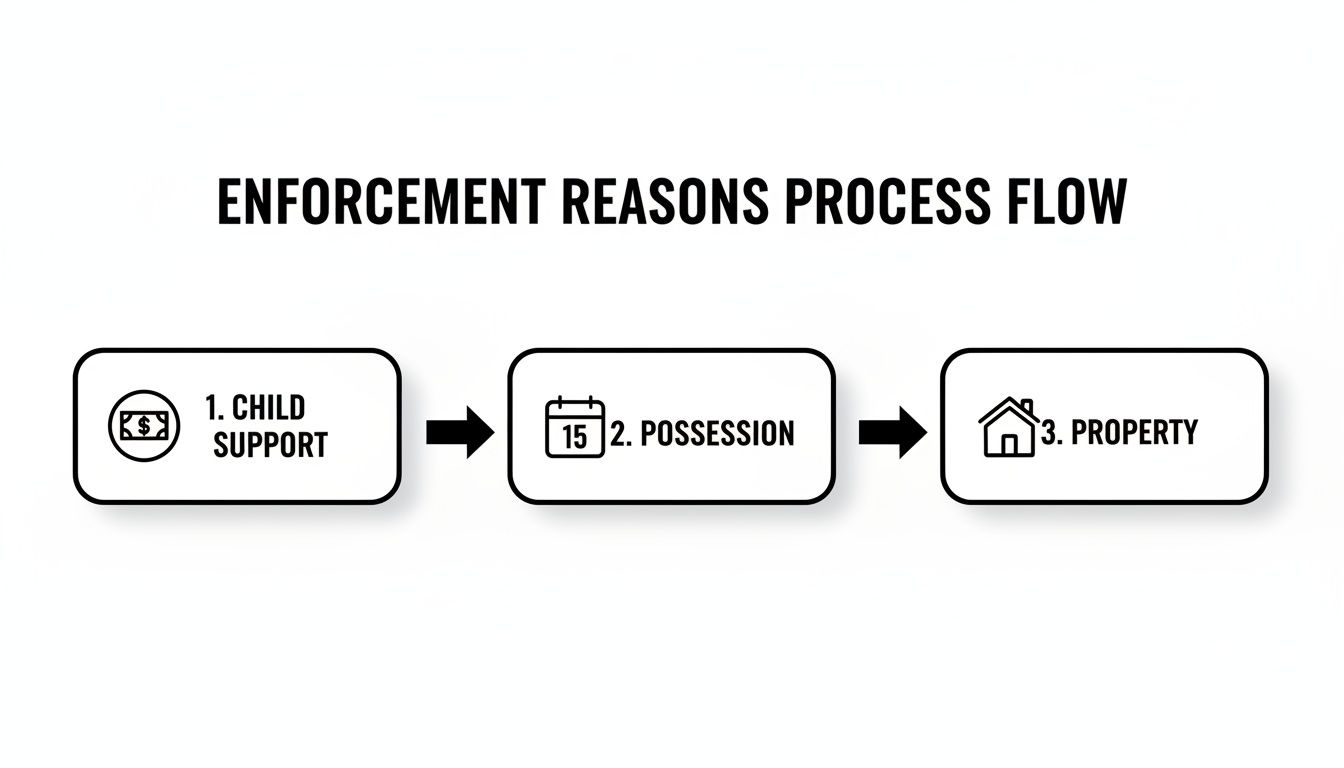
The flowchart below breaks down the most common reasons people file a Motion to Enforce, from child support and possession schedules to property division.
After filing, the other party must be formally notified through a process called service. This is a critical step. You cannot just email them a copy or hand it to them yourself. Proper service in Texas almost always requires:
- Hiring a Private Process Server or Sheriff: They will personally deliver a copy of the filed motion and a "citation" (a formal notice of the lawsuit) to your ex.
- Filing a Proof of Service: The server then files a document with the court confirming the date, time, and location the papers were delivered. This is your official proof that the other party was legally notified.
Once service is complete and proof is filed with the clerk, the court can finally schedule your hearing. Sticking to these procedural rules ensures the process is fair and that your case can move forward toward a resolution.
Preparing for Your Court Hearing
The feeling of nervousness before walking into a courtroom is completely normal, but solid preparation is the best way to turn that anxiety into confidence. Your court hearing for the Motion to Enforce is your chance to lay out the facts for the judge. This is where all your careful documentation pays off.

Your primary goal is simple: prove that a specific, clear court order was violated. The judge isn't there to re-litigate old arguments or listen to general complaints. They need to see a straight line connecting the order's command to the other party's failure to obey it.
Walking in prepared helps you stay focused on that goal. It’s how you present your case effectively and achieve the outcome you need.
Gathering and Organizing Your Evidence
Strong evidence is everything in an enforcement action. Your word alone isn’t enough; you need tangible proof that leaves no room for doubt. Before you step foot in the courthouse, organize everything into a clear, chronological story that the judge can easily follow.
Your evidence should include:
- Financial Records: For unpaid child support, this means bank statements showing the missing deposits, official payment records from the Attorney General’s office, or copies of cashed checks for the wrong amount.
- Written Communications: Print out relevant text messages, emails, and social media messages. Anything where your ex admits to the violation or makes excuses is powerful. For example, a text saying, "I'm not bringing the kids back Sunday, I decided to take them to the coast," is clear proof they broke the possession schedule.
- A Detailed Timeline: Create a simple log of every violation. Note the date, time, and a brief, factual description of what happened. This isn't about emotion; it's about showing the judge a clear pattern of non-compliance.
- Photos or Videos: Visuals can be incredibly compelling. A photo of a piece of property that was supposed to be turned over to you but is still in your ex’s garage speaks volumes.
When you present this evidence, keep it direct and factual. Avoid emotional language and stick to the specifics. Your job is to connect each piece of evidence back to a specific violation you listed in your motion.
Testifying and Courtroom Etiquette
How you present yourself in court matters just as much as the evidence you bring. The judge is observing your demeanor, your tone, and your respect for the process. Proper courtroom etiquette shows you take this seriously and are there to solve a problem, not start another fight.
Follow these simple rules:
- Dress Professionally: Business casual is always a safe bet.
- Address the Judge Correctly: Always use "Your Honor."
- Speak Clearly and Calmly: When it's your turn to speak, take a breath. Answer questions directly and avoid rambling.
- Be Respectful to Everyone: Never interrupt the judge or the other party. Even if you disagree with something they say, wait for your turn.
When you're on the stand, your testimony should be a calm, factual account of the violations. The key is to stay focused on the facts in your motion and not get dragged into arguments about unrelated issues. For more practical tips, see our guide on how to prepare for a custody hearing in Texas. By being organized and respectful, you make it easy for the judge to see the situation clearly and rule in your favor.
What the Court Can Do to Enforce an Order
It’s one thing to prove your ex violated a court order, but what can a judge actually do about it? A Texas family law judge has a wide range of tools to compel compliance, punish willful disobedience, and make you whole again.
These remedies are designed to fix the immediate problem and strongly discourage your ex from violating the order again. The judge will listen to the facts and choose the remedy—or combination of remedies—that best fits the situation.
Finding of Contempt of Court
The most serious tool a judge has is the power to find someone in contempt of court. This is a formal ruling that your ex intentionally and knowingly violated a clear order.
- Coercive Contempt: This is about forcing immediate compliance. The judge might order your ex to be jailed until they perform a specific action, like signing over a car title or paying a lump sum of back child support. The idea is simple: they hold the keys to their own jail cell.
- Punitive Contempt: This is meant to punish past violations. For each separate violation proven in court, a judge can sentence the non-compliant party to up to 180 days in county jail and impose a fine of up to $500.
Financial and Property-Related Remedies
Often, the most effective remedies are financial. Judges have broad authority to issue orders that correct the harm caused by the violation.
The Texas Family Code allows the judge to order the non-compliant party to pay your reasonable attorney's fees and all court costs. You shouldn't be financially punished for having to drag your ex back to court to make them follow an order they should have been obeying all along.
The court might also order one or more of the following:
- Wage Garnishment: For unpaid child support, the court can issue an order directly to your ex's employer, requiring them to deduct child support payments straight from their paycheck.
- Property Liens: The court can place a lien on your ex's non-exempt property, like a second home or investment property. This means they can't sell or refinance that asset until the debt to you is fully paid.
- Forced Sale of Property: If your decree ordered an asset to be sold but your ex refused to cooperate, the judge can appoint a receiver to take control of the property, sell it, and divide the money as the original decree required.
Possession and Visitation Remedies
When your time with your children has been wrongfully denied, the court’s primary goal is to fix that damage and make sure it doesn't happen again.
A judge will almost certainly order make-up visitation to compensate you for every period of possession you lost. This make-up time must be scheduled within one year of the enforcement hearing and should be of the same type and duration as the time that was denied. The process of enforcing judgments has become much more efficient in other legal systems. For instance, Canada's streamlined framework has significantly reduced enforcement times across its $2 trillion economy. You can learn more about how different jurisdictions handle the enforcement of foreign judgments on Wikipedia.
Filing a motion to enforce isn't just about accountability; it's about activating the court's power to restore the stability your original order was meant to provide.
What to Do Next
You have the right to hold your ex-partner accountable for violating a court order. The next step is to pinpoint the exact violations, gather solid proof, and file a precise motion to enforce with the court.
While it sounds straightforward, the legal and emotional hurdles can be tough to clear on your own. This is your chance to take back control and demand the stability your family was promised in the original order. As you think about getting legal help, you might be curious about how law firms market their services to reach people in your exact situation.
Taking the First Step
If you're ready to enforce your order and get your life back on track, the very first step is to talk with an experienced family law attorney. A knowledgeable lawyer can review your specific case, walk you through your options, and help you build a strategy that gets results.
The team at the Law Office of Bryan Fagan, PLLC, is here to provide the compassionate and assertive support you need. Schedule a free, no-strings-attached consultation with us today to protect your family and your future.
Common Questions About Enforcement Motions
When you're thinking about taking someone back to court, it's normal to have questions. Here are a few of the questions we hear most often from clients who are ready to file a motion to enforce in Texas.
How Long Do I Have to File a Motion to Enforce in Texas?
This is a critical question because the deadlines—statutes of limitations—are incredibly strict. The timeline depends on what part of your order is being violated.
- Property Division: To enforce the division of property from your divorce decree (like forcing the sale of a house), you typically have two years from the date the judge signed the decree.
- Child Possession (Visitation): If your ex is denying your court-ordered time with your child, you need to act fast. The deadline to file is generally just six months from the date of the violation.
- Unpaid Child Support: The law is much more forgiving here. You can usually collect unpaid child support up until two years after the child turns 18 or their support obligation ends.
Can I Make My Ex Pay for My Attorney's Fees?
Yes. The Texas Family Code gives judges the specific authority to order the non-compliant party to pay for your reasonable attorney’s fees and all associated court costs if you win. You shouldn't have to drain your savings just to make your ex follow an order they were already supposed to be following. While it's not a 100% guarantee, judges frequently award fees to the winning party as a matter of fairness.
What Happens if My Ex Still Refuses to Comply After the Hearing?
If you win your hearing and the judge issues a new order, but your ex still refuses to comply, the consequences become much more severe. A judge has several powerful tools to compel compliance, including:
- Coercive Contempt: The judge can order your ex to be put in jail until they comply with the order (e.g., they could be held until they sign over a car title).
- License Suspension: The court can request the suspension of their driver's license, any professional licenses they hold, and even recreational licenses like hunting and fishing permits.
- Heavy Fines: A judge can also impose daily fines that accumulate every single day compliance is delayed.
The bottom line is that Texas courts will not allow their orders to be ignored indefinitely.
If you're ready to enforce what's rightfully yours and bring stability back to your family, the team at The Law Office of Bryan Fagan, PLLC is here to give you the compassionate and authoritative support you need. Schedule a free, no-obligation consultation with us today by visiting our Texas divorce and family law website to protect your rights and get back your peace of mind.