Skip to content
That gut-wrenching feeling that tells you your child is in immediate danger is a signal you simply cannot ignore. An emergency custody hearing in Texas is a powerful legal tool designed for exactly these moments—when your child faces an imminent risk of serious physical or emotional harm.
This isn't the time to address typical parenting disagreements. This is a critical action reserved for true crises where waiting for a standard hearing would put your child in jeopardy.
When Your Child's Safety Cannot Wait
When your child’s safety is on the line, every second feels like an eternity. You’re likely battling a storm of fear, anger, and confusion, completely unsure of where to turn. It's essential to know that Texas law provides an immediate, powerful option for parents in your situation: filing for an emergency custody hearing.

This entire legal process is built for speed. Its sole purpose is to get you in front of a judge as quickly as possible to request protective measures that keep your child out of harm's way right now.
The Legal Standard: Imminent Danger
To get a judge to intervene, you must prove one critical thing: your child is in "imminent danger of physical or emotional harm." This specific phrase from the Texas Family Code is everything.
"Imminent" is the key word here. It means the threat is immediate and happening now, not something that might happen weeks or months down the road. A judge needs to see a clear and present danger to act. This is a high bar, and it’s what separates a true emergency from a serious but non-urgent custody dispute.
For instance, a fight over bedtimes, video games, or junk food won't cut it. However, the court will almost always see these situations as emergencies:
- Exposure to active drug or alcohol abuse in the home.
- Credible threats of parental kidnapping or a parent going into hiding with the child.
- Any instance of family violence, physical abuse, or sexual abuse.
- Severe neglect, like leaving a young child home alone or failing to provide basic necessities.
How a Judge Can Intervene Immediately
In these dire situations, the Texas Family Code gives a judge the power to issue a Temporary Restraining Order (TRO) on an ex parte basis. This is a crucial detail. It means the judge can make an initial ruling based only on your evidence, without the other parent even being present, to ensure your child is protected immediately.
These orders can do things like prevent the other parent from contacting you or the child, or even remove the child from their care on a temporary basis. If you're facing this kind of crisis, it's vital to understand how to get a Temporary Restraining Order as your first step.
A TRO isn't the final word. It’s a temporary shield designed to keep everyone safe until a full hearing can be held, usually within 14 days. At that hearing, both you and the other parent will get a chance to present your side of the story to the judge.
Proving Imminent Harm to the Court
That protective instinct telling you your child is in danger needs to be translated into cold, hard facts for a judge. In an emergency custody hearing, your fear is the starting point, but it's the concrete proof of immediate danger that forces the court to act. The Texas Family Code doesn't work on suspicion or bad feelings; it demands specific, credible evidence that your child faces a real, immediate threat.
A judge simply won't grant an emergency order based on vague statements like "he's a bad father" or "she's just unstable." You have to paint a vivid, factual picture of the risk. Think of it as showing, not just telling. Instead of saying the other parent is irresponsible, you have to provide a specific example of how that irresponsibility puts your child in immediate harm's way.
What Does Imminent Harm Actually Look Like?
Texas courts have a high bar for what constitutes "imminent harm." It’s not about disagreements over parenting styles, bedtimes, or diets. Your focus has to be on specific, high-risk behaviors that directly threaten your child's physical or emotional well-being right now.
Here are the kinds of serious situations that courts frequently see as creating a risk of imminent harm:
- Active Substance Abuse: This isn't about a past problem the other parent has overcome. It's about a parent currently using drugs or alcohol in a way that puts the child at risk—like driving drunk with them in the car, leaving drugs or paraphernalia where your child can find them, or being so impaired they can't properly supervise.
- Exposure to Domestic Violence: If your child is witnessing or is a victim of physical, verbal, or emotional abuse in the other parent’s home, that is a clear and present danger. Documenting police calls, getting photos of injuries, or saving threatening messages is absolutely critical here.
- Credible Threats of Parental Kidnapping: A parent threatening to take your child and flee the state or country is a textbook emergency, especially if they have the means to do it. This gets even more serious if they’ve cut off communication, sold their belongings, or suddenly quit their job.
- Severe Neglect or Unsafe Living Conditions: This means leaving a young child home alone for hours, failing to provide basic food or necessary medical care, or forcing your child to live in a hazardous environment—like a home with no running water, no electricity, or exposed wiring.
These are the types of high-stakes family crises that emergency hearings are built for. In fact, under the Uniform Child Custody Jurisdiction and Enforcement Act (UCCJEA), which Texas follows, our courts can exercise temporary emergency jurisdiction if a child has been abandoned or faces immediate threats of mistreatment or abuse.
Your Affidavit: The Foundation of Your Entire Case
The single most important document you will prepare is your sworn affidavit. This is your formal testimony to the judge, written down and signed under oath, detailing exactly why you need the court to intervene immediately. It must be packed with facts, not just your feelings.
Your affidavit should read like a clear, chronological report of the events that created this emergency. Put on your reporter hat and answer these questions for every single incident you describe:
- Who? Who was involved? Who saw it happen?
- What? What exactly happened? Don't generalize—be painfully specific.
- When? Give the exact date and, if possible, the time of day.
- Where? Where did this incident take place? Give the address.
For example, never just write, "The other parent was drinking." Instead, state it with factual power: "On Friday, October 26th, at approximately 8:00 PM, I arrived at the other parent's residence at 123 Main Street to pick up our child. I found the other parent passed out on the sofa. Our five-year-old child was alone and unsupervised in the living room, and there was an empty bottle of whiskey on the coffee table within the child's reach."
See the difference? That level of detail transforms a vague accusation into a powerful, factual statement a judge can actually act on. It shows the court the severity and immediacy of the risk, which is exactly what you need to do to get an emergency order and protect your child.
Your affidavit is your first—and best—chance to make your case. It is the bedrock of your request, and a well-written, detailed affidavit can be the most persuasive piece of evidence you present. It sets the entire tone for the hearing and gives the judge a clear, undeniable reason to grant the protective orders you’re asking for.
How the Texas Filing Process Works
When your child's safety is on the line, the last thing you need is to feel lost in a maze of legal paperwork. Filing for an emergency custody hearing in Texas can feel like a mountain to climb, but it’s actually a structured, step-by-step process designed to get you in front of a judge—fast.
Knowing these steps can bring a sense of control to a chaotic situation, letting you focus on what really matters: protecting your child. It all starts by preparing and filing a specific set of documents with the court. These aren't just forms; they are the legal tools that officially ask a judge to step in.
The Key Documents You'll Need
Your journey begins with a Petition for a Temporary Restraining Order (TRO). This legal document is your formal request for a judge to make immediate, temporary orders to protect your child. It’s almost always filed along with a Suit Affecting the Parent-Child Relationship (SAPCR) if one isn't already open.
But the most critical part of your filing is your sworn affidavit. This is the detailed, factual story we talked about earlier, signed under oath, that lays out exactly why this is an emergency. A judge will read your affidavit before they ever see you in person, so it has to be clear, detailed, and powerful.
Once prepared, you’ll file these documents with the District Clerk's office in the county where your child lives.
This simple flowchart breaks down the core legal process for proving imminent harm.
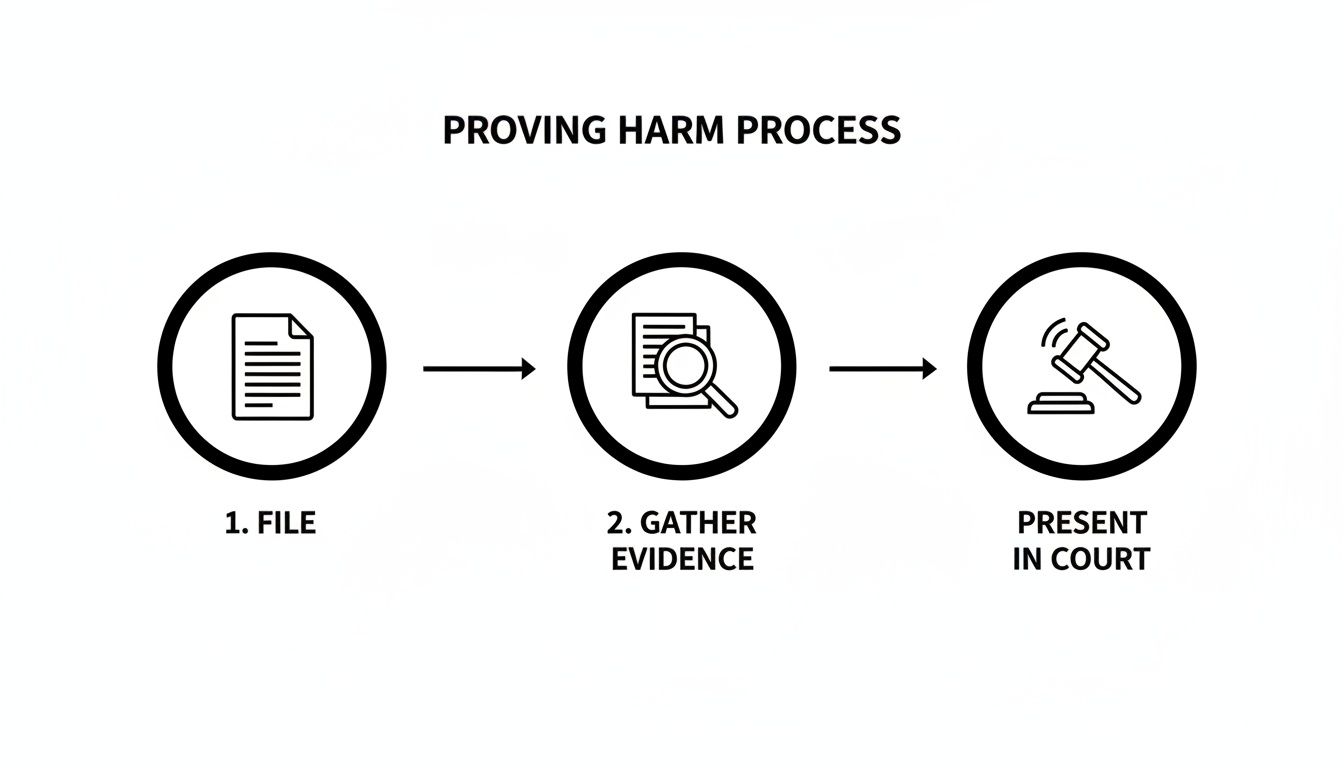
As you can see, securing an emergency order is a multi-step journey. It starts with the initial filing, is backed up by strong evidence, and ends with a judge’s decision.
The Initial 'Ex Parte' Hearing
After your petition and affidavit are filed, your attorney will request an immediate 'ex parte' hearing. Think of this as a brief, urgent meeting with the judge, often held the very same day you file. "Ex parte" is just a legal term meaning the other parent isn't present for this initial review.
The judge will look over your affidavit and might ask a few questions to clarify the situation. If they agree that there's convincing evidence of immediate danger to your child, they will sign the TRO. This order typically lasts for 14 days and schedules a full hearing where both parents can present their side of the story.
A signed TRO is a powerful court order. It provides instant, legally enforceable protection for your child while you get ready for the next steps in your emergency custody case.
Serving the Other Parent and Paying Court Fees
Once the judge signs the TRO, the other parent has to be legally notified. This is called "service of process." You can't just hand them the papers yourself. They have to be served by a neutral third party, like a sheriff's deputy or a private process server.
This step is absolutely non-negotiable. It ensures the other parent knows about the court order and the date for the upcoming hearing, protecting their due process rights and making the TRO fully enforceable.
Finally, you’ll need to pay court filing fees, which vary from county to county. If you can't afford them, you can file a "Statement of Inability to Afford Payment of Court Costs"—sometimes called a pauper's affidavit. If the judge approves it, your fees will be waived.
When you're dealing with the tight timelines of an emergency custody case, a legal deadline calculator can be a lifesaver to make sure everything gets filed on time. Every single deadline in this process is critical.
Gathering Evidence a Judge Will Consider
Your sworn testimony is powerful, but in the fast-paced, high-stakes environment of an emergency custody hearing, it's the hard evidence that truly moves the needle. When you’re under this kind of stress, knowing exactly what to look for and how to organize it can make all the difference. This is your game plan for gathering the proof you need to build an undeniable case.

A judge needs to see clear, objective proof that backs up every single claim you made in your affidavit. Your goal is to present a collection of evidence so clear and compelling that it leaves absolutely no doubt about the imminent risk to your child.
Building Your Case with Concrete Proof
Think of yourself as an investigator building a case file. You need documentation that illustrates the danger in no uncertain terms. Vague accusations are easily dismissed, but a folder full of dated, organized evidence is hard for any court to ignore.
Here’s what you should be laser-focused on gathering:
- Communications: Save everything. Every text message, email, voicemail, or social media post that contains threats, admissions of drug use, or demonstrates severe instability. Screenshot them, print them, and date them. These are incredibly powerful because they are the other parent’s own words.
- Official Records: Police reports from domestic disturbances, notes from Child Protective Services (CPS) investigations, or criminal records are gold. These documents come from neutral, official sources, which gives them significant weight in a courtroom.
- Photographs and Videos: A picture is truly worth a thousand words. Take clear photos or videos of unsafe living conditions—think filth, drug paraphernalia left in the open—or any visible injuries to you or your child. Video of the other parent’s erratic behavior can also be crucial.
- Witness Statements: Credible, third-party witnesses are invaluable. Ask teachers, doctors, therapists, or even trusted family members who have personally seen the dangerous behavior to write a short, signed statement detailing exactly what they saw and when they saw it.
Remember, if any of your documents are in a language other than English, you'll need to get them properly translated. It’s smart to understand how to accurately translate legal documents to ensure they will be admissible in court.
To help you get organized, here’s a quick checklist of what you should be looking for and why it matters to the judge.
Evidence Checklist for Your Emergency Hearing
| Evidence Category | Specific Examples | Why It's Important |
|---|---|---|
| Written Communication | Text messages, emails, social media DMs showing threats, substance abuse, or erratic behavior. | These are direct admissions in the other parent's own words, making them very difficult to dispute. |
| Official Reports | Police incident reports, CPS findings, criminal background checks, restraining orders. | Provides objective, third-party documentation of dangerous behavior from a source the court trusts. |
| Visual Proof | Photos/videos of unsafe home conditions, injuries, drug paraphernalia, or the other parent intoxicated. | Visual evidence makes the danger tangible and immediate for the judge. It’s hard to argue with a photograph. |
| Financial Records | Bank statements showing large cash withdrawals or spending on bars, liquor stores, or drugs. | Can demonstrate instability, addiction, or neglect of the child's financial needs. |
| Third-Party Witness | Signed, dated statements from teachers, doctors, therapists, or neighbors who have witnessed the harm firsthand. | Corroborates your claims with credible, unbiased observations, adding significant weight to your testimony. |
| Medical Documents | Doctor's notes detailing injuries, therapist reports on emotional distress, or drug test results. | Offers professional, expert validation of the physical or emotional harm being inflicted on the child. |
Putting this evidence together is a critical first step. It transforms your claims from words on a page into a solid, fact-based argument for immediate intervention.
Direct Evidence vs. Hearsay
It is absolutely crucial to understand the difference between evidence a judge can act on and what they’ll likely dismiss. Direct evidence is proof that speaks for itself—like a threatening text message or a police report. A judge can look at it and draw their own conclusion without needing anyone else's interpretation.
Hearsay, on the other hand, is an out-of-court statement used to prove a point. The classic example is testifying, "My neighbor told me she saw the other parent drinking and driving." Because your neighbor isn’t in court to be questioned, that statement is generally not allowed.
Focus your energy on collecting direct, tangible proof. While witness testimony is vital, physical evidence that a judge can hold and review is often the most convincing element in a time-crunched emergency hearing.
Organizing Your Evidence for Maximum Impact
Once you've gathered your proof, organization is everything. Don't just walk into court with a messy pile of papers. Arrange it all chronologically in a binder with clear labels and tabs for each piece of evidence. This simple step makes you look prepared and credible. More importantly, it helps your attorney present your case clearly and efficiently when every second counts.
Preparing for a custody hearing can feel completely overwhelming, but a structured, methodical approach will make all the difference. To build on this foundation, you can get more detailed insights into how to prepare for a custody hearing in our comprehensive guide. The more prepared you are, the more confident you will feel when you step into that courtroom.
What to Expect in the Courtroom
Walking into a courtroom for an emergency custody hearing can feel overwhelming, especially with your child's safety on the line. Knowing what the process looks like and who you'll be dealing with can go a long way in calming those nerves and helping you feel prepared. This is your moment to clearly show the judge why immediate action is critical, and understanding the courtroom landscape is a huge part of that.
The Key Players in Your Hearing
When you walk into the courtroom, it’s good to know who’s who. It might seem like a lot of people are involved, but each person has a very specific and important role.
- The Judge: This is the person in charge. The judge’s job is to listen to the testimony, look at the evidence, and make a legally binding decision based on what's in the best interest of your child.
- The Attorneys: Both you and the other parent will have a lawyer to present your case, question witnesses, and make legal arguments on your behalf.
- An 'Ad Litem' Attorney (in some cases): In really tough or complicated cases, a judge might appoint an attorney ad litem or a guardian ad litem. This is a neutral attorney whose only job is to represent your child's best interests. They might interview you, the other parent, and even the child before making a recommendation to the court. You can learn more about the role of a guardian ad litem in our in-depth article.
- The Bailiff: This is the uniformed officer who keeps order in the courtroom.
The Hearing Timeline and Procedure
Emergency custody hearings move fast. That initial ex parte order you received is only temporary, typically lasting just 14 days. The full hearing, where both sides get to present their case, has to happen within that two-week window.
Think of the hearing itself as a condensed trial. Your attorney will go first, presenting your evidence and testimony. You'll be sworn in, answer questions from your lawyer, and then face cross-examination from the other parent’s attorney. This is where all your detailed preparation and organized evidence truly pay off. Once your side is done, the other parent gets the same opportunity.
A judge in an emergency hearing is focused on one question: is there an immediate risk to the child? The proceedings are direct, fast-paced, and centered entirely on the evidence of imminent harm.
Possible Outcomes of the Hearing
After listening to both sides, the judge will make a ruling. It’s crucial to remember that these orders are still temporary. They are designed purely to keep your child safe until a more permanent order can be established later in your case.
Here are some of the most common outcomes:
- Granting Temporary Sole Custody: The judge might give you the exclusive right to decide where the child lives for the time being.
- Ordering Supervised Visitation: The other parent may only be allowed to see the child under the watch of another adult or at a specialized facility.
- Mandating Specific Actions: The judge can order the other parent to do things like attend counseling, submit to drug and alcohol testing, or stay away from your home and the child's school.
- Dissolving the TRO: If the judge doesn’t find enough evidence of immediate danger, they may dissolve the temporary order. Your case will then move forward on a standard custody schedule.
No matter the circumstances—whether you're a military parent dealing with deployment issues or in a high-asset divorce where financial control is a form of abuse—the court's primary focus remains your child's safety. The orders will be specifically tailored to address the danger at hand, be it substance abuse, family violence, or the risk of parental kidnapping.
After the Hearing: What Happens Next?
Walking out of the courtroom with an emergency order feels like a massive victory. And it is. You acted decisively to protect your child, and the judge agreed that immediate action was necessary. Take a deep breath. This is a critical first step, but it's important to understand this isn't the end of the road.
An emergency custody order is, by design, a temporary shield. It’s a powerful tool meant to stabilize a dangerous or harmful situation until everyone can come back to court for a more in-depth look at what’s best for your child in the long run. You’re in a much stronger, safer position now, but there are a few more phases to navigate.
The Path to a Permanent Order
The temporary order you just secured sets the groundwork for everything that follows. The Texas family court system is structured to move cases toward a final resolution that provides lasting stability for the child. This means your case will likely progress through a couple of key stages.
First, your case will enter the discovery phase. This is a formal process where you and the other parent exchange information, evidence, and documents relevant to custody. After that, it's almost certain the judge will order you both into mediation. This is a confidential negotiation session guided by a neutral professional who will help you and the other parent try to hammer out a final, mutually agreeable custody arrangement.
Remember, the ultimate goal is to transform your temporary protective orders into a detailed and durable Final Order that ensures your child's long-term safety and well-being.
Your Post-Hearing Checklist for Stability
What you do in the days and weeks after the hearing is just as crucial as the preparation you did beforehand. Your focus should be on consistency and strict compliance with the court's directives.
- Follow the Judge's Order to the Letter: Adhere to every single detail of the temporary order. This includes visitation schedules, communication guidelines, and any other restrictions. Even a minor deviation can be twisted and used against you later.
- Keep Documenting Everything: The issues that triggered the emergency hearing might not disappear overnight. Maintain your detailed journal of any new incidents, save all texts and emails, and continue gathering any relevant evidence. This ongoing documentation will be incredibly valuable as you build your case for a final order.
- Gear Up for Future Court Dates: The emergency hearing was just the opening act. Now is the time to work closely with your attorney to build a solid strategy for mediation and, if a settlement can't be reached, for a final trial.
You’ve successfully navigated the most urgent part of this crisis. You proved you will do whatever it takes to keep your child safe. Now, the mission shifts from ensuring immediate protection to securing their long-term stability.
Common Questions About Emergency Custody in Texas
When you're facing a crisis involving your child's safety, your mind is racing with questions. It's a stressful, confusing time. Let's walk through some of the most urgent questions parents ask to give you more clarity.
How Quickly Can I Get an Emergency Hearing?
In a true emergency, Texas courts move fast. If your child is in immediate danger, you can get an initial 'ex parte' hearing with a judge very quickly—sometimes within 24 to 48 hours after filing your paperwork.
The sole purpose of this first hearing is to get a Temporary Restraining Order (TRO) signed to protect your child right away. After that, the court will schedule a full hearing where the other parent can present their side, usually within 14 days.
What if the Judge Denies My Emergency Request?
It's incredibly disheartening when a judge denies your emergency request, but it's not the end of the road. A denial simply means the judge didn't see enough evidence of "imminent harm" to grant an order without hearing from the other parent.
This doesn't mean your custody case is over; it just means it will move forward on a standard, non-emergency timeline. This is the moment to sit down with your family law attorney to figure out what went wrong, gather stronger evidence, and build a new strategy for the next hearing.
Can an Emergency Custody Order Be Changed?
Yes, absolutely. An emergency order is just that—a temporary fix for an immediate crisis. It's not set in stone.
These orders are designed to be short-term. They can be modified or even completely thrown out at the next court date, once both parents have had a chance to present their evidence and tell their side of the story.
Keep in mind that a temporary order will eventually be replaced by a more permanent custody order as the case proceeds, either through mediation or a final trial. The other parent will get their day in court, and things can change.
What to Do Next
This journey can feel overwhelming, but you don't have to walk it alone. You acted to protect your child when it mattered most, and now you need a clear strategy to secure their long-term stability. The experienced attorneys at The Law Office of Bryan Fagan, PLLC are ready to help you turn this crucial first victory into lasting peace of mind for your family.
For a compassionate and confidential assessment of your situation, schedule a free, confidential consultation with our team today.