Skip to content
You may be sitting in your car after a prenatal appointment, wondering how you can leave a marriage while protecting your baby, your finances, and your future. In Texas, pregnancy doesn't prevent you from filing for divorce, but it can change when the court may finish the case and how parentage, custody, and support are handled.
When Pregnancy Meets Divorce in Texas
Maria is 28 weeks pregnant in Houston. She sits outside her OB-GYN's office, looking at the paperwork in her lap and realizing she can't wait any longer to leave her marriage. She wants the divorce filed, but four questions immediately trouble her:
- When can the divorce become final?
- Who will be listed as the baby's father?
- Who can make medical decisions if complications arise?
- How will the baby be supported after birth?
Maria's situation is difficult, but she isn't the first Texas parent to face it. A pregnancy-related divorce usually requires careful coordination between the marriage case and the legal issues that arise when the baby is born.
Texas allows no-fault divorce, meaning you generally don't have to prove that your spouse caused the marriage to end. Still, pregnancy affects the practical timeline. TexasLawHelp explains that you may file for divorce while a spouse is pregnant, but the case generally can't be finished until after the baby is born. Its explanation is direct: “you cannot get divorced if a spouse is pregnant.” TexasLawHelp's guidance on divorce when a spouse is pregnant explains why the case must wait until after birth.
That pause exists because the court needs a legally recognized parent before entering orders about the child. The court also has to address the child's conservatorship, possession, and support once the child exists outside the womb.
The practical rule: Filing can begin the divorce process, but pregnancy can prevent the judge from signing the final decree on the ordinary schedule.
You'll need to understand the mandatory 60-day waiting period, the 300-day paternity presumption, temporary orders, and the post-birth process. If you're looking for a local lawyer, you can review options through a Texas divorce lawyer in McKinney, but the same core framework applies across Texas courts.
How Pregnancy Reshapes the Divorce Timeline
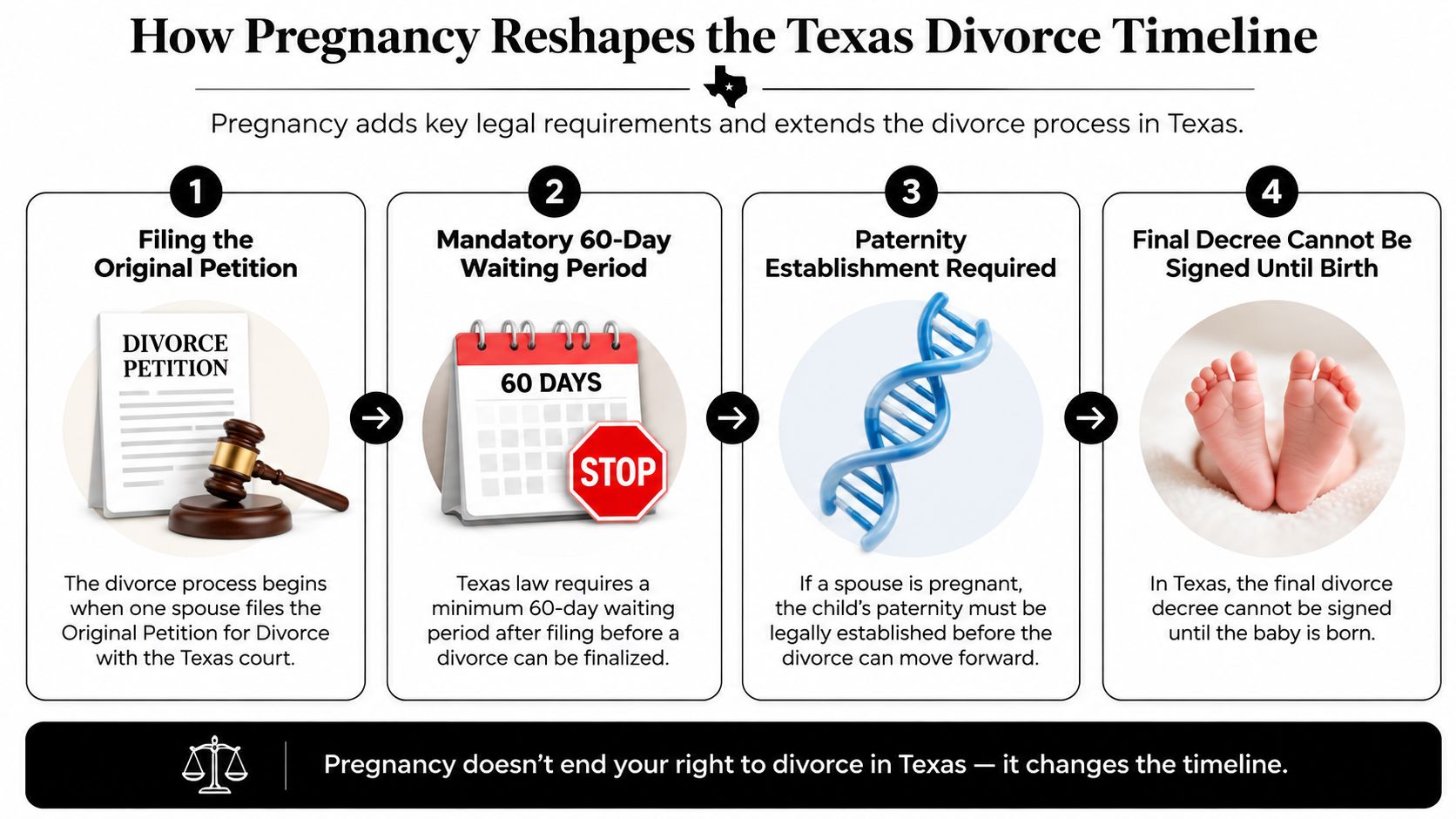
A Texas divorce filed during pregnancy develops on two tracks. The marriage case can begin, and the 60-day waiting period can run, while the court waits for the baby's birth before resolving parentage and child-related orders.
Filing starts the case
The first step is filing an Original Petition for Divorce in the appropriate Texas district court. The petition identifies the marriage, residency, property issues, and children or expected children involved. It also states the required allegations and requests for relief. You can review those requirements in The Original Petition for Divorce in Texas.
After filing, the other spouse must be formally served or sign a waiver of service. The case may then proceed through temporary hearings, discovery, mediation, and settlement discussions. Filing opens the case, but it does not end the marriage.
The 60-day clock keeps running
Texas Family Code § 6.702 generally prevents a court from granting a divorce before the 60th day after the suit is filed. The statute has narrow family-violence exceptions, including a qualifying conviction or deferred adjudication involving family violence, or an active protective order or magistrate's order for emergency protection based on family violence during the marriage. Texas Family Code § 6.702 and its family-violence exceptions describes those limited circumstances.
Pregnancy does not stop that clock. Reaching the end of the waiting period still may not be enough for the judge to sign the decree. The court may need the child to be born first so parentage, conservatorship, possession, and support can be addressed in a complete order.
Work can continue before birth
The waiting period and pregnancy pause do not put every issue on hold. The court may address temporary household and financial matters, while the spouses may agree on property use, bills, insurance, or temporary support. Mediation can also resolve property and parenting disputes before the final decree. A qualifying mediated settlement agreement may be binding under Texas law. Texas's 60-day waiting period and mediation options provides related background.
The timeline often works like a two-part schedule: preparation before delivery, then final parentage and child orders afterward. Courts commonly set a status hearing after the estimated delivery date or continue the case until birth. After delivery, the judge can address the 300-day paternity presumption and enter a complete Suit Affecting the Parent-Child Relationship, or SAPCR, order with the divorce. Temporary orders can keep finances and living arrangements stable while that final stage is pending.
Understanding the 300-Day Paternity Presumption
The central legal issue in a divorce while pregnant in Texas is the 300-day presumption of paternity. Under Texas Family Code § 160.204, a husband is presumed to be the father when a child is born during the marriage or within 300 days after the marriage ends. Texas Family Code § 160.204 sets out this presumption.
The rule matters even when spouses have separated or lived apart. It doesn't conclusively prove biological fatherhood, but it gives the former husband a legal status that must be addressed. The presumption can affect custody filings, support proceedings, and parentage planning after delivery.
Why birth matters
Before birth, the court generally can't complete genetic testing on the child or enter final parent-child orders for a child who hasn't been born. That's why a judge may continue the divorce case instead of finalizing it while pregnancy remains unresolved.
After birth, the parties may address parentage through genetic testing, an acknowledgment of paternity, a denial, or a court order. If the husband is the father, the final decree or related SAPCR order can include conservatorship, possession, and child support terms. If he isn't the biological father, the parties may need a paternity proceeding to resolve the presumption.
The Texas Legislature's 2024 bill text reflected this structure by requiring a pregnancy-related petition to state that a party is pregnant and whether either party intends to contest the unborn child's paternity. The bill also directed courts to defer parent-child issues until after birth while stating that pregnancy alone shouldn't prevent a divorce decree. That combination illustrates the tension between ending the marriage and protecting the child's legal interests. The 2024 Texas legislative bill text provides the legislative language.
| Trigger | Presumption Applies? | How to Rebut |
|---|---|---|
| Child is born during the marriage | Yes, the husband is presumed father | Use an appropriate legal challenge, which may involve testing or other admissible proof |
| Child is born within 300 days after the marriage ends | Yes, the former husband is presumed father | Address parentage through a court proceeding or another legally valid method |
| Another man may be the biological father | The marital presumption may still apply initially | Seek a paternity determination after birth and follow the applicable Texas process |
The presumption protects a child from being left without a legally recognized parent, but it can create confusion when spouses are separated or another man may be the biological father. You should address the issue early rather than assume the birth certificate will resolve it automatically. You can learn more through this resource on paternity laws in Texas.
Three Ways Paternity Gets Established in Texas
Texas recognizes several routes to legal fatherhood. The right path depends on the marital status, the facts surrounding the pregnancy, and whether anyone contests parentage.
| Path | When It Applies | How It Ends | Main Tradeoff |
|---|---|---|---|
| Marital presumption | The child is born during marriage or within 300 days after the marriage ends | The presumption is accepted or legally rebutted | It provides an immediate legal starting point but may not match biological parentage |
| Acknowledgment of Paternity | Parents voluntarily identify the biological father, whether married or unmarried | The required AOP process is completed | It can be efficient, but changing it later may require prompt action or a court challenge |
| Court-ordered paternity | A presumed, alleged, or possible father disputes parentage, or no presumption applies | The court enters an order after considering evidence, often including DNA testing | It produces an enforceable judgment but can take longer and may increase conflict |
The marital presumption
The first path arises automatically from the marriage or the timing of the birth. It continues to matter even when a divorce is pending or the spouses have lived separately. If the presumed father denies biological fatherhood, the denial does not automatically remove his legal status. The parties generally need to use a formal legal process after birth.
An acknowledgment
An Acknowledgment of Paternity, commonly called an AOP, is a voluntary legal document used to establish parentage. Parents may complete the process at the hospital or through a child support office. Because an AOP creates a legal parent-child relationship, you shouldn't sign one casually if you're uncertain about biological or legal parentage.
Texas's Attorney General explains that a presumed father has no legal rights until paternity is established through a recognized process. Texas paternity-order guidance discusses the questions that can arise when a presumed father, an alleged biological father, or the mother needs a formal determination.
A court order
A court-ordered paternity case may be necessary when someone contests an AOP, a presumed father denies parentage, or the parties disagree about who should be legally recognized. The court can then address parentage and move toward enforceable custody and support orders.
Temporary Orders and Protections Before the Baby Arrives
You don't have to wait until delivery to ask the court for help with urgent issues. Temporary orders can create stability while the divorce remains pending, especially when you need control over housing, money, insurance, or existing children's schedules.
Financial and household relief
Under Texas Family Code Chapter 105, a court may consider temporary relief connected to the family's immediate needs. Depending on the facts, requests may include:
- Temporary conservatorship and possession: If you already have children, the court can establish interim decision-making and possession schedules. The unborn baby won't have a final custody schedule before birth, but existing children still need predictable care.
- Temporary support: The court may address temporary child support for children already born and temporary spousal support when the facts support it.
- Medical expenses: You can ask how prenatal care, delivery costs, and insurance responsibilities should be handled while the case is pending.
- Insurance coverage: A temporary order may help preserve or arrange health insurance coverage for the pregnant spouse and children.
- Use of community funds: The court may address access to marital funds so necessary prenatal and household expenses can be paid.
Bring pay records, account statements, insurance information, medical bills, proof of monthly expenses, and records of payments your spouse has or hasn't made. A clear financial picture helps your attorney frame a workable request.

For a practical explanation of what to expect, review this guide to a temporary orders hearing in a Texas divorce.
Safety comes first
If family violence is involved, ask counsel about a protective order under Chapter 85. A protective order may address residence, contact, communication, and firearm surrender. A court may also consider expedited handling when pregnancy creates urgent safety concerns.
A Protective Order is a civil court order designed to protect against family violence. A Magistrate's Order of Emergency Protection is an emergency order that may be issued after an arrest involving family violence or other qualifying circumstances. They aren't interchangeable, so ask which remedy fits your immediate situation.
Bring to the first hearing: medical records relevant to urgency, financial documents, threatening messages, police reports, protective-order paperwork, and a short written list of the relief you need.
Ask your attorney whether you need a temporary restraining order, how to protect health coverage, who will pay prenatal expenses, and what arrangements should be made for any children already in the household.
A Realistic Look at How One Texas Case Unfolds
Consider a representative Texas couple, Elena and David. They're already living separately when Elena learns she's pregnant. They decide to file rather than leave the marriage unresolved, knowing the case may not end on the ordinary schedule.
Elena files the petition, David is served, and both sides attend a temporary-orders hearing. The court addresses interim support, responsibility for medical expenses, access to marital funds, and arrangements for children from an earlier relationship. During the waiting period, their attorneys exchange financial information and participate in mediation.
By the time of the baby shower, the parents have negotiated a framework for decision-making and possession after birth. They still haven't finalized the divorce because the child's parentage and child-related orders require the baby to be born first. David remains the presumed father under the Texas rule because the child is expected to be born within the legally relevant period after the marriage ends.

After delivery, the parties address whether genetic testing is needed. If parentage is accepted, they can focus on final custody, possession, support, and the remaining property division. If parentage is contested, that question must be resolved before the court can enter complete child-related orders.
The temporary orders served as a bridge. They didn't permanently decide every issue, but they kept the household functioning while the parties waited for the legal facts that could only be resolved after birth.
Every case differs. Cohabitation, income, business ownership, high-value assets, and domestic violence can change the strategy. The recurring rhythm is often a pause, a paternity issue, a birth, and final orders.
Your Practical Checklist Before and After Birth
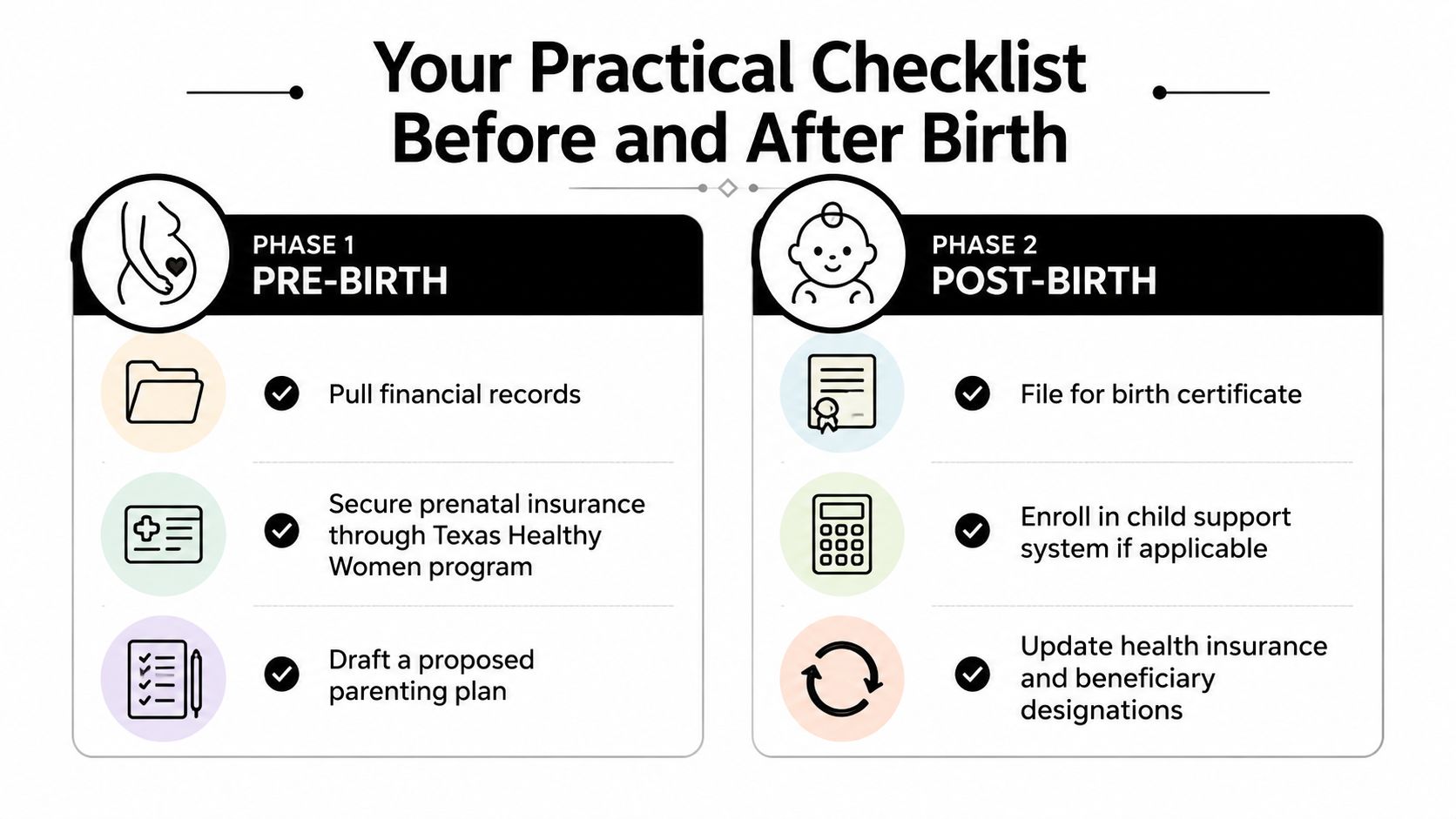
A refrigerator-friendly checklist can reduce the feeling that everything must be solved today. Divide your work into what protects you now and what can wait until after delivery.
Before birth
- Gather financial records: Save bank statements, tax returns, pay information, retirement records, business documents, real-estate records, loan statements, and insurance policies. Business owners and spouses with high-value estates should preserve records before accounts or access change.
- Protect prenatal coverage: Ask about coverage through the Texas Health Insurance Marketplace or CHIP Perinatal, and confirm how current marital insurance will operate during the case.
- Document income and expenses: Keep proof of earnings, prenatal bills, household costs, and payments made by each spouse.
- Plan medical support: Choose the people you want present at the hospital and tell your attorney about any safety or communication concerns.
- Request temporary relief: Don't wait until the due date if you need support, insurance, housing, or protection.
For emotional and practical preparation, a resource on modern parenthood for dads may help an expecting father think through the responsibilities that continue even while the marriage is ending.
After birth
Ask hospital staff and your attorney about birth-certificate information and any AOP paperwork before signing. If parentage is disputed, ask promptly about the appropriate court process, genetic testing, and how the divorce pleadings should be amended.
You'll also want a proposed newborn schedule, an insurance update, and a plan for support payments. Don't rely on informal promises when the baby's care, medical coverage, or legal parentage is uncertain.
This week versus later
This week, preserve records, secure safety, confirm insurance, and schedule legal advice. Later, your attorney can help refine the parenting plan, complete parentage proceedings, prepare support orders, and finish the property division.
Key Takeaways and Your Next Steps
Can you divorce while pregnant in Texas? You can file, but Texas courts generally won't finish the case while the pregnancy and parentage issues remain unresolved. The 60-day waiting period still applies, subject only to narrow family-violence exceptions.
Will your spouse automatically have parental rights? Not because the spouse is married to you. The husband may be presumed to be the father when the child is born during the marriage or within 300 days after the marriage ends, but legal parentage still must be established before enforceable custody and support rights are finalized. An AOP or court order may also establish parentage.
How long will the divorce take? It depends on the delivery date, the parties' cooperation, paternity disputes, property complexity, county procedures, and safety concerns. Pregnancy can extend the practical timeline well beyond the ordinary waiting period, so be cautious about anyone promising a fixed completion date.
What should you do now? Preserve financial and medical records, protect insurance, ask about temporary orders, and speak with counsel before signing paternity documents or property agreements. Mediation may help resolve issues efficiently, but it shouldn't replace informed advice when parentage, domestic violence, business interests, or substantial assets are involved.
If you need free or low-cost assistance, explore resources from Texas Legal Services Center and Lone Star Legal Aid. If domestic violence is part of your situation, contact the Texas Advocacy Project or a local domestic-violence shelter. You deserve a plan that protects your safety and gives your child a stable legal foundation.
The Law Office of Bryan Fagan, PLLC helps Texas families address pregnancy-related divorce, temporary orders, paternity, custody, support, mediation, property division, and enforcement concerns. Schedule a confidential free consultation by visiting Law Office of Bryan Fagan, PLLC so you can understand your options and decide what to do next.