Skip to content
Facing a divorce can leave you questioning everything about your future, especially your financial stability. The question “Will I be okay financially?” is one that can keep you up at night, but you are not alone in asking it. The straightforward answer is yes, you can get spousal support in Texas, but it's crucial to understand that it is never guaranteed. Texas has some of the strictest rules in the nation, and what many people call "alimony" is legally known here as spousal maintenance.
What Texas Law Says About Spousal Support
When you're facing an uncertain financial future after your marriage ends, it's natural to wonder about getting support. Let's be clear: Texas law is not designed to provide a permanent income stream. A judge’s primary goal is to offer temporary, rehabilitative help—a short-term bridge to give you, as the lower-earning spouse, the time and resources needed to gain the skills and employment to stand on your own two feet.
Think of it less like a lifelong pension and more like a helping hand for the next chapter of your life. In fact, under the Texas Family Code, the court starts with the assumption that spousal maintenance isn't necessary. This means the burden falls squarely on you, the requesting spouse, to prove that you meet a very specific and demanding set of criteria.
The Core Eligibility Requirements
Before a Texas judge will even consider awarding maintenance, you must first prove that you will not have enough property—including your own separate property—to provide for your "minimum reasonable needs" after the divorce is final. This is the first and most critical hurdle. If you cannot prove this fundamental need, the conversation about maintenance typically ends before it begins.
Once you have established that need, you also have to prove that at least one of the following situations applies to your marriage:
- The 10-Year Marriage Rule: The marriage lasted 10 years or longer, and you clearly lack the ability to earn enough income to meet your basic needs.
- Family Violence: Your spouse was convicted of (or received deferred adjudication for) a criminal act of family violence against you or your child. This act must have occurred within two years of filing for divorce or while the divorce was pending.
- Disability: You are unable to earn enough to support yourself because you have an incapacitating physical or mental disability.
- Care of a Disabled Child: You are the primary caregiver for a child of the marriage (of any age) who has a physical or mental disability that requires substantial care, preventing you from working and earning a sufficient income.
This flowchart breaks down the basic questions a court will ask when deciding if you can get spousal support in Texas.
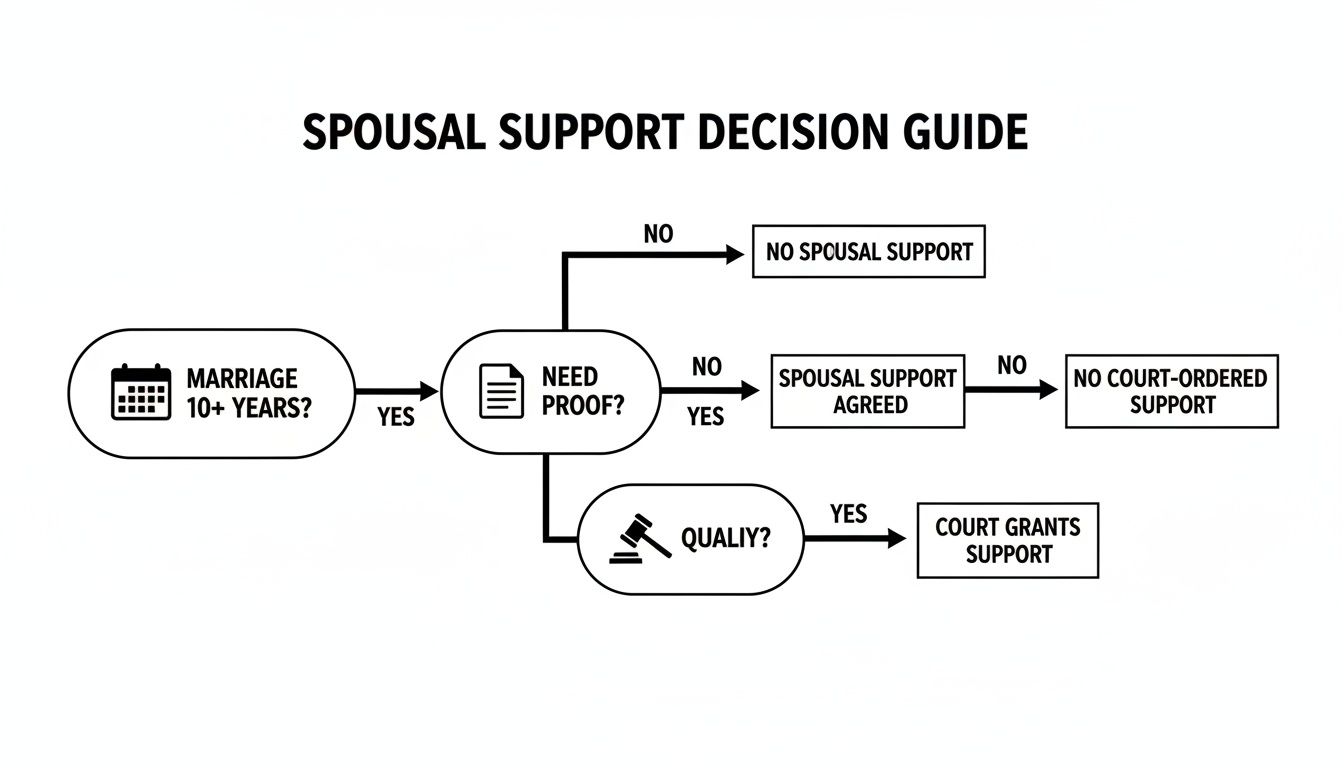
As you can see, eligibility boils down to a few key factors, like how long you were married and whether you can clearly demonstrate your financial need.
To help you see these pathways clearly, here’s a quick summary.
Quick Guide To Spousal Maintenance Eligibility In Texas
This table summarizes the primary pathways to qualify for court-ordered spousal maintenance in Texas, helping you quickly assess your situation.
| Eligibility Pathway | Marriage Duration Requirement | Additional Requirements |
|---|---|---|
| Long-Term Marriage | 10+ years | Lacks ability to earn enough for minimum reasonable needs. |
| Family Violence | None | Spouse convicted/received deferred adjudication for family violence. |
| Spouse's Disability | None | An incapacitating disability prevents earning sufficient income. |
| Child's Disability | None | Cares for a child with a disability that prevents working. |
Remember, in every scenario, you must first prove you will lack sufficient property after the divorce to meet your minimum reasonable needs. This table just outlines the additional qualifying circumstances.
Proving Your Case
The most common way people qualify is through the 10-year rule. But simply being married for a decade isn't enough. You must actively show the court that you have made "diligent efforts" to earn an income or acquire the necessary skills to become self-sufficient. This means you should be actively looking for a job or enrolled in a training program while the divorce is ongoing.
The court will want to see proof that you are actively trying to improve your situation. This isn't a passive process; you have to demonstrate that you're taking steps to get back on your feet.
Building a strong case means getting organized. You will need to create a detailed budget showing all your monthly expenses, gather bank statements, and have proof of your job search or school enrollment. It can feel like a lot to handle on top of everything else you are going through.
If you need help understanding exactly how you qualify for spousal support, our detailed guide can walk you through the specifics. Knowing what a judge is looking for is the first step toward building a successful request for the support you need to move forward.
How Spousal Maintenance Is Calculated And How Long It Lasts
Once you know you might qualify for spousal support, the next logical questions are always about the numbers: How much could you actually get, and for how long? Texas law doesn’t leave this to guesswork. It provides clear, strict guidelines to help you plan your financial future with more certainty. A judge cannot simply pull a number out of thin air; they must follow a specific formula designed to provide necessary support without placing an unfair burden on the paying spouse.

This structure is all about creating predictability. Instead of a vague, open-ended payment plan, Texas law focuses on giving you a clear runway to get back on your feet financially. Understanding these calculations is a critical first step in setting realistic expectations for your life after divorce.
The Statutory Cap on Maintenance Amounts
First and foremost, you need to know that Texas sets a firm ceiling on how much spousal maintenance can be awarded. This is one of the most important rules in the entire process.
Under the Texas Family Code, a judge can order monthly payments up to the lesser of $5,000 or 20% of the paying spouse's average monthly gross income. This isn't a starting point for negotiation; it's a hard limit.
This cap is in place to keep payments reasonable and tied directly to what the paying spouse actually earns. For example, if your spouse earns $15,000 in gross monthly income, the maximum maintenance payment would be capped at $3,000 (which is 20%), not the full $5,000. This approach protects your spouse's own financial stability while providing for you.
Figuring out these numbers can get tricky, especially with complex financial records. For a precise evaluation, especially in high-asset divorces or cases involving self-employment, you might need specialized financial support in Texas. Our detailed guide on how much spousal support you might get in Texas also walks through more specific examples.
How Long Can Spousal Maintenance Last?
Just as the law limits the amount of maintenance, it also sets strict limits on the duration. The length of your marriage is the biggest factor a judge will consider when deciding how long you can receive support. The goal is rehabilitative—to give you a set amount of time to become self-sufficient.
Here’s a step-by-step breakdown of the maximum timeframes based on how long you were married:
- Marriage of 10 to 20 years: You may receive maintenance for up to 5 years.
- Marriage of 20 to 30 years: You may receive maintenance for up to 7 years.
- Marriage of 30 years or more: You may receive maintenance for up to 10 years.
Of course, there are important exceptions. If you qualify for maintenance due to a disability or because you are caring for a disabled child from the marriage, the court can order payments to continue for as long as that condition exists. This provides crucial long-term support for those who genuinely cannot support themselves.
However, even with these timelines, spousal maintenance can end early. Payments will automatically stop if:
- Either you or your ex-spouse passes away.
- You, as the receiving spouse, remarry.
- You move in and start living with a new romantic partner in a permanent home.
This framework is designed to strike a balance, meeting your needs as the receiving spouse while giving the paying spouse a clear end date. It highlights the Texas legal system's view of maintenance as a temporary bridge to your independence, not a permanent paycheck.
Navigating The Process To Request Maintenance
Knowing you might qualify for spousal support is one thing; successfully navigating the Texas legal system to receive it is another. It can feel like you're standing at the bottom of a mountain, unsure of where to even start. But this isn't just about asking for help; it's about methodically building a case that proves to a judge why you need that support to get back on your feet.

The good news is that there is a clear path forward. Once you understand the key steps—from filing the right paperwork to gathering your evidence and negotiating a fair agreement—you can tackle this journey with much more confidence and peace of mind.
Step-by-Step: How to Request Spousal Support
The process of securing spousal support follows a clear procedural path, from your initial filing to the final court order.
- File the Original Petition for Divorce: This is the first official step. Your petition must do more than just start the divorce; it's your opening statement to the court. It is absolutely crucial that you specifically "plead for" or request spousal maintenance in this document. If you miss this step, you could lose your right to ask for it later.
- Gather Evidence in the Discovery Phase: Once the petition is filed, you and your spouse will exchange all relevant financial information. To make a compelling argument, you must paint a crystal-clear picture of your financial life. You need to prove that you cannot meet your "minimum reasonable needs" and that your spouse has the ability to help.
- Request a Temporary Orders Hearing: Divorce proceedings can take months. You can ask the court for a temporary orders hearing to request temporary spousal support, which helps you cover bills while the divorce is in progress. This provides a crucial financial bridge.
- Attend Mediation: Most Texas divorces are settled out of court through mediation. This confidential meeting allows you, your spouse, and your attorneys to work with a neutral mediator to reach an agreement. Agreeing on spousal maintenance in mediation gives you far more control and flexibility than leaving it to a judge.
- Present Your Case at a Final Hearing (If Necessary): If you cannot reach an agreement, your case will proceed to a final hearing where a judge will make the decision based on the evidence presented.
Gathering The Evidence You Need
Your job is to prove two key things: that you can't meet your "minimum reasonable needs" on your own, and that your spouse has the ability to help. The evidence you'll need to pull together includes:
- Financial Statements: Several months of bank statements, credit card bills, and any investment account summaries.
- Income Documentation: Recent pay stubs and at least three years of tax returns for both you and your spouse.
- A Detailed Monthly Budget: A thorough budget listing all your necessary expenses—housing, utilities, groceries, healthcare. This is one of the most persuasive tools in your arsenal.
- Proof of Job Search: If you are unemployed, keep meticulous records of job applications, interviews, and any job training you're pursuing. This shows the court you're making a real effort.
A well-documented budget is more than just a list of numbers; it’s the story of your financial life. It provides the court with concrete evidence of your needs and is essential for justifying your request for support.
Temporary vs. Post-Divorce Support: What's the Difference?
When you're facing a divorce, the financial pressure doesn't wait for a judge to sign the final papers. Bills keep coming, and you need a way to maintain stability right now. That’s why Texas law provides for two very different kinds of spousal support, each designed for a specific phase of the process.

Knowing the difference between temporary support and post-divorce maintenance is critical. It can protect your financial well-being from the moment you file for divorce until long after it’s over.
Temporary Spousal Support: A Financial Bridge
Think of temporary spousal support as a financial lifeline thrown to you while you navigate the turbulent waters of a divorce. Its only job is to maintain the financial status quo, ensuring you can cover your necessary and customary living expenses while the case is ongoing.
This support is requested at a temporary orders hearing, which usually happens within a few weeks or months of filing the divorce petition. Unlike long-term maintenance, the eligibility rules here are much more flexible. A judge will look at a few key things:
- Your immediate financial needs versus your ability to earn an income.
- Your spouse's ability to pay support.
- The lifestyle you both were accustomed to during the marriage.
This support is only valid while the divorce is pending. The moment a judge signs the Final Decree of Divorce, the temporary support order automatically ends.
Post-Divorce Spousal Maintenance: The Path to Independence
On the other hand, post-divorce spousal maintenance is the long-term support awarded in the final decree. This is what most people are really asking when they say, "can you get spousal support in Texas?" It is designed to provide limited, rehabilitative help so you, as a lower-earning spouse, can get back on your feet and become financially independent after the divorce is final.
This form of support is much harder to get. You must overcome the legal presumption that maintenance isn't needed and meet the strict eligibility requirements laid out in the Texas Family Code, such as the 10-year marriage rule or special circumstances involving disability or family violence.
Temporary support is about preserving the present, while post-divorce maintenance is about building a new future. One provides immediate stability, and the other offers a structured runway toward self-sufficiency.
Key Differences at a Glance
Let’s break down the core distinctions between these two critical financial tools in a more direct way.
| Feature | Temporary Spousal Support | Post-Divorce Spousal Maintenance |
|---|---|---|
| Purpose | To cover necessary expenses during the divorce process. | To provide limited support after the divorce is final. |
| Legal Standard | Based on needs and ability to pay; more flexible. | Subject to strict statutory eligibility rules. |
| Duration | Only lasts until the divorce is finalized. | Lasts for a set period defined by law (e.g., 5, 7, or 10 years). |
| When to Request | At a temporary orders hearing near the start of the case. | Must be pleaded for in the Original Petition for Divorce. |
Understanding these differences empowers you to advocate for your financial needs at every stage. Securing temporary support can provide immediate relief and give you the breathing room you need to build a strong case for post-divorce maintenance if you qualify. Both require careful planning and solid evidence.
Can Spousal Maintenance Be Changed or Ended?
A divorce decree feels final, but life can change in unexpected ways long after the ink is dry. A spousal maintenance order that made perfect sense at the time may no longer fit your reality a few years down the road. Whether you are paying or receiving support, you need to know that these court orders are not always set in stone.
Texas law recognizes that circumstances change. A major life event—like a new job, a health crisis, or a new relationship—can completely alter a person's financial situation. Because of this, the law provides clear pathways to modify or even terminate spousal maintenance payments.
When Spousal Maintenance Ends Automatically
Sometimes, the obligation to pay spousal maintenance stops on its own, without anyone needing to file a motion or return to court. The payments terminate immediately if any of these events happen:
- Death: The support obligation ends if either the paying spouse or the receiving spouse passes away.
- Remarriage: If you are receiving maintenance, the payments stop the moment you legally remarry.
- Cohabitation: Payments also end if you, the recipient, begin living permanently with a new romantic partner in a marriage-like relationship.
These triggers are written into the law to end the support obligation once you have entered a new supportive relationship or can no longer receive the payments.
The Legal Standard for Modifying a Support Order
What if something less final happens, like a job loss or a big promotion? For situations that do not trigger automatic termination, you can ask a court to modify the maintenance order. But you cannot request a change just because you want to pay less or wish you were receiving more.
To successfully change an existing spousal maintenance order, you must prove to the court that there has been a “material and substantial change” in the circumstances of either person since the original order was created.
This is a high legal standard. It means the change must be significant and likely permanent—not just a temporary dip in income or a minor expense. A judge needs a compelling reason to undo a previous court order. If you think your situation qualifies, you may want to learn more about when to hire family law order modification lawyers in Texas to help you navigate the process.
What Counts as a Material and Substantial Change?
So, what kind of life event is significant enough to convince a judge to make a change? While every case is unique, some common examples include:
- Involuntary Job Loss: The paying spouse is laid off or their position is eliminated.
- A Major Promotion or Raise: The paying spouse’s income increases significantly and permanently.
- Disability or Serious Illness: Either person develops a health condition that prevents them from working or reduces their earning capacity.
- The Recipient Becomes Self-Sufficient: The receiving spouse obtains a job or new source of income that allows them to meet their own minimum reasonable needs.
Ultimately, the goal of Texas spousal maintenance is to provide a temporary bridge to financial independence, not a lifetime of support. The statutory time limits—like a five-year cap for marriages of 10-20 years or a ten-year cap for those over 30 years—are designed to encourage self-sufficiency. Even within those limits, a significant change in circumstances can justify ending the support sooner. Discover more insights about these statutory limits on bryanfagan.com.
What to Do Next: Your Path to a Secure Financial Future
Feeling overwhelmed by what comes next is a completely normal part of divorce, but you don't have to stay there. The best way to regain a sense of control is by taking small, deliberate actions to start building a solid financial foundation for your new life.
Creating Your Plan
Instead of letting anxiety take over, you can channel that energy into a clear, solution-focused plan. The process of requesting spousal maintenance in Texas can be demanding, and the more prepared you are, the more confident you will feel.
Start by gathering all essential financial documents. This means several years of tax returns, recent pay stubs for both you and your spouse, and at least six months of bank and credit card statements. This paperwork is the bedrock of your case.
Next, draft a detailed post-divorce budget. Be honest and realistic about your "minimum reasonable needs"—this covers housing, utilities, transportation, food, and healthcare. This budget is a practical tool that demonstrates your financial reality to the court and helps you map out your future.
The single most important step you can take is to seek professional legal guidance. This isn't about creating conflict; it's a proactive move toward clarity, strategy, and peace of mind.
Key Takeaway
As you move forward, keep these core principles in mind, as they are the foundation for understanding whether you can get spousal support in Texas.
- Texas Has Strict Rules: Spousal maintenance is never a given. You must meet specific legal requirements, like the 10-year marriage rule or other qualifying circumstances.
- Documentation is Critical: You cannot just say you need help; you must prove it with hard evidence. A well-organized file of your financial life is your most powerful tool.
- The Goal is Self-Sufficiency: The court views maintenance as a temporary bridge to help you become financially independent, not a permanent solution.
Navigating this process alone is incredibly stressful. You deserve a partner who can protect your rights and help you build a strategic plan for your future.
At The Law Office of Bryan Fagan, PLLC, we help Texas families face these challenges with empathy and confidence. Schedule a free consultation with us today. Let’s work together to protect your financial future and help you move forward with your life.
A Few Common Questions About Spousal Support in Texas
When you are facing a divorce, your financial future is a huge source of stress. It is only natural to have a million questions. Here are some of the most common ones we hear, answered in plain English.
Can we agree on support ourselves without a judge?
Absolutely. In fact, for many couples, this is the best path forward.
While the court has very strict, black-and-white rules for ordering spousal maintenance, you and your spouse are free to create your own private agreement. This is called contractual alimony, and it is a much more flexible tool. You can agree to payment amounts and timelines that a judge legally could not order, allowing you to tailor a solution that fits your family's unique situation.
How does cheating affect spousal maintenance?
It can definitely have an impact. Texas is a "no-fault" divorce state, which means you don't have to prove someone did something wrong to get divorced. However, a judge is allowed to consider fault—like adultery—when deciding on spousal maintenance.
If the spouse asking for support was unfaithful, a judge might be less inclined to grant their request. On the other hand, if the higher-earning spouse's infidelity caused the marriage to end, the judge might look more favorably on the other spouse's need for support. It is one of several factors the court will weigh.
Is spousal support taxable?
This is a very important question, as the answer changed dramatically a few years ago.
For any divorce finalized after December 31, 2018, the person paying spousal maintenance cannot deduct the payments from their taxes. For the person receiving the money, it is not considered taxable income.
This change in federal tax law was a game-changer. It completely shifted the financial impact of support payments, so how these agreements are negotiated today is very different from how they were handled in divorces finalized in 2018 or earlier.
What if my ex stops paying court-ordered support?
If a court ordered your ex-spouse to pay maintenance and they have stopped, you have powerful legal tools to enforce the order. You do not have to sit back and hope for the best. The first step is to file a Motion for Enforcement with the same court that issued the divorce decree.
A judge has several ways to enforce the order:
- Wage Withholding: The court can order their employer to deduct payments directly from their paycheck.
- Judgment: A judge can issue a judgment for the entire past-due amount, plus interest.
- Contempt of Court: This is the most serious option. The judge can find them in contempt, which could lead to significant fines or even jail time.
You should not have to chase down a non-compliant ex-spouse on your own. Taking swift legal action is the fastest way to get the financial support you were awarded and protect your stability.
Navigating the complexities of spousal support requires a clear strategy and an advocate who understands Texas law inside and out. At The Law Office of Bryan Fagan, PLLC, we are dedicated to helping you protect your financial future with confidence and compassion. If you have questions about your eligibility for support or need to enforce an existing order, schedule a free consultation with our experienced team today. Visit us at https://texasdivorcelawyer.us to get started.