Skip to content
You believe your child deserves equal time with both parents, but the path forward can feel like an uphill battle. It’s a frustrating reality for many Texas parents: while 50/50 custody is possible, it’s simply not the default starting point for most judges. Courts are legally bound to prioritize whatever they decide is in the child's best interest, and that doesn't automatically mean an equal split of time.
This guide will walk you through what 50/50 custody truly means under Texas law, explain the step-by-step process for pursuing it, and provide practical advice to help you build the strongest possible case for your family.
Is Equal Parenting Time Possible in Texas?

When you're staring down a custody dispute, the hope for a straightforward 50/50 split is completely understandable. You want to remain a constant, stable presence in your child’s life, and an equal schedule feels like the fairest way to make that happen.
But before we go any further, it’s vital to understand that Texas family law has its own language, and it shapes every single custody outcome. For instance, judges almost always name parents as Joint Managing Conservators. This sounds like you're getting equal footing—and in many ways, you are. As explained in the Texas Family Code, this gives you both shared rights to make major decisions about your child's education, health, and well-being.
What it doesn't guarantee, however, is equal physical time with your child.
Understanding the Push for Equal Parenting
In recent years, a significant movement has pushed for greater recognition of the benefits of equal parenting. This gained major attention with Texas House Bill 803, often called the "equal parenting bill." Its goal was to make a 50/50 schedule the starting assumption in custody cases, flipping the old model on its head.
Though the bill ultimately did not pass, its momentum revealed a growing acknowledgment that children often thrive with substantial, meaningful involvement from both parents.
Despite this cultural shift, Texas remains a state where the Standard Possession Order is far more common. This means the burden is on you to build a strong, specific case demonstrating to a judge exactly why an equal schedule is truly in your child’s best interest.
The court's primary focus will always be the "best interest of the child," a standard defined by the Texas Family Code. Your entire strategy must revolve around proving how a 50/50 possession schedule serves your child's emotional, physical, and developmental needs better than any other arrangement.
Shared Decisions vs. Equal Time: What "Joint Custody" Really Means in Texas
When you're facing a custody case, it's easy to get tangled up in legal jargon. You hear terms like "joint custody" and immediately think it means a perfect 50/50 split of your child's time. But in a Texas courtroom, that's not how it works. The single most important distinction to grasp is the one between who makes the decisions and who has the child on any given day.
Getting this right from the start is the key to building a realistic strategy for your case. Think of it this way: Texas law views you and your co-parent as business partners in the most important venture of your lives—raising your child. The state strongly prefers a business model where you are co-CEOs, but that doesn't mean you'll spend the exact same amount of time in the office.
Joint Managing Conservatorship: The Power to Decide
In almost every single case, a Texas judge will name both parents Joint Managing Conservators. This is the legal term for shared decision-making power. As joint conservators, you are both given equal rights and responsibilities to make the big-picture choices for your child.
This authority covers critical decisions about:
- Education: Where your child goes to school and having access to their academic records.
- Healthcare: Giving consent for medical, dental, and psychological treatment.
- General Welfare: Making choices about things like religious upbringing and signing them up for extracurriculars.
This isn't just a suggestion; it's based on a powerful legal presumption in the Texas Family Code (Sec. 153.131). The law starts with the assumption that keeping both parents actively involved in these major life decisions is what’s best for a child. It's the court's default position unless one parent can prove the other has a history of family violence, neglect, or substance abuse that would endanger the child.
Possession and Access: The Physical Schedule
Now, let's go back to that co-CEO analogy. While you both have the authority to run the company, that doesn't dictate how much time each of you physically spends at the office. This is exactly how Texas law treats possession and access—the legal term for the physical parenting schedule.
Being named a Joint Managing Conservator does not automatically mean you get a 50/50 possession schedule. The court sees these as two completely separate issues. While the law presumes shared decision-making is best, it makes no such presumption about equal time.
A judge will start with the assumption that a Standard Possession Order is in the child's best interest. This schedule typically gives one parent the right to establish the child's residence while the other has the child on the first, third, and fifth weekends of the month, plus a split of holidays and summer.
This is the biggest hurdle for parents seeking a true 50 50 custody in Texas. The law requires you to overcome the standard presumption. You must present specific, compelling evidence showing why an equal schedule is better for your child's stability and well-being than the standard arrangement. This creates a very different legal challenge for physical custody versus legal rights. For more details, you can explore why legal and physical custody are treated so differently under Texas law.
Ultimately, you need to build two separate cases: one to affirm your role as a joint decision-maker (which is the likely outcome) and a much more detailed, evidence-based argument to prove that an equal possession schedule truly serves your child’s best interest.
Proving a 50/50 Schedule Is Best for Your Child
Walking into a courtroom to argue about your child's future is a daunting experience. In Texas, every single custody decision boils down to one guiding principle: the best interest of the child. If you want a 50/50 possession schedule, you have to do more than just say you want equal time. You need to build a rock-solid case showing that this specific arrangement is better for your child than any other alternative.
This isn't about what feels fair to you. It's about shifting your entire mindset from a parent-focused argument to a child-focused one. You need to present clear, practical evidence that an equal schedule provides stability, nurtures strong relationships with both parents, and supports your child's overall well-being.
The Holley Factors: Your Roadmap to Proving Best Interest
So, how does a judge figure out what's in a child's "best interest"? They don't just go with their gut. The Texas Supreme Court laid out a specific list of considerations, now known as the Holley Factors, to guide their decisions. Think of it as the official checklist the court uses to size up your family's situation.
While it's not a complete, exhaustive list, these factors give you a clear framework for the kind of evidence you need to gather. To make a compelling case for a 50/50 schedule, you have to tie every piece of your proof back to these points.
The court will look at:
- The child’s emotional and physical needs, now and in the future.
- Any potential emotional or physical danger the child might face.
- The parenting abilities of each individual asking for custody.
- The stability of the home environment each parent can offer.
- Programs available to help parents promote the child’s best interest.
- The specific plans each parent has for the child.
- Any actions or failures to act by a parent that suggest the current parent-child relationship isn't a healthy one.
Your job is to take these legal concepts and translate them into real-world proof. You need to show the judge—not just tell them—how your active involvement and a 50/50 schedule directly benefit your child across these categories.
Gathering Concrete Evidence for Your Case
Vague statements about being a "good parent" simply won't cut it in court. You need specific, documented evidence that paints a vivid picture for the judge of your role in your child's life. When trying to prove a 50/50 schedule is best, demonstrating the characteristics of a good parent and your ability to create a healthy, stable environment is critical.
Start by collecting documents that highlight your consistent involvement and reliability.
Your goal is to create a portfolio of evidence that demonstrates you are not just a “weekend parent” but an integral part of your child's daily life, capable of handling the responsibilities of equal parenting time.
Here are some practical examples of evidence that directly support a case for 50/50 custody in Texas:
- Proof of Daily Involvement: Gather up emails to teachers, confirmations for doctor's appointments, and photos of you at school plays or soccer games. Show that you’re the parent who helps with homework, manages their schedule, and is deeply plugged into their day-to-day routines.
- Communication Logs: Keep a clean record of your conversations with your co-parent through texts, emails, or a co-parenting app. This demonstrates your ability to cooperate, solve problems, and communicate respectfully about your child’s needs.
- Home and School Proximity: A simple map showing the short distance between your home, your co-parent's home, and your child's school can be incredibly powerful. It directly tackles the logistical worries a judge might have about a child going back and forth in a 50/50 schedule. For anyone looking to present a specific plan, you can learn more about how to present a 2-2-5-5 plan in a Texas divorce.
- A Detailed Parenting Plan: Don't just ask for 50/50—present a thought-out, workable plan. Outline the exact schedule, how holidays and vacations will be split, how transportation will be handled, and what the process is for resolving disagreements. This shows the court you are serious, organized, and committed to making the arrangement a success.
By methodically building your case around the Holley Factors and backing it up with tangible proof, you can effectively argue that an equal possession schedule is the best and most stable path forward for your child. It takes preparation, but that focus on what truly matters—your child's well-being—is what wins cases.
Finding a 50 50 Custody Schedule That Works
Once you've navigated the legal side of things, what does a 50/50 custody arrangement actually look like day-to-day? The best schedule is always the one that brings consistency and predictability to your child's life. It should minimize disruptions and keep their well-being front and center.
There's no magic formula here. The right schedule really depends on practical things like your child's age, how far apart you and the other parent live, and your respective work commitments. That said, Texas courts have seen a few popular schedules that provide a great starting point for finding a rhythm that works for your family.
Common 50 50 Custody Schedules in Texas
Let's break down the most common equal possession schedules Texas families use. Each one has its own vibe—what works for a teenager might not work for a toddler. Understanding the pros and cons will help you figure out the best fit.
- The Week-On, Week-Off Schedule: This is the simplest 50/50 setup. Your child spends one full week with you, then one full week with the other parent. It’s incredibly easy to track and dramatically cuts down on handoffs, which can be a source of conflict. This schedule is usually a better fit for older children and teens who can comfortably go seven days without seeing one parent.
- The 2-2-5-5 Schedule: This rotation is all about consistency during the school week. One parent always gets Mondays and Tuesdays, and the other always gets Wednesdays and Thursdays. You then simply alternate the long weekends (Friday, Saturday, Sunday). It's great because neither parent goes too long without seeing the kids, but it does mean more frequent exchanges.
- The 2-2-3 Schedule: With this plan, your child might be with Parent A for two days, Parent B for the next two, and then back with Parent A for a three-day weekend. The next week, it flips. This schedule is often preferred for younger children because it prevents any long separations from either parent. The trade-off? It has the most frequent handoffs.
The ultimate goal of any schedule is to create a stable, predictable routine for your child. The Texas Family Code doesn't force a specific 50/50 plan on anyone; it gives you the flexibility to build an order that serves your child’s unique needs first.
Comparing Popular 50 50 Custody Schedules
Deciding on a schedule can feel overwhelming. To make it a little easier, this table breaks down the most common options, highlighting what they're best for and where the challenges might lie.
| Schedule Name | How It Works | Best For | Potential Challenges |
|---|---|---|---|
| Week-On, Week-Off | The child spends 7 consecutive days with each parent. | Older children, teens, parents who live farther apart, and those who want fewer exchanges. | Can be too long for young children; parent can feel disconnected during their "off" week. |
| 2-2-5-5 | Parent A has Mon/Tues, Parent B has Wed/Thurs. Weekends (Fri-Sun) alternate. | School-aged children, parents who want a consistent weekday routine. | Requires more communication and coordination for the alternating weekends. |
| 2-2-3 | One parent has the child for 2 days, the other for 2, then the first for a 3-day weekend. The rotation flips weekly. | Toddlers and young children who benefit from frequent contact with both parents. | The high number of exchanges can be disruptive and requires excellent co-parenting. |
Ultimately, the "best" schedule is the one that minimizes stress for your child and is realistic for you and your co-parent to maintain.
How Holidays and Summer Fit In
A huge piece of any possession order is figuring out how to handle holidays, school breaks, and summer vacation. In most 50/50 arrangements, parents will agree to:
- Alternate major holidays like Thanksgiving and Christmas each year.
- Split spring break, with one parent taking it in even-numbered years and the other in odd years.
- Continue their regular possession schedule during the summer or switch to a week-on, week-off plan to accommodate longer vacations.
While a 50/50 schedule aims for equal overnights, it’s not as straightforward as the Standard Possession Order in Texas, which has clear default rules. Your 50/50 order needs to be extremely detailed to prevent arguments down the road.
The infographic below really nails the core principles a judge uses to evaluate any proposed parenting schedule. It all comes back to your child's needs, the stability you can offer, and your ability to work together.
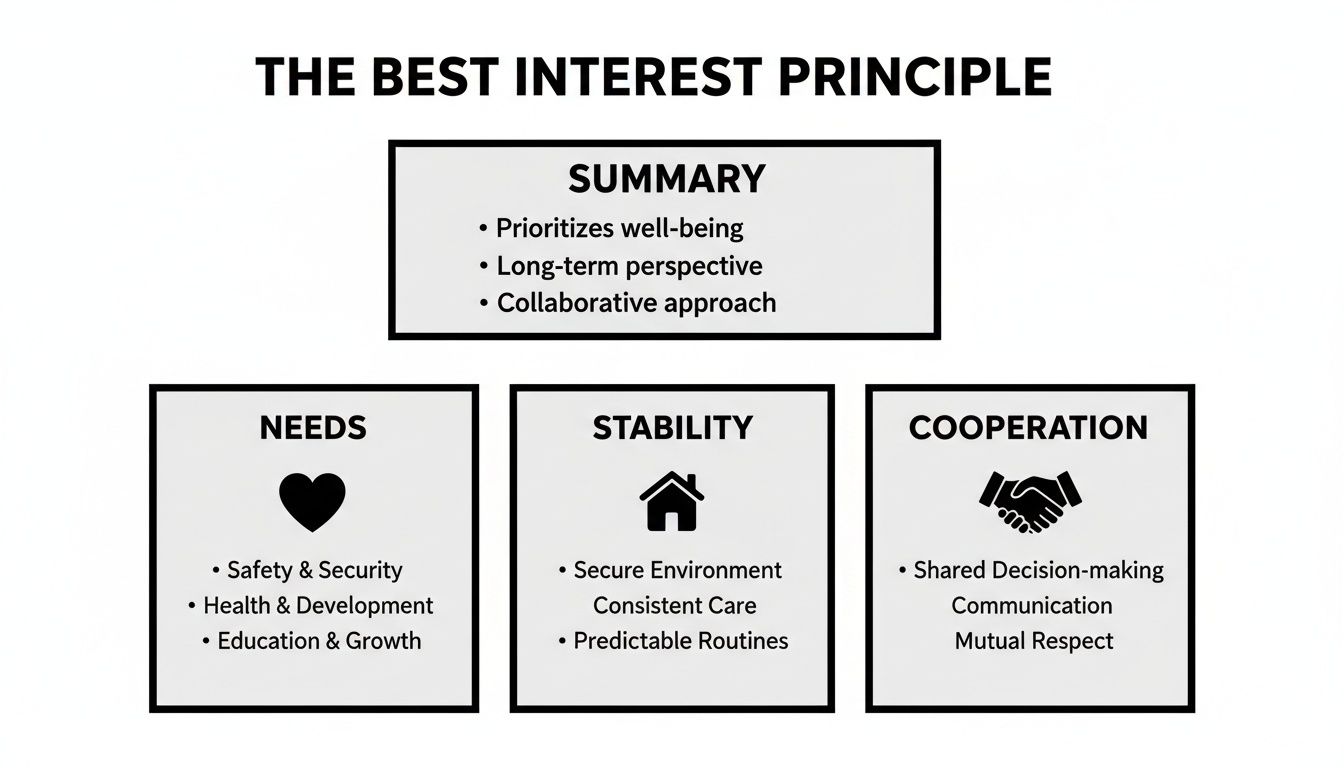
This is a great reminder that a successful 50/50 custody schedule is built on a solid foundation: meeting your child’s emotional needs, providing a stable environment, and showing a real commitment to cooperative co-parenting.
How Equal Possession Affects Child Support
Here’s one of the biggest myths in Texas family law: if you get a 50/50 custody schedule, nobody has to pay child support. It seems logical, right? If the time is equal, the costs should be too. But that’s not how the system actually works.
The reality is that even with an equal possession schedule, one parent—usually the one with the higher income—is still often ordered to pay child support. This surprises a lot of parents, but the court’s goal is to ensure the child experiences a similar standard of living in both homes. Child support is designed to balance financial gaps between parents, making sure the child's needs are met consistently, no matter whose house they're at. A 50/50 schedule is a huge factor in the calculation, but it doesn't just wipe the slate clean.
The Offset Method for Calculating Support
So if the standard guidelines don't quite fit, what do the courts do? When parents have equal possession time, Texas judges don't just throw out the rulebook. Instead, they often use a common-sense approach known as an "offset" calculation to figure out the final support amount. It’s a fair way to acknowledge both parents' financial roles while still accounting for any income differences.
This method is pretty straightforward and works in three steps:
- Calculate Support for Each Parent: First, the court runs the numbers to see what Parent A would owe Parent B based on their income and the Texas child support guidelines.
- Calculate the Other Parent's Obligation: Next, they do the exact same calculation for Parent B, figuring out what they would owe Parent A.
- Find the Difference (The Offset): Finally, the court subtracts the smaller amount from the larger one. The parent with the higher income is then ordered to pay the difference to the other parent.
This approach ensures the child gets financial support based on the parents' combined resources, just as they would if the family were still living under one roof.
A Practical Example of an Offset Calculation
Let's make this real. Imagine Parent A has a net monthly income that results in a guideline child support obligation of $1,200 for one child. Parent B earns less, and their guideline obligation comes out to $700.
Instead of having both parents write checks to each other, the court simply offsets the two amounts:
$1,200 (Parent A's obligation) – $700 (Parent B's obligation) = $500.
In this scenario, Parent A would pay Parent B $500 per month in child support.
Even with equal time, the Texas Family Code’s primary focus is providing for the child. The offset method honors the spirit of the 50/50 schedule while still ensuring the child's financial needs are met in a predictable way.
Factoring in Health Insurance and Other Costs
Child support isn't just about the monthly payment. It also covers the child's healthcare needs. Typically, the parent ordered to pay child support (the "obligor") is also responsible for providing the child’s health insurance. The cost of that monthly insurance premium can sometimes be deducted from the obligor's gross income before the support amount is calculated, which can lower the final payment.
Beyond that, out-of-pocket medical expenses—things like co-pays, deductibles, and prescription costs—are usually split 50/50 between the parents. Your final order should spell out exactly how these costs will be handled to prevent arguments down the road. For a deeper dive into the numbers, you can learn more about how to calculate child support in Texas in our detailed guide.
Understanding these financial realities from the beginning helps you create a co-parenting plan that is stable and sustainable. It allows you to move forward with a realistic budget and a clear picture of your obligations.
Building Your Strategy for Equal Parenting Time

Knowing the law is one thing, but using it to build a winning case is something else entirely. This is where you put your knowledge into action and create a real, practical plan to get the 50/50 custody arrangement you believe is best for your child.
Your approach will look very different depending on whether you and your co-parent are on the same page or if you’re gearing up for a courtroom fight. Either way, solid preparation, detailed documentation, and a child-first mindset are your strongest allies.
The Cooperative Path: Preparing for Mediation
If you and your co-parent can still work together, mediation is your best bet. It’s a process that lets you create a custom-fit parenting plan that a judge is almost certain to approve. The key here is to show up with a detailed, persuasive parenting plan that thinks ahead and solves future problems before they even start.
Your goal is to present a plan that proves you’ve thought of everything.
- Propose a Specific Schedule: Suggest a clear schedule (like a 2-2-5-5 or week-on/week-off) and be ready to explain exactly why it works for your child’s age and your family’s logistics.
- Map Out Holidays and Vacations: Don’t leave holidays to chance. Clearly define how major holidays, school breaks, and summer vacations will be split, often alternating year by year for fairness.
- Set Communication Ground Rules: Agree on how you’ll communicate (a co-parenting app is great for this) and set clear expectations for response times and tone.
- Plan for Future Disagreements: Life happens. Include a process for resolving disagreements down the road, like agreeing to return to mediation before ever filing a motion in court.
A well-crafted plan sends a powerful message to the mediator and the court: you are a stable, cooperative, and forward-thinking parent who is committed to making an equal parenting arrangement work.
The Courtroom Path: Gathering Your Evidence for Litigation
When mediation isn't going to happen and you have to convince a judge, your strategy shifts from planning to proving. You have to show the court that a 50/50 schedule isn't just what you want—it’s what your child needs. This means documenting your involvement day in and day out, proving you're a parent who can handle equal responsibility.
The statistics show it can be an uphill battle. In Texas, fathers typically receive around 33% of parenting time, which is right in line with the national average of 35%. This data shows that getting to a true 50/50 split often means pushing against an unspoken bias toward a more traditional possession schedule. For any parent fighting for more time, but especially for dads, this means building an undeniable case based on cold, hard facts. You can learn more about gender-based child custody statistics in Texas.
Your evidence needs to tell a compelling story: that you are a deeply involved, stable, and essential part of your child’s daily life, and an equal schedule is the only logical way to maintain that vital connection.
To build that story, you need to focus on gathering tangible proof.
Key Evidence to Present in Court
Your attorney will guide you on specifics, but you can start collecting critical documentation right now. The key is to organize your evidence so it paints a clear and consistent picture of your hands-on parenting.
Essential Documents for Your Case:
- Your Parenting Involvement Journal: This is your secret weapon. Keep a detailed calendar or log of everything you do. Note every doctor's appointment you went to, every parent-teacher conference you attended, and every single night you helped with homework. This journal becomes a powerful, undeniable record of your daily commitment.
- Communication Records: Collect texts and emails with your co-parent that show you are reasonable, cooperative, and always focused on the child’s best interests. Leave out the arguments—the goal is to demonstrate your ability to co-parent effectively.
- Proximity and Logistics: A simple map can be incredibly persuasive. Show the short distance between your home, your co-parent’s home, your child’s school, and their extracurriculars. This visual directly counters any claim that a 50/50 schedule would be disruptive or impractical.
- Witness Testimony: Think about who sees you parent. Identify potential witnesses who can speak to your skills—teachers, coaches, neighbors, or family friends who have seen firsthand how you interact with your child in a positive and nurturing way.
Whether you're headed for a friendly mediation or a contested court date, your strategy has to be proactive and child-centered. By preparing a thoughtful plan or assembling compelling evidence, you give yourself the power to advocate effectively for an equal role in your child’s future.
What to Do Next
Navigating a custody case is an emotional marathon, but now you have an honest, clear-eyed view of what it takes to achieve 50/50 custody in Texas. Getting there requires patience, solid preparation, and a deep understanding of what the court really cares about: your child's well-being.
Success isn't accidental. It's built on a few key pillars. You must understand the critical difference between being a joint conservator (sharing big decisions) and having possession (the actual time your child is with you). Most importantly, you have to build a compelling, evidence-based case showing that a 50/50 schedule is truly what's best for your child.
Forging a balanced co-parenting plan takes a strategic approach, guided by both experience and compassion. For those just starting this difficult transition, looking into concepts like Conscious Uncoupling can provide a helpful framework for shifting from spouses to co-parents on more amicable terms.
As you move forward, keep these essentials in mind:
- It’s All About the Child. Every single argument, piece of evidence, and proposal must be framed around your child's needs, stability, and happiness.
- Document Everything. Your consistent, day-to-day involvement is the most powerful proof you have. Keep track of it all.
- Be Realistic. Understand how equal schedules impact child support calculations and be ready for complete financial transparency.
- Get Help. You don't have to walk this path alone. A seasoned family law attorney is your most valuable ally in building a strong case.
The right legal partner can help you organize your evidence, see challenges before they arise, and present your case with confidence—whether you're in a mediation room or in front of a judge.
If you're ready to build a strong case for your family's future, the team at The Law Office of Bryan Fagan, PLLC is here to help you move forward. We invite you to schedule a free, no-obligation consultation to discuss your options and create a clear strategy. Schedule your free consultation today.