Facing the possibility of losing your parental rights is one of the most stressful and terrifying things a parent can go through. In Texas, the termination of parental rights is a permanent legal action that completely severs the parent-child relationship, turning you into a legal stranger to your own child. This isn't a decision any family court takes lightly; it's the most drastic measure available.
What This Drastic Legal Step Really Means
When a Texas court terminates your parental rights, it means every legal right, privilege, and duty you have to your child is gone—for good. This guide is here to bring clarity to what is undoubtedly one of the most difficult times in your life. Our goal is to replace fear and uncertainty with a solid understanding of the process, so you can face what’s ahead with confidence.
A termination case can be started by the other parent, another family member, or, most often, the Department of Family and Protective Services (DFPS). But no matter who files the petition, the court’s decision comes down to one single, powerful principle: the best interest of the child.
Why Texas Courts Are So Cautious
Judges approach these cases with the utmost seriousness because the outcome is irreversible. Once a judge signs that termination order, you lose the right to make any decisions about your child’s life—from their schooling and healthcare to their religious upbringing. You also lose the right to visitation or any other form of legal contact.
The legal standard for termination is "clear and convincing evidence." This is a much tougher bar to clear than the "preponderance of the evidence" standard used in most other civil cases. This high standard exists for a reason: to protect the fundamental constitutional right of a parent to raise their child.
It's also crucial to understand the landscape here in Texas. Our state has a reputation for being particularly aggressive when it comes to terminating parental rights. Since 2006, Texas courts have permanently cut the legal ties between parents and a staggering 91,589 children—more than any other state in the country. This statistic isn't meant to scare you, but to underscore just how serious these proceedings are and why getting experienced legal help is absolutely critical. You can learn more about these termination trends and what they mean for Texas families.
We’ll walk you through what this process means for your family, why the courts handle it with such gravity, and the essential steps you must take to protect your future.
Understanding the Legal Grounds for Termination in Texas
Having your parenting put under a microscope is a gut-wrenching experience that can make you feel accused and judged. But in Texas, the state can’t just decide to take your parental rights away. The court must prove that specific, legally defined reasons—known as statutory grounds—exist to justify such a permanent and life-altering decision.
Getting a handle on these grounds is the first step in building your defense. It’s not about memorizing legal codes, but about understanding how real-life situations are seen through the lens of the law.
The Two-Part Test Every Judge Must Apply
Before a Texas court can terminate your parental rights, it has to satisfy a critical two-part test. This isn't just a suggestion; it's a mandatory legal standard designed to protect families from being torn apart without a very good reason.
Here’s how it breaks down:
- Prove a Statutory Ground: The person or agency suing you (the petitioner) has to present clear and convincing evidence that you’ve done something—or failed to do something—that is specifically listed in the Texas Family Code.
- Prove It's in the Child's Best Interest: Even if a ground is proven, the judge must also find that terminating your rights is truly in the child’s best interest. This second piece is every bit as important as the first.
A judge simply cannot terminate your rights if only one of these is met. Both conditions have to be proven for the court to move forward. This dual requirement is the bedrock of any termination case and the foundation of your defense strategy.
What Constitutes Endangerment or Abandonment
The Texas Family Code lists several grounds for termination, but some come up far more often than others. Let’s break down what these terms actually mean when you're standing in a courtroom.
Endangerment is a broad category. It doesn't just mean you directly hurt your child. It means you knowingly put the child in conditions or surroundings that endangered their physical or emotional well-being.
A common example is exposing a child to illegal drug use or significant domestic violence in the home. The court isn't just looking at a single mistake, but a pattern of behavior that creates an unstable and unsafe environment for a child to live and grow.
Abandonment, on the other hand, has a very specific legal definition. It means you've voluntarily left the child alone or with another person without providing adequate support and have stayed away for a set period. The court will dig into your intent—were you planning to come back, or did you intend to give up your parental duties for good?
These grounds are clearly laid out to prevent arbitrary decisions. Let's take a look at the most common ones found under Texas Family Code § 161.001. You can find more detail about how Texas law defines these specific grounds and what evidence is typically used to prove them in court.
To make this easier to understand, here's a quick rundown of some key grounds for termination.
Common Grounds for Parental Rights Termination in Texas
This table summarizes key statutory grounds under Texas Family Code § 161.001, providing a simple definition for each to help you quickly identify what might apply to your situation.
| Statutory Ground | Plain-English Explanation | Example Scenario |
|---|---|---|
| Endangerment | Knowingly placing a child in a situation that risks their physical or emotional health. | Allowing a known drug dealer to live in the home where the child is exposed to illegal activities. |
| Abandonment | Leaving the child and ceasing contact or support for over six months with no intent to return. | A parent moves out of state, provides no financial support, and does not call or visit for seven months. |
| Non-Support | Failing to pay child support for a continuous period of one year, despite being able to. | A parent has a steady job but intentionally stops paying court-ordered child support for 13 consecutive months. |
| Failure to Comply | Not following the court-ordered service plan in a DFPS case meant to fix parenting issues. | A parent is ordered to attend drug counseling and submit to testing but repeatedly misses appointments and fails tests. |
| Imprisonment | Being incarcerated for a long period (two years or more) that disrupts the child's need for a stable home. | A parent is sentenced to five years in prison for a felony, leaving the child in foster care with no available family. |
As you can see, each ground is tied to specific actions or a pattern of neglect. It’s not about being a "bad parent" in a general sense; it's about meeting a precise legal definition.
Other Common Statutory Grounds
Beyond major grounds like endangerment and abandonment, several other situations can trigger a termination lawsuit. Knowing these can help you see the full picture and spot potential risks in your own case.
- Failure to Comply with a Court Order: If DFPS is involved and the court has ordered you to complete a service plan (like parenting classes, counseling, or drug testing), failing to follow that plan can be used as a ground for termination. This is one of the most frequent reasons parents' rights are terminated in DFPS cases.
- Imprisonment: If you've been convicted of a serious crime and your prison sentence will last for a significant period (often two years or more), this can be grounds for termination. The court looks at whether your absence will negatively impact the child’s need for stability and a permanent home.
- Failure to Support: Consistently failing to provide financial support for your child for a year or more, when you had the ability to do so, is another statutory ground. This goes beyond missing a few child support payments; it points to a pattern of neglecting your parental duties.
Each of these grounds requires the petitioner to provide solid proof. It's not enough to just throw an accusation out there; they have to back it up with evidence that meets that high "clear and convincing" standard. This is where having a skilled attorney becomes absolutely invaluable—they can challenge weak evidence and fight to protect your rights at every single turn.
How the Termination Process Works in Court
Stepping into the court system for a termination of parental rights case can feel like navigating a maze in the dark. Understanding the step-by-step process can significantly lower your stress and help you prepare for what’s coming. These cases move fast, and every stage is critical.
The whole journey kicks off when a Petition for Termination is filed. This is the official legal document that starts the lawsuit, and it could be filed by the other parent, a family member, or most often, the Department of Family and Protective Services (DFPS). This petition formally asks the court to permanently end your parental rights and lays out the specific legal grounds the other side thinks they can prove.
Receiving the Lawsuit and the First Hearing
Shortly after the petition is filed, you will be formally served with the lawsuit papers—a process known as receiving citation. This isn't just a letter you can toss aside; it's a legal notice that you are being sued, and you absolutely cannot ignore it. The moment you're served, a strict timeline begins, giving you a very short window to file a legal response. Failing to respond can lead to the court making a decision without you even being in the room.
If DFPS is involved, one of the first major hurdles is the Adversary Hearing. This hearing has to happen within 14 days of DFPS taking emergency custody of your child. The whole point is to decide if there’s enough evidence of immediate danger to keep your child out of your care while the case moves forward. It’s an incredibly early and critical moment where having an attorney is non-negotiable.
The legal clock in a termination case moves incredibly fast. Texas law requires these cases to be resolved quickly to provide stability for the child. This means you have no time to waste in seeking legal help and starting your defense.
The Role of the Ad Litem Attorney
In every termination case, the court will appoint an attorney ad litem for your child. It’s vital to understand this person's role: they don't work for you or for the other parent. Their one and only client is your child.
The ad litem’s job is to investigate the facts, talk to everyone involved—parents, teachers, doctors, you name it—and then tell the judge what they believe is in the child's best interest. You should always be cooperative and honest with the ad litem, because their opinion carries a lot of weight with the court.
Exchanging Information and Trying to Settle
As the case progresses, you’ll enter a phase called discovery. Think of it as the formal process of laying all the cards on the table. Both sides will ask for documents, send written questions (interrogatories), and possibly take depositions, which are sworn testimonies taken out of court. Discovery is how each side learns the strengths and weaknesses of the other's case before ever stepping into a trial.
Before you get to a final trial, the court will almost always require you to attend mediation. This is a confidential meeting where you, your attorney, the other party, and their attorney sit down with a neutral third-party mediator. The mediator’s job isn't to pick a side but to help everyone try to reach a settlement. It's a mandatory step designed to give you one last shot at resolving the case without a judge or jury making the final call. You can find more information about how mediation works in Texas family law and why it’s a required part of the process.
To give you a clearer picture, here is a simplified overview of how these stages typically unfold.
Timeline of a Texas Termination of Parental Rights Case
This table gives you a simplified look at the major stages in a termination case. It provides an estimated timeframe for each step, helping you understand how things move from the initial filing to a final order.
| Stage | What Happens | Typical Timeframe |
|---|---|---|
| Petition Filing | A lawsuit to terminate parental rights is officially filed with the court. | Day 1 |
| Service of Citation | You are formally served with the lawsuit papers, starting the legal clock for your response. | Within a few days of filing |
| Adversary Hearing (DFPS Cases) | An initial hearing to determine if the child should remain in DFPS custody. | Within 14 days of child's removal |
| Discovery | Both sides exchange evidence through requests for documents, interrogatories, and depositions. | Months 2-6 |
| Mediation | A mandatory settlement conference with a neutral mediator to try and resolve the case. | Usually occurs 30-60 days before trial |
| Final Trial | If no settlement is reached, the case is presented to a judge or jury for a final decision. | Often within one year of filing |
This timeline really drives home how quickly these termination cases move in Texas. Each deadline is critical, and missing just one can have devastating consequences for your ability to defend your rights as a parent. Because the stakes are so high and the process is so unforgiving, taking immediate action isn't just your best option—it's your only option.
Voluntary Relinquishment Versus Involuntary Termination
When you hear about parental rights being terminated, most people picture a dramatic courtroom battle. But it's critical to understand that the law provides two very different pathways: voluntary relinquishment and involuntary termination.
Involuntary termination is exactly what it sounds like—a lawsuit is filed against you, and another party has to prove to a judge that you are an unfit parent and that cutting ties is in your child's best interest. It’s a fight where you are defending your right to be a parent.
Choosing to Relinquish Your Rights
On the other side of the coin is voluntary relinquishment. This isn't something that happens to you; it's a choice you make. It involves signing a legal document called an affidavit of relinquishment, where you formally and willingly agree to give up your parental rights forever.
This almost always occurs in specific, often agreed-upon, family situations. A couple of the most common scenarios include:
- Stepparent Adoptions: A parent remarries, and their new spouse wants to become the child's legal parent. For that to happen, the other biological parent must agree to relinquish their rights so the stepparent can adopt the child and create a new, legally recognized family unit.
- Private Adoptions: Sometimes, a birth parent decides that the best and most loving choice for their child’s future is to place them for adoption with another family.
This infographic lays out the general timeline for a termination case in Texas, from the first filing all the way to a final trial.
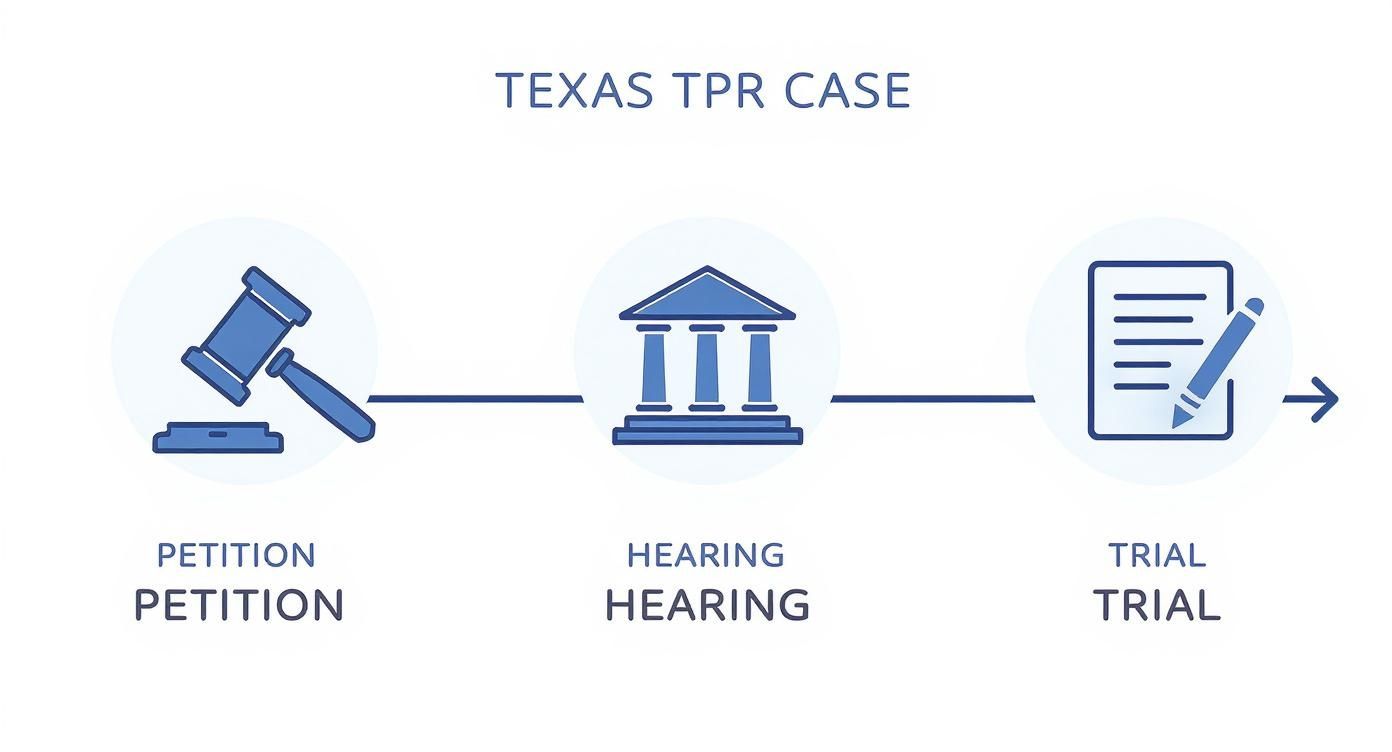
Whether you choose it or it's forced upon you, the case still has to go through the formal court process before anything is legally finalized.
The Irreversible Nature of This Decision
Even when you sign the papers willingly, the outcome is the same: the decision is permanent. There are no take-backs. You must file a witnessed affidavit with the court, but it doesn't end there. A judge still has to review everything and make an independent finding that terminating your rights is truly in the child’s best interest. The court will not just rubber-stamp your decision.
Once a judge signs that final order, the door closes for good. You can't change your mind a year later if your life circumstances change or you have regrets. This is a profound choice with lifelong emotional and legal consequences.
Because this decision is so absolute, you should never, ever feel pressured or coerced into signing away your parental rights. Before you even think about taking this step, it is absolutely essential that you speak with an experienced family law attorney. We can walk you through what you are truly giving up and make sure your rights are protected every step of the way. A free consultation can give you the clarity you need to make the right decision for you and your child.
How to Build a Defense Against Termination
Getting served with a lawsuit to end your parental rights feels like the world is ending. It's a gut-wrenching, terrifying moment, but it's not the final word. You absolutely have the right to fight for your child and your family, and building a powerful, proactive defense begins the second those papers land in your hands.

This isn't just about saying "I didn't do it." It's about taking active steps to show the court exactly why keeping you in your child's life is in their best interest. You have to prove that you are a safe, committed, and vital part of who they are.
Taking Action Demonstrates Commitment
The most compelling defense is almost always built on consistent, positive action. If the Department of Family and Protective Services (DFPS) is involved and has given you a service plan, your number one mission is to complete every single task on that list—diligently and without complaint.
- Attend every class and appointment: Whether it’s parenting classes, therapy, or counseling, show up on time and be an active participant.
- Submit to all testing: If the court orders drug or alcohol testing, never miss one. A clean track record of negative results is incredibly powerful evidence in your favor.
- Maintain positive visitation: Treat every single visit with your child as a chance to reinforce your bond. Be present, be loving, and make every moment count.
This goes far beyond just checking boxes on a list. It’s about demonstrating to the judge that you are willing to do whatever it takes to resolve the issues that triggered the lawsuit. In a courtroom, your actions will always speak louder than your words.
Disproving the Allegations and Proving Your Case
While you’re working hard on your service plan, your attorney will be working just as hard to dismantle the case against you. Every termination suit has to prove two key things: that a statutory ground for termination exists, and that termination is in the child’s best interest. Your defense strategy will attack both of these pillars.
This means gathering your own evidence to poke holes in the other party's claims. You can collect documents, find witnesses who can speak to your character and parenting abilities, and show proof of a stable home and job. A seasoned attorney knows how to challenge flimsy evidence, question the credibility of witnesses, and shine a spotlight on the positive aspects of your relationship with your child.
The stakes are incredibly high. The law in Texas gives courts significant power to move quickly and separate a child from their parent, even when there are doubts about guilt. This reality makes a swift and strong defense absolutely critical.
A skilled attorney does more than just argue facts in court; they build a compelling narrative for the judge. They won't just argue that the other side failed to meet its high burden of proof. They will also paint a clear picture of why your relationship provides your child with essential love, stability, and identity that simply cannot be replaced.
The Best Interest Argument Is Your Strongest Shield
Ultimately, the entire case comes down to what is best for your child. Your defense must be laser-focused on this point. You and your legal team will work to show the judge all the reasons why your child needs you in their life. This might involve demonstrating:
- The strong emotional bond between you and your child.
- Your ability to provide a safe and stable home environment.
- The support system you have from family and friends.
- The potential emotional harm the child would suffer if your relationship were severed.
Successfully fighting a termination lawsuit is a monumental task, but it is absolutely possible. With the right legal strategy and a dedicated effort to show the court your commitment, you can protect your family.
If you are also trying to figure out the process of getting your child back after a removal, you can learn more by reading our guide on regaining custody after CPS removal in Texas.
What Happens After a Termination Order Is Final
The moment a judge finalizes a termination order, it’s a profound and permanent shift. For the parents, it closes a chapter of their life, often with a great deal of pain. For the child, it’s the legal beginning of a new one. Understanding what this final decision means—both legally and practically—can help everyone involved process this difficult outcome and see the path forward. The court's ruling isn't a suggestion; it’s an absolute finality that creates a new reality for everyone.

Once that order is signed, all your legal rights and duties as a parent are completely extinguished. It’s a clean slate, legally speaking. This means you no longer have the right to seek custody or visitation. You can't make decisions about your child’s schooling, healthcare, or upbringing. On the flip side, your legal duty to provide financial support also comes to an end, and any future child support obligations are eliminated.
The Path Forward for Your Child
The entire purpose behind the termination of parental rights in Texas is to give a child a chance at a permanent, stable home. In almost every case, this means clearing the legal path for adoption. The child is now legally free to be adopted by another family—often the foster family they've been living with, a stepparent who has stepped into that parental role, or other relatives.
This is the final piece of the puzzle. The court's primary goal has always been to protect the child's best interest for the long haul, and a secure, loving adoption is how that is achieved. You can learn more about how the state facilitates this next chapter in our detailed guide on the adoption process in Texas.
Post-Termination Contact Agreements
What about staying in touch? In some rare situations, especially in voluntary relinquishment cases like a stepparent adoption, the parties might talk about a post-termination contact agreement. This is an informal arrangement for things like receiving pictures and letters or maybe even having an occasional visit.
It is absolutely critical to understand that these agreements are not legally enforceable in Texas courts. They are built entirely on goodwill and trust, not on the power of a court order.
Since you no longer have any legal standing as a parent after the termination, you can't go to court and file a motion to enforce the agreement if the adoptive parents change their minds and decide to stop contact. It's a harsh reality, but one you must be prepared for. The adoptive parents have the full legal authority to decide what is best for the child, and that includes making decisions about any future contact with biological family members. A final termination order truly means the legal relationship has come to a complete end.
What to Do Next
It’s completely understandable to feel overwhelmed right now, but what you do next is the single most important thing. This guide has walked you through the absolute gravity of a suit for the termination of parental rights in Texas, the court process, and the non-negotiable need for an experienced lawyer. Now, it’s time to move from learning to acting.
In these cases, procrastination is your biggest enemy. That legal clock is ticking—loudly—and the timelines are incredibly unforgiving. The sooner you get a dedicated advocate fighting in your corner, the better your chances are of securing a positive outcome for you and your child.
A termination order is one of the few actions in family law that is truly permanent and irreversible. Unlike custody or support orders that can be modified, there is no going back once a judge's signature makes it final.
Because the stakes are this high, having a clear strategy from day one is critical. An experienced attorney can immediately file the necessary legal responses to protect you from a default judgment. They can begin gathering evidence and start building a powerful case focused on what truly matters—your child’s best interest. You may also want to explore our guide on the complex Texas laws on getting your child back after adoption to understand every angle of these permanent decisions.
Your future as a parent may very well depend on what you do today. This is no time to hesitate. Follow these crucial steps to protect your family:
- Do Not Ignore Any Legal Notices: Treat every single document from the court or DFPS with the utmost seriousness.
- Gather Your Documents: Start collecting any evidence that supports your case—things like text messages, emails, photos, and any proof of your involvement in your child's life.
- Schedule a Consultation: Your most important step is to speak with a family law attorney who specializes in these high-stakes cases.
You have options, but you have to act now to use them.
The fight to protect your family is the most important one you will ever face. At The Law Office of Bryan Fagan, PLLC, we understand what is at stake and are ready to stand by your side with the compassionate, authoritative guidance you deserve. We invite you to schedule a free, confidential consultation with our attorneys to discuss your case and protect what matters most—your relationship with your child. Contact us today at https://texasdivorcelawyer.us.