When you realize you might have to fight for your children, it can feel like the ground is falling out from under you. But winning a custody battle in Texas isn't about being the most aggressive person in the room; it's about methodically showing the court that you are the parent best equipped to provide a stable, loving, and supportive future for your child.
Understanding What Texas Courts Prioritize

Before you step into a Texas family courtroom, you have to understand one critical point: the judge's decision will come down to a single guiding principle: the best interest of the child. This isn't just a feel-good phrase; it's the legal cornerstone of the Texas Family Code, and it dictates every single custody decision made in the state.
Your entire case needs to be built around proving that your child's physical and emotional well-being will flourish with you. This means setting aside the personal conflict with your ex-partner and putting your child’s needs front and center.
What "Best Interest" Means in Practice
To determine what's in a child's best interest, the court looks at a list of factors, often called the "Holley Factors." Think of them not as a rigid checklist, but as a framework the judge uses to build a complete picture of your child's life. Your job is to tell a compelling story, backed up by solid proof, that addresses these key areas.
Some of the most important factors include:
- Emotional and Physical Needs: Who has been the primary caregiver? Who schedules the doctor's appointments, helps with homework, and knows how to soothe a nightmare?
- Parental Abilities: The court will examine your ability to provide a safe, stable, and nurturing home. This covers everything from your living situation to your personal conduct and decision-making.
- Stability of the Home: Consistency is crucial in family court. A parent who can offer a steady home life, a predictable routine, and a supportive community has a significant advantage.
- The Child's Wishes: If your child is 12 or older, the judge might talk to them in private to hear their preference. It’s important to remember this isn't the deciding vote, but it is one more piece of the puzzle the judge will consider.
Focus your energy on showcasing your strengths as a parent, your deep involvement in your child’s life, and your unwavering commitment to their happiness.
Getting a firm grasp on these guiding principles for custody decisions is your first strategic move. It helps you see the road ahead, anticipate what the judge needs to know, and start gathering the proof that you're the parent best prepared to meet your child’s needs.
Building Your Case with Powerful Evidence
In a custody fight, your word alone isn’t enough. The story you tell the judge must be backed up by credible, organized evidence. This is where your focus and diligence can completely change the outcome.
It’s not about finding one "smoking gun." It’s about weaving together a consistent, believable narrative that proves you’re a responsible and involved parent. Every text message, doctor's appointment, and school event becomes a potential piece of the puzzle. Your job is to document this journey methodically, turning everyday parenting duties into a powerful argument for why your child’s best interests are served with you.
Start a Detailed Parenting Journal Today
Your single most powerful tool is a simple parenting journal. This isn't just a diary for your feelings; it's a factual logbook of your involvement in your child's life. A basic notebook or a secure digital document can become the foundation of your entire case.
Make sure your entries are factual, dated, and specific. Focus on documenting things like:
- Your Parenting Time: Note when you have your child and what you did together. Be specific—homework, dinner, park visits, special moments. This paints a picture for the court.
- Communication with the Other Parent: Log every call, text, or email. Stick to the facts: "Spoke with [Ex's Name] at 6:15 PM on 10/26. Discussed picking up our son from soccer practice. Conversation was calm."
- Appointments and Events: Record every doctor's visit, parent-teacher conference, and extracurricular activity you attend. This is hard proof of your active involvement.
- Concerns: If the other parent misses a visit, is consistently late, or if your child comes home saying things that worry you, document it immediately. Include the date, time, and specific details.
This journal creates a real-time record that is far more credible than trying to remember events months later on the witness stand. It shows the court a clear pattern of your stability, involvement, and responsible co-parenting.
Curate Your Digital Communications Wisely
In a custody dispute, text messages and emails can be both a blessing and a curse. Don't just dump thousands of irrelevant messages on your attorney—it creates unnecessary work and dilutes your most important points. You need to be strategic.
Focus on collecting communications that show a clear pattern. Look for messages that demonstrate:
- The other parent’s refusal to co-parent or communicate effectively.
- Admissions of behavior that could endanger the child (like substance use or neglect).
- Your consistent efforts to coordinate schedules and always put the child's needs first.
- Any attempts by the other parent to undermine your relationship with your child. This behavior can be part of a bigger problem, and you can learn more about how to prove parental alienation if you suspect it's happening.
Keep your own communication clean, concise, and child-focused. Imagine a judge reading every single text you send. If it doesn't reflect well on your parenting, don't send it.
Gather Third-Party Documentation and Witnesses
Objective evidence from neutral parties carries immense weight in court. These are people and records that have no personal stake in the outcome but can speak to your character and parenting abilities. Start collecting official records that paint a picture of your child's life and your central role in it.
The documents you gather are the backbone of your case, transforming your claims from mere words into undeniable facts. Below is a checklist of the essential documentation you should start organizing immediately.
Essential Documentation for Your Custody Case
| Evidence Category | Specific Examples | Why It's Important |
|---|---|---|
| School Records | Report cards, attendance records, emails from teachers, disciplinary notes. | Shows your child is (or isn't) thriving and demonstrates your involvement in their education. |
| Medical Records | Doctor/dentist visit summaries, immunization records, therapy notes. | Proves your commitment to your child's health and well-being. |
| Financial Records | Receipts for child-related expenses (clothes, food, activities), proof of child support payments. | Demonstrates financial responsibility and your contributions to the child's needs. |
| Communication Logs | Organized texts, emails, and co-parenting app messages. | Provides a factual record of communication patterns, cooperation (or lack thereof), and disputes. |
| Photos & Videos | Pictures from holidays, school events, and daily activities. | Visually supports your bond with your child and your presence in their life. |
| Witness Information | Names and contact details for teachers, coaches, counselors, neighbors. | Identifies credible, third-party individuals who can testify about your parenting skills. |
Having these documents organized not only strengthens your position for a potential trial but also gives you significant leverage in settlement negotiations. While preparing for a potential trial is crucial, remember that most cases never actually see the inside of a courtroom.
In fact, statistics show that approximately 90% of custody arrangements are settled without a judge's final ruling. You can discover more insights about family law statistics and trends on growlaw.co. This makes your evidence-gathering efforts doubly valuable, as they strengthen your position in settlement talks.
Navigating the Texas Family Court Process
Walking into family court for the first time can feel intimidating. But once you understand the key stages of a Texas custody case, the process becomes much less mysterious, giving you back a sense of control. Here is a step-by-step breakdown of the process.
Your journey starts with the initial filing of a legal document called a Petition. This officially opens your case and tells the court what you're asking for regarding your children. Once the other parent is served with the Petition, the clock starts ticking. This kicks off one of the most critical early events in your case: the temporary orders hearing.
The Decisive Temporary Orders Hearing
The temporary orders hearing is often your first time in front of a judge. Its purpose is to set the ground rules and a temporary possession schedule that will remain in effect while your case is pending—a process that can last for months, sometimes even over a year.
It’s best to think of it as a mini-trial. You and your lawyer will present evidence and testimony, and the judge will make immediate decisions on critical issues like:
- Who gets to decide where the child lives (geographic restriction).
- Who has the right to make important decisions (medical, educational, etc.).
- What the temporary possession and visitation schedule will look like.
- How much temporary child support will be paid.
Do not underestimate the importance of this hearing. The orders put in place here often create a status quo—a new normal that judges are hesitant to disrupt later without a powerful reason. A win at this stage can set a favorable tone for the rest of your case.
The Mandatory Stop at Mediation
Before you ever see the inside of a courtroom for a final trial, the judge will almost certainly order you and the other parent to mediation. This is a confidential meeting where a neutral, third-party mediator helps you both try to reach an agreement on your own terms.
Mediation isn’t about winning or losing. It’s a practical process designed to find common ground and create a parenting plan that actually works for your family, saving you the staggering emotional and financial cost of a trial. If you're successful, you'll sign a Mediated Settlement Agreement (MSA), which is a binding contract that gets filed with the court and becomes part of your final decree.
Key Players Who Can Influence Your Case
As your case moves forward, the judge might appoint other professionals to provide recommendations. It’s crucial to understand their roles because their opinions carry a lot of weight.
- Amicus Attorney: This is an attorney the court appoints to represent the child's best interests, not yours or the other parent's. The amicus will interview everyone involved—you, the other parent, the kids, teachers, counselors—to form an independent recommendation for the judge.
- Custody Evaluator: If there are serious concerns about mental health, parental fitness, or other complex issues, the court may bring in a custody evaluator. This is a licensed mental health professional who conducts a deep-dive investigation, including psychological tests and home visits, before submitting a detailed report to the court.
These professionals are the eyes and ears of the court. Their reports can absolutely sway a judge’s final decision. Cooperating with them and consistently presenting yourself as a stable, child-focused parent is essential.
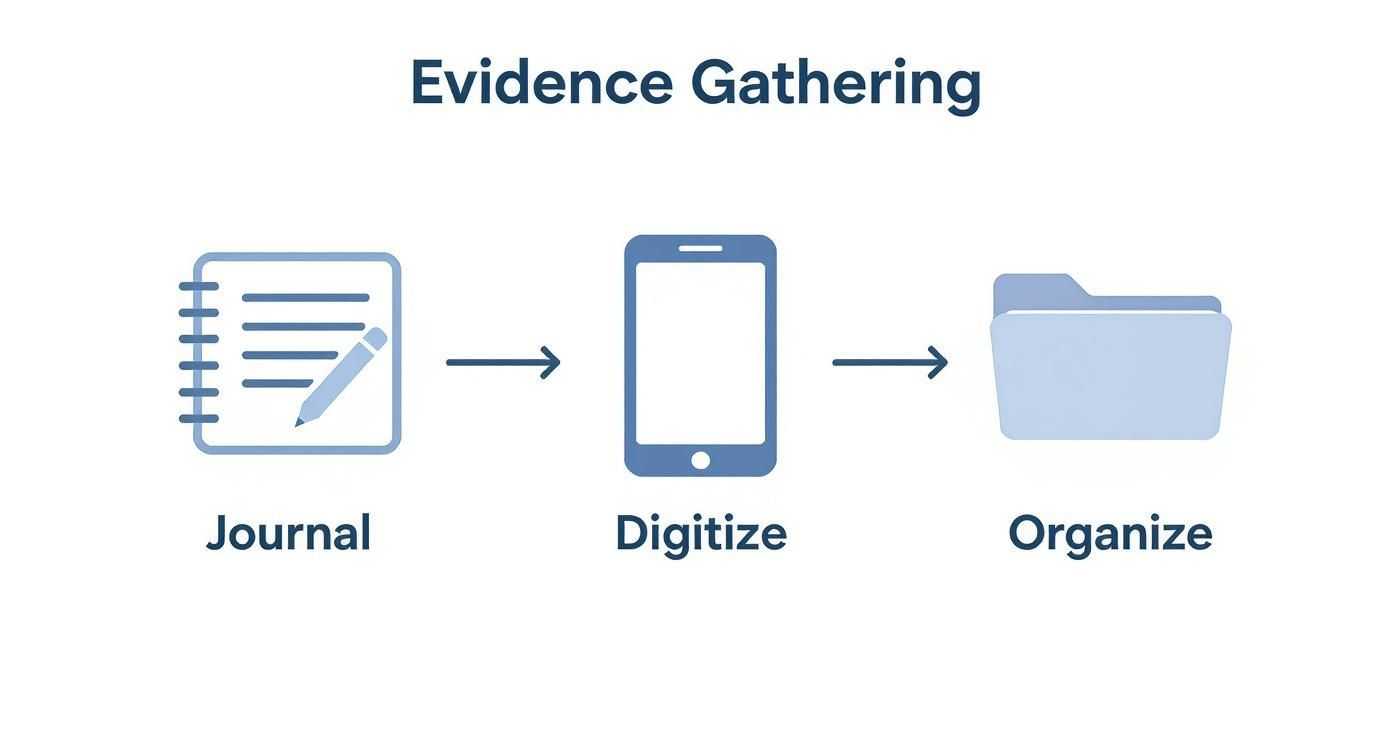
This systematic approach—journaling events, saving proof, and keeping it organized—makes sure you’re always prepared. Knowing how to file for custody is the first step, but navigating these next stages with a solid strategy is how you truly build a winning case.
Demonstrating You Are the Right Parent

During a custody battle, it feels like every move you make is under a microscope—because it is. You aren’t just telling the court you’re the best parent for your child; you have to show them through your actions, words, and overall conduct. This is all about proving your stability and fitness as a parent, both inside and outside the courtroom.
Mastering Your Conduct Outside the Courtroom
Long before you ever see a judge, your behavior is already setting the stage. Texas courts look favorably on parents who can keep their cool and put their child’s needs ahead of their own anger or frustration.
One of the biggest mistakes you can make is getting drawn into hostile communication with your co-parent. It’s easy to get pulled into nasty arguments over text or email, but those exchanges can—and will—be used as evidence that you can’t co-parent effectively. Before you send any message or make any post, ask yourself: "Would I be comfortable with a judge reading this out loud in court?" If the answer is no, delete it.
This same level of scrutiny applies to your online presence. For an opposing attorney, social media is a goldmine. A photo of you having a drink with friends can be twisted to suggest you’re an irresponsible parent. Here’s how to protect yourself:
- Go Private: Immediately set all your social media profiles to the highest privacy settings.
- Pause Posting: The safest bet is to take a complete break from social media until your case is resolved.
- Be Mindful: If you must post, keep it positive and completely unrelated to your child, your ex, or your legal situation.
Your goal is to present a consistent, unwavering image of stability. That means showing up on time for exchanges, communicating with respect, and always putting your child’s well-being first.
Projecting Confidence and Credibility in Court
Your appearance in the courtroom is your chance to make a direct impression on the judge. How you carry yourself speaks volumes about how seriously you’re taking this process.
Dressing professionally is a non-negotiable sign of respect for the court. Think business casual—a collared shirt, slacks, or a conservative dress. Stay away from anything flashy, revealing, or overly casual.
When you speak, your demeanor is just as important as your words.
- Address the Judge Properly: Always use "Your Honor."
- Speak Clearly and Calmly: Take a deep breath before you answer. Rushing your words or speaking with an angry tone will undermine your credibility.
- Be Respectful to Everyone: This includes the opposing attorney and your ex. Outbursts or eye-rolling will only hurt your case.
Delivering Powerful and Honest Testimony
When you’re on the witness stand, your only job is to provide clear, factual answers. This isn’t the time to air every grievance. Your attorney will guide you, but keep these principles in mind:
- Listen Carefully to the Question: Make sure you fully understand what is being asked before answering.
- Answer Only What is Asked: Do not volunteer extra information. Keep it short and to the point.
- Stick to the Facts: Base your answers on what you personally know, saw, and did. Avoid speculation or hearsay.
- Be Honest: Never lie or exaggerate. Getting caught in a falsehood, even a small one, can completely destroy your credibility.
Ultimately, winning your custody battle is about demonstrating that you are the consistent, reliable, and emotionally stable parent your child needs.
Connecting Finances to Your Custody Strategy

It’s easy to think a custody battle is all about parenting skills, but in Texas, your financial stability is a massive piece of the puzzle. The court’s primary duty is to make sure your child’s needs are met. A well-organized financial picture proves you’re the parent who can provide that essential stability. Your financial life is woven directly into the "best interest of the child" standard.
Understanding Texas Child Support Calculations
In Texas, child support is not a random number. The Texas Family Code provides specific, guideline-based calculations based almost entirely on the paying parent's income. This practical advice applies to all parents, including business owners and those with complex estates.
Here’s a simplified look at how it works:
- Figure Out Net Monthly Resources: The court starts with your gross monthly income and subtracts things like taxes and the child's health insurance premiums. There's a cap on the income used for these calculations, which is adjusted for inflation.
- Apply Percentage Guidelines: A set percentage is then applied to those net resources based on how many children are involved. For one child, it's 20%. For two children, it is 25%, and so on.
The possession schedule can also affect this amount. If you have a schedule that’s getting closer to a 50/50 split, a judge might see that as a good reason to deviate from the standard guidelines.
The Critical Importance of Financial Transparency
During any custody case, you'll have to exchange financial information with the other parent. This typically means filling out a Financial Information Statement and backing it up with documents like pay stubs, tax returns, and bank statements.
Trying to hide assets or lie about your income is one of the fastest ways to lose all credibility with a judge. When you get caught—and you almost always do—it makes you look dishonest about everything else in your case.
Custodial parents in the U.S. receive an average of $3,431 annually in child support. For the 12.9 million custodial parents out there, these payments are a vital part of the family budget, which is why courts look so closely at a parent's ability to provide financial stability.
If you suspect your ex is hiding assets, you might need help from a professional. It's worth understanding forensic accounting to see how experts can uncover the truth and present it clearly to the court. This is often a game-changer in high-asset cases or when one party is not being transparent.
Common Financial Mistakes That Can Wreck Your Case
Your actions leading up to and during the custody process matter. Avoid these critical mistakes at all costs:
- Intentionally Quitting or Reducing Your Income: This is called "intentional underemployment." If a judge thinks you quit a good job just to lower your child support obligation, they can base the support order on your earning potential, not what you’re actually making.
- Hiding or Transferring Assets: Moving money to a friend's account or "gifting" large sums to family members will destroy your credibility.
- Running Up Debt on Joint Accounts: Racking up credit card debt without the other parent's knowledge looks incredibly irresponsible and can tarnish your image.
- Failing to Cover Child-Related Costs: If you’re ordered to pay for health insurance or other expenses and you don't, it sends a clear message to the judge that you can't be relied on to meet your child's needs.
Your financial plan is a direct reflection of your ability to provide a stable future for your child.
Key Takeaway: What to Do Next
Realizing your child’s future is on the line is an overwhelming feeling, but clarity and strategy are your best friends right now. Winning a custody battle isn’t about a single courtroom showdown. It’s about securing a stable, loving future for your child by consistently proving you’re the parent best equipped to provide it.
An Actionable Checklist to Keep You on Track
To keep everything moving in the right direction, pour your energy into these critical tasks:
- Get Your Documents in Order: Pull together your parenting journal, financial records, and every other piece of evidence into one secure, organized system.
- Stay Composed: Commit to child-focused communication with the other parent. That means no arguments over text and absolutely no posts about your case on social media.
- Protect Your Child’s Routine: Stability is everything in the eyes of the court. Do whatever it takes to keep your child’s life—their school, friendships, and activities—as normal as possible.
The single most impactful step you can take right now is to get professional legal guidance. An experienced Texas family law attorney can shape your story and evidence into a compelling legal strategy built for your unique situation.
You don’t have to do this alone. The right legal partner will give you the clarity, confidence, and strong advocacy you need. If you’re ready to take control and protect your family’s future, we are here to help. Schedule a free, confidential consultation with the experienced attorneys at The Law Office of Bryan Fagan, PLLC. Let’s start building your strategy together.
Got Questions About Your Texas Custody Case?
Going through a custody battle brings up a ton of questions. Let's clear up some of the most common things Texas parents ask.
What's the Difference Between Sole and Joint Conservatorship?
In Texas, we use the term "conservatorship" instead of "custody" to cover a parent's rights and responsibilities. While many people aim for "sole custody," you should know that Texas law strongly prefers Joint Managing Conservatorship.
This means both parents get a say in the big decisions—like schooling, major medical procedures, and psychiatric care. It's designed to keep both parents deeply involved. Usually, one parent is named the "primary" joint managing conservator, which gives them the exclusive right to decide where the child lives (often within a specific geographic area).
Can My Child Decide Who They Want to Live With?
This is a common question. The answer is yes… and no.
Under the Texas Family Code, a child who is 12 years or older has the right to speak privately with the judge about their preference. A judge will listen to what your child has to say and take it very seriously. However, the child's preference is not the deciding factor. It's just one piece of the puzzle. The judge's final decision will always come down to what is in the child's overall best interest.
What's a Custody Battle Really Going to Cost Me?
The cost of a Texas custody case can vary widely. If you and the other parent are fighting over every detail, expenses can pile up fast. Hiring expert witnesses or going to a final trial will drive your legal bills up. The best way to control costs is through mediation.
Reaching a negotiated settlement is, without a doubt, the most effective way to control the financial and emotional costs of a custody case. It saves money and spares your family the stress of a long court battle.
You don't have to figure all this out on your own. The attorneys at The Law Office of Bryan Fagan, PLLC have been guiding parents through these exact challenges for years. We're here to protect your rights and your child's future.
Schedule your free, confidential consultation today by visiting https://texasdivorcelawyer.us to start building a winning strategy.